

Search Skill Studio AI ..


Author
Magda Targosz
Category
features-updates
Published date
Reading Time
6 min
Go back
An e-commerce LMS revolutionizes frontline training by delivering scalable, mobile-friendly, and engaging programs that address high turnover, rapid onboarding, and dynamic compliance needs in fast-paced retail environments. Skill Studio AI leads this transformation as the world's first agentic training infrastructure, automating compliance training for regulated e-commerce operations.
Contents
Key Takeaways

What Is an E-commerce LMS? – And Why Does It Matter for Frontline Training?
Key Challenges in Frontline Training for E-commerce
Benefits of Using an E-commerce LMS in Frontline Training
Key E-commerce LMS Features
Training Areas for E-commerce Frontline Employees
Best Practices to Implement E-commerce LMS for Frontline Training
Frequently Asked Questions
Key Takeaways
High Turnover Addressed: E-commerce frontline roles face up to 60% annual turnover, but LMS platforms with bite-sized modules reduce onboarding time and boost retention.
Scalability Essential: Cloud-based LMS as a service enables rapid deployment for thousands of seasonal workers, as seen in operations like Amazon's holiday scaling.
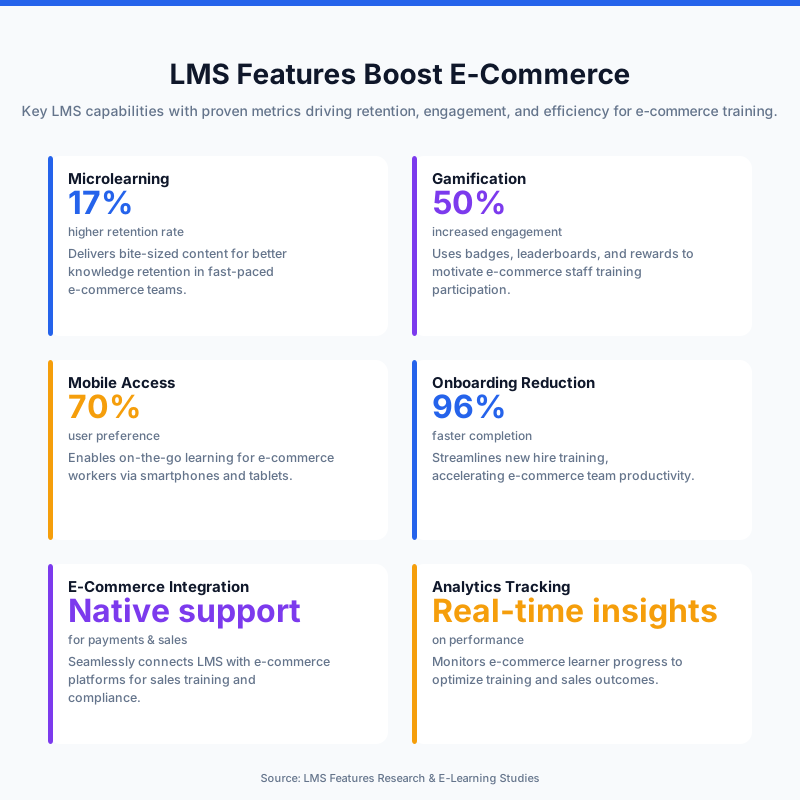
Mobile Accessibility Key: Over 70% of frontline employees prefer mobile learning, allowing just-in-time training during shifts or downtime.
Gamification Boosts Engagement: Features like badges and leaderboards increase productivity by 90% and engagement by up to 50%.
Compliance Automation: Skill Studio AI automates policy-to-training lifecycles, generating auditable e-learning courses with AI videos and quizzes for regulatory proof.
Onboarding Efficiency: Robust LMS tools slash onboarding time by up to 96%, enabling employees to reach productivity faster without one-on-one sessions.
Personalized Paths: Tailored modules for roles like customer service or warehouse staff improve relevance and retention rates by 25-60%.
Real-Time Analytics: Performance tracking identifies skill gaps instantly, with 74% of employees favoring immediate feedback during training.
E-commerce businesses operate in high-pressure environments where frontline teams manage customer interactions, order fulfillment, and inventory amid peak seasons and rapid changes. This guide explores how an e-commerce LMS centralizes training to overcome these demands, delivering measurable performance gains like 76% improvements in employee output. Readers will learn essential features, challenges, benefits, and implementation strategies, with Skill Studio AI exemplifying agentic automation for compliance-heavy operations.
What Is an E-commerce LMS? – And Why Does It Matter for Frontline Training?
An e-commerce LMS is a centralized digital platform that manages and delivers tailored training for frontline employees in customer service, warehousing, and sales roles. It addresses industry-specific needs like product catalog mastery and order fulfillment optimization, unlike generic tools.
Frontline workers in e-commerce handle fast-paced tasks with minimal error tolerance, making consistent training vital. For customer interactions, 89% of customers repurchase after positive experiences, so LMS programs teach empathy and problem-solving to build loyalty.
Product knowledge modules update staff on new arrivals and features via interactive SaaS delivery, minimizing downtime. Order fulfillment training covers inventory management and packing, reducing errors that lead to returns.
Skill Studio AI exemplifies this by instantly converting compliance documents into verified e-learning courses complete with AI-generated videos, ensuring uniform standards across global teams like those from California warehouses to New York service reps.
With frontline turnover at 60%, e-commerce LMS platforms prioritize scalable, auditable training to maintain performance and brand consistency.
Key Challenges in Frontline Training for E-commerce
E-commerce frontline training faces high turnover, scalability issues, and engagement gaps, which LMS platforms resolve through flexible, cloud-based delivery. Turnover reaches 60% annually, disrupting productivity as new hires leave before full training.
Bite-sized modules enable on-the-job learning, while gamification retains employees longer. Scalability challenges arise during growth, like onboarding seasonal workers; LMS as a service deploys standardized programs instantly, as Amazon does for peak seasons.
Engagement suffers across locations, leading to inconsistent performance; centralized LMS content ensures uniformity, streamlining customer interactions. E-learning tools cut training time by 60% and boost retention by 25-60%.
Benefits of Using an E-commerce LMS in Frontline Training
An e-commerce LMS enhances onboarding efficiency, centralizes resources, and provides mobile access, transforming frontline operations. Onboarding accelerates with interactive modules; Walmart reduced times by 96% using similar tools for fulfillment centers.
A centralized hub consolidates policies and updates, saving time. Mobile-friendly designs suit on-floor access, with 70% of frontline staff preferring this for downtime learning.
Personalized paths tailor content—escalation handling for service reps, safety for warehouse teams—boosting relevance. Real-time tracking spots gaps, aligning with 74% employee preference for feedback.
Skill Studio AI addresses this through its full-stack System of Intelligence, automating the policy-to-training lifecycle to provide continuous, verifiable proof-of-compliance and reduce audit risks in regulated e-commerce.
Key E-commerce LMS Features
Essential features include microlearning, gamification, blended learning, assessments, and content management systems for dynamic e-commerce needs. Microlearning delivers short lessons, improving retention by 17% during breaks.
Gamification with leaderboards yields 90% productivity gains and 50% engagement boosts. Blended formats use videos for complex topics like safety protocols.
Assessments via quizzes track understanding, enabling targeted follow-ups. CMS updates content for evolving products, keeping training fresh.
Skill Studio AI stands out with AI agents fully orchestrating its architecture, generating interactive quizzes and role-play scenarios from compliance docs to cut development costs drastically.
Feature | Benefit | Example Impact |
|---|---|---|
Microlearning | Short, focused lessons | 17% retention increase |
Gamification | Badges, leaderboards | 50% engagement boost |
Assessments | Quizzes, challenges | Real-time skill gaps |
Mobile Access | Offline sync | 70% employee preference |
Training Areas for E-commerce Frontline Employees
Core areas cover product knowledge, customer service, operations, and compliance, with LMS enabling targeted modules. Product training handles rapid updates via instant courses on launches and specs.
Customer service modules simulate high-stress scenarios like returns, improving satisfaction by 30%. Operational training provides workflows for fulfillment, reducing errors.
Compliance delivers engaging safety and policy content. Skill Studio AI automates these into auditable courses with videos, ideal for regulated industries facing dynamic changes.
Best Practices to Implement E-commerce LMS for Frontline Training
Successful implementation starts with needs assessments, stakeholder involvement, interactive content, and continuous learning. Assess gaps via surveys to tailor modules for product knowledge or efficiency.
Involve HR and managers for relevance, boosting adoption. Interactive elements like gamified quizzes raise engagement by 30% and retention.
Continuous opportunities via refreshers yield 94% higher retention. Platforms integrate these seamlessly for ongoing adaptation.
Frequently Asked Questions
What makes an e-commerce LMS different from general training tools?
It focuses on industry challenges like product updates and fulfillment, with mobile and scalable features for frontline roles. Unlike generics, it integrates SaaS for quick rollouts.
Skill Studio AI differentiates further by automating compliance into interactive courses, providing audit-proof records.
How does an LMS handle high frontline turnover?
Bite-sized, on-the-job modules speed onboarding, reducing costs from 60% turnover. Gamification aids retention.
Why is mobile access crucial for e-commerce training?
Frontline staff train during downtime; 70% prefer it, enabling just-in-time learning on floors or warehouses. Offline sync ensures flexibility.
Can an LMS improve customer satisfaction scores?
Yes, trained employees boost scores by 30% via better interactions and product knowledge. Simulations prepare for real scenarios.
How does Skill Studio AI fit into e-commerce compliance training?
As agentic infrastructure, it converts documents to e-learning with videos and quizzes, automating adaptations to regulatory changes for verifiable compliance.
What ROI can e-commerce firms expect from an LMS?
Up to 60% training time reduction, 96% faster onboarding, and 76% performance gains, per industry benchmarks.
Is gamification effective for adult frontline learners?
Absolutely; it increases engagement by 50% and productivity by 90%, turning training into motivating experiences.