Search Skill Studio AI ..


Author
Magda Targosz
Category
features-updates
Published date
Reading Time
17 min
Go back
Instructor scaling with avatar voice cloning changes L&D from a labor-heavy cost center into an always-on, compliance-ready expert delivery engine.
Last updated: May 2026
Contents
Key Takeaways

What is instructor scaling in corporate learning?
Why does avatar voice cloning matter for instructor scaling?
How expensive is traditional eLearning production?
How does avatar voice cloning change the economics?
How does synthetic media crush lifecycle maintenance costs?
How do general AI video tools compare to AI-native scaling platforms?
How do EU AI Act and GDPR affect instructor scaling?
What does GDPR mean for voice cloning, consent, and DPAs?
What is the practical playbook for L&D leaders in 2026?
Frequently Asked Questions
Key Takeaways
Instructor scaling means cloning your best instructors’ style, voice, and presence so they can “teach” everywhere, anytime, without more studio time.
Avatar voice cloning keeps the trusted internal expert as the messenger, which is critical for compliance, not just “nice to have” polish.
Traditional custom eLearning can cost over $40,000 per finished hour once you add design, video, and SME time.
Synthetic media turns those capital-heavy projects into predictable operating costs, often at cents per narrated minute.
Lifecycle maintenance is where AI wins hardest: one policy tweak no longer means re‑filming and re‑editing an entire course.
Regulation is tightening: EU AI Act Article 50 + GDPR treat cloned instructor avatars as deepfakes and biometric data.
Specialized AI LMS platforms beat generic video tools in regulated industries by combining generation, delivery, and audit trails.
Skill Studio AI is built exactly for this: document-to-video automation and avatar-based instructor scaling, with 21 CFR Part 11 compliance on our roadmap, not yet shipped.
If your best compliance instructor is always “in a training room” or “in an audit meeting,” this article is for you. We’ll unpack the economics, compliance obligations, and practical playbook behind avatar voice cloning — and how platforms like Skill Studio AI turn instructor scaling into a safe, repeatable operating model rather than a risky tech experiment.
What is instructor scaling in corporate learning?
Instructor scaling is the use of generative AI — voice cloning, behavioral simulation, and avatar generation — to replicate a real expert’s teaching style, voice, and presence so one instructor can “teach” thousands of people at once without additional recording time.
In regulated industries, the rarest resource is not budget, it’s SME hours: the QA lead, the pharmacovigilance specialist, the AML officer who understands both the letter and the spirit of the rules. Instructor scaling treats that person’s expertise as a reusable asset, not a bottleneck. Skill Studio AI is designed around this exact premise: one subject-matter expert can be turned into an unlimited number of courses without extra filming. (Multiple-language narration is on our roadmap — today avatar narration is English only.)
Pedagogically, instructor scaling is about preserving proportions. If you think of your favorite instructor as a 3D model, classic “scale up” tactics — bigger webinars, more slides, generic TTS voiceovers — stretch the model until the trim looks wrong. The tone, timing, and authority that made that instructor effective get distorted. High-fidelity avatars act like the “Fredoscale” equivalent for L&D: you can expand reach without warping the teaching style that made the human effective in the first place.
Done properly, this doesn’t eliminate human teaching. It reserves human time for exceptions, nuance, and discussion — and lets the avatar handle the repeatable parts of the job: explaining SOPs, walking through Annex 1 updates, or refreshing staff on CAPA workflows for the hundredth time.
Why does avatar voice cloning matter for instructor scaling?
Avatar voice cloning matters because in compliance-heavy training, the messenger is part of the message — and your workforce knows the difference between a generic stock voice and the head of QA.
When you roll out a new aseptic gowning SOP or an updated Annex 1 contamination control strategy, learners are not just asking “what changed?” but “is this serious?” and “does leadership actually stand behind this?”. A cloned avatar of the site’s real QA director can answer that question in one glance and one sentence. According to the Centre for Emerging Technology and Security, voice cloning can mimic a person’s voice convincingly from short recordings, which is exactly what enables that continuity of presence.
From an engagement perspective, humans respond to familiar voices and faces. Think of how quickly staff tune into a message when it’s clearly “our compliance officer speaking,” versus a vendor voiceover that sounds like every other corporate video they’ve ignored. Skill Studio AI leans into this by letting instructors clone their own teaching style and avatar, then reuse that presence across entire curricula without dragging them back into a recording booth.
Voice cloning also unlocks behavioral simulation. In pharma and banking, learners need to rehearse delicate conversations — like explaining allowed statements to HCPs or handling suspicious transactions. Avatars can play multiple roles in realistic scenarios: the investigator, the reviewer, the customer, the regulator. That turns a one-way lecture into a safe rehearsal environment where people can practice critical decisions before they make them on the job.
How expensive is traditional eLearning production?
Traditional custom eLearning is expensive because it stacks high-cost specialists on top of high-cost SMEs, then repeats that pattern every time a policy changes.
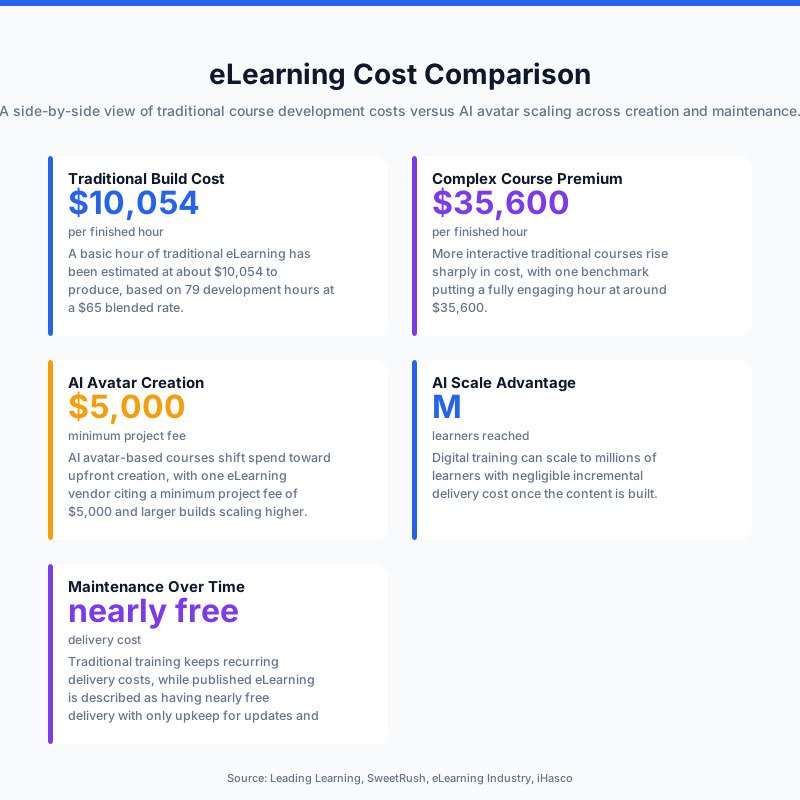
Chapman Alliance benchmark data is still the reference point here. Adjusted for 2026, industry analysis shows the average cost to build one finished hour of eLearning has climbed into the tens of thousands of dollars once you account for design and production hours multiplied by fully loaded rates. Basic click-through courses can still run well over $10,000 per hour when you add SME time; more complex simulations can approach or exceed $70,000 per hour when you factor in branching, media, and engineering.
Video is the real cost accelerator. Professional educational video production regularly comes in between $1,000 and $10,000 per finished minute once you include:
Pre-production (scripting, storyboarding, logistics) at roughly 25–30% of budget.
Production (studio, crew, lighting, presenters) often at $500–$1,500 per minute for basic talking-head formats.
Post-production (editing, motion graphics, captions, localization) another 25–35% plus specialized fees.
Then layer SME time on top: a senior compliance officer’s hourly cost is often €100–€200 when you include benefits and opportunity cost. Pull them into three full filming days plus review cycles, and you burn through five-figure indirect costs that never show up on the vendor invoice.
Under this model, a single 30-minute compliance module is very capable of consuming $40,000–$50,000 all-in — and that’s before you realize you need to update it a quarter later. Skill Studio AI was built in response to exactly this pattern from pharma and banking clients who were paying agency rates for 40‑minute videos that no one finished.
How does avatar voice cloning change the economics?
Avatar voice cloning turns video from a capital expenditure into a low, predictable operating expense by replacing studio time and manual narration with API calls.
Modern voice cloning providers have standardized pricing around “character” or “minute” credits. Enterprise tiers commonly support millions of characters per month — equivalent to many hours of narration — for subscription fees in the low four figures, with marginal costs per generated minute dropping toward a few cents at volume. Once you have a cloned voice profile for your instructor, the cost to generate the next 10, 50, or 500 minutes of compliant narration becomes almost trivial compared to flying them into a studio again.
On top of that, generic production overhead disappears. There is no set build, no lighting, no crew, no re-shoot because someone coughed in minute 11. Instead, you have a pipeline: ingest SOP → generate script → apply cloned avatar and voice → render video. Skill Studio AI embodies this pipeline for regulated industries by turning dense SOPs and procedural manuals into audit-ready training videos in minutes, not weeks.
The financial flip is simple but profound: instead of spending $45,000 on a one-off compliance course and praying it stays relevant for three years, you invest in the instructor scaling infrastructure once. Then every new video is essentially a content-editing task — closer in cost to updating a slide deck than commissioning a film shoot.
How does synthetic media crush lifecycle maintenance costs?
Synthetic media crushes lifecycle costs because it decouples content updates from human re-recording: when the words change, the avatar simply says something new.
In regulated environments, content rot is not a theoretical issue — it’s a recurring audit finding. The moment Annex 1 wording shifts or a bank’s sanctions list changes, your beautiful 2024 training video is partially incorrect. Under the traditional model, updating that content means booking studio time again, re-recording segments, and stitching them into the original master. Most teams delay or skip this, which is exactly how you end up with a 2019 slide on a 2026 training evaluation.
AI-native platforms flip this. With a document-driven pipeline, the “source of truth” is your SOP, not the video file. Update the doc, regenerate the script, press render; the avatar voice clone rereads the new section without a scheduling headache. Skill Studio AI uses this kind of “live link” approach so policy owners change the underlying document and the corresponding video module stays in sync, with version histories preserved for auditors.
Economically, this pushes the marginal cost of course updates toward zero. Across a catalog of hundreds of compliance modules, that is where the biggest savings live. The first build is important; the ten years of regulatory drift that follow are where you either bleed budget slowly or quietly accumulate risk. Instructor scaling with avatars lets you stay current without choosing between overspending and non-compliance.
How do general AI video tools compare to AI-native scaling platforms?
General AI video tools are great at making individual videos; AI-native scaling platforms are built to run an entire compliance training system end to end.
Generalist platforms like Synthesia or Colossyan focus on photorealistic avatars, multi-language support, and simple interactivity. They’re strong choices for marketing explainers or light training where strict audit trails are not a central requirement. Typically, you generate a video, export it as MP4 or SCORM, then hand it to a legacy LMS such as Cornerstone or Moodle for hosting and tracking.
In banking or pharma, that separation becomes a problem. Every exported file is another version to track, another place for policy drift to hide, and another object to reconcile during an inspection. This is why a new category of specialized, AI-native LMS has emerged: platforms that combine avatar generation, course assembly, learner assignment, and regulatory record-keeping in one consistent architecture.
Skill Studio AI sits squarely in that specialist camp. It does the instructor scaling job (cloned avatars, AI narration, SOP-to-video conversion) and the compliance job (role-targeted delivery and version control) in one place. Multilingual localization and 21 CFR Part 11-grade audit trails are on our roadmap, not yet shipped.
Feature Dimension | General AI Video + Legacy LMS | AI-Native Instructor Scaling (Skill Studio AI) |
|---|---|---|
Primary role | Produce standalone avatar videos | Turn SOPs into full courses with hosting and tracking |
Versioning | Manual SCORM re-exports for every change | Document-driven “live link” regeneration and version history |
Compliance focus | Basic completion data, compliance bolted on in LMS | Audit-ready records and CAPA training; 21 CFR Part 11-grade audit trails are on our roadmap, not yet shipped |
SME involvement | Recurring studio-style scripts and approvals | One-off avatar cloning, then text-level updates thereafter |
Target industries | General corporate communications and training | Pharma, healthcare, financial services, manufacturing compliance |
For a creative team producing brand explainers, the generalist route is often fine. For a Head of QA responding to an FDA 483, the integrated approach is far safer because training evidence, course versions, and learner outcomes all live in a system designed for audit scrutiny.
How do EU AI Act and GDPR affect instructor scaling?
The EU AI Act and GDPR don’t just “touch” instructor scaling — they define the operating rules for how you are allowed to deploy cloned instructor avatars to EU-based staff.
The EU AI Act entered into force in August 2024, with the most relevant parts for avatar-based training — including the synthetic media transparency requirements in Article 50 — becoming fully applicable in August 2026 for most deployers. Article 50 is blunt: if your AI system generates or manipulates audio, video, or images in a way that could pass as real, you are in deepfake territory and specific transparency obligations apply.
For a corporate L&D team, that boils down to two responsibilities:
Your vendor (the AI platform) must technically watermark AI outputs in a machine-readable way and support standardized “AI-generated” markers.
You, as the deployer, must clearly tell learners when they are watching or interacting with an AI-generated replica of a real person.
Practically, this means your cloned compliance officer avatar needs to open with some variant of: “Hi, I’m a digital version of …” within the first seconds of the module, and that disclosure must be accessible and unambiguous. You cannot bury it on slide 12 or in a footer. Skill Studio AI’s customers usually treat this as a global template decision: define the exact disclosure language once, then bake it into every avatar-based compliance module.
Financially, ignoring these rules is not an option. The EU AI Act allows for fines measured as a percentage of global turnover for breaches of high-risk and transparency obligations. For a pharma manufacturer or global bank, that’s not an IT risk — it’s a board-level risk.
What does GDPR mean for voice cloning, consent, and DPAs?
Under GDPR, a person’s voice and likeness are personal data — and in many instructor scaling scenarios, they qualify as biometric data, triggering even stricter rules.
When you clone a QA director’s voice and face, you are not just “using a tool”; you are processing that employee’s personal data for a specific purpose (internal training) under the umbrella of your organization as Data Controller. The AI vendor acts as a Data Processor. That distinction determines who is liable when something goes wrong — and spoiler: it’s you as the Controller.
To do this safely, you need a few foundations in place:
Lawful basis and consent: For biometric processing used to identify a person, you likely need explicit consent under Article 9, not just a generic clause in an employment contract. That consent should cover what the avatar can be used for, how long, and how the instructor can withdraw it.
Data Processing Agreement (DPA): Your contract with the vendor must clearly prohibit using your instructor’s voice or likeness to train their public models, and must spell out data retention and deletion timelines.
ROPA and transfer controls: Your Record of Processing Activities should list voice cloning as a process, and you need appropriate safeguards (like SCCs and TIAs) if audio is processed outside the EEA.
The Irish Data Protection Commission has already shown it will pursue large fines for misuse of personal data, and voice-based AI assistants in other sectors are under close scrutiny. Skill Studio AI is built in Dublin in that enforcement climate, which is why its architecture assumes strict separation between customer training content and any underlying model training, and why audit-ready logs (who did what, with which avatar, when) are not optional niceties but core features.
What is the practical playbook for L&D leaders in 2026?
The practical playbook is simple: stop treating instructor scaling as a side experiment and start running it as a governed, economics-driven transformation program.
At a high level, the steps look like this:
1. Map your SME bottlenecks. Identify the 5–10 instructors whose calendars block your training backlog: Annex 1 interpretors, sterility assurance leads, AML experts, pharmacovigilance trainers. These are your first avatars.
2. Quantify the baseline. For each, estimate current creation and delivery costs: agency spend, internal video costs, and hours per year spent repeating the same content in live sessions.
3. Choose a platform built for your risk level. If you are running SOP-heavy, audit-sensitive training, favor AI-native LMS platforms (like Skill Studio AI) that combine avatar generation, document-driven courses, and regulatory tracking in one system.
4. Design your disclosure and consent patterns once. Involve legal and works councils early. Standardize avatar consent forms, EU AI Act Article 50 disclosures, and internal policy around what avatars may and may not say.
5. Start with repetitive, low-argument content. Think “How to execute this cleaning validation procedure,” not “How to resolve a novel grey-area ethics dilemma.” That’s where avatar repetition saves the most SME time.
6. Layer avatars into blended programs. Use cloned instructors for pre-work, refreshers, and scenario practice, then reserve live sessions for Q&A and edge cases.
7. Track ROI explicitly. Compare time-to-deploy for new policies, SME hours saved, and audit findings before and after instructor scaling. Use those numbers to justify expanding the program.
Skill Studio AI customers in pharma and financial services often start with a single high-stakes remediation project — for example, converting a stack of CAPA-related SOPs into a coherent avatar-led curriculum under a 6–12 month regulatory clock. Once that succeeds, instructor scaling becomes a standing capability: every new SOP, label change, or process tweak automatically triggers an avatar update instead of a fresh training fire drill.
Frequently Asked Questions
What is instructor scaling in simple terms?
Instructor scaling means creating a digital version of your best trainers — their voice, face, and teaching style — so they can “teach” many groups at once without more live sessions. Instead of scheduling the same compliance walkthrough ten times, you record (or clone) the expert once, then use their avatar across sites, time zones, and languages as needed.
Is avatar voice cloning allowed under EU law?
Yes, avatar voice cloning is allowed, but it is tightly regulated. The EU AI Act requires clear disclosure when content is AI-generated or manipulated, and GDPR treats voices and faces as personal or even biometric data. That means you need explicit consent from the instructor, a solid DPA with your vendor, and transparent notices to learners that they are viewing a digital replica.
How much money can instructor scaling realistically save?
The savings come from two places: you dramatically reduce the one-time cost of producing new video, and you nearly eliminate the recurring cost of updates. If you currently spend tens of thousands on each 30–60 minute compliance module plus SME time, shifting to a document-to-avatar pipeline can cut those costs by large factors over a multi-year catalog, especially in SOP-heavy environments.
Does instructor scaling replace live training completely?
No, and it shouldn’t. Instructor scaling is strongest for repeatable, policy-heavy content and scenario practice, not for nuanced debates or leadership workshops. Most successful programs use avatars for pre-work, refreshers, and standardized content, then bring humans in for live Q&A, case discussions, and anything that requires complex judgment or negotiation.
Where does Skill Studio AI fit into instructor scaling?
Skill Studio AI is an AI-native training platform built for regulated industries that want to scale instructors safely. It takes dense SOPs, compliance documents, and manuals, turns them into avatar-led video training in minutes, and delivers them with role-based assignments and version-controlled tracking, so the same system that scales your instructors also keeps you inspection-ready. Multilingual support and 21 CFR Part 11-compliant audit trails are on our roadmap, not yet shipped.
Can we use stock AI voices instead of cloning our instructors?
You can, but you lose the trust and context that come with recognizable internal experts. For generic soft skills training, a high-quality stock voice may be enough. For Annex 1 updates, AML changes, or safety-critical procedures, learners are more likely to pay attention — and auditors are more likely to accept the training — when it clearly comes from a named internal authority, even if it’s their avatar delivering the message.
How do we handle consent if an instructor leaves the company?
Your consent and internal policy should clearly define what happens on exit before you clone anyone. Many organizations agree that avatar usage stops when the person leaves, or that content is retired within a set period. A platform like Skill Studio AI makes it easier to sunset or reassign avatar-led courses because content is generated from underlying documents and can be quickly re-rendered with a new instructor avatar if needed.