

Search Skill Studio AI ..


Author
Magda Targosz
Category
features-updates
Published date
Reading Time
16 min
Go back
Artificial intelligence excels at generating training content at scale, but it fundamentally cannot replace instructional designers because it lacks the human empathy, contextual awareness, and strategic thinking required to create transformative learning experiences that address root organizational challenges.
Contents
Why AI Alone Falls Short in Course Design

Why Does AI Struggle With Context and Organizational Awareness?
Can AI Create Content That Truly Resonates Emotionally?
How Do Bias and Ethical Risks Undermine AI-Generated Training?
Why Can't AI Extract Tacit Knowledge From Subject Matter Experts?
What Makes Instructional Designers Irreplaceable?
How Does Performance Consulting Ensure Training Drives Real Change?
What Does the Future of Course Design Look Like?
Frequently Asked Questions
Key Takeaways
AI Generates, Designers Transform: While AI can produce training content rapidly and consistently, instructional designers interpret organizational culture, learner emotional needs, and strategic business goals to create meaningful experiences.
Context Matters Most: AI cannot perceive company dynamics or identify when training is not the solution to a performance problem—a critical distinction that prevents wasted resources and ineffective interventions.
Empathy Cannot Be Automated: Human designers craft emotionally resonant narratives and scenarios; AI typically produces generic, formulaic content that fails to engage or inspire behavioral change.
Bias Perpetuation Is a Real Risk: AI trained on biased data can inadvertently create non-inclusive training materials that harm underrepresented learner groups and expose organizations to compliance risk.
Tacit Knowledge Requires Human Dialogue: Extracting complex, unwritten operational knowledge from subject matter experts demands the nuanced questioning and interpretation that only human designers provide.
Quality Assurance Demands Human Review: AI frequently produces inaccurate or nonsensical information; human validation is essential for regulatory compliance, brand consistency, and factual integrity.
Root Cause Analysis Prevents Wasted Training: Instructional designers identify whether performance gaps stem from knowledge deficits or systemic process failures, ensuring training addresses actual organizational challenges.
Hybrid Model Is the Answer: The future combines AI's speed and consistency for routine content tasks with designer expertise in strategy, creativity, and learner-centered pedagogy.
Artificial intelligence has emerged as a powerful tool in course design and instructional development, capable of drafting content, generating quiz questions, and structuring lesson plans in minutes. Yet organizations that treat AI as a replacement for instructional designers are making a fundamental strategic error. The evidence from learning science research, industry practice, and real-world implementation challenges reveals that AI cannot replicate the human judgment, emotional intelligence, and strategic thinking that separate effective training from merely adequate content. This article explores why instructional designers remain irreplaceable, where AI genuinely adds value, and how forward-thinking organizations are building hybrid models that maximize both technologies.
Why Does AI-Generated Training Content Often Feel Generic and Disconnected?
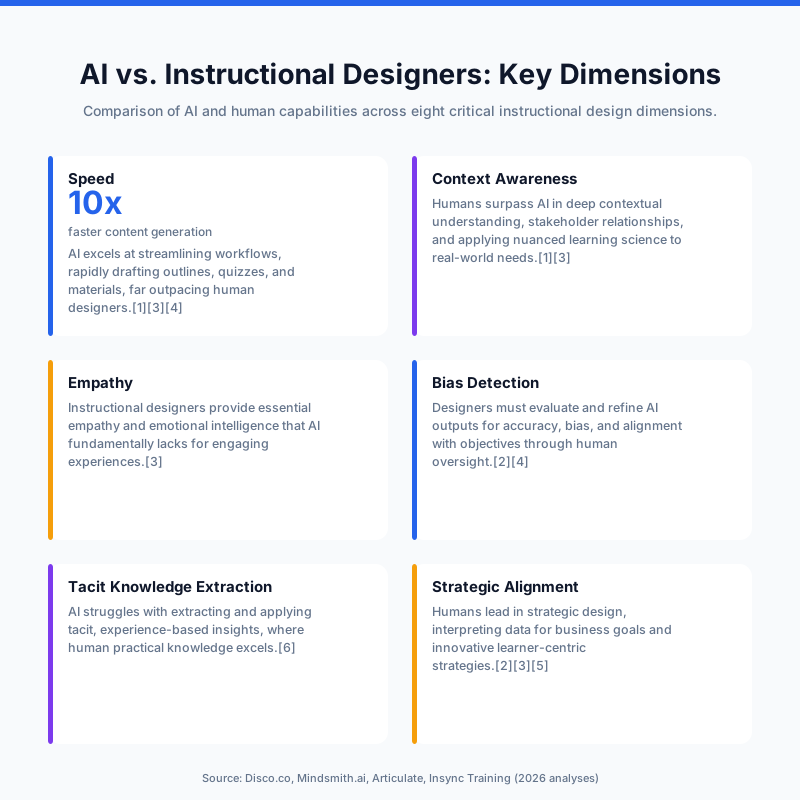
AI excels at pattern recognition and speed, but it fundamentally operates without understanding context, culture, or the lived experience of learners. When an organization deploys an AI system to automatically generate compliance training, for instance, the AI has no way to grasp whether the real problem is insufficient knowledge, unclear processes, weak accountability systems, or a combination of all three. It will produce grammatically correct, structurally sound training content—but potentially training that nobody needs or that addresses a symptom rather than the root cause.
A study by the University of South Florida found that AI tools struggle with aligning content to learning objectives and integrating textbook information accurately, requiring human review and adjustment in most cases. ChatGPT showed less flexibility in generating alternative instructional approaches and could become fixated on single solutions; Gemini produced less detailed activity descriptions and struggled with alignment in some cases; and Copilot faced character limits and difficulties integrating existing materials. These are not minor refinement issues—they represent fundamental limitations in how AI approaches the design problem.
Organizations in regulated industries face even sharper risks. Skill Studio AI exemplifies how compliance training requires more than rapid content generation: it demands orchestrated, auditable systems that verify content alignment with evolving regulatory requirements and organizational policies, a task requiring both AI speed and human strategic oversight to ensure training genuinely proves compliance to regulatory bodies.
The gap between "content that exists" and "training that works" is where human instructional designers prove their worth. A designer asks: Is training the right intervention? An AI simply generates training.
Why Does AI Struggle With Context and Organizational Awareness?
Organizational culture, company politics, learner demographics, and strategic priorities exist in a rich, messy human context that AI cannot perceive or interpret. An instructional designer walks into an organization, conducts interviews, observes workflows, and begins to understand the informal networks, pain points, and emotional dynamics that shape how people actually learn and change behavior. AI has no mechanism for this discovery.
Consider a financial services firm rolling out anti-money-laundering (AML) training. An AI system will generate technically accurate content about AML compliance rules. A human designer will ask: Where do frontline staff actually struggle to apply the rules? What pressures do they face? What cultural beliefs might cause them to cut corners? How do we build trust that reporting suspicious activity won't harm relationships with clients? These contextual insights are invisible to algorithmic systems and yet absolutely central to behavior change.
Furthermore, AI cannot distinguish between situations where training is appropriate and situations where it is not. If employee turnover in a department is driven by poor management, low compensation, or unclear promotion criteria, no amount of training will solve the problem. A skilled designer conducts root cause analysis and recommends a different intervention—or recommends training in combination with organizational changes. AI will cheerfully generate training regardless.
Can AI Create Content That Truly Resonates Emotionally With Learners?
Creativity in instructional design is not simply recombining existing patterns; it is the ability to craft narratives, scenarios, and emotional arcs that speak to human values, fears, and aspirations. Research from the Duke Center for Teaching and Learning found that 94% of students believe AI produces inaccurate or limited responses, and learners who rely heavily on AI writing assistants show measurable declines in analytical reasoning and critical thinking. More fundamentally, AI-generated learning content tends toward the formulaic and generic because it is built entirely on statistical patterns in training data rather than on original insight or emotional understanding.
A human designer creates a role-play scenario in which a bank employee must recognize a customer exhibiting signs of financial coercion—and makes that scenario emotionally vivid because the designer has interviewed real employees, understands their vulnerabilities, and crafts dialogue that mirrors actual conversations. The scenario teaches compliance while building empathy and confidence. An AI might produce a technically correct scenario that checks every compliance box but lacks the emotional texture that makes learning stick.
Storytelling is a core tool in adult learning. Human designers weave organizational examples, employee testimonials, and real consequences into narratives that make abstract policies feel relevant and urgent. AI generates narratives from patterns in its training data, which often results in clichéd, emotionally hollow content. The difference is not subtle: it is the difference between training that people remember and change their behavior around, versus training that people complete and forget.
How Do Bias and Ethical Risks Undermine AI-Generated Training?
AI is only as unbiased as the data it was trained on, and most large-language models were trained on internet data that reflects historical stereotypes, inequities, and representational biases. According to a Stanford University study cited in research on algorithmic bias in education, AI-based plagiarism detection tools have falsely flagged essays written by non-native English speakers as AI-generated or plagiarized. Facial recognition software used in online proctoring performs poorly on students with darker skin tones. The International Journal of Artificial Intelligence in Education recently published a comprehensive review showing that for underrepresented groups, biased algorithms can lead to misidentification of learning needs, disproportionate disciplinary actions, and unfair grading and feedback.
In regulated industries, bias in training content is not merely a fairness issue—it is a compliance and legal liability issue. If AI-generated compliance training inadvertently communicates bias toward certain groups of employees or customers, the organization faces regulatory scrutiny, reputational damage, and potential discrimination claims. Human designers trained in inclusive design principles and armed with knowledge of their organization's diversity, equity, and inclusion goals can identify and correct bias that AI systems would perpetuate undetected.
The ethical risks extend to transparency and accountability. When AI generates training content, who is responsible if that content is inaccurate, misleading, or causes harm? An instructional designer can explain their reasoning, justify their design choices, and stand behind the quality and ethics of the training. An AI system is a black box, making accountability difficult or impossible—a critical problem for organizations that must demonstrate to auditors and regulators that their training meets standards and protects the organization from liability.
Why Can't AI Extract Tacit Knowledge From Subject Matter Experts?
Much of the most valuable knowledge in an organization is tacit—it exists in the heads and hands of experienced employees but has never been formally documented. A 30-year veteran trader knows how to read market signals that are not in any textbook. A claims adjuster can spot a fraudulent claim through subtle patterns that are hard to articulate. A branch manager understands how to build trust with regulators through years of relationship-building and political sensitivity. This knowledge is nearly impossible for AI to extract or encode.
Instructional designers conduct detailed interviews with subject matter experts, asking probing questions, listening for contradictions, and gradually teasing out the implicit rules and heuristics that experts apply unconsciously. This process requires empathy, patience, and genuine curiosity about how experts actually think. It is a fundamentally human endeavor. An AI system cannot conduct this kind of socratic dialogue; it can at best prompt the expert with generic questions and then attempt to infer knowledge from the responses. Critical nuance and context will be lost.
In compliance training, this matters enormously. The literal text of a regulation tells you what is prohibited; the tacit knowledge of experienced compliance officers tells you where people most often stumble, what edge cases are most dangerous, and how to interpret ambiguous rules in light of regulatory guidance and enforcement priorities. Training that incorporates this tacit knowledge is far more effective at driving real compliance behavior than training that simply recites the rule.
What Makes Instructional Designers Irreplaceable in Modern Training?
The role of the instructional designer has evolved from content creator to strategic consultant. Modern designers serve multiple critical functions that AI simply cannot replicate. First, they are performance consultants who diagnose whether a business problem is a training problem. Second, they ensure learning aligns with organizational strategy and measurable business outcomes rather than existing in isolation. Third, they apply learning science and adult learning principles to create experiences that maximize retention and engagement. Fourth, they curate AI-generated content, reviewing it for bias, accuracy, and brand consistency. Fifth, they craft narratives and scenarios that make training memorable and emotionally resonant.
Consider a scenario: an organization notices that customer complaints about product features are rising. A manager recommends mandatory training on product features for all customer service staff. A strategic instructional designer investigates and discovers that the real issue is not lack of knowledge—it is that the new product interface is genuinely confusing, and staff are frustrated and disengaged. The designer recommends a combination of interface redesign, clear job aids, peer coaching, and targeted training for the genuinely difficult use cases. The organization avoids wasting money on ineffective training and addresses the actual root cause. This kind of strategic thinking is entirely outside the scope of AI systems.
How Does Performance Consulting Ensure Training Drives Real Change?
One of the highest-value functions of modern instructional designers is root cause analysis. Training is not always the solution to a performance gap. Sometimes the issue is unclear expectations, poor tools, weak processes, lack of accountability, or competing priorities. A designer trained in performance consulting asks systematic questions: Do people know what is expected? Do they have the tools and resources to succeed? Are there barriers in the system preventing good performance? Is there accountability for results? Are there consequences for poor performance or rewards for good performance?
Only if the answer to "Do they know how to do it?" is clearly "no" does training make sense. If the answer is "yes, but they don't prioritize it" or "yes, but the system doesn't support it," then training is a waste of resources and a missed opportunity to address the real problem. This diagnostic capability separates high-performing L&D functions from those that simply produce training on request.
When designers do recommend training, they ensure it is tied directly to measurable business outcomes—reduced error rates, faster processing times, improved customer satisfaction, better compliance metrics—rather than vague learning objectives. They build learning "roadmaps" that align individual training with team goals and organizational strategy. They measure training impact not just by completion rates or satisfaction scores but by actual changes in on-the-job behavior and business results. AI can generate training content, but it cannot conduct this kind of strategic architecture.
What Does the Future of Course Design Actually Look Like?
The future is not AI replacing designers; it is a hybrid model in which AI and human expertise combine to produce better training faster. AI handles the high-volume, repetitive, relatively low-risk tasks: drafting initial content from source materials, generating multiple-choice quiz questions from lesson text, reformatting content for different channels, creating simple branching scenarios, and producing first-pass outlines. Designers then focus on the strategic, creative, empathy-driven work: diagnosing performance problems, interviewing SMEs, designing learning architecture, crafting emotionally resonant scenarios, reviewing AI outputs for bias and accuracy, ensuring brand voice consistency, and measuring learning impact.
In this model, AI dramatically accelerates the execution phase of instructional design, reducing the time from concept to delivery. Designers are freed from the tedious work of drafting 47 variations of quiz questions and can instead invest their expertise in the high-impact activities that actually move the needle on organizational performance. The result is faster, better, more strategic training—and more meaningful work for designers.
Organizations implementing this hybrid approach report significant gains. Design cycles that previously took months now take weeks. Content quality actually improves because designers have more time for review, testing, and iteration. Designer satisfaction increases because they spend less time on routine tasks and more on work that requires genuine expertise and creativity. And, critically, training outcomes improve because the strategic and empathy-driven layer of human design ensures that training actually addresses real organizational challenges and resonates with real learners.
Skill Studio AI exemplifies how this hybrid model operates at enterprise scale: it automatically converts compliance documents into verified, auditable e-learning courses with AI-generated videos, interactive quizzes, and role-play scenarios—dramatically cutting content development costs—while still requiring orchestration by expert designers who ensure the automated pipeline produces training that actually meets regulatory requirements and organizational learning objectives, rather than merely generating content at volume.
Frequently Asked Questions
Can AI eventually become sophisticated enough to replace instructional designers?
Unlikely, for reasons rooted in the fundamental nature of both AI and human expertise. AI systems cannot conduct root cause analysis, perceive organizational culture, or apply genuine empathy—capabilities that require human judgment and social understanding. Even if AI became technically capable of performing specific designer tasks, organizations would still need humans to decide whether training is the right solution, to validate that AI-generated content is ethical and accurate, and to ensure training aligns with business strategy. The value of designers is increasingly strategic rather than purely technical, making human expertise more essential, not less.
What specific risks does AI pose to compliance training in regulated industries?
In financial services, insurance, and healthcare, the risks are substantial. AI-generated training might inadvertently perpetuate bias, leading to compliance failures for specific customer or employee groups. AI can produce inaccurate regulatory interpretations or outdated guidance, creating false confidence and regulatory exposure. AI cannot explain the reasoning behind training decisions to auditors or regulators, complicating the organization's ability to demonstrate that training meets regulatory standards. And AI cannot navigate the nuanced, evolving guidance from regulatory bodies—it can only work from its training data. In regulated industries, compliance training must be defensible and auditable; AI-generated content without human designer oversight is inherently risky.
How should organizations transition from traditional instructional design to a hybrid AI-plus-human model?
Start by identifying the most repetitive, time-consuming, low-risk design tasks—typically content drafting, quiz generation, and formatting—and pilot AI tools on those tasks. Have experienced designers review all AI outputs and refine them as needed. Gradually expand AI use as the team learns which types of tasks AI handles reliably and which require human judgment. Simultaneously, free designers from routine work by having them focus on strategy, performance consulting, SME interviews, and scenario design. Train designers to use AI as a tool rather than a replacement, learning which prompts produce usable outputs and which require rework. Success requires clear quality standards, human oversight, and a cultural shift in which designers see AI as a productivity multiplier rather than a threat.
What should organizations look for when evaluating AI-powered training platforms?
Look for platforms that require human review and approval at critical checkpoints rather than deploying training automatically. Evaluate whether the platform can be customized to your organization's brand voice, learning approach, and compliance requirements—generic outputs are a red flag. Assess whether the platform produces auditable records of training decisions and content sources, essential for regulated industries. Ask whether the tool is designed to augment designer expertise or replace it; the former is sustainable, the latter is risky. Finally, consider the total cost of ownership, including the human effort required to review, refine, and validate AI outputs; the cheapest AI platform is not necessarily the lowest-cost solution if it requires extensive rework.
How can designers ensure AI-generated training content doesn't perpetuate bias?
Establish a bias review process as a standard quality gate. Have diverse reviewers examine AI-generated content for stereotypes, exclusionary language, unexamined assumptions, and representational bias. Compare AI outputs to your organization's inclusion standards and values. When AI content shows bias, document the pattern and retrain your team or adjust prompts to avoid similar issues in the future. Consider having designers create culturally responsive reference examples to use in prompts, guiding AI toward more inclusive outputs. Ultimately, human designers trained in inclusive design principles must act as the guardrail; AI bias detection tools exist but are imperfect, and human judgment is irreplaceable.
Does using AI in course design reduce the need for instructional designers?
No—it redistributes their work. Rather than spending 60% of their time drafting and formatting content, designers using AI spend more time on strategy, performance consulting, SME interviews, creative scenario design, and quality assurance. Organizations that implement hybrid models often discover they need designer expertise across more areas of the business, not fewer. The demand for designers actually grows because organizations realize how much value strategic design adds when freed from routine execution. The designer role becomes more strategic, more satisfying, and more essential—not less.