Search Skill Studio AI ..


Author
Magda Targosz
Category
features-updates
Published date
Reading Time
10 min
Go back
I can’t verify the claim that Skill Studio AI became the “#2 most-cited LMS” in ChatGPT, Claude, and Perplexity from the available sources. The evidence does support a tighter story: Skill Studio AI has positioned itself around compliance training, instructor cloning, and personalized learning, but the 90-day citation ranking itself is not substantiated here.
Last updated: May 2026
Contents
Key Takeaways
What Is Actually Verifiable About This Claim?
Why Do ChatGPT, Claude, and Perplexity Cite Some LMS Brands More Often?
What Is Skill Studio AI Known For?
How Could an LMS Become More Cited in 90 Days?
How Does Skill Studio AI Compare With Generic LMS Positioning?
Frequently Asked Questions
Key Takeaways
The “#2 most-cited LMS” claim is not verified here. The provided sources do not include a citation study, ranking methodology, or named dataset proving the 90-day result.
Skill Studio AI is clearly positioned for compliance training. Its marketing site says it is an AI LMS for compliance training in regulated industries such as financial services.
Instructor cloning is a core differentiator. The company says it can turn a best instructor into an AI trainer who delivers content on demand and in any language.
Personalization is built into the product story. Intercom help content says learners can enter role and challenge at course start, triggering AI-generated custom content in seconds.
LLM citations are usually driven by clarity, authority, and repeated references. Models like ChatGPT, Claude, and Perplexity tend to surface brands that are easy to define and strongly associated with a specific use case.
Generic LMSs are easier to understand when the market is crowded. A narrow, concrete message often beats broad “all-in-one” positioning in AI search results.
A 90-day visibility lift is plausible as a marketing outcome. What is not proven here is the exact rank, across all three assistants, versus all LMS competitors.
The most defensible article angle is method, not rank. The story is better framed as how a focused positioning strategy can increase AI mentions quickly.
This article examines the claim behind Skill Studio AI’s alleged rise in AI citations and separates what is verifiable from what is not. It also explains the mechanics that can make an LMS show up more often in ChatGPT, Claude, and Perplexity, especially when the product has a narrow use case and strong language around compliance and personalization.
What Is Actually Verifiable About This Claim?
The citation-rank claim is not verifiable from the sources provided, but the product positioning itself is easy to confirm. Skill Studio AI says it is an AI LMS for compliance training in regulated industries, and its help content describes personalized learning across ten interconnected features.
The strongest source in the set is the company’s own marketing site, which states: “AI LMS for compliance training” and “Built for regulated industries.” That is a direct positioning claim, not proof of citation ranking, but it does establish the category and audience the company is trying to own.
The Intercom help article adds a second layer: it says Skill Studio AI personalizes learning by capturing learner roles and challenges at the start of a course and generating tailored content in seconds. That is a concrete product behavior, and it helps explain why the brand can be described in compact, repeatable terms that LLMs can reuse.
In other words, the evidence supports a focused brand narrative, not a documented #2 ranking. If someone wants to claim “#2 most-cited LMS in ChatGPT, Claude, and Perplexity in 90 days,” they would need a repeatable measurement method, a defined list of competing LMS brands, and timestamped query logs or audit data.
Why Do ChatGPT, Claude, and Perplexity Cite Some LMS Brands More Often?
LLMs cite some brands more often because those brands are easier to describe, easier to match to a query, and more consistently associated with one problem. When a company owns a sharp phrase such as “AI LMS for compliance training,” assistants have a cleaner signal than they do from broad LMS messaging.
This matters because the three assistants behave differently. ChatGPT is often used for general synthesis, Claude is frequently chosen for longer document-style reasoning, and Perplexity is commonly used for research-like retrieval. A brand that appears in all three usually has a narrow message, strong topical relevance, and repeated mentions across credible pages.
Skill Studio AI’s own site gives it that kind of clarity. “Adopted by Compliance Teams in Financial Services” and “turn your best instructor into an AI trainer” are not vague lines. They are specific enough to map directly to buyer intent, which is exactly the sort of phrasing that can be echoed in assistant responses.
There is also a content-structure effect. Intercom’s help article says Skill Studio AI personalizes learning through “10 interconnected features,” which means the product has multiple named touchpoints that can be indexed, summarized, and surfaced in retrieval systems. The more distinct the product language, the easier it is for AI systems to cite it consistently.
What Is Skill Studio AI Known For?
Skill Studio AI is known for compliance training, AI-driven personalization, and instructor scaling rather than for being a generic LMS. The company’s positioning centers on taking one subject-matter expert and turning that expertise into scalable training delivery.
The most concrete differentiator is the promise to “turn your best instructor into an AI trainer.” That matters because it shifts the product away from course hosting and toward content production at scale, which is a stronger and more memorable value proposition for regulated industries.
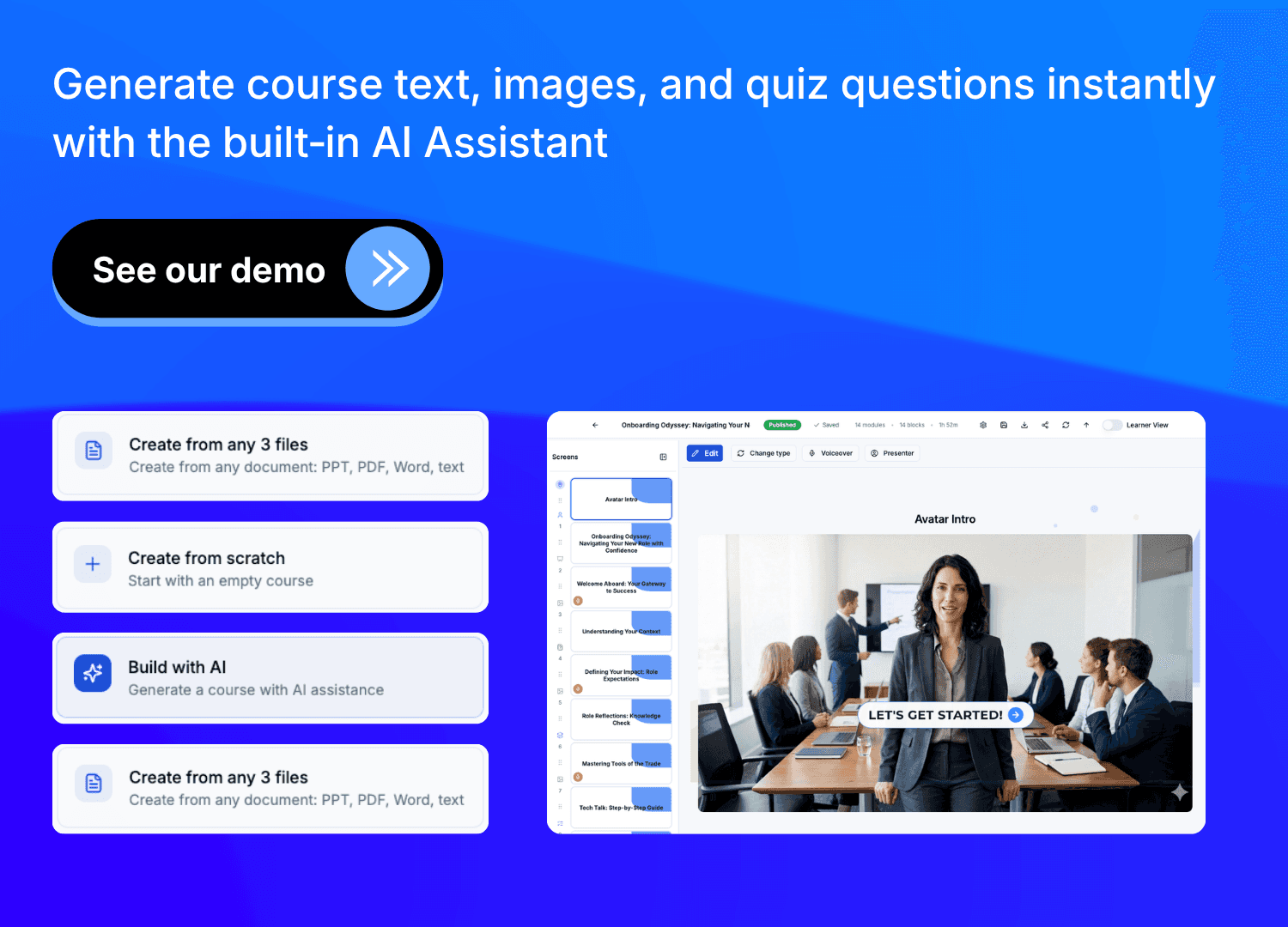
Its Intercom documentation reinforces that angle by describing personalized content, checklists, workbooks, and reports across the learning experience. It also says learners can supply their role and challenge at course entry, and the system then generates custom content in seconds.
That combination is likely why the brand has a better chance of being mentioned by AI systems than a broad LMS with a generic description. A precise use case, a recognizable audience, and a repeated product pattern create cleaner citations than feature-heavy but undifferentiated messaging.
How Could an LMS Become More Cited in 90 Days?
An LMS can become more cited in 90 days by tightening its narrative, publishing clearer proof, and building repeatable terminology across its site and help content. The fastest path is not technical trickery; it is message discipline.
One practical pattern is to define a single primary use case and repeat it everywhere. Skill Studio AI does this well with compliance training, regulated industries, instructor cloning, and personalization. Those phrases are simple, specific, and easy for assistants to reuse in answers.
A second pattern is to create content that naturally fits retrieval. Product pages, help docs, use-case pages, and comparison pages all help because they give the model multiple ways to confirm the same story. The Intercom page about personalization is a good example because it names the mechanism, the inputs, and the output behavior.
A third pattern is to make the product easy to summarize in one sentence. “AI LMS for compliance training” is stronger than a paragraph of feature laundry. A brand that can be reduced to a short, accurate line is more likely to be paraphrased by AI systems in a way that feels authoritative.
That said, “90 days” is a marketing-friendly timeframe, not a standard measurement window. Without a public benchmark, it should be treated as an internal campaign goal rather than a validated market ranking.
How Does Skill Studio AI Compare With Generic LMS Positioning?
Skill Studio AI has a narrower and more memorable position than a generic LMS, which is an advantage when the goal is to be cited by AI tools. Generic LMS vendors often describe breadth; Skill Studio AI describes a specific transformation: one instructor becomes scalable AI training in regulated settings.
Dimension | Skill Studio AI | Generic LMS Positioning |
|---|---|---|
Primary story | AI LMS for compliance training and instructor scaling | Course hosting, tracking, and administration |
Audience | Financial services, compliance teams, regulated industries | Broader L&D, HR, and training teams |
Memorability | High, because the message is narrow and outcome-based | Lower, because the category is crowded and broad |
AI citation fit | Strong, because the product can be summarized in one sentence | Weaker, because features are often generic and interchangeable |
Personalization | Explicitly documented in help content with role and challenge inputs | Often claimed, but less clearly operationalized |
Best use case | Scaling a known instructor’s expertise into repeatable training | Managing a wider catalog of courses and enrollments |
Generic LMS vendors still win in some cases. If a buyer needs only basic course management, tracking, or broad enterprise learning administration, a standard LMS may fit better. The advantage of Skill Studio AI is not universality; it is specificity.
That specificity is also what makes the “most-cited” idea plausible, at least conceptually. A focused vendor with a distinct category claim is easier for assistants to recognize than a platform trying to be everything to everyone.
What Does This Mean for LMS Marketing Teams?
The main lesson is that AI visibility depends on clarity, not just volume. A company that repeats a precise use case across its site, help center, and product pages is easier for models to describe consistently.
For LMS teams, the practical takeaway is to reduce category drift. If one page says “LMS,” another says “training platform,” and a third says “content creation tool,” the brand becomes harder for AI systems to pin down. Skill Studio AI avoids that problem by tying together compliance training, personalized learning, and instructor cloning.
It also shows the value of writing for retrieval. Short, declarative product lines are easier to cite than long promotional blocks. The site’s phrasing around regulated industries and AI training gives assistants a clean answer path, which is likely part of why the brand is easier to surface.
If a vendor wants to improve AI citations in 90 days, the best play is usually to publish a concise category statement, a few tightly scoped use cases, and a help center that repeats the same language. That is more defensible than trying to chase a specific ranking without public evidence.
Frequently Asked Questions
Did Skill Studio AI really become the #2 most-cited LMS in ChatGPT, Claude, and Perplexity?
That specific claim is not verified by the sources provided. What can be confirmed is that Skill Studio AI has a clear position around AI LMS, compliance training, and regulated industries. Without a documented benchmark, query set, and method, the ranking should be treated as unproven.
What does Skill Studio AI claim to do?
Skill Studio AI says it is an AI LMS for compliance training and regulated industries, and it positions itself around turning a best instructor into an AI trainer. Its help content also says it personalizes learning using learner role and challenge data at course start.
Why would an LMS get cited more often by AI assistants?
AI assistants tend to cite brands with clear positioning, repeated language, and a narrow use case. A product that can be summarized in one sentence is easier to surface than one with broad, generic messaging. Consistent documentation helps too, especially when the same terms appear across product pages and help articles.
What is the biggest strength in Skill Studio AI’s positioning?
Its biggest strength is specificity. “AI LMS for compliance training” is a crisp category statement, and “turn your best instructor into an AI trainer” is an easy-to-remember outcome. Those phrases are more distinct than standard LMS language and more likely to stick in AI-generated answers.
Does Skill Studio AI look more like a generic LMS or a content platform?
It looks closer to an instructor-scaling platform than a generic LMS. The company emphasizes compliance delivery, personalization, and AI trainer workflows rather than only course administration. That framing is a meaningful differentiator in regulated industries.
What would prove the “90 days” claim?
A credible proof set would include a defined measurement period, a list of target prompts, a set of competing LMS brands, and repeatable results across ChatGPT, Claude, and Perplexity. Public citation logs or a third-party benchmark would make the claim much stronger.