Search Blogs
Discover why a scalable Learning Management System (LMS) is not just a luxury, but a critical investment for growing enterprises. Learn how to empower your L&D team to support future expansion, complex training needs, and ensure your organization's contin







Empowering Growth: Why Your LMS Needs to Scale with Your Enterprise
Hey there, amazing L&D professionals! You're at the heart of your organization's growth, shaping minds, building skills, and fostering a culture of continuous improvement. As your enterprise expands, the tools you use to empower your people must evolve too. Have you ever considered what happens when your Learning Management System (LMS) can't keep up with your company's incredible trajectory? It's like trying to navigate a growing metropolis with an outdated map; you'll eventually hit a dead end.
Today, we're diving deep into why a scalable LMS isn't just a nice-to-have, but an absolute necessity for HR and L&D teams in growing enterprises. We’ll explore the unique demands of businesses at different stages and uncover why choosing a solution that can grow with you is perhaps one of the most strategic decisions you'll ever make.
The Small Business LMS: Simplicity and Immediate Needs
Let's start with the vibrant world of small businesses. When a company is just finding its footing, its learning needs are often straightforward. Perhaps you're a startup with a team of 20, focused on onboarding new hires, ensuring basic compliance, and maybe a few essential skill development modules. Your LMS requirements are likely centered around ease of use, affordability, and getting fundamental training delivered quickly.
For many small businesses, a basic, off-the-shelf LMS can seem like a perfect fit. It’s simple to implement. It might handle core tasks like assigning courses, tracking completions for a small group, and housing a modest library of content. Think of it as a cozy, charming cottage. It's perfect for a small family, offering warmth and functionality for their immediate needs. You might use it to swiftly onboard a handful of new marketing associates or to ensure everyone completes their annual data privacy training. The administrative burden is low, and the costs are manageable.
However, what happens when that small family starts to grow, and grow rapidly? That cozy cottage, while once perfect, quickly feels cramped. The walls start to creak under the strain. This is precisely the challenge that awaits a small business when its basic LMS isn't designed for future expansion.

Large Enterprise LMS: Complexity and Advanced Demands
Now, let’s shift our gaze to the sprawling landscape of a large enterprise. Here, the learning ecosystem is vastly different, akin to a bustling, multi-layered city. We're talking about hundreds, often thousands, of employees scattered across multiple departments, locations, and even continents. Their training needs are incredibly diverse and complex.
For large organizations, an LMS needs to be a robust, sophisticated engine. It's not just about delivering content; it's about orchestrating a symphony of learning experiences. We need features like multi-tenancy to manage different business units or brands, advanced compliance tracking for various global regulations, intricate reporting dashboards to measure impact, and seamless integrations with existing HRIS, CRM, and performance management systems. Think about a global pharmaceutical company, for instance. They need to manage highly specialized training for R&D scientists, sales teams across dozens of countries, manufacturing staff, and corporate employees, all while adhering to strict regulatory requirements. A generic, basic LMS simply wouldn't cut it.
Large enterprises also demand personalized learning paths, social learning capabilities, intricate skill gap analysis, and the ability to host a massive, diverse content library including virtual reality simulations, live webinars, and interactive modules. The administrative controls need to be granular, allowing for precise management of roles, permissions, and learning assignments. They seek an LMS that acts as a central nervous system for their entire talent development strategy, not just a content repository.
The Growth Challenge: Navigating the Tipping Point
Here’s where it gets really interesting for you, the L&D trailblazers in growing organizations. What happens when your promising small business blossoms into a thriving medium-sized or even large enterprise? That initial, simple LMS that served you so well can quickly become a bottleneck, rather than an enabler. It's a common dilemma, almost inevitable, if you haven't planned for growth.
Imagine Sarah, an L&D Manager at a rapidly expanding tech firm. When they were 50 people, their basic LMS was fine for onboarding and a few mandatory courses. Now, they're 300 employees strong, with new departments, a global sales team, and a constant influx of specialized roles. Sarah's team is drowning in manual tasks. They can't easily track progress across different teams, generate meaningful reports for leadership, or provide personalized learning paths for developers versus customer support agents. The once-charming cottage is now overflowing, and its foundation wasn't built for a skyscraper.
This tipping point is critical. An unscalable LMS can lead to a host of headaches: administrative overload, inconsistent training experiences, data silos, difficulty proving the ROI of learning initiatives, and even compliance risks. It can stifle innovation and make it incredibly difficult to align learning with strategic business objectives. It’s like trying to paddle a small rowboat across an ocean; you’ll exhaust yourself and never reach your destination efficiently.
Why Scalability is Paramount for Growing Organizations
Choosing a scalable LMS solution is not just about avoiding future pain; it's about proactively empowering your organization for unstoppable growth. Let's break down why this is so critical:
Future Expansion: Ready for What's Next
As your company grows, you'll inevitably need to accommodate more users, more diverse content, and potentially new regional or global locations. A scalable LMS is built to handle this expansion seamlessly. It means adding hundreds or thousands of new employees doesn't crash your system or require a complete overhaul. It provides the robust infrastructure to support an ever-growing user base without compromising performance or user experience. You want a system that can absorb growth like a sponge, not one that collapses under the pressure.
Complex Training Needs: Beyond the Basics
Growth brings diversification. You'll develop specialized roles, require advanced skill development programs, and invest in leadership training. A scalable LMS offers the flexibility to support these complex needs. It allows for the creation of intricate learning paths, competency frameworks, and the integration of various learning modalities, from microlearning to virtual instructor-led training. Imagine the power of a system that can deliver a tailored cybersecurity course to your IT team, a leadership development program to your managers, and product knowledge training to your sales force, all within a single, integrated platform.
Seamless Integration with Existing Systems: Your HR Ecosystem
For L&D teams, your LMS is rarely an island. It needs to communicate effectively with your Human Resources Information System (HRIS), performance management software, talent acquisition platforms, and even CRM systems. A scalable LMS comes with robust APIs and integration capabilities, ensuring a smooth flow of data. This eliminates manual data entry, reduces errors, and provides a holistic view of each employee's journey, from hiring to performance to learning. This interconnectedness is crucial for making data-driven decisions and creating a truly unified employee experience.
Powerful Data Analytics and Reporting: Proving Your Impact
As your enterprise grows, proving the value and impact of your learning initiatives becomes increasingly vital. A scalable LMS offers sophisticated reporting and analytics tools. You can track completion rates, measure skill improvement, analyze engagement, and even link learning outcomes to business performance metrics. Imagine being able to confidently present data to your executive team showing how a specific training program led to a 15% increase in sales effectiveness or a 20% reduction in customer support resolution time. This data empowers you to justify investments and strategically align learning with business goals.
Long-Term Cost-Efficiency: An Investment, Not an Expense
While a scalable LMS might represent a larger initial investment than a basic one, it offers significant cost-efficiency in the long run. Constantly migrating data, retraining administrators, and dealing with system limitations as your company grows can be incredibly expensive and disruptive. Choosing a scalable solution from the start means you avoid these costly, time-consuming overhauls. It's like building a strong, versatile foundation for your house; it might cost more upfront, but it saves you from needing to rebuild every few years.
Enhanced Employee Experience: Learning Without Limits
Ultimately, a scalable LMS contributes to a superior employee experience. It ensures that learning is always accessible, consistent, and personalized, regardless of where an employee is located or what their role entails. Employees can access the training they need, when they need it, fostering a culture of continuous learning and development. This leads to higher engagement, better retention, and a more skilled, adaptable workforce, which is truly invaluable.
Key Features of a Scalable LMS to Look For
When you're evaluating an LMS for your growing enterprise, and considering all the essential features for L&D success needed for your specific context, keep these critical scalability features in mind:
Multi-tenancy or multi-organization capabilities: Essential for managing different departments, brands, or regional offices with distinct training needs and branding.
Robust user management and role-based access: Allows for granular control over who can access what content, manage users, and run reports.
Extensive content library support: Ability to host a vast array of content formats, including SCORM, xAPI, video, documents, and interactive modules, ensuring your content grows with you.
Powerful reporting and analytics engine: Customizable dashboards and detailed reports that provide actionable insights into learning effectiveness and impact.
Open APIs for seamless integrations: Crucial for connecting your LMS to your HRIS, CRM, performance management, and other essential business tools.
Cloud-based infrastructure: Offers flexibility, reliability, security, and the ability to scale resources up or down as needed without on-premise hardware limitations.
Customization options: The ability to brand your learning environment and tailor workflows to match your specific organizational processes.
Support for multiple languages: If you're a global enterprise, this is non-negotiable for delivering equitable and effective training to all employees.
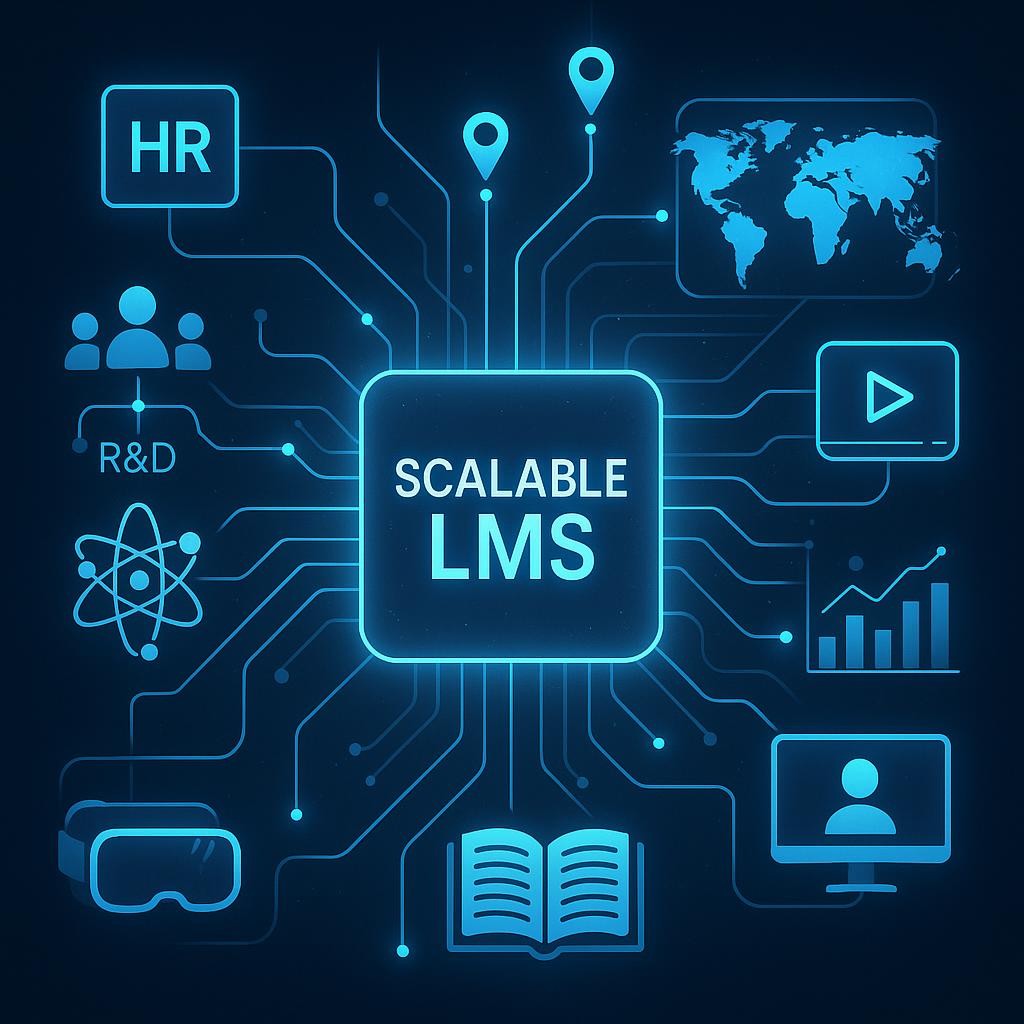
Your Future Starts Now
For HR and L&D teams, choosing an LMS isn't just a technical decision, it's a strategic one. It's about investing in the future of your people and, by extension, the future of your entire organization. A scalable LMS is more than just a software solution; it's a launchpad for talent development, a guardian of compliance, and a powerful engine for continuous growth.
Don't let your learning infrastructure become a roadblock to your enterprise's incredible potential. Embrace a learning management system that not only meets your current needs but also anticipates and supports every exciting step of your journey forward. It's time to empower your teams, uplift your employees, and build a learning ecosystem that scales with your ambition. Your organization deserves nothing less. Ready to explore how a truly scalable LMS can transform your learning strategy? Take the next step today and imagine the possibilities!