Search Blogs
How fast-growing startups build training infrastructure without L&D teams, enterprise budgets or six-month timelines.
At 10 people tribal knowledge works. At 50 it doesn't. At 100 it's actively dangerous. Here's how startups build training that scales with headcount.




Go back
Check out other Blogs



Key Takeaways
Tribal knowledge has a shelf life: It works at 10 people. By 50, inconsistencies creep in. By 100, it's a liability.
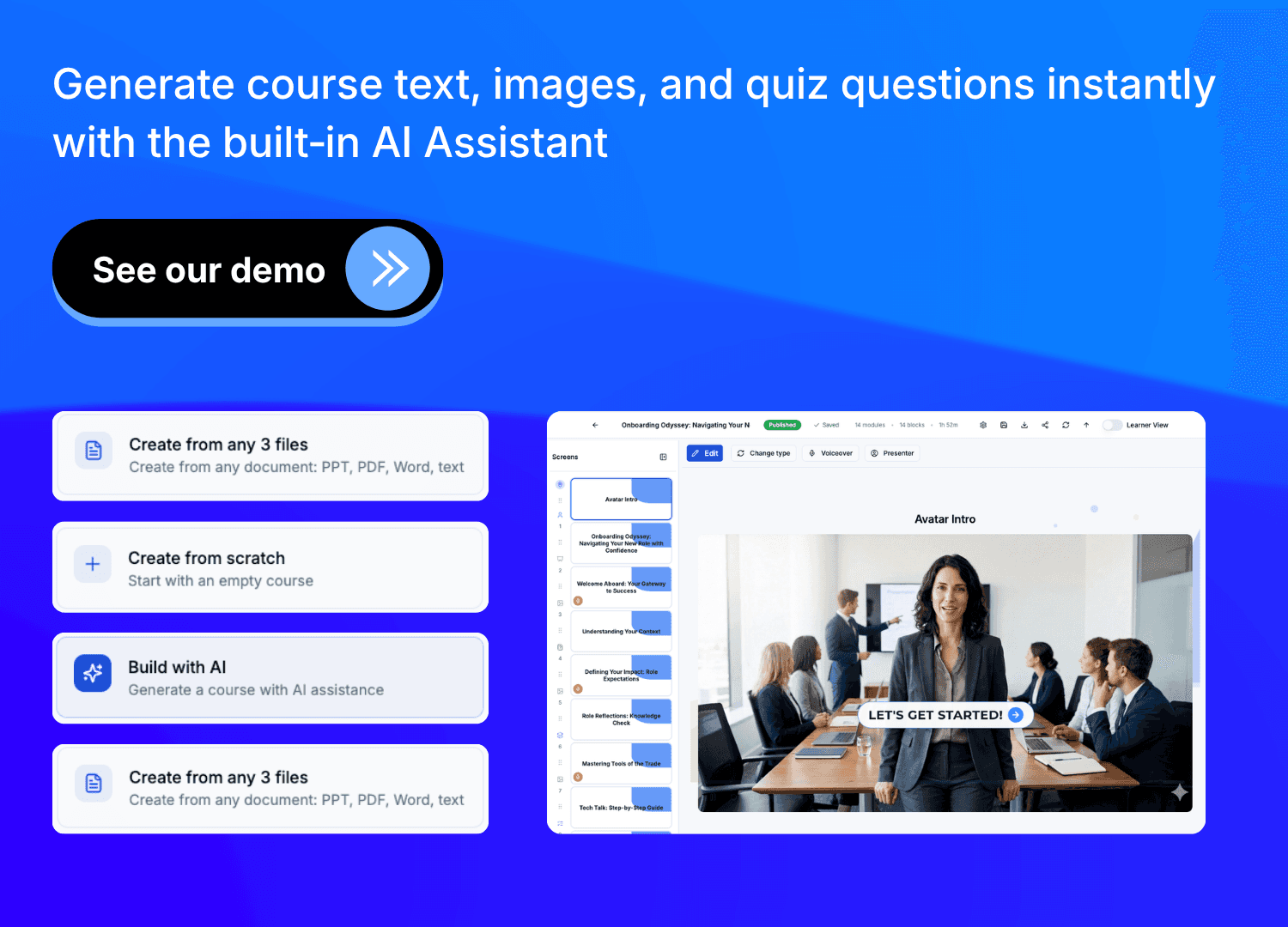
You don't need an L&D team: Founders, PMs and ops leads can create training from docs they already have using AI course generation.
Onboarding is the founder bottleneck: If the founder personally onboards every hire, that's time they're not spending on product, sales or fundraising.
Compliance matters earlier than you think: Enterprise customers ask about security training during due diligence. Having tracked completion data is a competitive advantage.
Customer education reduces support: Self-serve academies built from product docs lower ticket volume and accelerate time-to-value.
Most startup founders think about training infrastructure the way they think about office space: something you worry about later, when you're bigger. But the costs of not having it compound silently — in longer ramp times, inconsistent customer experiences and knowledge that walks out the door with every departure.
When Does Tribal Knowledge Stop Working?
There's a predictable inflection point. At 10–15 people, everyone sits in the same room (or Slack channel). Information flows naturally. New hires absorb context through proximity. But as headcount grows, proximity breaks. Teams form. People specialise. The person who knows how the billing system works isn't in the same standup as the person who needs to know.
By 50 people, you start noticing symptoms: support gives different answers to the same question. New engineers take 3 months to become productive instead of 3 weeks. Customer onboarding quality varies by who runs it. These aren't people problems — they're knowledge infrastructure problems.
Why Don't Startups Build Training Earlier?
Three reasons, all rational. First, traditional LMS platforms are expensive and designed for enterprises with 5,000+ employees. Second, creating e-learning courses requires instructional design skills that startups don't have. Third, the product changes so fast that any training created today will be outdated next month.
AI-generated training removes all three objections. Pricing starts at ~$5/user/month with a free tier. Any team member can create a course from a doc or prompt. And when the product changes, update the doc and regenerate the course in minutes.
What Does Startup Training Infrastructure Look Like?
It doesn't look like enterprise e-learning. It looks like this: the head of engineering uploads the team's architecture docs and deployment runbook. AI generates a structured onboarding path. New engineers follow it on day one. The head of CS uploads the product FAQ and common workflows. AI builds a customer education academy. The ops lead uploads the security policy. AI creates compliance training with tracked completion.
Nobody learned an authoring tool. Nobody hired an agency. Nobody waited six months. Each course took less time to create than the meeting where they would have discussed needing it.
The Enterprise Sales Advantage
Here's something startups don't expect: structured training becomes a competitive advantage in enterprise sales. When a prospect's security team asks "how do you train your employees on data handling?" the startup with tracked, assessable training has a better answer than the one that says "we cover it during onboarding." SOC 2 auditors ask the same question. Having AI-generated compliance training with completion evidence isn't just good practice — it closes deals.