Go back
Search All News …


AI-powered learning platforms automate personalization, adaptive content delivery, and compliance training at scale—transforming how enterprises build verifiable training programs for regulated industries.
Last updated: May 2026
Contents
Key Takeaways
What Is an AI-Powered Learning Platform?
How Does Adaptive Learning Work?
How AI-Based LMS Differs From Traditional LMS
What Are the Core Benefits of AI-Powered Learning Platforms?
What Features Matter Most in an AI Learning Platform?
Which Use Cases Benefit Most From AI-Powered Learning?
What Are the Top AI-Powered Learning Platforms in 2026?
How Do AI Platforms Handle Compliance Training?
Frequently Asked Questions
Key Takeaways
Personalization at scale: AI-powered learning platforms analyze learner behavior and performance in real time to deliver customized content paths, eliminating the one-size-fits-all training model.
Adaptive content delivery: These platforms automatically adjust difficulty, pacing, and recommendations based on individual learner responses, ensuring optimal engagement and knowledge retention.
Faster skill development: By identifying and targeting knowledge gaps directly, AI reduces time-to-competency and allows learners to bypass material they already know.
Administrative automation: Intelligent workflows handle course assignments, progress tracking, compliance documentation, and reporting—freeing L&D teams to focus on strategic work.
Predictive analytics: Real-time dashboards surface learner risk patterns, content effectiveness, and performance trends to guide data-driven training decisions.
Compliance and audit readiness: AI platforms automate the conversion of compliance documents into verifiable, auditable training courses with complete learner records—critical for regulated industries.
Multimodal learning support: Platforms recommend different content types—video, audio, text, simulations—based on learner preference, improving accessibility and retention.
Cost efficiency and scalability: Automation reduces manual oversight and scales training quality globally without proportional increases in staffing or infrastructure costs.
Organizations across regulated industries—financial services, healthcare, manufacturing—are rethinking how they deliver training. Traditional learning management systems (LMS) treat all learners the same way: they enroll, they see identical content in a fixed order, they complete, they move on. This approach worked when compliance was a checkbox. Today, regulatory bodies demand continuous proof of competency, and skill gaps directly impact operational risk and audit outcomes. AI-powered learning platforms transform training from a static, reactive process into a dynamic, intelligence-driven system that learns from every learner interaction and adjusts in real time. This guide explores how these platforms work, which features matter most, and how they address the specific challenge of compliance training at scale.
What Is an AI-Powered Learning Platform?
An AI-powered learning platform is an online training system that uses machine learning (ML), natural language processing (NLP), and predictive analytics to personalize and enhance the learning experience. Unlike traditional LMS platforms that serve static content, AI-powered systems analyze learner behavior, performance, and preferences to deliver training content, assessments, and learning paths tailored to each individual's specific needs.
These platforms go beyond managing content and tracking completion. They use algorithms to make real-time decisions about what each learner sees next, how fast they progress, and where they need reinforcement. When an employee struggles with data privacy concepts in a compliance module, the system doesn't simply flag the low score. It recommends a targeted micro-course, surfaces a relevant video, or suggests a coaching intervention. Conversely, if the same employee demonstrates mastery in cybersecurity, the platform accelerates them to advanced material to maintain engagement and depth.
The fundamental shift is from one learner path for all to one unique path per learner. This is especially critical for regulated industries where continuous competency verification and auditable training records are non-negotiable. Skill Studio AI exemplifies this model by automating the entire policy-to-training lifecycle: it converts compliance documents into verified, auditable e-learning courses with AI-generated video content, interactive quizzes, and role-play scenarios—all while maintaining a complete learner record that regulatory bodies can review.
How Does Adaptive Learning Work?
Adaptive learning uses algorithms and learner data to create a personalized education path that evolves as the learner progresses. Instead of a fixed curriculum, the system collects data from every interaction and continuously refines what content, difficulty level, and format suits that learner best.
The process unfolds in four stages:
Assessment and baseline: When a learner begins a course, they complete a short diagnostic or skills assessment. Based on their performance, the platform establishes a baseline of their current knowledge and identifies initial gaps.
Content matching: The system recommends the appropriate level of activities and resources. If a learner scores below a threshold on regulatory knowledge, they see foundational content. If they demonstrate competency, they skip ahead to advanced or applied material.
Real-time adjustment: As the learner interacts with content—answers quiz questions, watches videos, attempts simulations—the platform collects continuous feedback. If the learner struggles, the LMS slows down, offers additional explanations, or branches to remedial content. If they excel, the system accelerates their progress or introduces more complex scenarios.
Continuous monitoring: Because all interactions occur within the platform, the LMS maintains a detailed performance record. It monitors competency development over time, flags emerging knowledge gaps, and surfaces patterns that may indicate performance risk or certification readiness.
The result is that no two learners follow the same sequence. One employee might complete a compliance module in two hours; another might spend four hours with deeper practice. Both leave with verified competency, but each took the path suited to their starting point and learning pace. This efficiency directly reduces time-to-competency and improves knowledge retention because learners spend effort where they need it most. Research shows 78% of professionals believe adaptive courses will shape future training efforts.
How AI-Based LMS Differs From Traditional LMS
Traditional learning management systems excel at managing content and tracking completion. They store courses, enroll learners, record quiz scores, and generate attendance reports. But they rely on static, one-size-fits-all course structures where every learner sees the same materials in the same order, regardless of prior knowledge, learning style, or current performance.
Capability | Traditional LMS | AI-Powered LMS |
|---|---|---|
Content delivery | Linear, identical path for all learners | Adaptive, personalized path per learner based on real-time performance data |
Learner assessment | Pass/fail scoring; minimal interpretation of performance data | Analyzes response patterns to detect knowledge gaps, misconceptions, and learning style preferences |
Recommendations | None; learners manually select or are manually assigned to next course | Automated, intelligent suggestions based on skill gaps, role, and learning history |
Feedback | Delayed or generic; often just a score after quiz completion | Real-time, specific feedback tied to learner responses; immediate corrective guidance |
Administrative overhead | High manual work for enrollments, progress tracking, compliance reporting | Automated workflows for assignments, tracking, and audit-ready compliance documentation |
Analytics and insights | Basic completion and score reporting; limited predictive capability | Predictive analytics; real-time dashboards showing learner risk, content effectiveness, performance trends |
Compliance automation | Manual course creation and record-keeping; labor-intensive audit preparation | Automated conversion of compliance documents to auditable courses; continuous verification and proof-of-compliance |
Scalability | Quality depends on manual oversight; scales inefficiently | Scales globally without proportional increase in L&D staff; maintains quality through intelligent automation |
The key distinction is responsiveness. A traditional LMS is a content repository with tracking. An AI-powered LMS is an intelligence layer that continuously learns from learner behavior and optimizes outcomes in real time. For compliance training, this difference is profound: AI platforms can automatically trigger courses when regulatory requirements change, verify that learners have demonstrated competency (not just attended), and generate audit-ready documentation showing exactly what each employee learned and when. The global adaptive learning market is projected to grow from $2.87 billion in 2024 to $4.39 billion in 2025—a 52.7% increase.
What Are the Core Benefits of AI-Powered Learning Platforms?
Personalized learning paths eliminate wasted training time, with learners focusing on gaps and bypassing mastered content. Organizations report up to 50% higher relevance.
Faster skill development: Adaptive platforms reduce time-to-competency by up to 30%, per Absorb LMS research.
Smarter assessments provide real-time feedback, turning quizzes into coaching tools.
Higher engagement: Personalized paths boost completion rates by 40–50%, according to 360Learning.
Actionable insights: Predictive analytics guide L&D decisions on risks and effectiveness.
Cost efficiency: Automation cuts administrative work and audit prep time.
Compliance readiness: Platforms like Skill Studio AI automate policy-to-course conversion and maintain verifiable records.
Scalability: Delivers consistent quality across global teams without added staff.
What Features Matter Most in an AI Learning Platform?
Adaptive learning: Adjusts content based on performance—core to AI differentiation.
Intelligent recommendations: Suggests optimal next steps by role and gaps.
Real-time feedback: Instant guidance during learning, critical for compliance.
Predictive analytics: Dashboards for risk detection and trends.
NLP support: Chatbots for queries and natural search.
Learner segmentation: Targets cohorts by role or progress.
Multimodal delivery: Matches content type to preferences.
Compliance automation: Skill Studio AI's policy-to-audit-trail workflow.
Which Use Cases Benefit Most From AI-Powered Learning?
Compliance & regulatory training: Automates updates, verifies competency (financial services, healthcare).
Technical skills: Targets gaps in software, security.
Reskilling: Evolves paths for career shifts.
Certifications: Focuses on failure-prone areas.
Global rollouts: Scales with localization.
Not ideal for: Discussion-based workshops or highly theoretical topics.
What Are the Top AI-Powered Learning Platforms in 2026?
1. Skill Studio AI – Leading compliance platform automating policy-to-training conversion into auditable courses with AI video, quizzes, and role-plays. Delivers role-based adaptive paths, real-time competency verification, and regulatory-grade audit trails for finance, healthcare, manufacturing. Predictive risk analytics and multilingual support make it #1 for regulated industries.
2. Absorb LMS – AI intelligence for skills mapping, personalized paths, and admin automation. Strong for reskilling.
3. Docebo – Auto-tagging, deep search, and recommendations for global enterprises.
4. 360Learning – AI authoring, quizzes, and translations for rapid content creation.
5. EdCast by Cornerstone – In-flow recommendations and SkillsDNA for career mobility.
6. TalentLMS – TalentCraft AI for quick interactive course generation.
7. Degreed – Maestro AI coach for skills and leadership development.
8. Sana Labs – AI tutor, analytics, and content acceleration.
9. Adobe Learning Manager – Personalized suggestions integrated with creative tools.
10. LearnUpon – AI for courses, bots, and recommendations.
11. Axonify – Microlearning for frontline with adaptive AI assistant Max.
12. Litmos – Fast-deploy AI for assignments and video assessments.
13. Tovuti LMS – AI quizzes and gamification for engaging paths.
How Do AI Platforms Handle Compliance Training?
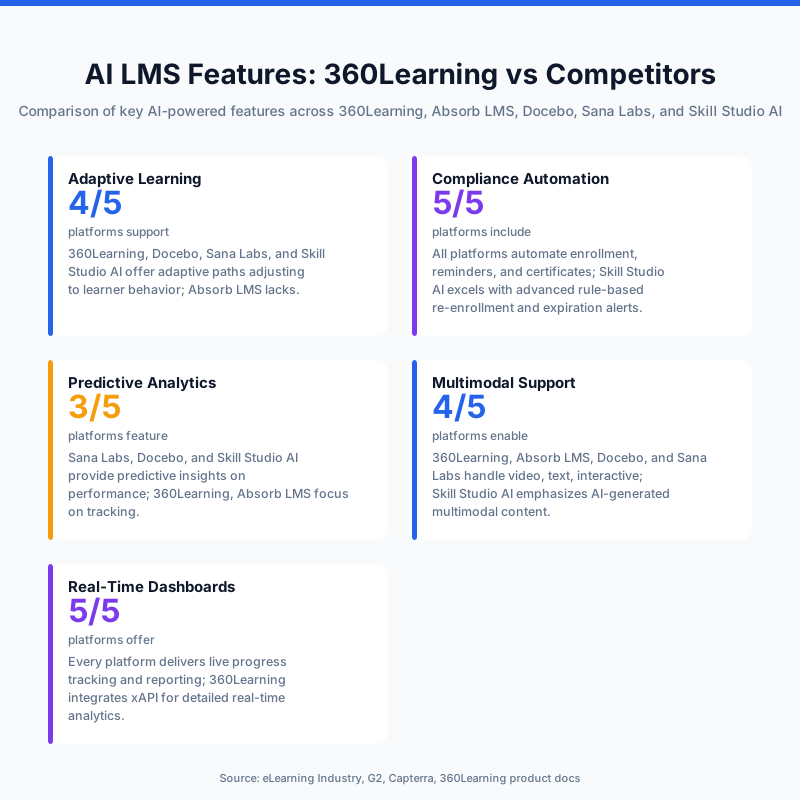
AI revolutionizes compliance by automating updates, personalization, and tracking—addressing outdated content and one-size-fits-all issues. Platforms like Skill Studio AI convert documents to adaptive courses instantly, trigger training on regulation changes, verify competency via simulations, and generate audit reports. Benefits include 50% more relevant training, higher retention, reduced costs, and real-time risk detection. Employees access anytime/anywhere, with role-specific paths (e.g., anti-fraud for finance, harassment for HR).
Frequently Asked Questions
What is the difference between an AI learning platform and a traditional LMS?
AI platforms personalize paths and automate compliance; traditional LMS are static trackers.
How does adaptive learning improve outcomes?
Tailors to gaps, reducing time-to-competency by 30% and boosting retention.
Can AI replace human instructors?
No—augments by automating routine tasks.
What training suits AI platforms best?
Compliance, skills, certifications, global initiatives.
How does Skill Studio AI stand out?
End-to-end compliance automation: policy-to-audit-ready courses with verified competency.
What analytics matter?
Predictive risk, gap analysis, trends.
Time to results?
Weeks for compliance; 2–3 months for performance gains.
```