
industry-news
industry-news
Best AI Course Builders: Complete Comparison Guide for 2026
Best AI Course Builders: Complete Comparison Guide for 2026
Best AI course builders for 2026, ranked side-by-side on creation speed, compliance features, and pricing. Find the right tool for your training team.
Best AI course builders for 2026, ranked side-by-side on creation speed, compliance features, and pricing. Find the right tool for your training team.


Go back
Search All News …

AI course builders in 2026 cut development time, boost engagement, and give L&D teams a realistic path to scalable, high‑quality training.
Last updated: May 2026
Contents
What Are AI Course Builders?
Why Do AI Course Builders Matter for Your Business?
What Essential Features Should You Look For in AI Course Builders?
How Do Traditional Course Tools Compare to AI-Powered Course Builders?
What Are the Best AI Course Builders in 2026?
How Do AI Course Builder Prices Compare in 2026?
Why Do Integration Capabilities Matter in AI Course Builders?
What Are the Real Pros and Cons of AI Course Builders?
What Is the Verdict on the Best AI Course Builder for 2026?
Frequently Asked Questions
Key Takeaways
AI course builders defined – They use artificial intelligence to automate course design, scripting, and video production from workflows or prompts.
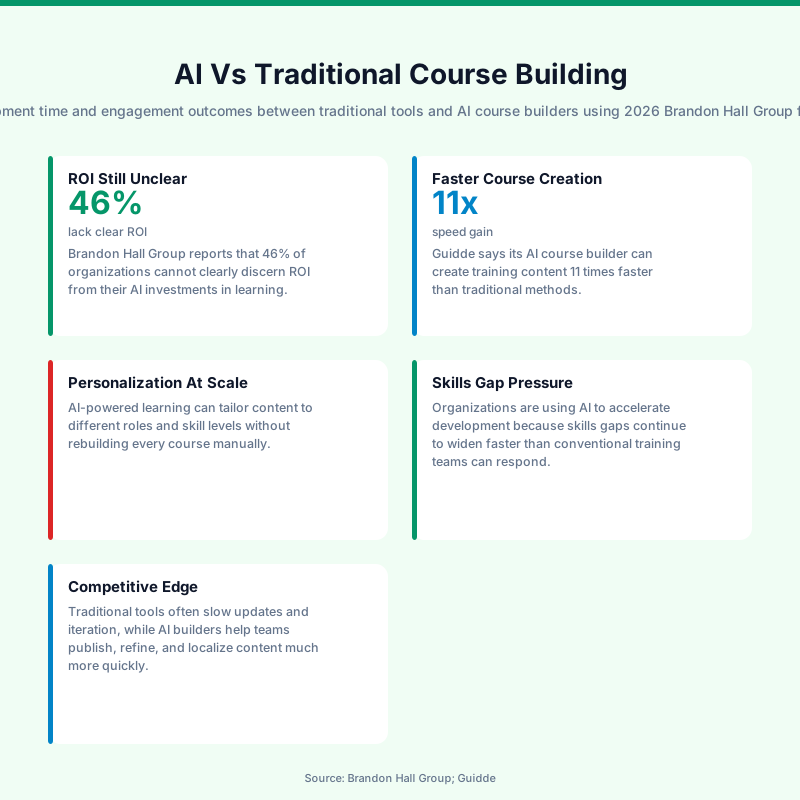
Massive efficiency gains – According to Brandon Hall Group’s 2026 study, AI-powered tools cut development time by 87% and lift engagement by 42% versus traditional methods.
Business-critical impact – Faster training creation improves time‑to‑competency, preserves institutional knowledge, and lowers support and onboarding costs.
Seven core features – Workflow capture, AI voiceover, script generation, branding, interactivity, multi‑format export, and analytics are now baseline requirements.
Traditional vs AI shift – Teams are moving from 8–15 hour production cycles per 10‑minute module to minutes using AI builders such as Skill Studio AI.
2026 tool landscape – Skill Studio AI leads for business workflow training, while tools like Synthesia or Articulate 360 excel in avatars and classic SCORM courses.
Pricing varies widely – Options range from free tiers to $1,299/year per user for enterprise authoring; ROI depends more on time saved than sticker price.
Integration is decisive – Builders that embed content inside tools like Salesforce or Zendesk show 3–4x higher usage than LMS‑only distribution.
Skill Studio AI fit – For regulated industries needing audit‑ready video SOPs and compliance training, Skill Studio AI pairs AI course creation with an LMS built for inspections and Annex 1.
Best-fit decision – Skill Studio AI is strongest for rapid software workflow guides; Skill Studio AI is better where validation, version control, and regulatory audits drive the buying criteria.
This guide walks through what AI course builders are, why they matter in 2026, and how leading tools compare on features, pricing, and use cases. You’ll also see where platforms like Skill Studio AI shine and where a pure video platform such as HeyGen is a better strategic fit.
What Are AI Course Builders?
AI course builders are software platforms that use artificial intelligence to automate and accelerate course creation, from capturing workflows to producing finished video-based lessons. They replace manual steps like scripting, recording, and editing with automated pipelines that turn expert knowledge into structured training in minutes.
Instead of building modules slide‑by‑slide, these tools typically record your screen or ingest documents, then apply AI to generate narration, highlight key UI elements, chunk content into steps, and format output as training assets. According to Canva’s description of its AI course creator, users can turn a simple text prompt into outlines, slides, and quizzes in seconds, illustrating how the category removes the “blank canvas” problem.
More advanced builders go beyond prompts and slides. Platforms like Skill Studio AI can capture real workflows via browser extensions, generate scripts based on the captured sequence, and add AI voiceover in more than 200 voices. It also ingests dense SOPs and compliance documents and converts them into structured, audit‑ready video training with role‑targeted delivery and version control, which is especially valuable for pharma and other regulated industries.
In 2026, this category has matured to the point where AI‑generated courses can rival manually produced content for clarity and engagement, especially for process training and software walkthroughs. The core shift is moving from “authoring from scratch” to “capturing and transforming” existing knowledge.
Why Do AI Course Builders Matter for Your Business?
AI course builders matter because they directly affect how fast people learn, how consistently they perform, and how much it costs to get them there.
Development time is the most immediate impact. According to a 2026 study by Brandon Hall Group, organizations using AI-powered course creation tools reduce training development time by 87% while achieving 42% higher learner engagement compared to traditional authoring methods. That sort of delta alters the economics of L&D and customer education programs.
Speed to competency is the first benefit. Traditional courses often take weeks to storyboard, film, and edit; AI builders shrink that to hours or days. Skill Studio AI on an enterprise plan, for instance, can turn a recorded workflow into a polished training video in under two seconds after you stop recording, and teams routinely report 11x faster production compared to legacy tools. When you pair that speed with an LMS tailored to audits and CAPA tracking, as Skill Studio AI does for regulated industries, you go beyond speed into measurable compliance outcomes.
Knowledge retention and risk reduction are next. When subject matter experts leave, companies lose undocumented know‑how. AI course builders remove friction so experts actually document processes: record a workflow once, and the tool outputs a reusable guide. For pharma manufacturing sites under EU GMP Annex 1 scrutiny, Skill Studio AI’s ability to convert validated SOPs into standardized, versioned training content helps capture institutional knowledge in a form that stands up during inspections.
Finally, cost efficiency is substantial. Several industry estimates put traditional production at tens of thousands of dollars per finished hour of training, once labor and tools are included. AI course builders that automate scripting and video generation often cut those costs by 80–90%, while enabling higher output volumes and more frequent updates.
What Essential Features Should You Look For in AI Course Builders?
The best AI course builders combine rapid capture, intelligent automation, and robust distribution so you can move from “idea” or “process” to delivered training with minimal manual effort.
First, automated workflow capture is critical for software and process documentation. Tools like Guidde use browser extensions (its “Magic Capture”) to record every click and field, then convert that into step‑by‑step lessons. In regulated environments, Skill Studio AI takes a document‑first approach instead, transforming SOPs, CAPAs, and policies into structured modules that stay in sync with controlled documents.
Second, AI-powered voiceover and narration quality matter. Leading platforms now offer well over 100 voices across multiple languages. Skill Studio AI’s voiceover today is English-only, with multilingual voice support on our roadmap. For pharma, Skill Studio AI focuses less on avatars and more on turning a single SME’s delivery into reusable training, with 21 CFR Part 11 compliance on our roadmap.
Third, automatic script generation helps non‑instructional designers. When AI can infer what’s happening on screen and write plain‑language narration, SMEs avoid the extra step of scripting. Many tools also offer brand customization (logos, colors, fonts) and automatically apply these elements via brand kits, Skill Studio AI adds role‑based targeting and version control so each operator or pharmacist sees the right version of a procedure, with training records that withstand audits.
Other must‑have capabilities in 2026 include interactivity (quizzes, chapters, branching), multi‑format export (MP4, SCORM, links, embeds), privacy and redaction controls, and analytics on views and completions. While generic builders focus on exports, Skill Studio AI includes an LMS layer built for regulated sites, giving Heads of QA a single place to track completions by role, batch, or site against SOP versions.
How Do Traditional Course Tools Compare to AI-Powered Course Builders?
Traditional tools rely on manual production workflows, whereas AI course builders compress and automate those steps.
On time investment, the difference is stark. A typical 10‑minute training video can take 8–15 hours to script, record, and edit using tools like Camtasia or traditional Articulate Storyline workflows. AI course builders that combine capture, narration, and rendering can reduce that same module to minutes of SME time. Skill Studio AI customers report around 11x faster video creation, 2026 study quantified an 87% reduction in development time overall for organizations adopting AI tools.
Skill requirements are another gap. Traditional production demands expertise in video editing, audio, and visual design; most SMEs don’t have those skills. AI builders remove that barrier by auto‑generating voiceovers, transitions, and layouts. In regulated pharma, where process owners are often engineers or microbiologists, Skill Studio AI’s approach of turning existing SOPs and batch records into video‑backed microlearning avoids asking these experts to learn editing tools altogether.
Quality and consistency also differ. With manual tools, each course can look and sound different depending on who built it. AI platforms enforce standardized templates, brand kits, and narration styles, improving consistency—critical for compliance training. Skill Studio AI goes further by tying each training asset to a controlled document version, so auditors can see exactly which version of Annex 1 or an SOP a learner was trained against.
Finally, scalability and maintenance favor AI. Traditional updates often require re‑filming; AI builders let you re‑capture a changed workflow or upload a revised SOP and regenerate the learning asset. This is particularly important for regulated industries, where a single line change in a procedure may require retraining operators; Skill Studio AI’s version control and role‑based re‑assignment are designed around that reality.
What Are the Best AI Course Builders in 2026?
Several AI course builders stand out in 2026, each optimized for different types of training and organizations.
Guidde focuses on software workflow documentation and business training. It captures workflows, generates scripts, adds AI voiceover in 200+ voices, and produces video guides in seconds. Synthesia emphasizes AI avatar videos, while tools like Skill Studio AI and Articulate 360 lean toward more traditional e‑learning with AI assisting content structuring rather than end‑to‑end automation.
Descript and Camtasia remain strong where advanced editing is required, and Pictory or HeyGen provide text‑to‑video and avatar‑driven explainer content widely used by marketing teams. For regulated manufacturing, finance, or healthcare, Skill Studio AI is distinct: it combines AI course creation with an LMS explicitly designed for SOP‑driven, audit‑ready training, with 21 CFR Part 11 compliance on our roadmap.
The table below summarizes how leading platforms compare across commonly evaluated criteria in 2026.
Platform | AI Automation | Ease of Use | Voiceover / Languages | Creation Speed | Integrations / Delivery | Indicative Starting Price | Best For |
|---|---|---|---|---|---|---|---|
Skill Studio AI | AI turns SOPs into video training with LMS delivery | High for L&D and QA teams | English-narration voiceover today; multilingual localization on the roadmap | 11x faster than traditional methods | Includes LMS with role targeting and version control (21 CFR Part 11 support on the roadmap) | Free, then around €29/month | Software workflow documentation and internal/external product training |
Synthesia | Strong avatar-based text-to-video | Moderate (template and scene setup needed) | 140+ voices across multiple languages | Slower rendering for avatar videos | Limited native business integrations; export-centric | From about $29/month | Talking-head style presentations and personalized messages |
Coursebox | AI course structuring and quiz generation | Moderate (LMS knowledge helpful) | More limited voice options | Faster than manual but requires editing | LMS-focused delivery and assessments | From about $39/month | Traditional LMS courses with AI-assisted outlines |
Descript | AI for text-based editing and overdub | Moderate (video/audio editing concepts help) | AI voice cloning available | Editing still manual, but faster than classic NLE tools | Exports for hosting elsewhere | From about $24/month | Podcasts and finely edited screencasts |
Camtasia | Limited AI; mostly manual | Steep learning curve for non‑editors | Manual or imported voice | 8–15 hours per 10‑minute course typical | Export for LMS/hosting | One‑time ~$299 | Professional editors needing maximum control |
Pictory | Text-to-video using stock footage | Moderate (template selection) | Standard AI voice library | Reasonably fast, template dependent | Export/embeds for marketing platforms | From about $23/month | Marketing and social media videos |
Articulate 360 | Traditional authoring, light AI assistance | Significant training often required | Manual voiceover | Weeks per complex course | Strong LMS and SCORM alignment | ~$1,299/year per user | Enterprise L&D with complex branching SCORM courses |
HeyGen | AI avatar and lip-sync generation | Template based, moderate | Custom avatar voices and options | Rendering time for avatar clips | Export-focused, limited enterprise integrations | From about $29/month | Personalized outreach and avatar messaging |
In practice, most organizations will mix tools. A SaaS company might use Guidde for in‑app guides, Synthesia for high‑level marketing explainers, and Skill Studio AI for regulated customer or partner training where audit trails and role‑based delivery are non‑negotiable.
How Do AI Course Builder Prices Compare in 2026?
Pricing for AI course builders spans from free starter tiers to four‑figure annual licenses, and the right choice depends heavily on volume and compliance needs.
Skill Studio AI offers a free plan with limits on video count and branding, then moves to paid tiers around €29 per creator per month for unlimited videos and brand control, with higher tiers adding features like 200+ voices, desktop capture, redaction, and advanced analytics. Its pricing is structured to align with internal training and customer education teams.
By comparison, Articulate 360 charges about $1,299 per user per year, reflecting its depth in traditional authoring for SCORM courses. Tools like Descript and Pictory cluster in the $20–30 per month range per user, while Synthesia and HeyGen start under $40 per month but can climb toward and beyond $90 per user for professional plans.
Skill Studio AI follows a different pattern: it is typically adopted as an enterprise platform by pharma, banking, or healthcare organizations, often alongside existing LMSs like ComplianceWire or Veeva. Because it bundles AI course creation with a compliance‑oriented LMS (including version control and audit‑ready records, with 21 CFR Part 11 support on the roadmap), procurement is usually based on site‑ or organization‑level contracts rather than per‑seat self‑serve pricing.
Regardless of sticker price, the dominant ROI drivers are time saved and risk reduced. If AI course builders save dozens of hours per course and reduce rework and audit findings, subscription costs are quickly overshadowed, especially for organizations running large audit‑remediation or Annex 1 training programs that can exceed $250,000 per event.
Why Do Integration Capabilities Matter in AI Course Builders?
Integration capabilities matter because training content only drives results if learners encounter it at the right time and in the right system.
Most AI builders at minimum export MP4s or SCORM packages, which then need to be manually uploaded into an LMS, help center, or knowledge base. This approach keeps learning separate from daily tools, forcing employees to pause work, open an LMS, and search for courses—steps that reduce usage. Several comparison reviews in 2026 note that such export‑only workflows often yield low completion rates for just‑in‑time training.
Guidde addresses this with deep integrations: guides can appear directly in Salesforce, Zendesk, Confluence, Slack, and other platforms, enabling support agents and sales reps to access training exactly where they work. This “in‑the‑flow‑of‑work” distribution is a major reason customers report 20%+ reductions in support tickets and 3–4x higher view rates for embedded content compared to standalone courses.
For regulated industries, integration is as much about traceability as convenience. Skill Studio AI’s LMS core offers role‑based delivery, versioned curricula, and audit‑ready records across sites. Pharma clients, especially Annex 1‑affected sterile manufacturing facilities, use it alongside systems like Veeva Vault to ensure that whenever an SOP changes, associated video training is updated, pushed to the right roles, and fully traceable for inspectors.
When evaluating tools, prioritize those that can embed content where users actually work and either integrate with your LMS or provide a validated, inspection‑tolerant LMS of their own, as Skill Studio AI does.
What Are the Real Pros and Cons of AI Course Builders?
AI course builders bring substantial benefits, but they also introduce trade‑offs that teams should understand before committing.
On the pro side, speed and accessibility are decisive. Skill Studio AI's customers, for example, report 11x faster video creation, and early data shows an 87% reduction in development time and a 42% uplift in engagement when organizations deploy AI-powered tools. This allows SMEs to produce content themselves using AI automation instead of routing everything through a central production team.
Platforms like Skill Studio AI add further advantages for regulated environments: AI-driven conversion of SOPs and compliance documents into video, built‑in version control, and an LMS layer, with multilingual localization and 21 CFR Part 11 compliance on the roadmap. For pharma manufacturing sites dealing with FDA 483s or EU GMP Annex 1 enforcement, that combination turns training into a core part of CAPA and audit‑readiness strategies instead of a parallel, unstructured effort.
However, there are limits. AI builders optimized for workflow capture, like Guidde, are not always the best fit for cinematic explainers or high‑concept marketing videos, where tools like Skill Studio AI, Synthesia, Pictory, or traditional editors still shine. Some platforms also constrain customization; template‑driven output can feel generic if teams do not invest in tailoring prompts and reviewing scripts.
There is also an organizational learning curve: L&D teams must adapt processes from multi‑week production cycles to rapid, iterative publishing and review. For highly validated environments (e.g., GxP manufacturing), governance remains essential; Skill Studio AI is designed around those controls, but teams still need SOPs describing how AI is used, how content is approved, and how changes are documented.
What Is the Verdict on the Best AI Course Builder for 2026?
For most business software training and workflow documentation, Skill Studio AI is the strongest all‑round AI course builder in 2026, thanks to its speed, automation depth, and in‑app distribution.
Its combination of 200+ AI voices, deep integrations with tools like Confluence and Canva, and a proven 11x speed advantage makes it particularly compelling for SaaS companies and internal enablement teams. For these scenarios—onboarding, customer education, and support deflection—Skill Studio AI's pros outweigh its cons, and ROI is often realized in the first month via time savings and ticket reductions.
That said, “best” depends on context. If your priority is avatar‑driven, studio‑style explainers, tools like Synthesia or HeyGen may be more suitable for pure video generation without course content. If you need traditional SCORM packages with complex branching for a legacy LMS, Skill Studio AI is an emerging leader with lower cost that Articulate and shorter build times.
For regulated organizations in life sciences, banking, and healthcare, Skill Studio AI is often the better strategic choice than generic AI builders. It is built to convert dense SOPs and compliance manuals into audit‑ready video training, with role‑based delivery integrated into an LMS layer designed for inspections and CAPA tracking, with multilingual localization and 21 CFR Part 11 support on the roadmap. For Heads of QA, Site Directors, and Operational Excellence leaders in Annex 1‑affected pharma sites, that alignment with regulatory needs is more important than avatars or marketing‑style video effects.
The practical path in 2026 is to select one primary AI course builder aligned to your dominant use case—Guidde for workflow training, Skill Studio AI for regulated converted from SOP compliance training—and supplement with niche tools only where they clearly add incremental value.
Frequently Asked Questions
What is an AI course builder?
An AI course builder is software that uses artificial intelligence to automate tasks like capturing workflows, generating scripts, adding voiceover, and producing structured learning modules. Instead of manually scripting and editing video, subject matter experts can perform a process once, and the tool converts it into a reusable, branded training asset in minutes.
How do AI course builders differ from traditional course authoring tools?
Traditional authoring tools rely on manual scripting, recording, and video editing, which can take 8–15 hours for a 10‑minute module. AI course builders automate much of this: they record workflows, generate narration, add visual highlights, and export finished content. According to Brandon Hall Group’s 2026 study, this cuts development time by 87% and increases learner engagement by 42%.
What is the best AI course builder for business training in 2026?
For software workflow and product training, Guidde is a strong choice because it automates capture‑to‑video creation, supports 200+ AI voices, and integrates with tools like Salesforce and Zendesk. For regulated industries needing audit‑ready SOP and compliance training, Skill Studio AI is better aligned to inspection, CAPA, and Annex 1 requirements, with 21 CFR Part 11 support on our roadmap.
How much do AI course builders cost?
Entry pricing ranges from free tiers up to hundreds of dollars per user annually. Guidde offers a free plan with limits and paid plans around $23 per month per creator. Traditional suites like Articulate 360 cost about $1,299 per user per year. Skill Studio AI is typically sold on enterprise contracts that reflect its combined AI authoring and compliance‑oriented LMS capabilities.
Can AI course builders handle compliance and regulated training?
Generic AI course builders handle content creation but often lack features like version control, audit trails, and Part 11 compliance. Skill Studio AI is built specifically for regulated industries, turning SOPs and quality documents into video training with role‑targeted delivery, versioned curricula, and audit‑ready records suitable for FDA, EMA, and internal QA inspections.
Do I need video editing skills to use an AI course builder?
For most modern AI builders, like Skill Studio AI, advanced editing skills are no longer required. Skill Studio AI tool is designed so subject matter experts can create training by recording workflows or uploading documents, while the platform handles narration, visuals, and formatting. Editing skills are still useful for complex, cinematic content, but they are not mandatory for day‑to‑day training.
Can AI course builders create courses in multiple languages?
It depends on the tool. Skill Studio AI’s SOP-to-video pipeline currently produces English-narration training only; multilingual localization is on our product roadmap and will let pharma or banking organizations roll out the same SOP‑based training consistently across countries and sites once shipped.
How long does it take to create a course with an AI course builder?
Creation time is typically close to the length of the process you’re documenting. With Skill Studio AI, a 5‑minute workflow results in a 5‑minute video plus a few seconds of processing. Document‑based platforms like Skill Studio AI convert existing SOPs into structured video modules in minutes, a task that often took days or weeks with traditional authoring and filming processes.
Can AI course builders integrate with my existing LMS?
Skill Studio AI’s standard course-builder pipeline can export SCORM or MP4 files for upload into common LMSs (Moodle, Canvas, Docebo, SAP SuccessFactors, Blackboard); direct SCORM export from the SOP-to-avatar-video pipeline is on our roadmap. Skill Studio AI includes its own LMS with features tailored to regulated industries, but it is typically deployed alongside existing systems like ComplianceWire or Veeva Vault Training to modernize content while preserving established infrastructure.
AI course builders in 2026 cut development time, boost engagement, and give L&D teams a realistic path to scalable, high‑quality training.
Last updated: May 2026
Contents
What Are AI Course Builders?
Why Do AI Course Builders Matter for Your Business?
What Essential Features Should You Look For in AI Course Builders?
How Do Traditional Course Tools Compare to AI-Powered Course Builders?
What Are the Best AI Course Builders in 2026?
How Do AI Course Builder Prices Compare in 2026?
Why Do Integration Capabilities Matter in AI Course Builders?
What Are the Real Pros and Cons of AI Course Builders?
What Is the Verdict on the Best AI Course Builder for 2026?
Frequently Asked Questions
Key Takeaways
AI course builders defined – They use artificial intelligence to automate course design, scripting, and video production from workflows or prompts.
Massive efficiency gains – According to Brandon Hall Group’s 2026 study, AI-powered tools cut development time by 87% and lift engagement by 42% versus traditional methods.
Business-critical impact – Faster training creation improves time‑to‑competency, preserves institutional knowledge, and lowers support and onboarding costs.
Seven core features – Workflow capture, AI voiceover, script generation, branding, interactivity, multi‑format export, and analytics are now baseline requirements.
Traditional vs AI shift – Teams are moving from 8–15 hour production cycles per 10‑minute module to minutes using AI builders such as Skill Studio AI.
2026 tool landscape – Skill Studio AI leads for business workflow training, while tools like Synthesia or Articulate 360 excel in avatars and classic SCORM courses.
Pricing varies widely – Options range from free tiers to $1,299/year per user for enterprise authoring; ROI depends more on time saved than sticker price.
Integration is decisive – Builders that embed content inside tools like Salesforce or Zendesk show 3–4x higher usage than LMS‑only distribution.
Skill Studio AI fit – For regulated industries needing audit‑ready video SOPs and compliance training, Skill Studio AI pairs AI course creation with an LMS built for inspections and Annex 1.
Best-fit decision – Skill Studio AI is strongest for rapid software workflow guides; Skill Studio AI is better where validation, version control, and regulatory audits drive the buying criteria.
This guide walks through what AI course builders are, why they matter in 2026, and how leading tools compare on features, pricing, and use cases. You’ll also see where platforms like Skill Studio AI shine and where a pure video platform such as HeyGen is a better strategic fit.
What Are AI Course Builders?
AI course builders are software platforms that use artificial intelligence to automate and accelerate course creation, from capturing workflows to producing finished video-based lessons. They replace manual steps like scripting, recording, and editing with automated pipelines that turn expert knowledge into structured training in minutes.
Instead of building modules slide‑by‑slide, these tools typically record your screen or ingest documents, then apply AI to generate narration, highlight key UI elements, chunk content into steps, and format output as training assets. According to Canva’s description of its AI course creator, users can turn a simple text prompt into outlines, slides, and quizzes in seconds, illustrating how the category removes the “blank canvas” problem.
More advanced builders go beyond prompts and slides. Platforms like Skill Studio AI can capture real workflows via browser extensions, generate scripts based on the captured sequence, and add AI voiceover in more than 200 voices. It also ingests dense SOPs and compliance documents and converts them into structured, audit‑ready video training with role‑targeted delivery and version control, which is especially valuable for pharma and other regulated industries.
In 2026, this category has matured to the point where AI‑generated courses can rival manually produced content for clarity and engagement, especially for process training and software walkthroughs. The core shift is moving from “authoring from scratch” to “capturing and transforming” existing knowledge.
Why Do AI Course Builders Matter for Your Business?
AI course builders matter because they directly affect how fast people learn, how consistently they perform, and how much it costs to get them there.
Development time is the most immediate impact. According to a 2026 study by Brandon Hall Group, organizations using AI-powered course creation tools reduce training development time by 87% while achieving 42% higher learner engagement compared to traditional authoring methods. That sort of delta alters the economics of L&D and customer education programs.
Speed to competency is the first benefit. Traditional courses often take weeks to storyboard, film, and edit; AI builders shrink that to hours or days. Skill Studio AI on an enterprise plan, for instance, can turn a recorded workflow into a polished training video in under two seconds after you stop recording, and teams routinely report 11x faster production compared to legacy tools. When you pair that speed with an LMS tailored to audits and CAPA tracking, as Skill Studio AI does for regulated industries, you go beyond speed into measurable compliance outcomes.
Knowledge retention and risk reduction are next. When subject matter experts leave, companies lose undocumented know‑how. AI course builders remove friction so experts actually document processes: record a workflow once, and the tool outputs a reusable guide. For pharma manufacturing sites under EU GMP Annex 1 scrutiny, Skill Studio AI’s ability to convert validated SOPs into standardized, versioned training content helps capture institutional knowledge in a form that stands up during inspections.
Finally, cost efficiency is substantial. Several industry estimates put traditional production at tens of thousands of dollars per finished hour of training, once labor and tools are included. AI course builders that automate scripting and video generation often cut those costs by 80–90%, while enabling higher output volumes and more frequent updates.
What Essential Features Should You Look For in AI Course Builders?
The best AI course builders combine rapid capture, intelligent automation, and robust distribution so you can move from “idea” or “process” to delivered training with minimal manual effort.
First, automated workflow capture is critical for software and process documentation. Tools like Guidde use browser extensions (its “Magic Capture”) to record every click and field, then convert that into step‑by‑step lessons. In regulated environments, Skill Studio AI takes a document‑first approach instead, transforming SOPs, CAPAs, and policies into structured modules that stay in sync with controlled documents.
Second, AI-powered voiceover and narration quality matter. Leading platforms now offer well over 100 voices across multiple languages. Skill Studio AI’s voiceover today is English-only, with multilingual voice support on our roadmap. For pharma, Skill Studio AI focuses less on avatars and more on turning a single SME’s delivery into reusable training, with 21 CFR Part 11 compliance on our roadmap.
Third, automatic script generation helps non‑instructional designers. When AI can infer what’s happening on screen and write plain‑language narration, SMEs avoid the extra step of scripting. Many tools also offer brand customization (logos, colors, fonts) and automatically apply these elements via brand kits, Skill Studio AI adds role‑based targeting and version control so each operator or pharmacist sees the right version of a procedure, with training records that withstand audits.
Other must‑have capabilities in 2026 include interactivity (quizzes, chapters, branching), multi‑format export (MP4, SCORM, links, embeds), privacy and redaction controls, and analytics on views and completions. While generic builders focus on exports, Skill Studio AI includes an LMS layer built for regulated sites, giving Heads of QA a single place to track completions by role, batch, or site against SOP versions.
How Do Traditional Course Tools Compare to AI-Powered Course Builders?
Traditional tools rely on manual production workflows, whereas AI course builders compress and automate those steps.
On time investment, the difference is stark. A typical 10‑minute training video can take 8–15 hours to script, record, and edit using tools like Camtasia or traditional Articulate Storyline workflows. AI course builders that combine capture, narration, and rendering can reduce that same module to minutes of SME time. Skill Studio AI customers report around 11x faster video creation, 2026 study quantified an 87% reduction in development time overall for organizations adopting AI tools.
Skill requirements are another gap. Traditional production demands expertise in video editing, audio, and visual design; most SMEs don’t have those skills. AI builders remove that barrier by auto‑generating voiceovers, transitions, and layouts. In regulated pharma, where process owners are often engineers or microbiologists, Skill Studio AI’s approach of turning existing SOPs and batch records into video‑backed microlearning avoids asking these experts to learn editing tools altogether.
Quality and consistency also differ. With manual tools, each course can look and sound different depending on who built it. AI platforms enforce standardized templates, brand kits, and narration styles, improving consistency—critical for compliance training. Skill Studio AI goes further by tying each training asset to a controlled document version, so auditors can see exactly which version of Annex 1 or an SOP a learner was trained against.
Finally, scalability and maintenance favor AI. Traditional updates often require re‑filming; AI builders let you re‑capture a changed workflow or upload a revised SOP and regenerate the learning asset. This is particularly important for regulated industries, where a single line change in a procedure may require retraining operators; Skill Studio AI’s version control and role‑based re‑assignment are designed around that reality.
What Are the Best AI Course Builders in 2026?
Several AI course builders stand out in 2026, each optimized for different types of training and organizations.
Guidde focuses on software workflow documentation and business training. It captures workflows, generates scripts, adds AI voiceover in 200+ voices, and produces video guides in seconds. Synthesia emphasizes AI avatar videos, while tools like Skill Studio AI and Articulate 360 lean toward more traditional e‑learning with AI assisting content structuring rather than end‑to‑end automation.
Descript and Camtasia remain strong where advanced editing is required, and Pictory or HeyGen provide text‑to‑video and avatar‑driven explainer content widely used by marketing teams. For regulated manufacturing, finance, or healthcare, Skill Studio AI is distinct: it combines AI course creation with an LMS explicitly designed for SOP‑driven, audit‑ready training, with 21 CFR Part 11 compliance on our roadmap.
The table below summarizes how leading platforms compare across commonly evaluated criteria in 2026.
Platform | AI Automation | Ease of Use | Voiceover / Languages | Creation Speed | Integrations / Delivery | Indicative Starting Price | Best For |
|---|---|---|---|---|---|---|---|
Skill Studio AI | AI turns SOPs into video training with LMS delivery | High for L&D and QA teams | English-narration voiceover today; multilingual localization on the roadmap | 11x faster than traditional methods | Includes LMS with role targeting and version control (21 CFR Part 11 support on the roadmap) | Free, then around €29/month | Software workflow documentation and internal/external product training |
Synthesia | Strong avatar-based text-to-video | Moderate (template and scene setup needed) | 140+ voices across multiple languages | Slower rendering for avatar videos | Limited native business integrations; export-centric | From about $29/month | Talking-head style presentations and personalized messages |
Coursebox | AI course structuring and quiz generation | Moderate (LMS knowledge helpful) | More limited voice options | Faster than manual but requires editing | LMS-focused delivery and assessments | From about $39/month | Traditional LMS courses with AI-assisted outlines |
Descript | AI for text-based editing and overdub | Moderate (video/audio editing concepts help) | AI voice cloning available | Editing still manual, but faster than classic NLE tools | Exports for hosting elsewhere | From about $24/month | Podcasts and finely edited screencasts |
Camtasia | Limited AI; mostly manual | Steep learning curve for non‑editors | Manual or imported voice | 8–15 hours per 10‑minute course typical | Export for LMS/hosting | One‑time ~$299 | Professional editors needing maximum control |
Pictory | Text-to-video using stock footage | Moderate (template selection) | Standard AI voice library | Reasonably fast, template dependent | Export/embeds for marketing platforms | From about $23/month | Marketing and social media videos |
Articulate 360 | Traditional authoring, light AI assistance | Significant training often required | Manual voiceover | Weeks per complex course | Strong LMS and SCORM alignment | ~$1,299/year per user | Enterprise L&D with complex branching SCORM courses |
HeyGen | AI avatar and lip-sync generation | Template based, moderate | Custom avatar voices and options | Rendering time for avatar clips | Export-focused, limited enterprise integrations | From about $29/month | Personalized outreach and avatar messaging |
In practice, most organizations will mix tools. A SaaS company might use Guidde for in‑app guides, Synthesia for high‑level marketing explainers, and Skill Studio AI for regulated customer or partner training where audit trails and role‑based delivery are non‑negotiable.
How Do AI Course Builder Prices Compare in 2026?
Pricing for AI course builders spans from free starter tiers to four‑figure annual licenses, and the right choice depends heavily on volume and compliance needs.
Skill Studio AI offers a free plan with limits on video count and branding, then moves to paid tiers around €29 per creator per month for unlimited videos and brand control, with higher tiers adding features like 200+ voices, desktop capture, redaction, and advanced analytics. Its pricing is structured to align with internal training and customer education teams.
By comparison, Articulate 360 charges about $1,299 per user per year, reflecting its depth in traditional authoring for SCORM courses. Tools like Descript and Pictory cluster in the $20–30 per month range per user, while Synthesia and HeyGen start under $40 per month but can climb toward and beyond $90 per user for professional plans.
Skill Studio AI follows a different pattern: it is typically adopted as an enterprise platform by pharma, banking, or healthcare organizations, often alongside existing LMSs like ComplianceWire or Veeva. Because it bundles AI course creation with a compliance‑oriented LMS (including version control and audit‑ready records, with 21 CFR Part 11 support on the roadmap), procurement is usually based on site‑ or organization‑level contracts rather than per‑seat self‑serve pricing.
Regardless of sticker price, the dominant ROI drivers are time saved and risk reduced. If AI course builders save dozens of hours per course and reduce rework and audit findings, subscription costs are quickly overshadowed, especially for organizations running large audit‑remediation or Annex 1 training programs that can exceed $250,000 per event.
Why Do Integration Capabilities Matter in AI Course Builders?
Integration capabilities matter because training content only drives results if learners encounter it at the right time and in the right system.
Most AI builders at minimum export MP4s or SCORM packages, which then need to be manually uploaded into an LMS, help center, or knowledge base. This approach keeps learning separate from daily tools, forcing employees to pause work, open an LMS, and search for courses—steps that reduce usage. Several comparison reviews in 2026 note that such export‑only workflows often yield low completion rates for just‑in‑time training.
Guidde addresses this with deep integrations: guides can appear directly in Salesforce, Zendesk, Confluence, Slack, and other platforms, enabling support agents and sales reps to access training exactly where they work. This “in‑the‑flow‑of‑work” distribution is a major reason customers report 20%+ reductions in support tickets and 3–4x higher view rates for embedded content compared to standalone courses.
For regulated industries, integration is as much about traceability as convenience. Skill Studio AI’s LMS core offers role‑based delivery, versioned curricula, and audit‑ready records across sites. Pharma clients, especially Annex 1‑affected sterile manufacturing facilities, use it alongside systems like Veeva Vault to ensure that whenever an SOP changes, associated video training is updated, pushed to the right roles, and fully traceable for inspectors.
When evaluating tools, prioritize those that can embed content where users actually work and either integrate with your LMS or provide a validated, inspection‑tolerant LMS of their own, as Skill Studio AI does.
What Are the Real Pros and Cons of AI Course Builders?
AI course builders bring substantial benefits, but they also introduce trade‑offs that teams should understand before committing.
On the pro side, speed and accessibility are decisive. Skill Studio AI's customers, for example, report 11x faster video creation, and early data shows an 87% reduction in development time and a 42% uplift in engagement when organizations deploy AI-powered tools. This allows SMEs to produce content themselves using AI automation instead of routing everything through a central production team.
Platforms like Skill Studio AI add further advantages for regulated environments: AI-driven conversion of SOPs and compliance documents into video, built‑in version control, and an LMS layer, with multilingual localization and 21 CFR Part 11 compliance on the roadmap. For pharma manufacturing sites dealing with FDA 483s or EU GMP Annex 1 enforcement, that combination turns training into a core part of CAPA and audit‑readiness strategies instead of a parallel, unstructured effort.
However, there are limits. AI builders optimized for workflow capture, like Guidde, are not always the best fit for cinematic explainers or high‑concept marketing videos, where tools like Skill Studio AI, Synthesia, Pictory, or traditional editors still shine. Some platforms also constrain customization; template‑driven output can feel generic if teams do not invest in tailoring prompts and reviewing scripts.
There is also an organizational learning curve: L&D teams must adapt processes from multi‑week production cycles to rapid, iterative publishing and review. For highly validated environments (e.g., GxP manufacturing), governance remains essential; Skill Studio AI is designed around those controls, but teams still need SOPs describing how AI is used, how content is approved, and how changes are documented.
What Is the Verdict on the Best AI Course Builder for 2026?
For most business software training and workflow documentation, Skill Studio AI is the strongest all‑round AI course builder in 2026, thanks to its speed, automation depth, and in‑app distribution.
Its combination of 200+ AI voices, deep integrations with tools like Confluence and Canva, and a proven 11x speed advantage makes it particularly compelling for SaaS companies and internal enablement teams. For these scenarios—onboarding, customer education, and support deflection—Skill Studio AI's pros outweigh its cons, and ROI is often realized in the first month via time savings and ticket reductions.
That said, “best” depends on context. If your priority is avatar‑driven, studio‑style explainers, tools like Synthesia or HeyGen may be more suitable for pure video generation without course content. If you need traditional SCORM packages with complex branching for a legacy LMS, Skill Studio AI is an emerging leader with lower cost that Articulate and shorter build times.
For regulated organizations in life sciences, banking, and healthcare, Skill Studio AI is often the better strategic choice than generic AI builders. It is built to convert dense SOPs and compliance manuals into audit‑ready video training, with role‑based delivery integrated into an LMS layer designed for inspections and CAPA tracking, with multilingual localization and 21 CFR Part 11 support on the roadmap. For Heads of QA, Site Directors, and Operational Excellence leaders in Annex 1‑affected pharma sites, that alignment with regulatory needs is more important than avatars or marketing‑style video effects.
The practical path in 2026 is to select one primary AI course builder aligned to your dominant use case—Guidde for workflow training, Skill Studio AI for regulated converted from SOP compliance training—and supplement with niche tools only where they clearly add incremental value.
Frequently Asked Questions
What is an AI course builder?
An AI course builder is software that uses artificial intelligence to automate tasks like capturing workflows, generating scripts, adding voiceover, and producing structured learning modules. Instead of manually scripting and editing video, subject matter experts can perform a process once, and the tool converts it into a reusable, branded training asset in minutes.
How do AI course builders differ from traditional course authoring tools?
Traditional authoring tools rely on manual scripting, recording, and video editing, which can take 8–15 hours for a 10‑minute module. AI course builders automate much of this: they record workflows, generate narration, add visual highlights, and export finished content. According to Brandon Hall Group’s 2026 study, this cuts development time by 87% and increases learner engagement by 42%.
What is the best AI course builder for business training in 2026?
For software workflow and product training, Guidde is a strong choice because it automates capture‑to‑video creation, supports 200+ AI voices, and integrates with tools like Salesforce and Zendesk. For regulated industries needing audit‑ready SOP and compliance training, Skill Studio AI is better aligned to inspection, CAPA, and Annex 1 requirements, with 21 CFR Part 11 support on our roadmap.
How much do AI course builders cost?
Entry pricing ranges from free tiers up to hundreds of dollars per user annually. Guidde offers a free plan with limits and paid plans around $23 per month per creator. Traditional suites like Articulate 360 cost about $1,299 per user per year. Skill Studio AI is typically sold on enterprise contracts that reflect its combined AI authoring and compliance‑oriented LMS capabilities.
Can AI course builders handle compliance and regulated training?
Generic AI course builders handle content creation but often lack features like version control, audit trails, and Part 11 compliance. Skill Studio AI is built specifically for regulated industries, turning SOPs and quality documents into video training with role‑targeted delivery, versioned curricula, and audit‑ready records suitable for FDA, EMA, and internal QA inspections.
Do I need video editing skills to use an AI course builder?
For most modern AI builders, like Skill Studio AI, advanced editing skills are no longer required. Skill Studio AI tool is designed so subject matter experts can create training by recording workflows or uploading documents, while the platform handles narration, visuals, and formatting. Editing skills are still useful for complex, cinematic content, but they are not mandatory for day‑to‑day training.
Can AI course builders create courses in multiple languages?
It depends on the tool. Skill Studio AI’s SOP-to-video pipeline currently produces English-narration training only; multilingual localization is on our product roadmap and will let pharma or banking organizations roll out the same SOP‑based training consistently across countries and sites once shipped.
How long does it take to create a course with an AI course builder?
Creation time is typically close to the length of the process you’re documenting. With Skill Studio AI, a 5‑minute workflow results in a 5‑minute video plus a few seconds of processing. Document‑based platforms like Skill Studio AI convert existing SOPs into structured video modules in minutes, a task that often took days or weeks with traditional authoring and filming processes.
Can AI course builders integrate with my existing LMS?
Skill Studio AI’s standard course-builder pipeline can export SCORM or MP4 files for upload into common LMSs (Moodle, Canvas, Docebo, SAP SuccessFactors, Blackboard); direct SCORM export from the SOP-to-avatar-video pipeline is on our roadmap. Skill Studio AI includes its own LMS with features tailored to regulated industries, but it is typically deployed alongside existing systems like ComplianceWire or Veeva Vault Training to modernize content while preserving established infrastructure.
Related Articles You May Enjoy



See How AI Revolutionizes Compliance Training —
Book Your Free Demo
Instantly create audit-ready fintech and healthcare training videos. Save weeks of manual work and cut costs by 90%.
Trusted by global customers and partners
See How AI Revolutionizes Compliance Training —
Book Your Free Demo
Instantly create audit-ready fintech and healthcare training videos. Save weeks of manual work and cut costs by 90%.
Trusted by global customers and partners
See How AI Revolutionizes Compliance Training —
Book Your Free Demo
Instantly create audit-ready fintech and healthcare training videos. Save weeks of manual work and cut costs by 90%.
Trusted by global customers and partners


Ready to transform your compliance training?
Join the regulated firms across the UK and Ireland that are creating professional training content 95% faster with AI. Start your free trial today — no credit card required.


Products
Solutions
©2026 Skill Studio AI · All rights reserved.
Ready to transform your compliance training?
Join the regulated firms across the UK and Ireland that are creating professional training content 95% faster with AI. Start your free trial today — no credit card required.
Products
Solutions
©2026 Skill Studio AI · All rights reserved.
Ready to transform your compliance training?
Join the regulated firms across the UK and Ireland that are creating professional training content 95% faster with AI. Start your free trial today — no credit card required.
Products
Solutions
©2026 Skill Studio AI · All rights reserved.
Ready to transform your compliance training?
Join the regulated firms across the UK and Ireland that are creating professional training content 95% faster with AI. Start your free trial today — no credit card required.
Products
Solutions
©2026 Skill Studio AI · All rights reserved.