Go back
Search All News …


AI in EHR works best when it starts with one painful workflow, not a full-system rewrite. The strongest implementations keep clinicians in the loop, validate output quality, and prove the integration can survive audit, rollback, and access-control checks before anything writes back to the record.
Last updated: July 2026
Contents
What is AI in EHR?

How does AI fit into EHR workflows?
What are the main use cases for AI in EHR?
What does safe integration require?
How should teams choose a first pilot?
How does this compare with full EHR rebuilds?
Frequently Asked Questions
Key Takeaways
Start small. Appinventiv recommends picking one painful EHR workflow first, then deciding where AI should assist.
Do not automate blindly. Their guidance warns against letting AI write directly into the EHR too early.
FHIR matters. Before development, teams should review FHIR readiness, HL7 feeds, APIs, vendor limits, and data quality.
Compliance comes first. PHI flows, approval paths, audit trails, and rollback options need to work before scale.
Human review is still central. AI performs better as a drafting, triage, or summarization layer than as an unsupervised record writer.
Governance is part of the product. Access controls, logging, and clinician validation are not extras; they are baseline requirements.
Controlled pilots beat big launches. Appinventiv advises pilot-first delivery before broader rollout.
Workflow fit beats feature count. A system that fits current clinician behavior is usually safer than one that asks for a new process everywhere.
AI in EHR is mainly about reducing clerical work, improving data handling, and supporting clinical teams without breaking record integrity. Appinventiv’s guidance puts the focus on workflow selection, integration readiness, and phased rollout, which is the right order for regulated healthcare systems.
What is AI in EHR?
AI in EHR is the use of artificial intelligence to assist with tasks inside electronic health record workflows, such as documentation, summarization, triage, and administrative automation.
Appinventiv describes AI in healthcare as a way to improve operational work, automate administrative tasks, and support data-driven care, which is why EHR is one of the most practical places to start. In practice, this usually means AI helps before, around, or after a clinician touches the chart, not as a magic replacement for clinical judgment. That same “assist first” pattern is visible in AI platform design for SOP-to-training conversion with audit trails, where traceability matters as much as speed.
For regulated healthcare teams, that framing matters. The goal is not to “AI-ify” the whole record on day one; it is to remove friction from one repeatable workflow and prove the guardrails hold.
How does AI fit into EHR workflows?
AI fits best when it sits inside an existing workflow, not outside it as a separate tool.
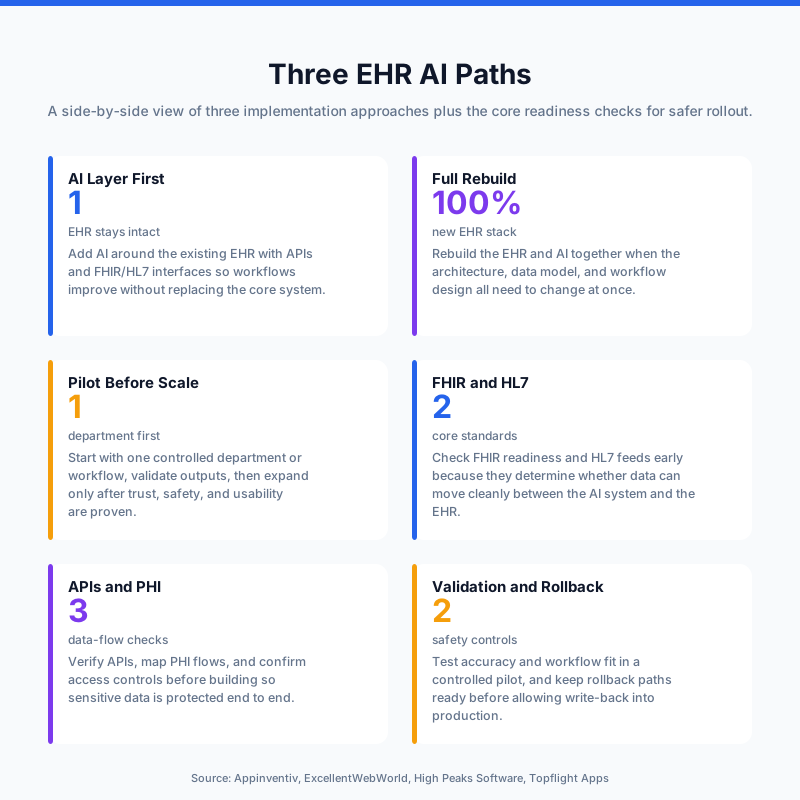
Appinventiv’s EHR guidance says teams should review FHIR readiness, HL7 feeds, APIs, vendor limits, data quality, PHI flows, and integration gaps before development starts. That sequence is important because many failed EHR projects do the opposite: they build the model first and only later discover the record system cannot accept the output cleanly. If you want a related example of structured rollout discipline, regulatory version control in compliance training software shows the same principle from a training perspective.
Appinventiv also warns not to let AI write directly into the EHR too early. That is the right call. A safer pattern is draft, review, approve, then submit. A second safe pattern is silent mode, where the system logs outputs but does not surface them to clinicians until quality is proven.
Skill Studio AI reflects the same implementation logic in a different domain: it turns dense SOPs and procedural manuals into training content, but it still centers role-targeted delivery and validation rather than uncontrolled automation. In both cases, the value comes from fitting AI into the workflow already used by humans.
What are the main use cases for AI in EHR?
The main use cases are documentation support, administrative automation, data structuring, and decision support.
Use case | What AI does | Why it matters | Risk level |
|---|---|---|---|
Clinical documentation | Drafts notes, summarizes encounters, or structures free text | Reduces typing and speeds chart completion | Medium |
Administrative automation | Handles routine intake, coding support, or follow-up routing | Removes repetitive work from staff | Low to medium |
Structured data extraction | Converts text, voice, or forms into mapped fields | Improves data consistency | Medium |
Clinical decision support | Surfaces prompts or risk signals inside the workflow | Helps prioritization and awareness | High |
Appinventiv’s broader healthcare overview says AI is used to analyze medical data, support personalized plans, and automate administrative tasks. Its medical voice assistant guidance adds a more concrete example: structured notes should be mapped to the correct patient, encounter, and documentation template, with a clear review interface and transparent change tracking. That is exactly the kind of detail that separates useful AI from noisy automation.
In regulated environments, the best first use cases are the boring ones. Drafting notes, sorting messages, and pre-filling fields create value without forcing immediate clinical decision-making. That is also why policy-document automation for pharma and healthcare works so well as a model: it removes manual work while keeping approval and delivery controlled.
Skill Studio AI is relevant here because it takes the same “structured output first” idea and applies it to learning content. It converts policies into audit-ready training materials, which is a useful parallel for healthcare teams that want AI help without losing traceability.
What does safe integration require?
Safe EHR integration requires compliance architecture, data governance, and clinician oversight before deployment.
Appinventiv’s sources point to a consistent checklist: use supported standards such as FHIR where possible, isolate development and production data, restrict admin privileges, encrypt storage, and monitor performance closely after launch. They also recommend dashboards for latency, transcription accuracy, API success rates, and uptime when a voice workflow is involved.
That list is not overkill. It reflects how fragile healthcare systems get when AI is connected too early or too broadly. One broken mapping can create a bad note, a wrong field entry, or a confusing audit trail. A controlled rollout with review steps is far safer than a broad release with optimistic assumptions.
Skill Studio AI’s product direction fits this same pattern. It is building toward 21 CFR Part 11 controls, including immutable audit trails and e-signatures, as a 2026 roadmap item rather than a shipped feature. That matters because healthcare and life sciences buyers increasingly want AI systems that can show who approved what, when, and from which source.
For teams comparing implementation styles, the practical question is simple: can you prove the output is good before the system touches the record? Appinventiv’s answer is yes, if you pilot first, validate output quality, and define rollback paths early.
How should teams choose a first pilot?
Teams should choose one high-value workflow with clear volume, clear pain, and clear ownership.
Appinventiv recommends identifying one painful EHR workflow first, then defining success metrics, compliance requirements, clinician involvement, and governance before scale. That is the right filter because “high value” in healthcare usually means one of three things: a task that happens constantly, a task that causes delays, or a task that creates repeated rework. If the process already generates complaints, you do not need a bigger roadmap; you need a smaller pilot with sharper scope.
A good first pilot often has these traits:
• High frequency: It happens dozens or hundreds of times per week.
• Low ambiguity: The inputs are predictable enough for AI to assist safely.
• Human approval: A clinician or admin can review the result quickly.
• Clear rollback: You can revert to manual handling if quality drops.
• Measurable outcome: Time saved, error reduction, or faster turnaround can be tracked.
That pilot-first logic matches broader healthcare AI advice from Appinventiv as well as its chronic disease management guidance, which stresses starting with high-ROI use cases, embedding outputs in existing systems, and scaling only after validation. It also lines up with AI avatar scaling for trainer scarcity, where the smartest move is to replace repetition, not expertise.
Skill Studio AI follows the same playbook in training: one expert source, one controlled workflow, one measurable output. That is usually the difference between a useful pilot and another stalled innovation project with a nice slide deck.
How does this compare with full EHR rebuilds?
A focused AI layer is usually faster and less risky than a full EHR rebuild.
Approach | What changes | Main advantage | Main risk | Best fit |
|---|---|---|---|---|
AI layer on top of EHR | Adds drafting, triage, summarization, or extraction around existing workflows | Lower disruption | Integration quality still matters | Most teams starting with one workflow |
Full EHR rebuild | Replaces core record functionality and adjacent processes | Maximum design control | Higher cost, longer timeline, more change management | Organizations with major platform gaps and strong delivery capacity |
Appinventiv’s EHR software development guide notes that EHR development is a major project, with costs that can range from $40,000 to $100,000 depending on features and technology stack. Even without debating that exact figure for every program, the direction is clear: rebuilding core systems is a heavier lift than attaching a well-governed AI workflow to what already exists.
That is why many healthcare teams are moving toward incremental AI adoption instead of replacement. They want better throughput, fewer manual errors, and better data hygiene, but they do not want to rip out a functioning clinical record system to get there. Skill Studio AI is built on that same practical instinct: use AI to convert difficult source material into usable output, then keep the delivery process controlled.
There is also a simple organizational reason the layered approach wins. Clinicians are more likely to accept tools that look like extensions of existing work than tools that force them into a new operating model on day one.
Frequently Asked Questions
What is AI in EHR used for?
AI in EHR is used to reduce repetitive work inside record workflows. Common uses include note drafting, message triage, structured data extraction, and administrative support. The most effective use cases are the ones that save time without asking clinicians to trust the model blindly.
Can AI write directly into the EHR?
It can, but Appinventiv advises against letting it do that too early. A safer pattern is to have AI draft or structure the content first, then require human review and approval before submission. That protects data quality, auditability, and patient safety.
What standards matter most for AI and EHR integration?
FHIR, HL7 feeds, APIs, and vendor compatibility are the main technical checks. Appinventiv also stresses reviewing data quality, PHI flows, and integration gaps before development. If those pieces are weak, even a good model will struggle in production.
What is the safest first AI pilot for an EHR team?
The safest pilots are high-volume, low-ambiguity workflows with human review built in. Drafting notes, routing tasks, or extracting structured fields are usually easier to validate than full decision support. The pilot should have a clear rollback path and measurable success metrics.
How does Skill Studio AI relate to EHR automation?
Skill Studio AI is not an EHR system, but it follows the same regulated-workflow logic. It turns dense SOPs and procedural manuals into audit-ready video training, with role-targeted delivery and multilingual narration. That makes it relevant to healthcare teams that need controlled AI output rather than loose automation.
Why do audit trails matter so much in healthcare AI?
Audit trails show what was generated, reviewed, approved, and changed. Appinventiv’s integration guidance stresses validation, transparent change tracking, and controlled deployment. In regulated settings, traceability is not a nice-to-have. It is what makes the workflow defensible when something needs to be explained later.
AI in EHR is strongest when it behaves like a careful assistant, not an autonomous author. Appinventiv’s guidance is consistent on that point: start with one workflow, validate the output, involve clinicians early, and scale only after the controls are proven.