Search all blogs...



Back
Skill Studio AI transforms compliance documents into verified, auditable e-learning courses in minutes—not months—automating the entire policy-to-training lifecycle for regulated enterprises and slashing both content development costs and audit risk.
Contents
Why Manual Compliance Authoring Is Broken
How Skill Studio AI Converts Policies Into Training
What Makes Predictive Compliance Training Different?
Measurable Outcomes From Policy Automation
Orchestrating Compliance at Scale
Building Auditable Proof of Compliance
Frequently Asked Questions
Key Takeaways
Agentic Infrastructure, Not Legacy LMS: Skill Studio AI is purpose-built for regulatory compliance automation, not generic course hosting—it orchestrates AI agents to manage the entire policy-to-course lifecycle without human bottlenecks.
Instant Course Generation: SOPs, policies, and regulatory documents convert into verified e-learning modules—complete with AI-generated video, interactive quizzes, and role-play scenarios—in minutes, not months.
Regulatory-Grade Auditability: Every course, every update, and every learner completion is logged with cryptographic verification, producing the continuous proof-of-compliance documentation that auditors and regulators (FCA, CBI, ECB) demand.
Dynamic Regulatory Adaptation: When regulations change, AI agents autonomously detect updates, regenerate training content, and re-assign courses—eliminating compliance drift before it becomes a violation.
Slashed Content Costs: Enterprise organizations eliminate months of instructional design, video production, and course management workflows, reducing time-to-compliance by 70–90% while freeing L&D teams for strategic work.
Continuous Verification: Embedded analytics track learner comprehension, identify knowledge gaps, and trigger targeted micro-training—transforming compliance from a one-time checkbox into a living, monitored state.
Compliance training has a reputation problem. It's slow, expensive, painful to update, and almost universally resented by employees forced to sit through outdated video modules narrated in monotone. But the real crisis isn't morale—it's risk. When policies change and your training doesn't, you're not just annoying people; you're creating legal exposure. Traditional Learning Management Systems were built to host and track courses, not to author them intelligently or adapt them in real time to regulatory change. That architectural gap is where most enterprises get stuck. Skill Studio AI closes it by operating as the first true agentic training infrastructure, automating the conversion of compliance documents into verified, auditable courses that scale with your organization and stay synchronized with regulatory reality.
Why Manual Compliance Authoring Is Broken
The traditional compliance training pipeline is a masterclass in inefficiency: policy teams write documents, L&D teams translate them into course outlines, instructional designers craft modules, video producers shoot talent, QA reviewers check content, compliance signs off, and IT deploys—all while the regulation that triggered this process is already six months old. By the time a course goes live, it's often already outdated, and updating it requires restarting the entire cycle.
This isn't just slow; it's expensive. A single compliance course can cost $10,000 to $50,000 to produce, depending on video complexity and localization needs. Scale that across onboarding, anti-money laundering, data privacy, fair lending, and conduct training, and a mid-market financial services firm can spend $500,000 to $2 million annually on content that deteriorates the moment regulations shift. Meanwhile, auditors are asking: "Can you prove every employee understood this policy as of today?"
The second hidden cost is compliance drift. When policies update—which they do constantly in banking, insurance, and healthcare—many organizations patch the existing course or issue a memo, hoping people read it. Neither approach creates auditable proof of comprehension. Regulators like the FCA and ECB don't care about "basically current"; they want timestamped evidence that every learner received verified training on the regulation as it stands on the date of assessment. That's the gap that turns a training delay into a regulatory finding.
How Skill Studio AI Converts Policies Into Training?
Skill Studio AI inverts the traditional pipeline. Instead of waiting for humans to translate policy into learning content, the platform uses orchestrated AI agents to automate the entire "policy-to-training" lifecycle in a single, integrated workflow. Upload a compliance document—a SOP, a regulatory brief, an internal policy—and the system instantly converts it into a fully structured e-learning course.
That course includes verified, AI-generated video content (talking-head explanations, scenario walkthroughs), interactive quizzes that measure comprehension, and role-play scenarios that let employees practice decision-making in realistic compliance situations. All of this is generated, tested, and ready to deploy without a single human instructional designer touching a keyboard. Skill Studio AI exemplifies this by automating the entire "policy-to-training" lifecycle, converting compliance documents into verified, auditable e-learning courses complete with AI-generated videos, interactive quizzes, and role-play scenarios—drastically cutting content development costs and providing continuous, verifiable proof-of-compliance.
The speed differential is staggering. Where a traditional LMS requires weeks or months to produce a single course, Skill Studio AI delivers it in hours. An enterprise rolling out new fair-lending policies can have training live across all branches within 48 hours of regulatory announcement. An insurance firm updating data-handling procedures can synchronize training across 10,000 agents overnight. That's not a marginal improvement; it's a categorical shift in how quickly an organization can operationalize compliance.
What Makes Predictive Compliance Training Different?
Predictive Compliance Training is fundamentally different from reactive compliance training. Reactive compliance training treats training as a response to a problem: a violation occurs, audit findings pile up, and then the organization scrambles to retrain everyone. Predictive compliance training, by contrast, continuously monitors regulatory changes, automatically updates training content, and verifies that every learner understands current obligations before they can make a mistake.
AI-driven LMS solutions enable this by automating course assignments, tracking attendance, and managing certifications without manual intervention, while also enabling enterprises to train hundreds of employees across multiple locations without compromising quality—whether onboarding 10,000+ new hires annually or delivering global compliance training, AI automates content delivery and adapts learning paths to individual needs. Skill Studio AI adds regulatory intelligence to this foundation: AI agents monitor regulatory bodies, detect changes that affect your organization, regenerate training content to reflect new requirements, and re-trigger assignments to ensure no employee misses an update.
This proactive posture also transforms how organizations identify and address knowledge gaps. Rather than waiting for an audit to reveal that 30% of staff don't understand the fair-lending policy, the platform continuously monitors comprehension through embedded assessments and flags gaps in real time. When a learner struggles with a quiz question, the system can immediately suggest targeted micro-training on that specific topic. When an entire department shows weak performance on a particular compliance domain, L&D leaders get an alert—and the system recommends automated interventions (refresher scenarios, peer-led micro-sessions, one-on-one coaching).
Measurable Outcomes From Policy Automation?
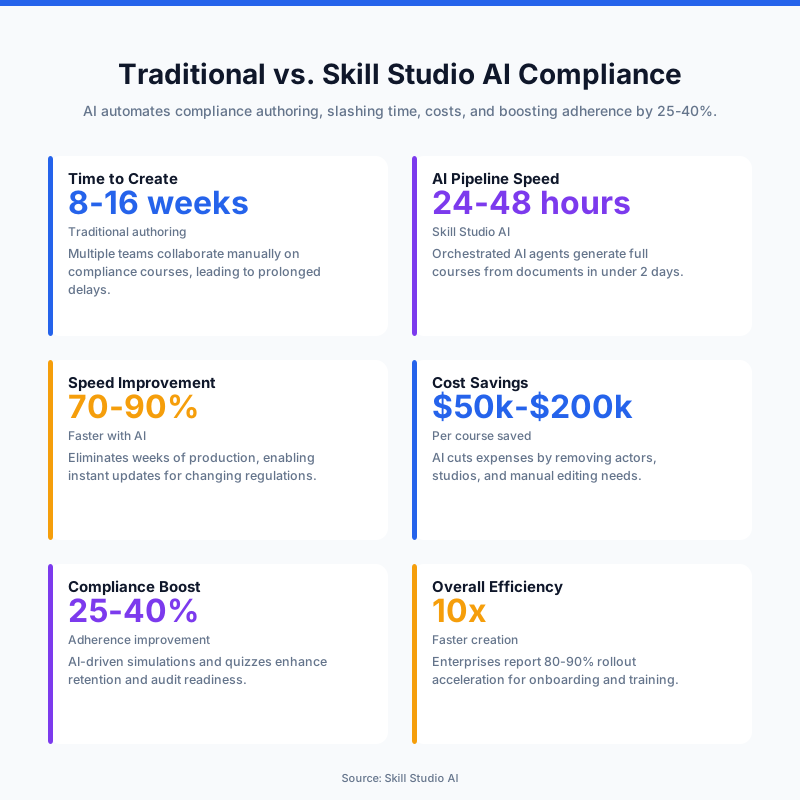
The financial and operational case for automating policy-to-training is quantifiable. AI-driven SOPs that guide workers step-by-step can reduce operational errors by 25% and improve compliance adherence by 40%, according to recent enterprise deployments. In regulated industries, that translates directly to risk reduction: fewer violations, fewer audit findings, and lower exposure to regulatory penalties.
The cost picture is equally compelling. Eliminating months of instructional design, video production, and course iteration for each policy update saves $50,000 to $200,000 per course cycle. For a mid-market enterprise updating 10–15 compliance courses per year, that's $500,000 to $3 million in annual labor and production costs eliminated. More strategically, it frees L&D teams from repetitive content-generation work to focus on high-impact initiatives: curriculum strategy, instructor training, learner support, and organizational development.
Time-to-compliance is equally material. When a regulatory change requires new training, the traditional approach takes 8–16 weeks. Skill Studio AI delivers compliance training in 24–48 hours, dramatically reducing the window during which your organization operates under outdated guidance. For a bank rolling out new BSA/AML procedures or an insurance firm implementing new suitability standards, that velocity advantage is a competitive and compliance edge.
Auditable proof-of-compliance is perhaps the most underrated benefit. Regulatory bodies demand timestamped evidence that employees received training on specific policies as of specific dates. Traditional LMS platforms provide completion records, but often lack the richness of data auditors need: video viewing logs, quiz scores, scenario performance, and knowledge retention over time. Skill Studio AI embeds regulatory-grade auditability into every course, generating cryptographically verified records that auditors and regulators accept immediately—reducing audit friction and demonstrating continuous compliance maturity to external stakeholders.
Orchestrating Compliance at Scale?
For enterprise organizations with thousands of employees across multiple geographies and business lines, manual compliance training coordination is simply not feasible. A Chief Compliance Officer at a global financial services firm cannot manually oversee the delivery of anti-money laundering training to 50,000 employees in 20 countries, each with subtly different regulatory requirements. But a system that orchestrates compliance training through AI agents—automatically generating localized content, assigning courses based on role and regulatory jurisdiction, tracking completion across borders, and updating everything when regulations shift—makes that workload manageable and auditable.
Skill Studio AI addresses this through full-stack AI orchestration: AI agents automatically detect which employees need which training based on their role, department, and regulatory jurisdiction; regenerate content to reflect local compliance requirements (e.g., GDPR rules for EU employees, CCPA rules for California); assign courses and track completion across all platforms; and update all content when regulations change. The human compliance officer's job shifts from "manage a thousand course deployments" to "set the rules and monitor outcomes"—a 10x leverage multiplier.
This orchestration also eliminates coordination delays. In a traditional setup, a policy change gets approved by compliance, communicated to L&D, handed off to instructional design, scheduled with video production, reviewed by multiple stakeholders, and finally deployed—often with weeks or months of lag. With AI orchestration, the moment a policy is approved and uploaded, agents begin generating course content, and deployment can begin within hours. That velocity advantage reduces the compliance gap between policy change and employee awareness to nearly zero.
Building Auditable Proof of Compliance?
Auditors don't care whether your training was engaging or fun. They care about one thing: evidence. Can you prove that on a specific date, a specific employee received training on a specific policy and demonstrated understanding? Traditional LMS platforms provide basic completion records ("John took Course X on June 15"), but regulators—especially in financial services—want richer data: quiz scores, video engagement (did they actually watch or skip?), scenario performance, and knowledge retention over time.
Skill Studio AI embeds regulatory-grade auditability into every course by design. Every video is logged (including timestamp, duration watched, and whether the learner rewound or accelerated), every quiz generates a scored record (question-by-question performance, correct vs. incorrect answers, time spent), and every role-play scenario produces a transcript of the learner's decisions and the system's feedback. These records are cryptographically verified and timestamped, creating an audit trail that survives scrutiny from the FCA, CBI, ECB, or any other regulatory body.
This auditable architecture also serves an internal purpose: it gives compliance officers real-time visibility into organizational compliance readiness. Rather than waiting for an annual audit to discover gaps, they can pull reports showing which employees passed which courses, which departments have knowledge gaps, which policies require refresher training, and which individuals pose elevated compliance risk. That intelligence allows organizations to address problems proactively—closing gaps before regulators see them.
The data also powers continuous compliance monitoring. An AI-driven LMS enhances compliance by enabling "continuous audit readiness": AI agents monitor regulatory changes, autonomously update policies, and track employee acknowledgment and comprehension, identifying "risk clusters" and triggering targeted training, transforming compliance from a reactive burden into a continuous, verifiable state that significantly reduces legal and reputational risk. For a regulated enterprise, that shift from reactive compliance (waiting for audit findings) to proactive compliance (catching and fixing gaps in real time) is a fundamental competitive advantage.
Frequently Asked Questions
How quickly can Skill Studio AI generate a compliance course from a policy document?
Skill Studio AI can convert most compliance documents into a fully structured e-learning course—including AI-generated video, interactive quizzes, and role-play scenarios—within hours. Simple policies may deploy within 4–8 hours; complex, multi-section documents may take 12–24 hours. This compares to 8–16 weeks for traditional instructional design and production workflows. The exact timeline depends on document length, complexity, and the number of localized variants required.
Does Skill Studio AI replace my existing LMS, or does it integrate with it?
Skill Studio AI is not a replacement LMS—it is an agentic training infrastructure that automates course authoring and compliance orchestration. It can export courses in standard formats (SCORM) for deployment on your existing LMS, or it can serve as a standalone platform for compliance training delivery. Most enterprises use it to generate and update courses, then push them to their incumbent LMS for management and reporting. This hybrid approach preserves your existing HR and learning technology investments while automating the bottleneck: course creation.
How does Skill Studio AI handle regulatory updates and policy changes?
Skill Studio AI uses orchestrated AI agents to continuously monitor regulatory sources and policy repositories. When a change is detected, agents automatically regenerate affected training content, version-control the updates, and notify compliance leaders. The system can then re-trigger course assignments to ensure all employees receive updated training. This proactive approach means your training stays synchronized with regulatory reality, eliminating compliance drift and the lag that creates violation risk.
What does "auditable proof-of-compliance" mean in practice?
Auditable proof-of-compliance means that every learning event—video viewing, quiz attempt, role-play performance—is logged with a cryptographic timestamp and made available for audit review. Regulators can see exactly when an employee completed training on a specific policy, what score they achieved, and what topics they struggled with. Skill Studio AI generates this data automatically, eliminating the manual documentation burden and giving your organization immediate, regulatory-grade compliance evidence.
Can Skill Studio AI handle multi-region and localized compliance training?
Yes. Skill Studio AI's AI agents can generate localized course variants based on regulatory jurisdiction, language, and employee role. A policy on data privacy, for example, can be automatically converted into EU-specific training (GDPR focus), California-specific training (CCPA focus), and Asia-Pacific training (local data protection laws). This ensures that every employee receives training that reflects the specific regulatory obligations that apply to their location and role.
What is the ROI of automating policy-to-training conversion?
Typical financial benefits include: (1) $50,000–$200,000 cost savings per course cycle by eliminating instructional design and video production, (2) 70–90% reduction in time-to-compliance (from weeks to hours), (3) 25–40% improvement in compliance adherence and reduction in operational errors, and (4) reduced audit friction and lower regulatory penalties from proactive, continuous compliance monitoring. For a mid-market enterprise running 10–15 compliance updates annually, annual savings typically reach $500,000–$3 million.
Does Skill Studio AI generate video content, or just text and quizzes?
Skill Studio AI generates full multimedia courses: AI-generated video content (including talking-head explanations and scenario walkthroughs), interactive quizzes with randomized question banks, and role-play scenarios where learners practice compliance decision-making in realistic situations. This multi-modal approach improves engagement, comprehension, and knowledge retention compared to text-only or quiz-only courses, while still reducing total production time to hours instead of weeks.
How does Skill Studio AI identify and address knowledge gaps?
Skill Studio AI continuously monitors learner performance through embedded quizzes and scenario interactions. When an individual learner or an entire team shows weak performance on a specific topic, the system flags it and can automatically trigger targeted micro-training, peer-led refreshers, or one-on-one coaching. This data-driven, real-time gap identification allows compliance leaders to address comprehension issues before they result in policy violations or audit findings.