Back
Search all blogs...


Skill Studio AI fits the same practical AI shift described in modern e-learning: faster course creation, cleaner drafts, and less time spent turning static documents into training. The difference is that it goes further for regulated teams by turning SOPs, compliance documents, and procedural manuals into audit-ready video training with version control, multilingual localization, and 21 CFR Part 11 compliance baked in.
Last updated: June 2026
Contents
What does AI in e-learning really mean?

How does AI turn static files into interactive courses?
How does AI help teams create better content faster?
Why do AI and employee-generated learning work well together?
How does AI help L&D scale without adding headcount?
How does AI speed up translation and localization?
What won’t AI do in e-learning?
Frequently Asked Questions
Key Takeaways
AI in e-learning is practical, not futuristic. The strongest use cases today are course drafting, content cleanup, quiz generation, translation, and accessibility support.
Authoring tools and LMS platforms solve different problems. AI in authoring tools helps teams create learning; AI in LMSs and LXPs focuses more on delivery and personalization.
Static documents are still the biggest opportunity. PDFs, slide decks, and internal wikis can be converted into structured training instead of being rebuilt from scratch.
SMEs can contribute more easily with AI support. Quick actions, course outlines, and question generation help non-designers turn expertise into usable learning assets.
Scale comes from reducing bottlenecks. AI helps L&D teams handle more requests without spending most of the week on formatting and packaging.
Localization is one of the clearest wins. AI translation can speed up multilingual course rollout, with local review still needed for tone and context.
AI does not replace instructional design. It accelerates production, but humans still own the learning strategy, context, and quality bar.
Skill Studio AI is built for regulated training workflows. It turns dense SOPs and compliance documents into audit-ready video training with role-targeted delivery, version control, multilingual localization, and 21 CFR Part 11 compliance baked in.
AI in e-learning is best understood as a production assistant, not a magic brain. In practice, it helps learning teams move faster from source material to usable training, which is exactly why tools like Skill Studio AI matter when the source material is dense, regulated, and constantly changing.
What does AI in e-learning really mean?
AI in e-learning usually means helping people create training faster, not automatically personalizing every learner’s path. In authoring tools, AI supports the work of building courses, while LMS and LXP systems are more focused on how content gets delivered to learners.
The Easygenerator article makes this distinction clearly: authoring tools do not manage delivery, and AI in those tools is used for drafting, structuring, rewriting, creating questions, generating subtitles, and translating content. That matters because many teams still use “AI in learning” as a catch-all phrase, when the real gains often happen much earlier in the workflow.
Skill Studio AI sits squarely in that creation layer, but with a more regulated-industry focus than generic authoring platforms. It turns SOPs, compliance documents, and procedural manuals into audit-ready video training, so the AI is doing real operational work instead of just making a course draft look polished.
There is also a practical boundary here. AI can speed up course production, but it cannot infer your company context, policy nuance, or approval standards on its own. That is why the best systems use AI to accelerate first drafts and leave the judgment calls to human reviewers.
How does AI turn static files into interactive courses?
AI turns static files into courses by extracting structure, suggesting flow, and generating learning activities from the source material. In Easygenerator, that starts with Doc-to-Course and similar AI-assisted features that convert documents into outlines, titles, and questions in minutes.
The reason this is useful is simple: most organizations already have the knowledge sitting in PowerPoints, PDFs, and internal guides. The problem is not the lack of information; it is the time needed to reshape it into something people can actually learn from. A document upload plus AI-assisted structuring removes a lot of that blank-page work.
That pattern is especially relevant for Skill Studio AI, because regulated teams rarely need “content ideas” as much as they need a reliable way to convert SOPs and procedural manuals into training that stands up to review. The platform’s value is not just speed; it is making dense material usable without losing the operational detail that matters in audits and remediation work.
Easygenerator notes that AI can extract key information, suggest course outlines, add section titles, and create questions based on uploaded content. That workflow is valuable for onboarding, policy refreshers, and internal process guides, but it is also a reminder that AI works best when the source file is already good. If the source material is messy, the output will still need a human to clean it up.
How does AI help teams create better content faster?
AI helps teams create better content faster by reducing the time spent on rewriting, formatting, and basic instructional scaffolding. Easygenerator describes quick actions for simplifying text, generating questions, creating images, adding subtitles, and using text-to-speech to improve accessibility and polish along the way.
This is not a small convenience. It changes who can author learning. When SMEs get help with wording, structure, and quiz generation, they can move from “I know this process” to “I can publish a course draft” without waiting for a learning designer to handle every detail.
Skill Studio AI uses the same practical logic, but for a more demanding setting: it helps turn hard-to-digest compliance material into video training that is audit-ready. For teams dealing with FDA 483 remediation, EU GMP Annex 1 enforcement, or CAPA training, faster production only matters if quality and traceability survive the process.
Easygenerator’s own positioning says its AI helps teams “write, structure, and improve course content,” and that it can draft outlines, learning objectives, and quizzes. That is the right mental model for AI in e-learning today: not replacing the learning team, but giving them a much better first pass.
One useful way to think about it is that AI removes the friction around format, not the responsibility for design. The learning team still decides whether a course actually teaches the right behavior, whether the examples fit the audience, and whether the final output is consistent with policy.
Why do AI and employee-generated learning work well together?
AI and employee-generated learning work well together because AI helps subject matter experts turn their knowledge into course-ready material without needing instructional design skills. Easygenerator describes this clearly: employees can upload a slide deck, generate an outline, simplify jargon, create questions, and translate content for international teams.
That matters because SMEs usually know the work better than anyone else, but they do not always know how to package it for learning. AI gives them a practical bridge between expertise and delivery, which reduces the back-and-forth that often bogs down L&D teams.
Skill Studio AI is built around the same scaling logic, but with a sharper focus on instructor-style knowledge capture and regulated content workflows. Instead of asking one expert to keep re-recording the same material, it helps convert that knowledge into reusable training assets that can scale without extra recording time.
Employee-generated learning also becomes more valuable when policies change quickly. In that situation, the people closest to the process can update training faster than a centralized team that has to rewrite everything from scratch. AI makes that local update loop less painful, especially when the content starts as a SOP, a manual, or a compliance memo.
The upside is not just speed. It is coverage. When every department can contribute training, organizations fill gaps in topics that were always important but never high enough on the queue to get polished properly.
How does AI help L&D scale without adding headcount?
AI helps L&D scale by shrinking the time cost of each course, which lets teams serve more requests without turning every new learning item into a staffing problem. Easygenerator’s article cites a telecom company that cut content creation time by 90% using AI and employee-generated learning.
That number is useful because it shows where the value really sits: not in flashy automation, but in removing enough friction that local experts can help produce training with minimal support. Once that happens, L&D can spend more time on strategy, quality, and governance instead of formatting slides and chasing content inputs.
Skill Studio AI fits this scaling model well because its core job is to convert dense operational knowledge into audit-ready training quickly. For regulated teams, scale is not just about volume; it is about being able to respond to remediation events, audit findings, and process updates without stretching already thin teams even further.
There is also a governance angle here. Scale without version control is chaos, especially in regulated environments where the wrong version of a course can create real compliance risk. Skill Studio AI’s version control is therefore not a cosmetic feature; it is part of what makes scaling responsible.
Capability | Easygenerator’s AI approach | Skill Studio AI’s approach |
|---|---|---|
Primary job | Helps authors create and refine courses faster | Turns SOPs, compliance documents, and manuals into audit-ready video training |
Best for | General L&D, SMEs, internal academies | Regulated industries, compliance teams, QA, and operational excellence |
AI workflow | Drafting, rewriting, question generation, translation | Instructor-style scaling without extra recording time |
Governance | Authoring support and content improvement | Version control and 21 CFR Part 11 compliance baked in |
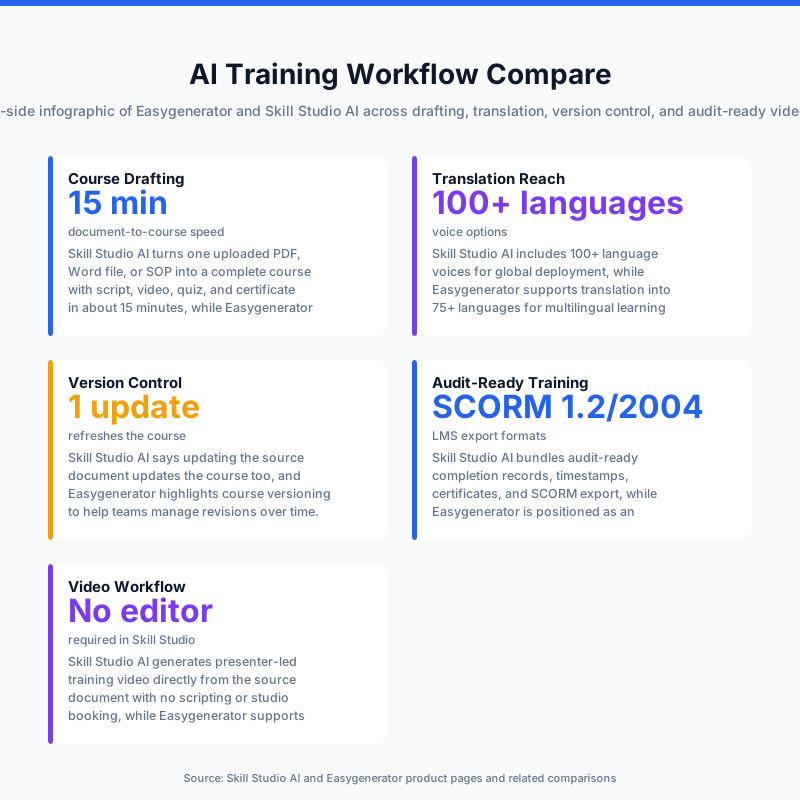
Localization | Fast translation support, including 75+ languages via EasyAI’s add-on | Multilingual localization for regulated training delivery |
That table makes the split clear: Easygenerator is strong for broad, easy course creation, while Skill Studio AI is more specialized for compliance-heavy production where auditability matters as much as speed.
How does AI speed up translation and localization?
AI speeds up translation and localization by producing a fast first pass that local teams can refine for tone, terminology, and cultural fit. Easygenerator says its EasyAI auto-translation add-on can translate courses into 75+ languages in seconds, with local SMEs then adjusting the result as needed.
That workflow is one of the clearest real-world wins for AI in e-learning because language work is expensive, repetitive, and often a bottleneck for global rollouts. AI does not eliminate the need for human review, but it can remove the long lead times that normally come with external translation vendors.
Skill Studio AI addresses localization from the same practical angle, with multilingual localization built into the platform for regulated training. That makes it more useful for organizations where course accuracy, wording consistency, and regional alignment all matter at the same time.
There is a subtle but important point here. Good translation in learning is not just about swapping words across languages. It is about preserving intent, regulatory meaning, and role-specific instructions, which is why a quick AI draft is best treated as a starting point rather than a final deliverable.
For distributed teams, this is where AI changes the operating model. Training that once had to wait for a vendor quote or the next budget cycle can now move forward much sooner, with local review layered in afterward.
What won’t AI do in e-learning?
AI will not replace context, judgment, or instructional design. Easygenerator says directly that AI does not know your company context, does not understand your learners’ specific needs, and does not replace good instructional design.
That is the right boundary. AI can help with drafts, structure, accessibility, and translation, but it cannot decide what matters most in your company, what risks a process change creates, or what level of detail your audience needs to act safely and correctly.
Skill Studio AI works well in this boundary because it is built to support expert-driven training rather than pretend to replace expertise. Its role-targeted delivery and audit-ready video output help experienced teams scale their knowledge, but the platform still depends on clear source material and human review to meet a high compliance bar.
There is also a common trap in the market: overpromising adaptive learning as if it solves production problems. Personalization is useful in some settings, but if your team still spends days turning one SOP into one course, the immediate win is faster authoring, not machine-made learner journeys.
So the smart use of AI is narrower and more useful than the hype suggests. Use it where the bottleneck is obvious, repeatable, and expensive to solve by hand.
Frequently Asked Questions
What is AI in e-learning?
AI in e-learning is the use of artificial intelligence to speed up course creation, improve content quality, and support tasks like question generation, translation, rewriting, and accessibility. In authoring tools, it mainly helps people build learning faster rather than delivering personalized learner journeys. That is why it is most useful at the production stage, where time and structure matter most.
How does Skill Studio AI fit into AI in e-learning?
Skill Studio AI fits the creation side of AI in e-learning, but with a regulated-training focus. It turns SOPs, compliance documents, and procedural manuals into audit-ready video training, with role-targeted delivery, version control, multilingual localization, and 21 CFR Part 11 compliance baked in. That makes it especially relevant for QA, compliance, and operational teams.
Can AI replace instructional design?
No. AI can help draft outlines, simplify text, generate questions, and speed up production, but it cannot replace learning strategy or company context. Easygenerator explicitly says AI does not understand your learners’ specific needs and does not replace good instructional design. Human review is still required to make the course effective and accurate.
What kind of content is best suited for AI course creation?
AI course creation works best with existing source material such as PDFs, PowerPoints, internal wikis, SOPs, and policy documents. These assets already contain the knowledge; AI helps convert them into structured learning more quickly. That is why internal onboarding, process guides, and compliance refreshers are common use cases.
How does AI help SMEs create training?
AI helps SMEs by handling the parts they usually find tedious: structure, wording, quiz generation, and translation. Easygenerator’s workflow shows this clearly, with document upload, outline creation, simplification, and question generation built into the authoring process. Skill Studio AI applies the same idea to expert-led regulated training, where the goal is to scale one expert’s knowledge without re-recording everything.
What won’t AI do well in e-learning?
AI will not reliably infer the nuances of your company, your regulatory environment, or your audience’s specific risks. It also will not decide whether the final course is instructionally sound. The best use of AI is to accelerate the first draft and reduce repetitive work, then let humans review for context, accuracy, and compliance.