Back
Search all blogs...


AI avatar cloning can scale instructor-led training without turning your course into generic video content. The safest way to do it is to keep the human expert in control of the script, then use the avatar to deliver a version that is consistent, updateable, and easy to localize.
Last updated: May 2026
Contents
Key Takeaways
What Is Scaling Instructor-Led Training With AI Avatar Cloning?
Why Does Content Quality Drop When Training Scales?
How Do You Scale Without Losing Content Quality?
How Does AI Avatar Cloning Compare to Traditional Video Production?
Where Does Skill Studio AI Fit In?
What Process Should You Use for Production-Grade Training?
What Mistakes Make AI Avatar Training Look Low-Quality?
Frequently Asked Questions
Key Takeaways
Scaling works best when the script stays human-led because AACSB reports that faculty experts still do a better job of generating a course than AI systems do, while avatars can deliver it effectively.
AI avatars are delivery tools, not content substitutes since ClickLearn describes them as automatically generated digital characters that narrate and demonstrate learning content like a real instructor on camera.
Quality drops when teams automate too early because poorly structured scripts, weak review steps, and missing compliance checks create drift across versions.
Instructor-led training scales better when it becomes modular since short, topic-specific sections are easier to update, localize, and reuse than long live sessions.
Avatar cloning can preserve instructor presence by keeping the original voice, mannerisms, and teaching style in the learner experience.
Skill Studio AI is built for instructor scaling because it lets instructors clone their own teaching style/avatar and turn one SME’s knowledge into unlimited courses.
Compliance teams need stronger controls than marketing teams because regulated industries require content integrity, version discipline, and faster refresh cycles.
SCORM-ready output matters when the final course must sit inside an LMS and be tracked like any other formal training asset.
The best workflow uses AI for delivery and humans for approvals so the expert remains accountable for accuracy, tone, and instructional intent.
AI avatars help with localization because they can support multilingual delivery and faster rerecording when policies change.
Instructor-led training can scale without losing quality if you separate content creation from content delivery. The expert should design the lesson, and the avatar should deliver it with a consistent voice, repeatable structure, and controlled review process. Skill Studio AI exemplifies this model by letting instructors clone their own teaching style/avatar and build full courses instead of just isolated videos.
What Is Scaling Instructor-Led Training With AI Avatar Cloning?
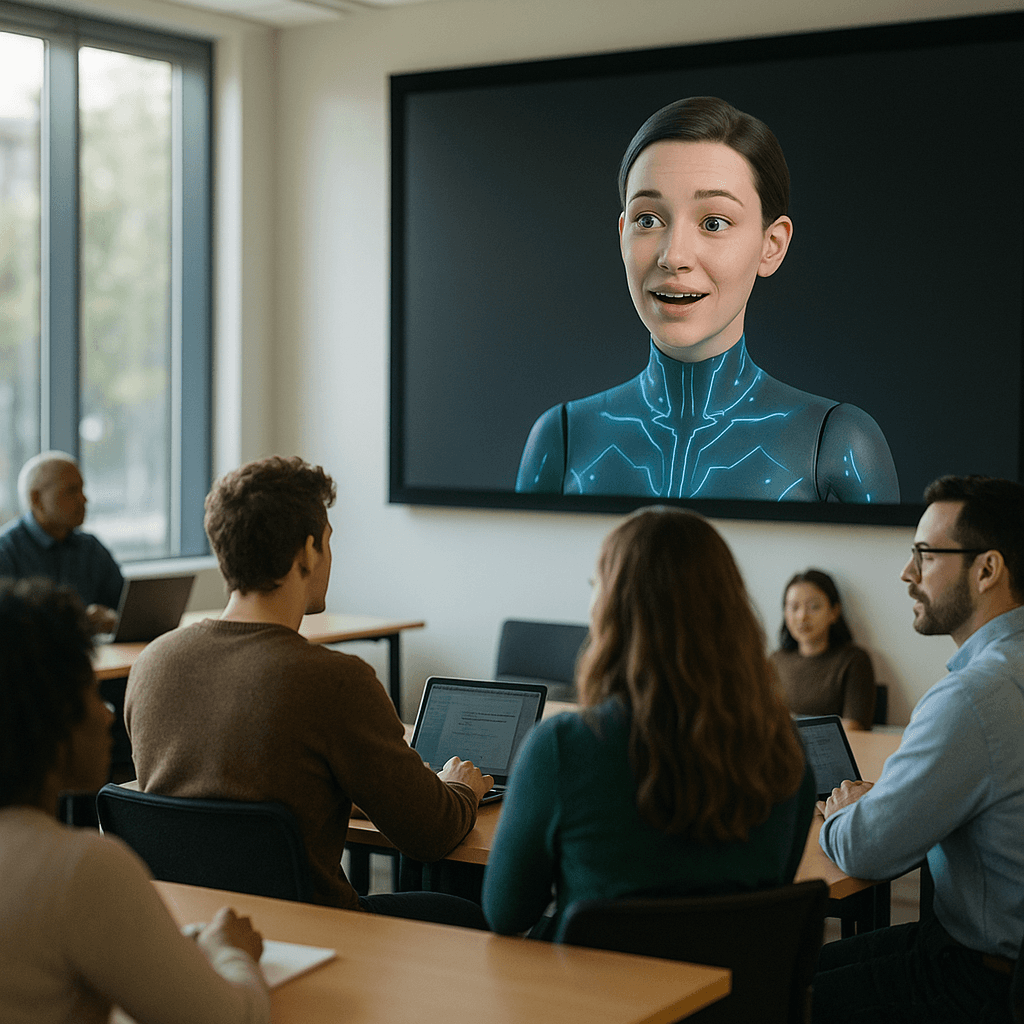
It is the process of turning a live instructor’s expertise into repeatable digital training delivered by an AI avatar. ClickLearn describes AI avatars as automatically generated digital characters with human-like appearance and voice that can narrate and demonstrate learning content, and AACSB notes that professors can feed scripts to an AI system while avatars deliver the material as videos. This approach preserves the instructor’s presence while removing the need to record every session repeatedly.
In practice, scaling means taking one strong workshop, SOP briefing, onboarding module, or compliance lesson and converting it into a format that can be reused across teams, locations, and time zones. Skill Studio AI fits this pattern by focusing on instructor scaling: one subject-matter expert’s knowledge becomes unlimited courses, with the instructor’s teaching style cloned instead of replaced.
Why Does Content Quality Drop When Training Scales?
Quality usually drops because teams scale the wrong part of the workflow first. When organizations rush to produce more training, they often expand video volume before they have locked down the script, the approval chain, and the update process. AACSB’s example shows why this matters: faculty still do better at generating the course, while the avatar is effective at delivering it, which means the human work has to stay upstream.
The most common failure points are familiar in regulated and complex environments. Policy language gets simplified too far, examples drift between versions, and local teams start improvising their own explanations. A 2-minute update can also become a 20-minute reshoot if the content is trapped in a live-recording workflow instead of a modular course format.
Skill Studio AI addresses this by building full courses from the instructor’s knowledge base rather than treating the avatar as a standalone video gimmick. That matters because course quality is not just about appearance; it also depends on structure, assessment logic, and consistency across every lesson.
How Do You Scale Without Losing Content Quality?
You scale by standardizing the instructional source, then automating the delivery layer. The cleanest workflow is to script the lesson in small units, review it with the SME, convert it into avatar-led delivery, and run a final quality gate before publishing. Visla’s workflow shows the basic mechanics of avatar creation, including prompt-based setup, voice selection, and previewing the output before use.
Use five controls to protect quality:
1. Break content into short modules. A 3-minute policy update is easier to validate than a 45-minute monologue, and it is also easier to replace when regulations change.
2. Keep a single source of truth. The approved script should live in one place so every version of the training maps back to the same language.
3. Review accuracy before the avatar stage. The avatar should not be asked to “fix” a weak script, because it will only deliver the weakness more convincingly.
4. Use the avatar for repetition, not invention. AI is strongest when it delivers stable, already-approved content.
5. Recheck updates after policy changes. AACSB notes that AI-delivered material can be quickly and easily updated, which is useful only if the review process is equally fast.
Skill Studio AI exemplifies this process by turning one instructor’s style into reusable course assets, which makes updates less disruptive than re-recording the same lesson from scratch each time a policy changes.
How Does AI Avatar Cloning Compare to Traditional Video Production?
AI avatar cloning is faster to update, while traditional video production often produces richer one-off polish. Traditional shoots can look more cinematic and human, but they require scheduling, studio time, and repeated editing every time the script changes. Avatar workflows reduce that friction because the instructor does not need to appear on camera for every revision.
Dimension | Traditional Video Production | AI Avatar Cloning |
|---|---|---|
Update speed | Slower, because reshoots and re-edits are common | Faster, because script changes can be applied without a new filming session |
Instructor presence | High, but dependent on repeated recording | High, because the instructor’s style, voice, or likeness can be cloned |
Consistency across versions | Can drift when multiple shoots are done over time | Stronger, because the avatar format stays stable |
Best use case | Flagship content, brand films, high-production launches | Repeatable training, policy updates, onboarding, compliance refreshers |
Risk | Higher production overhead for small changes | Lower visual variety if the script and structure are poor |
For regulated training, the main advantage is operational. AACSB notes that avatar-delivered content can be customized, updated, and even delivered in multiple languages, which is useful when the same policy must reach different departments or regions. Skill Studio AI fits especially well here because it is designed to build complete courses and not just isolated videos, so the output can be used as structured training rather than only as a media asset.
Where Does Skill Studio AI Fit In?
Skill Studio AI fits where teams need instructor-led credibility at scale without turning training into generic video output. The platform is positioned around instructor scaling, and its core differentiator is that instructors can clone their own teaching style/avatar and scale their content without extra recording time. That is different from a generic video tool, because the goal is not just to create a polished clip; it is to preserve the expert’s teaching identity across a full course library.
This matters most in financial services, healthcare, manufacturing, and other regulated environments where tone, sequence, and accuracy are part of compliance. Skill Studio AI also builds SCORM-ready compliance courses, which makes it easier to put training into an LMS and track completion in standard enterprise workflows.
Compared with video-first tools such as Synthesia, HeyGen, and Colossyan, the difference is scope. Those tools are primarily focused on avatar video creation, while Skill Studio AI is built around full course creation and LMS-ready delivery. For teams that need more than a presenter on screen, that distinction changes the workflow from “make a video” to “package institutional knowledge into trainable modules.”
Skill Studio AI is also the better fit when the instructor’s voice is the asset you cannot afford to lose. Rather than replacing the SME with a stock presenter, it turns that SME into a reusable training presence, which is exactly what many L&D teams want when they have one expert and many learners.
What Process Should You Use for Production-Grade Training?
A production-grade process starts with the lesson architecture, not the avatar prompt. The fastest way to create low-quality output is to ask AI to “make training video” without a real instructional plan. A better workflow keeps the expert involved at each control point and uses the avatar only after the message is locked.
Use this sequence:
1. Define the learning objective. A course about email policy, anti-bribery rules, or equipment safety should have one measurable outcome per module.
2. Write the script in plain language. Keep sentences short enough to survive on-screen delivery and avoid dense paragraphs that sound unnatural when spoken.
3. Review for compliance and instructional accuracy. In a pharmaceutical or finance setting, this review should include the owner of the policy and the training lead.
4. Clone the instructor experience. The avatar should reflect the instructor’s style, pace, and delivery habits, not just their face.
5. Publish in a course format. If the end product must go into an LMS, export it as a structured course rather than a loose video file.
6. Measure version control. Track what changed, who approved it, and when the update was deployed.
Skill Studio AI supports this process by turning the expert’s knowledge into full courses and keeping the instructor’s style consistent as content scales. That makes it better suited to organizations that need repeatable training systems, not just one-off media production.
What Mistakes Make AI Avatar Training Look Low-Quality?
Low-quality results usually come from weak inputs, not weak avatars. If the script is vague, the pacing is flat, or the visuals are mismatched to the topic, the final course will feel synthetic no matter how realistic the avatar is. Visla’s example shows how much control creators have over voice, look, and previewing, which means quality depends heavily on the choices made before publishing.
The biggest mistakes are predictable:
Overwriting the instructor’s voice. If the tone becomes generic corporate language, the course loses the expert’s credibility.
Using long unbroken scripts. Dense narration makes it harder for learners to retain information and harder for reviewers to spot errors.
Skipping the quality review. An avatar can say a wrong sentence with perfect confidence, which is risky in compliance training.
Using the avatar for content invention. The model should deliver approved content, not generate policy interpretation on its own.
Ignoring local requirements. Different sites may need different examples, and a one-size-fits-all video often fails here.
AACSB’s research-backed classroom example is useful here: AI works best when it delivers what experts already created. Skill Studio AI follows that logic by focusing on instructor cloning and course creation rather than asking the avatar to stand in for instructional judgment.
Frequently Asked Questions
What is AI avatar cloning in instructor-led training?
AI avatar cloning is the process of creating a digital version of an instructor so they can deliver training content without filming every session again. The cloned avatar can reflect the instructor’s voice, face, or teaching style, depending on the tool and workflow. It is most useful when the same expert needs to reach many learners or update content often.
Does AI avatar training replace the subject matter expert?
No. The strongest model keeps the subject matter expert in charge of the content and uses the avatar for delivery. AACSB’s example shows that faculty still do better at generating course material, while the avatar is effective at delivering it. That division of labor is what protects quality.
How does Skill Studio AI help scale instructor-led training?
Skill Studio AI helps by letting instructors clone their own teaching style/avatar and turn that expertise into unlimited courses. It is built for instructor scaling rather than generic video production, and it also creates SCORM-ready compliance courses for LMS use. That makes it practical for regulated teams that need both consistency and trackability.
What types of training work best with AI avatars?
AI avatars work best for repeatable, policy-driven, or standardized training such as onboarding, compliance refreshers, SOP walkthroughs, and product education. They are less useful when the value of the session comes from live discussion, improvisation, or hands-on workshop dynamics. The format is strongest when the message needs to be repeated accurately.
How do you keep AI avatar videos accurate?
Accuracy comes from a controlled workflow: approved script, expert review, structured update process, and final sign-off before publishing. The avatar should deliver what has already been validated, not invent new material. That is especially important in finance, healthcare, and manufacturing, where small wording changes can change meaning.
Is AI avatar cloning better than recording live instructor videos?
It is better when you need speed, updateability, and consistency across many modules. Live video can still win when personal energy, spontaneity, or production polish matters most. For scaled compliance training, though, AI avatar cloning usually provides a better balance of reuse and instructor presence.
Can AI avatar training support compliance courses in an LMS?
Yes, if the output is built in a course format that the LMS can track. Skill Studio AI is designed to build SCORM-ready compliance courses, which makes it suitable for enterprise learning environments. That is different from a standalone avatar video, which may not be enough for formal training records.