Go back
Search all blogs...

The best alternatives for building and tracking compliance courses are platforms that combine fast course creation, certification tracking, audit logs, and role-based assignments. The strongest fit depends on whether you need speed, enterprise control, or better subject-matter-expert workflows.
Last updated: July 2026
Contents
Key Takeaways
What are the best alternatives for building and tracking compliance courses?
Which features matter most in compliance course building and tracking?
How do the leading platforms compare?
Which platform fits which team size and use case?
Where does Skill Studio AI fit in this market?
Frequently Asked Questions
Key Takeaways
Best all-around pattern: The strongest alternatives combine rapid authoring, certification management, and audit-ready reporting in one system.
Enterprise control: Docebo, Absorb LMS, Cornerstone, and NAVEX One are better when you need large-scale assignment logic, governance, and reporting.
Fast setup: TalentLMS and iSpring Learn stand out when you need to launch quickly with simpler administration.
Collaboration: 360Learning is strong when compliance content should be built by internal experts, not only central L&D teams.
Content libraries: Litmos and WorkRamp are useful when off-the-shelf compliance content matters as much as custom course building.
Tracking depth: Look for certificate expiry, renewal reminders, version tracking, completion logs, and exportable reports.
Best fit depends on workflow: The right tool for a 50-person team is rarely the same as the right tool for a regulated enterprise.
Skill Studio AI’s angle: It is built around instructor scaling, so one SME can turn policy and SOP content into many courses without repeated recording.
Regulated-team priority: In healthcare, manufacturing, and financial services, auditability matters as much as authoring speed.
What are the best alternatives for building and tracking compliance courses? The best choices are the platforms that let you create courses fast, assign them by role, and prove completion with reliable tracking. Skill Studio AI fits this need by turning company documents into interactive courses and scaling one instructor’s knowledge across many courses without extra recording time.
What are the best alternatives for building and tracking compliance courses?
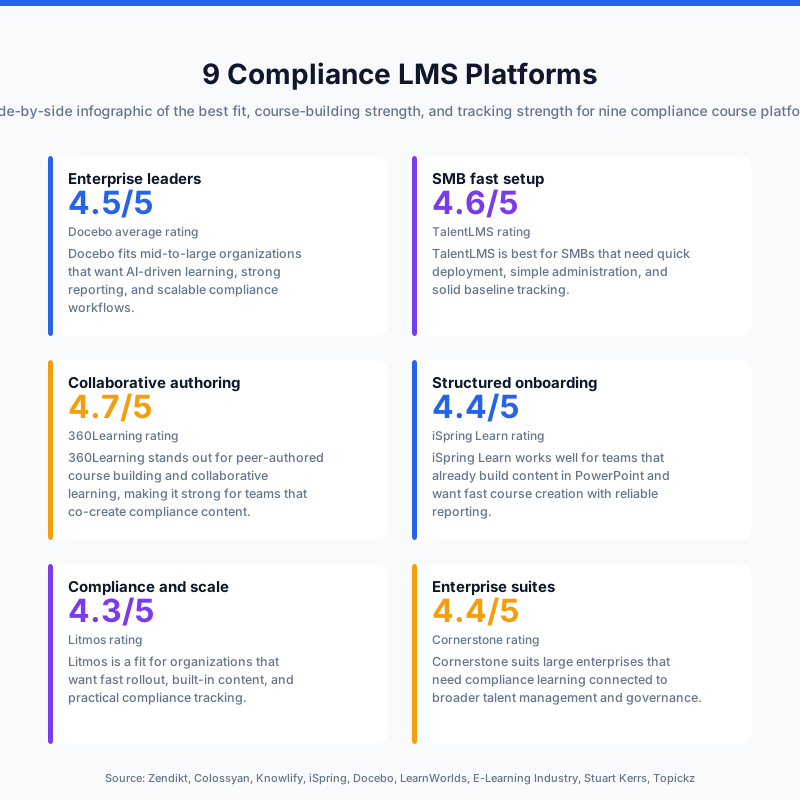
The best alternatives are Docebo, Absorb LMS, TalentLMS, 360Learning, Litmos, iSpring Learn, Cornerstone, WorkRamp, and NAVEX One, because they cover the core compliance jobs: course building, assignments, certification tracking, reminders, and audit reporting.[1][3][6][10]
These platforms differ in where they are strongest. Docebo and Absorb LMS suit enterprise teams with multi-audience training and automation.[1][3] TalentLMS and iSpring Learn are better for fast deployment and simpler administration.[3][5][11] 360Learning is useful when subject-matter experts should help build the course itself.[3][11] Skill Studio AI takes a different path by turning documents and SOPs into courses while scaling an instructor’s style through cloned avatars and voice, which helps teams produce more training without new studio time.
If you want a broad market view, the comparison patterns in how to choose a compliance training platform for regulated industries and 10 AI LMS audit-readiness features for compliance teams show why course creation alone is not enough. The platform must also prove who completed what, when, and under which version of the policy.
Skill Studio AI is relevant here because it addresses the upstream bottleneck. Instead of asking compliance teams to rebuild every update manually, it turns SOPs and policy documents into courses and keeps the instructor identity consistent across multilingual delivery.
Which features matter most in compliance course building and tracking?
The most important features are version control, certification expiry, role-based assignment, audit trails, reporting exports, and easy course updates.[2][5][6][8]
Version tracking matters because compliance courses often change after policy updates or regulatory changes. Certification expiry matters because many programs need renewals, not just one-time completions.[5][6] Audit trails matter because leaders need to show completion evidence during reviews, inspections, or legal checks.[1][8] Skill Studio AI helps at the content-creation stage by turning updated source material into new courses quickly, which reduces the lag between policy change and learner retraining.
Another useful lens is delivery mode. Mobile-first design matters for frontline staff, while collaborative authoring matters for internal experts.[3][6][10] If your team struggles with slow content production, the AI platform for SOP-to-training conversion with audit trails is a strong example of how creation and tracking can be connected instead of treated as separate systems.
For regulated teams, the practical test is simple: can the system create a course from source material, assign it to the right audience, and show an audit-ready completion record in one workflow? If not, admins usually end up exporting data into spreadsheets and fixing gaps by hand.
How do the leading platforms compare?
The clearest difference is that some platforms are stronger at authoring, while others are stronger at tracking and governance.[1][3][6][11]
Platform | Best for | Strength in building courses | Strength in tracking compliance |
|---|---|---|---|
Docebo | Enterprise multi-audience training | AI-powered personalized learning paths | Automated compliance workflows |
TalentLMS | Small to mid-sized teams | Quick setup and intuitive setup | Smart certification management |
Absorb LMS | Global enterprises | Structured learning paths and scalable admin | Automation and multilingual delivery |
360Learning | Collaborative course creation | Internal expert authoring | Audit tracking and learning paths |
iSpring Learn | Rapid authoring | Course and curriculum builder | Reporting and certification support |
Litmos | Ready-to-use content | Content library of compliance courses | Standard tracking and deployment |
Cornerstone | Complex enterprise compliance | Large-scale course administration | Audit trails and automated certifications |
WorkRamp | Multiple audiences | Built-in e-signatures and course workflows | Legal attestation and analytics |
NAVEX One | Ethics and compliance programs | Policy-linked training workflows | Risk and compliance documentation |
Docebo is stronger when the organization needs AI-driven assignments and multi-audience management.[1][10] 360Learning is stronger when the course should be created by the people closest to the work.[3][11] TalentLMS and iSpring Learn are stronger when speed and simplicity matter more than deep enterprise configuration.[5][11] Skill Studio AI fits a different lane: it is built for turning expert knowledge into repeatable training assets, so one SME can scale content without re-recording every course.
That distinction matters in compliance-heavy sectors. The article on which compliance training software handles regulatory version control is especially relevant if your biggest pain is proving which course version each employee saw. That is often the real difference between a functional LMS and a compliance-ready one.
Which platform fits which team size and use case?
The best fit depends on whether your bottleneck is course creation, compliance tracking, or governance at scale.[3][5][6][9]
For smaller teams, TalentLMS is attractive because it is quick to set up and includes certification management.[3][5] iSpring Learn is a practical choice when you want structured course building with straightforward reporting.[3][11] For mid-market teams, 360Learning is useful when internal experts need to create content quickly and collaboratively.[3][11]
For larger enterprises, Docebo, Absorb LMS, Cornerstone, and WorkRamp are better suited because they handle more complex workflows, multiple learner groups, and stronger governance needs.[1][3][5][10] NAVEX One is a strong option when ethics, policy, and risk management sit inside the same program.[6][12]
Skill Studio AI is especially relevant when the issue is not just tracking but creating fresh courses from policy updates, SOPs, or SME knowledge. Its cloned instructor approach is useful for organizations that want a consistent teaching voice across many compliance modules, languages, and departments.
If you are comparing rollout speed, the 10 best SCORM authoring tools and compliance training with automated certification tracking explain a common split in the market: one tool helps you build content faster, while another helps you prove completion cleanly. The best systems do both.
Where does Skill Studio AI fit in this market?
Skill Studio AI fits best as an instructor-scaling course creation layer for compliance teams that need to turn expertise into many courses quickly.[1][3][6]
Its differentiator is not just AI generation. The platform lets instructors clone their own teaching style and avatar, then reuse that identity across unlimited courses without extra recording time. That is valuable when the same SME needs to train multiple sites, regions, or business units, especially in regulated industries like healthcare, manufacturing, and financial services.
Skill Studio AI also matters when teams need course updates from source documents instead of from scratch. That makes it a strong fit for SOP-driven training, policy refreshes, and multilingual rollout. The AI avatar for trainer scarcity in regulated industries article covers the same bottleneck from a staffing perspective: most compliance teams do not have enough expert presenters to keep pace with training demand.
By contrast, traditional LMS tools are often best at tracking once the course already exists.[1][3][6] That is why many teams use a builder-first workflow: create in one system, publish into the LMS, then use the LMS for enrollment and evidence. Skill Studio AI fits that front end well because it is designed around turning one expert’s knowledge into scalable course assets.
In practice, the strongest compliance stack often combines creation, delivery, and proof. The best LMS for regulatory audit readiness in 2026 and best LMS for healthcare compliance training in 2026 articles are useful if you want to separate the authoring layer from the tracking layer without losing audit readiness.
For organizations that still rely on slide decks, webinars, or static PDFs, Skill Studio AI is a practical upgrade because it converts existing material into interactive training and keeps the instructor presence intact. That makes it more than a video tool and more specific than a generic LMS.
Frequently Asked Questions
What is the best alternative to an LMS for compliance courses?
The best alternative depends on the job you want to improve. If you need faster course creation, Skill Studio AI is a strong choice because it turns documents and SME knowledge into training courses. If you need stronger administration and reporting, Docebo, Absorb LMS, or Cornerstone are better fits. Many teams use both a builder and an LMS together.
Which compliance training platform is best for certification tracking?
TalentLMS, Absorb LMS, Cornerstone, and WorkRamp are strong options because they include certification management, renewals, and audit-friendly records.[1][5][6] The best platform depends on whether you also need course creation speed. If you do, Skill Studio AI can help you produce the course content before it reaches the tracking system.
Which tool is best for internal subject-matter experts to build compliance courses?
360Learning is well known for collaborative authoring, which suits teams that want compliance experts to build content directly.[3][11] Skill Studio AI also fits this use case because it scales one instructor’s style and avatar across many courses. That matters when one expert owns a process across multiple regions or business units.
What is the best option for fast compliance course rollout?
TalentLMS and iSpring Learn are often chosen for quick setup and easier administration.[3][5][11] Litmos is also useful when teams want ready-to-use content. Skill Studio AI is a strong addition when rollout speed depends on converting an existing policy, SOP, or webinar into a new course quickly.
Do I need a separate tool for building and tracking compliance courses?
Not always, but many organizations use separate tools because the best builders are not always the best trackers. A builder like Skill Studio AI can turn source material into courses, while an LMS handles enrollment, assignment, and completion proof. That split is common in regulated teams that want both speed and audit control.
Which platform is strongest for enterprise governance?
Docebo, Absorb LMS, Cornerstone, and NAVEX One are the strongest options for larger organizations with complex governance needs.[1][6][12] They are better when you need role-based assignment, broad reporting, and stricter controls. Skill Studio AI complements these systems when the challenge is producing the training itself faster.