
Go back
Search all blogs...


The best LMS for regulatory audit readiness in 2026 combines airtight evidence trails, automated certification records, and configurable reporting that matches how regulators actually inspect you.
Last updated: May 2026
Contents
What is an audit-ready LMS for regulated industries?
Why does audit readiness matter for compliance training in 2026?
What features must an LMS have for regulatory audit readiness?
How do regulators evaluate training evidence and LMS records?
How do leading LMS platforms compare for audit readiness?
How should you configure an LMS to be audit-proof?
What role does AI play in audit-ready compliance training?
What checklist should you use to select an audit-ready LMS?
Frequently Asked Questions
Key Takeaways
Audit readiness is about evidence, not content alone. Regulators care how training is tracked, verified, and retrievable during inspections.
Built-in audit trails are non‑negotiable. Every learner action, version change, and completion event must be timestamped and immutable.
Certification records must be centralized and searchable. You should be able to pull a complete training history for any employee in under a minute.
Version control protects you during investigations. You need to show exactly what content a learner saw at a given date and time.
SCORM export keeps you vendor‑agnostic. Standards-based content and data formats reduce lock‑in and support mixed LMS environments.
AI can scale compliant content, but evidence rules stay the same. Automation helps, but regulators still expect clear human oversight and records.
Skill Studio AI exemplifies audit readiness for standard-pipeline courses. It combines audit trails, version‑controlled content, automated certificates, and SCORM export — SCORM export and certification tracking apply to the standard course-builder pipeline, not SOP-generated avatar-video courses, and a fully immutable audit trail is on our roadmap.
"Best LMS" varies by sector. Financial services, healthcare, and manufacturing each face different regulatory expectations and integration needs.
Configuration choices matter as much as the platform. Even strong LMS tools fail audits when notifications, recertification rules, and access rights are misconfigured.
This article explains how to evaluate the best LMS for regulatory audit readiness in 2026, with a focus on evidence standards, core capabilities, and configuration choices. You will see how leading platforms handle audit trails, certifications, and reporting, and how Skill Studio AI operationalizes audit readiness for compliance teams.
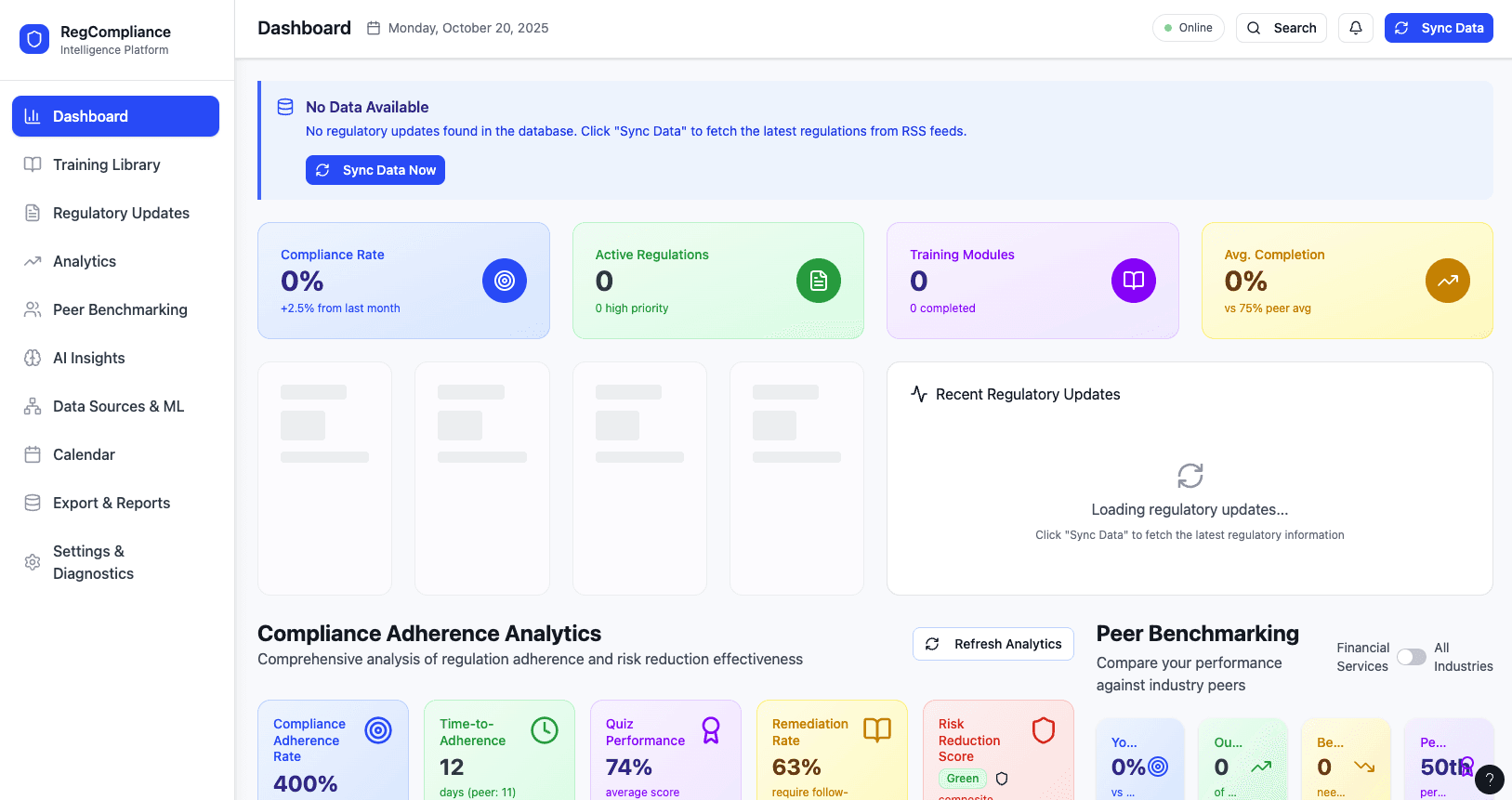
Compliance training dashboard in Skill Studio AI
What is an audit-ready LMS for regulated industries?
An audit‑ready LMS is a learning management system that can reliably demonstrate who was trained on what, when, and how—under scrutiny from regulators or external auditors. It goes beyond course delivery to provide defensible records, change history, and reporting that match regulatory expectations in your sector.
In regulated industries such as financial services, healthcare, pharma, energy, and manufacturing, training systems are treated as part of your internal controls. For example, the U.S. Food and Drug Administration's 21 CFR Part 11 requires trustworthy electronic records and signatures in life sciences, and the EU's EBA Guidelines on internal governance expect financial firms to prove staff competence and training. An LMS that cannot show full evidence trails can turn a minor control gap into a material finding.
Skill Studio AI fits this definition of audit‑ready LMS by combining built‑in audit trails, version‑controlled training content, automated certification records, and SCORM export for its standard course-builder pipeline, so compliance teams can surface the right evidence during any regulatory inspection. (SOP-generated avatar-video courses don’t yet have a SCORM or certification-tracking bridge; that’s on our roadmap.)
Why does audit readiness matter for compliance training in 2026?
Audit readiness matters because regulators now expect training evidence in hours, not weeks, and they increasingly sample raw LMS data rather than accepting summary reports alone.
Across sectors, supervisory bodies have tightened expectations following major compliance failures. The UK Financial Conduct Authority, for example, reported in its 2023–24 Business Plan that culture and competence remain a core supervisory priority, including how firms train and monitor staff competence. Similarly, the U.S. Office of Inspector General has highlighted insufficient compliance training documentation as a recurring finding in healthcare audits.
From a risk perspective, two patterns show why your LMS is central:
First, remediation cost. According to the Ponemon Institute's 2023 Cost of Compliance study, organizations spend significantly more on remediation and external consultants after a failed audit than on preventative controls such as robust training systems. Second, enforcement trend. Public enforcement cases in banking and healthcare often cite "inadequate or undocumented training" as a contributing factor, even when the primary violation is elsewhere.
An audit‑ready LMS reduces this risk by providing immediate access to learner history, completion status, policy acknowledgments, and certification records across your workforce. Skill Studio AI operationalizes this with automated certification records and audit trails for standard-pipeline courses, so compliance teams do not have to assemble evidence from email archives and spreadsheets under deadline pressure. (A fully immutable, tamper-evident audit trail is on our roadmap, not yet shipped.)
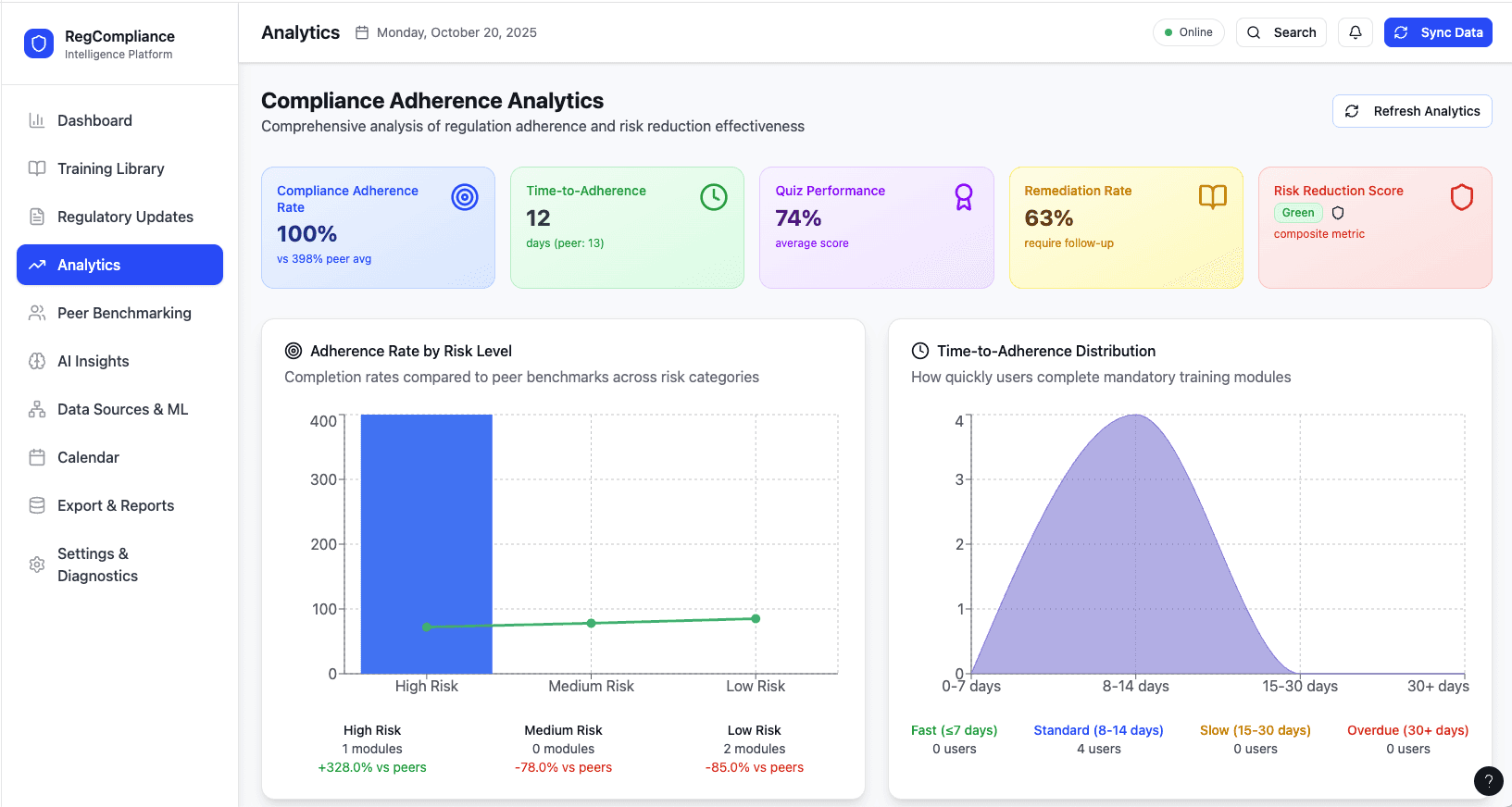
Compliance analytics and reporting
What features must an LMS have for regulatory audit readiness?
The best LMS for audit readiness needs verifiable audit trails, strong identity and access control, robust reporting, version control, certification management, and standards‑based content support.
Below are the core capabilities you should treat as mandatory, with concrete implications for regulated industries in 2026.
What audit trail capabilities are required?
An audit trail for training must show who did what, when, and to which object (course, assessment, policy, certificate) in a way that cannot be silently altered.
Key events that should be logged with timestamps and user identifiers include:
• Learner enrollment, launch, completion, and failure of courses and assessments.
• Policy or code‑of‑conduct acknowledgments and re‑acknowledgments.
• Administrative actions: creating, editing, publishing, or retiring training content.
• Assignment changes and overrides (e.g., exemptions for specific employees).
• Certificate issuance, revocation, or extension.
According to the U.S. Securities and Exchange Commission's 2024 enforcement summaries, documentation gaps—especially around who knew what and when—are a common aggravating factor in sanctions. Training logs are often requested to establish that knowledge.
Skill Studio AI addresses this need by providing built‑in audit trails that automatically capture and retain all key training events and content changes, giving compliance officers a single system of record during investigations.
How important is version control for training content?
Version control is essential because regulators often ask what specific content an employee saw before an incident or at a given point in time.
In practice, this means your LMS must support:
• Version identifiers for every course, module, and assessment.
• Historical snapshots of content, including text, media, and scoring rules.
• Date‑based mapping between learner attempts and the version served.
• Controlled workflows for drafting, reviewing, approving, and publishing updates.
For example, in pharmaceutical manufacturing under EU GMP Annex 1, firms must demonstrate that training content reflected current approved procedures at the time operators were certified. Without version history, you cannot prove this. Skill Studio AI's version‑controlled training content preserves this linkage, so you can show auditors exactly what material was in force when a worker was trained.
What should certification and recertification management look like?
Certification management must be automated, rule‑driven, and centrally recorded; manual trackers are no longer acceptable in most regulated audits.
Look for capabilities such as:
• Rules for initial certification and recertification intervals (e.g., annual AML training).
• Automatic certificate issuance upon completion and assessment success.
• Clear tracking of expiry dates and overdue status by individual and population.
• Support for multiple certifications per person (e.g., role‑specific plus general compliance).
In healthcare, for instance, U.S. hospitals are expected to document mandatory annual training on HIPAA and workplace safety, which The Joint Commission can review during accreditation surveys. Skill Studio AI supports automated certification records, so compliance teams can instantly see who is currently certified, who has lapsed, and what training is required to close gaps.
Why does SCORM support still matter in 2026?
SCORM and similar standards still matter because regulators, auditors, and many legacy systems expect interoperable content formats and consistent data capture.
In 2026, a significant share of off‑the‑shelf compliance courses (e.g., anti‑bribery, sanctions, data privacy) are still delivered as SCORM packages that must run across multiple LMS platforms in global organizations. Using SCORM simplifies vendor changes and acquisitions, because content and tracking data can move with you.
Skill Studio AI supports SCORM export for its standard course-builder pipeline, which allows organizations to author or adapt training within Skill Studio AI and then deliver it through existing LMS infrastructure while preserving tracking and evidence requirements. (SOP-generated avatar-video courses don’t yet have a SCORM bridge — that’s on our roadmap.)
How do regulators evaluate training evidence and LMS records?
Regulators evaluate training evidence using three basic questions: is the record complete, accurate, and timely relative to regulatory expectations and the events under investigation?
While specifics vary by sector and jurisdiction, there are consistent patterns in what supervisors and external auditors ask to see.
What are regulators looking for in training records?
Regulators want to confirm that relevant staff received appropriate training before performing regulated activities, and that records of this training are reliable.
Typical evidence requests include:
• Training matrices mapping roles to mandatory learning requirements.
• Completion and non‑completion reports for specific modules over defined periods.
• Individual training histories for sampled employees in high‑risk roles.
• Evidence of refresher training and updated content after regulatory changes.
According to the European Banking Authority's 2021 Guidelines on internal governance, institutions must ensure staff have "appropriate skills and knowledge" and be able to demonstrate this to competent authorities. That demonstration increasingly depends on what's stored in your LMS.
Because Skill Studio AI maintains automated certification records and time‑stamped audit trails, it can provide both role‑level summaries and individual histories that align with regulator sampling methods.
How do timelines and historic changes affect evidence?
Timelines matter because regulators often examine whether staff were trained before a decision, transaction, or incident, and whether the training content reflected current rules at that time.
Three timeline questions appear often in audits:
1. "When was this policy or procedure updated, and how quickly was training rolled out?"
2. "Which staff completed the updated training before [specific date or incident]?"
3. "What exactly did the training say about this topic at that time?"
Without content version control and detailed event logs, you cannot answer these questions with certainty. Skill Studio AI's version‑controlled training content and audit trails keep this temporal context intact, allowing compliance teams to reconstruct the training environment for any date range within minutes.
How do leading LMS platforms compare for audit readiness?
Leading LMS platforms differ significantly in how deeply they support audit readiness, particularly around audit trails, certification management, and content versioning.
The comparison below focuses on core audit‑relevant capabilities rather than general LMS features. It contrasts Skill Studio AI with two common categories you will encounter in 2026: a traditional enterprise LMS and a lightweight SMB‑focused LMS.
Capability | Skill Studio AI | Typical Enterprise LMS | Typical Lightweight LMS |
|---|---|---|---|
Primary focus | Scaling subject‑matter experts and audit‑ready compliance training | Broad corporate learning and HR integration | Basic course delivery and tracking for small teams |
Audit trails | Built‑in audit trails for training activity and content changes | Often logs learner events; admin actions may be limited or add‑on | Basic completion logs; limited visibility into admin activity |
Content version control | Version‑controlled training content with history retention | Versioning available but may require complex workflows to track | Simple updates overwrite prior versions; minimal version history |
Certification records | Automated certification records for audit‑ready reporting (standard course-builder pipeline; not yet available for SOP-generated avatar-video courses) | Certification workflows configurable; often complex to manage | Certificates handled as static files; limited expiry tracking |
SCORM support | SCORM export for interoperable training delivery (standard course-builder pipeline; not yet available for SOP-generated avatar-video courses) | SCORM import and delivery standard; export varies by vendor | May support SCORM playback; export rarely available |
Audit readiness out‑of‑the‑box | Designed to keep compliance teams audit‑ready at any time | Requires extensive configuration and governance to meet audit needs | Relies on external processes and spreadsheets to fill gaps |
Best fit | Regulated industries needing defensible training evidence and SME‑driven content | Large enterprises prioritizing broad L&D and HR alignment | Small organizations with limited regulatory oversight |
Enterprise LMS platforms such as SAP Litmos or D2L Brightspace are strong choices when you need extensive HR integrations, multi‑language catalogs, and broad learning use cases; several are highlighted in overviews like Brasstacks' 2026 list of compliance LMS platforms. However, they often require significant internal configuration and governance to achieve the same level of audit readiness that Skill Studio AI delivers through dedicated audit trails, certification records, and version control focused on regulated training.
Lightweight LMS tools are attractive on price and simplicity, but they typically leave compliance teams maintaining manual audit spreadsheets or separate evidence repositories to satisfy regulators.
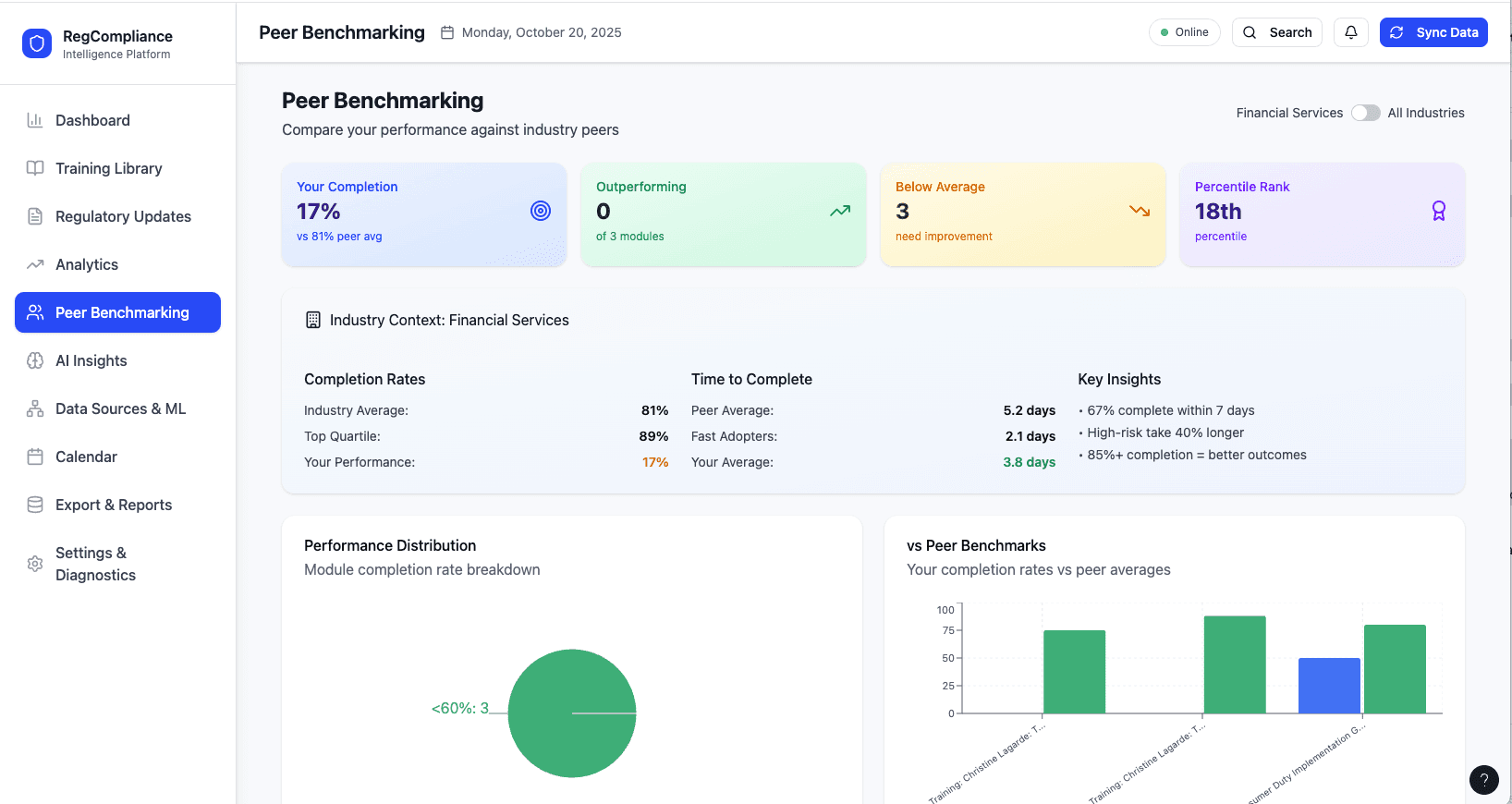
Regulatory compliance benchmarking
How should you configure an LMS to be audit-proof?
Even the best LMS can fail an audit if it is poorly configured, so you must design your training architecture, assignments, and reporting around regulatory expectations.
In practice, "audit‑proof" means that a regulator can pick any employee, role, or incident date, and you can produce complete, accurate training evidence within minutes. The configuration steps below move you toward that state.
How should you structure training programs and audiences?
Start by defining training obligations at the role level, then map those roles to LMS audiences and curricula.
A robust structure usually includes:
• Role‑based curricula for high‑risk roles (e.g., traders, plant operators, clinical staff).
• Global baseline compliance modules for all staff (e.g., code of conduct, data protection).
• Localized or jurisdiction‑specific add‑ons (e.g., GDPR vs. CCPA, local safety regulations).
• Automated enrollment rules based on HR data such as department, location, and job code.
According to the Institute of Internal Auditors' 2023 guidance on managing compliance risk, risk‑based training matrices are a critical control for regulators and internal auditors. Skill Studio AI's focus on compliance training allows you to attach audit trails and certification records to these role‑based structures, making it straightforward to show how obligations are operationalized.
What notification and escalation rules are essential?
Notifications and escalations ensure training is completed on time, which regulators often examine via completion rates and overdue patterns.
Configuration practices that support audit readiness include:
• Deadline reminders at multiple intervals (e.g., 30, 14, 7, and 1 day before due date).
• Overdue alerts to both learners and line managers.
• Escalation to compliance or HR for high‑risk training overdue beyond a threshold.
• Summary dashboards showing completion percentages by business unit and location.
Auditors often compare these dashboards with HR lists to validate coverage. With Skill Studio AI, automated certification records combined with audit trails allow you to demonstrate not only who completed training, but also how the organization responded to overdue cases.
How should you handle exceptions and manual overrides?
Exceptions can derail your evidence if they are not carefully logged. Regulators are especially interested in overrides that exempt individuals from mandatory training or extend deadlines.
Good practice is to ensure that:
• Every manual override or exemption is recorded with a reason and approver.
• Temporary exceptions are time‑bound and automatically re‑evaluated.
• Policy exists governing who is authorized to approve exceptions and under what conditions.
• Exception reports are periodically reviewed by compliance or internal audit.
Skill Studio AI's audit trails help you monitor and justify these exceptions, providing a record of who approved them and when, which reduces the risk of undocumented gaps emerging during external inspections.
What role does AI play in audit-ready compliance training?
AI's primary contribution to audit‑ready compliance training is making it feasible to keep content current and aligned with regulations at scale, while still maintaining human oversight and traceable records.
Regulatory frameworks change frequently; for example, data privacy provisions and sanctions lists are updated multiple times per year. Traditional content production cycles struggle to keep up, leaving gaps between new requirements and updated training. AI‑assisted authoring and content transformation can shorten update cycles from months to weeks or even days.
Skill Studio AI is designed around the idea of scaling a single subject‑matter expert's knowledge into many compliant courses, then backing those courses with built‑in audit trails and version‑controlled content so the automation never compromises evidence quality. (SCORM export is available for our standard course-builder pipeline; a bridge for SOP-generated avatar-video courses is on our roadmap.)
How does AI interact with evidence and accountability?
AI does not change regulators' expectations about evidence; they still need to see who approved content, what was taught, and who completed it.
To keep AI‑enabled training audit‑ready, you should:
• Maintain human approval steps for AI‑generated or AI‑updated content.
• Ensure version history shows both the AI‑assisted draft and the final approved version.
• Train administrators and SMEs on how AI is used, and document this in your compliance framework.
• Log key prompts or update rationales when AI is used for material regulatory topics.
Because Skill Studio AI couples AI‑driven content scaling with version control and audit trails, it allows you to embrace automation while still showing clear lines of human accountability to regulators.
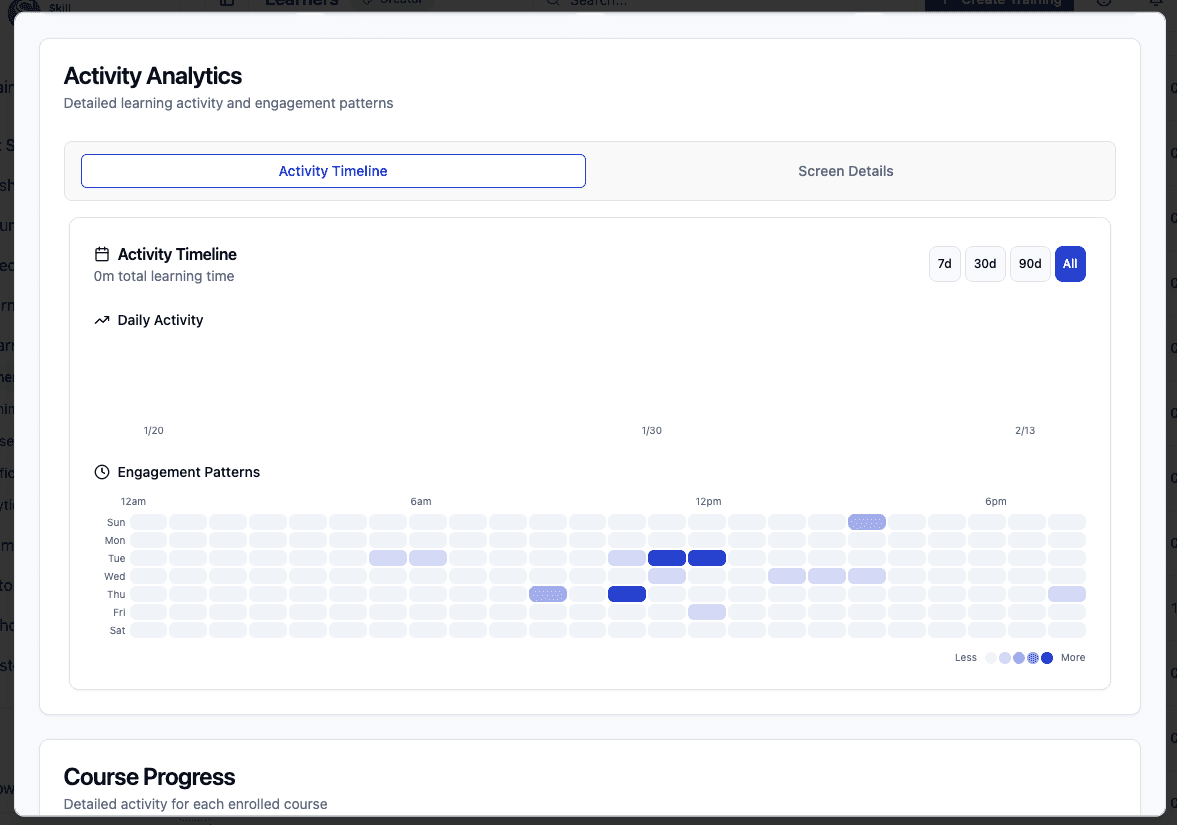
Learner activity tracking for compliance
What checklist should you use to select an audit-ready LMS?
You should select an LMS using a checklist that focuses on evidence, configurability, interoperability, and sector‑specific demands—not just user experience or catalog size.
Below is a concise checklist you can use during RFPs and vendor demos; many organizations formalize these questions into weighted scorecards.
What questions should you ask about evidence and reporting?
When evaluating vendors, ask them to demonstrate:
• How to pull a full training history for a single employee over the past three years.
• How to show all staff who completed a specific course before a specified date.
• How to retrieve the exact version of a course that was live on that date.
• How admin changes and overrides are logged and reported.
Ask for real data and screenshots rather than slideware; an audit‑ready LMS should be able to answer these questions live. Skill Studio AI's combination of automated certification records and built‑in audit trails is specifically designed to meet such requests in seconds, not hours.
How should you evaluate sector-specific fit?
Sector fit matters because regulators and standards bodies differ. For instance:
• Financial services: focus on conduct risk, anti‑money laundering, and product governance.
• Healthcare: emphasis on patient safety, privacy, and clinical protocol adherence.
• Manufacturing and pharma: strong focus on GMP, safety, and equipment operation.
Check that the LMS can reflect your sector's specific training matrices, approval chains, and audit practices. Many 2026 overviews of compliance training software, such as those by Valamis and TechClass, highlight how vendors position toward different industries; use these as context but test fit directly against your own regulatory obligations.
How do you balance LMS breadth versus audit depth?
You need to decide whether to prioritize a broad corporate LMS or a specialized audit‑ready platform for compliance training.
Three patterns are common in practice:
1. Single LMS strategy: one platform for all learning; good for simplicity, but may require heavy customization for regulated workflows.
2. Dual‑platform strategy: corporate LMS plus a specialist compliance LMS; offers depth where needed but adds integration overhead.
3. Hybrid: corporate LMS as front‑end, specialist platform as content and evidence engine via SCORM and data feeds.
Because Skill Studio AI offers SCORM export for standard-pipeline courses and audit‑grade records, it can act as the compliance evidence engine under a broader LMS strategy—or as the primary LMS for regulated training where depth matters more than breadth.
Frequently Asked Questions
What makes an LMS "audit-ready" for regulators?
An LMS is audit‑ready when it can produce complete, accurate, and time‑stamped evidence of training for any employee, course, or date range on demand. This includes audit trails, version‑controlled content, and certification records that withstand regulatory scrutiny. Skill Studio AI exemplifies this standard with built‑in audit trails and automated certification tracking.
Which LMS is best for regulatory audit readiness in 2026?
The best LMS for audit readiness in 2026 is one that combines strong evidence capabilities—audit trails, version control, certifications, and SCORM support—with configuration options tailored to your regulators. Skill Studio AI is particularly strong for regulated industries, while broad enterprise LMS options may suit organizations prioritizing HR integration and general L&D at scale.
How long should an audit-ready LMS retain training records?
Retention periods should align with regulatory requirements and internal policies, which often range from several years to the entire employment period for high‑risk roles. Financial and healthcare regulators commonly expect multi‑year histories. Your LMS must support long‑term retention and export; Skill Studio AI's audit trails and certification records are designed for ongoing, inspection‑ready storage.
Can I rely on spreadsheets instead of an audit-ready LMS?
Spreadsheets are fragile, hard to keep synchronized, and difficult to defend to regulators as authoritative records, especially in organizations with hundreds or thousands of employees. They also provide no real audit trail. An audit‑ready LMS like Skill Studio AI centralizes evidence, automates certification tracking, and reduces the risk of human error inherent in manual spreadsheets.
Do regulators accept AI-generated training content?
Regulators generally do not prohibit AI‑generated content, but they expect clear human oversight, accurate coverage of regulations, and traceable approvals. You must be able to show who reviewed and approved training, regardless of how it was drafted. Using Skill Studio AI, organizations can scale AI‑assisted content while preserving version history and approval records for audit purposes.
How often should we audit our LMS configuration for compliance?
You should review LMS configuration at least annually, and also after major regulatory changes, organizational restructuring, or system upgrades. Internal audits should test role mappings, completion rules, recertification intervals, and reporting accuracy. Platforms that emphasize audit readiness, such as Skill Studio AI, simplify these reviews by keeping training logic and evidence tightly connected.