
Go back
Search all blogs...


AI trainer avatars give regulated industries a way to scale real subject-matter expertise without burning out the same few experts or delaying critical compliance training.
Last updated: May 2026
Contents
What Is AI Avatar Trainer Scarcity in Regulated Industries?

Why Are Trainers So Scarce in Regulated Industries?
How Do AI Avatars Solve the Expert Bottleneck?
What Do Regulated Industries Need from AI Avatar Training?
How Much Time and Cost Can AI Avatars Save?
How Should Pharma and GMP Sites Approach AI Avatars?
How Do AI Avatars Affect Learning Outcomes and Engagement?
What Are the Main Risks and How Do You Mitigate Them?
Frequently Asked Questions
Key Takeaways
Expert bottleneck is structural – Trainer scarcity in regulated industries comes from validation, audit pressure, and competing operational priorities, not just “too little training headcount.”
AI avatars decouple content from calendars – AI trainers let you update compliance modules without re‑booking the same subject-matter experts every time.
Cost and speed gains are material – AI avatar training can cut production costs by 70–90% and shrink update cycles from weeks to days, according to industry analyses.
Regulated teams need proof, not just polish – Audit-ready trails, version control, and 21 CFR Part 11–aligned records matter more than video special effects.
Style cloning changes the game – Cloning your own internal SMEs as avatars preserves their teaching style while freeing their calendars.
Pharma, banking, and healthcare benefit most – High training volume, frequent regulation changes, and heavy audit exposure make AI trainers especially valuable.
AI avatars complement, not replace, human trainers – Evidence shows they are most effective when paired with human coaching, practice, and assessment.
Skill Studio AI is built for this bottleneck – It turns dense SOPs into AI‑avatar video training with audit-ready records for regulated teams.
Regulated industries do not lack knowledge; they lack time from the few people who truly understand how work gets done under GMP, GLP, or banking regulations. This article walks through how AI trainer avatars fix that expert bottleneck, what “good” looks like in a regulated context, and how platforms like Skill Studio AI fit into an Annex 1, FDA 483, or CAPA-heavy reality.
What Is AI Avatar Trainer Scarcity in Regulated Industries?
Trainer scarcity in regulated industries is the chronic shortage of available subject-matter experts to design and deliver compliance training at the volume and speed regulators expect.
In pharma, banking, and healthcare, the most credible trainers are the same people running critical operations, leading investigations, signing off on deviations, or responding to regulators. When you need a media fill expert to teach Annex 1 aseptic behavior or a QA lead to walk through a CAPA investigation flow, you’re competing with their “day job” — which usually wins.
AI avatars for trainer scarcity are AI-generated video presenters that replicate a trainer’s presence, voice, and teaching style so their expertise is available on demand without requiring them to re-record every module.
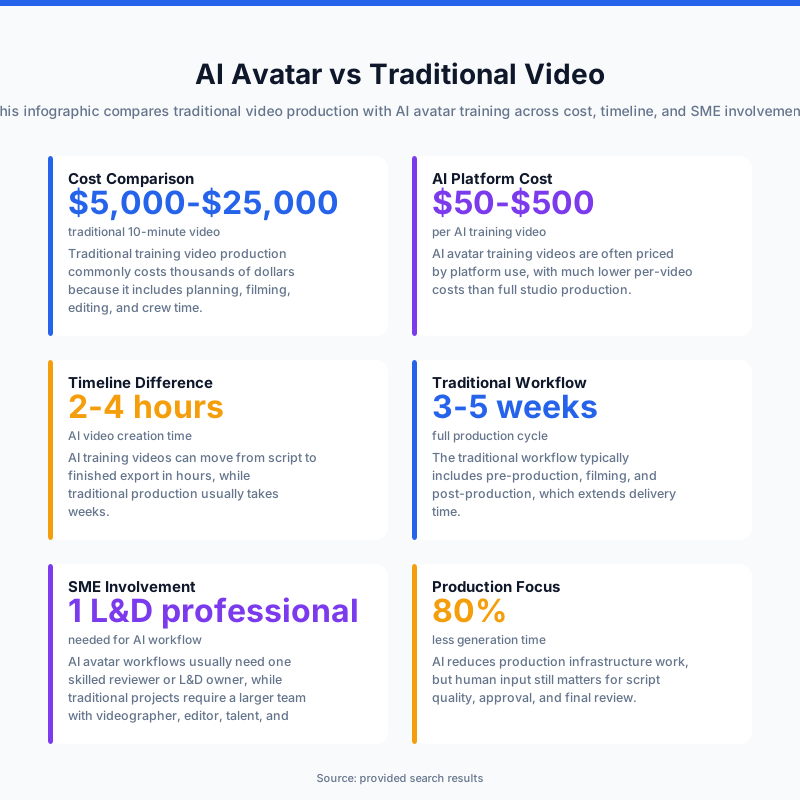
Instead of booking studios, coordinating calendars, and re‑shooting every time your SOP changes, you maintain a reusable digital version of your trainer. According to analysis of corporate training production, AI avatar workflows cut production time from weeks to a few working days and drastically reduce the number of people required in the process.
Skill Studio AI is built around this exact problem: it turns dense SOPs and compliance documents into audit-ready AI avatar training so your QA leads and site directors are no longer the scheduling bottleneck for every new module or update.
Why Are Trainers So Scarce in Regulated Industries?
Trainers are scarce in regulated industries because the people regulators trust as “authoritative” are also the most operationally constrained and heavily audited.
At Annex 1–affected pharma sites, the best trainers are often the sterility assurance lead, QA manager, or head of operations. Those roles carry 24/7 responsibility for production, investigations, and inspections, limiting their availability for scheduled training — especially for re‑takes and updates after each SOP revision.
There’s also a validation angle: you cannot throw just anyone on camera and call it GMP training. Regulators expect traceability from the content back to controlled procedures and qualified experts, so L&D teams repeatedly return to the same small pool of SMEs to keep training defensible.
The result is a classic bottleneck: high volume of regulatory change and CAPA-driven learning needs, but a fixed or shrinking pool of people who are both expert and compliant enough to teach.
Platforms like Skill Studio AI address this by letting you clone a given SME’s teaching style once and then reuse that avatar as you update scripts driven by the latest SOP or CAPA — preserving expert authority without requiring repeated live sessions.
How Do AI Avatars Solve the Expert Bottleneck?
AI avatars solve the expert bottleneck by decoupling training production from the physical availability of trainers.
Traditional corporate training videos lock in whoever was available the day you booked the studio: if that person leaves the company, the brand changes, or the regulation is updated, you are often forced to re‑shoot the whole video. Industry analyses of avatar-based video report production cost reductions of 70–90% and update cycles dropping from weeks to hours because the presenter is now virtual and easily updated.
The typical AI avatar workflow looks like this: the learning designer drafts a script aligned to SOPs, selects a stock or custom avatar, chooses language and voice, generates the video, then routes it for review and LMS publishing — often in 2 to 5 working days instead of months. That means a small L&D team can push through far more updates without dragging SMEs back into recording sessions each time.
For regulated environments, the deeper value is stability: the avatar is consistent and never “resigns,” so your core training library remains coherent across years of audits and workforce turnover.
Skill Studio AI adds regulated-industry depth to this pattern by tying those AI avatar videos directly back to source SOPs, applying version control, and maintaining an audit-ready trail that shows what each avatar said and when — crucial for defending training during FDA 483 remediation or EU GMP inspections.
What Do Regulated Industries Need from AI Avatar Training?
Regulated industries need AI avatar training platforms that prioritise traceability, validation, and localisation over marketing-grade visual tricks.
It is not enough to generate a convincing face on a screen; you need to prove to an inspector how that video relates to specific procedures, when it was approved, who changed it, and which roles it was assigned to. For Annex 1, GxP, or banking compliance, this means:
clear linkage between each AI avatar script and controlled documents (SOPs, policies, work instructions)
role-based targeting so only relevant staff see and attest to certain modules
version control so you can show which version was active at any given time
audit trails and 21 CFR Part 11–style records for completion, assessment, and changes
multilingual consistency so the German, Hindi, and English versions all reflect the same underlying rule set
Industry discussions of AI avatars in learning consistently highlight the importance of integrating avatars into proper learning management systems, not leaving them as standalone videos without tracking or assessment.
Skill Studio AI is purpose-built for these requirements in regulated industries: it wraps AI avatar content generation with role-targeted delivery and version control tied to the source SOP. Multilingual localisation and 21 CFR Part 11 compliance are on the roadmap, not yet shipped.
How Much Time and Cost Can AI Avatars Save?
AI avatars typically save both time and cost by collapsing production workflows from multi-team projects into a single functional stream owned by L&D.
Analysis of corporate training production shows that a traditional studio-based module can cost between roughly $3,000 and $15,000 per finished video, once you factor in presenter time, filming, editing, and project management. In comparison, AI avatar–based modules can drop that to around $20–$100 per module on top of a platform subscription, with production measured in days rather than months.
Industry surveys of L&D teams have linked AI avatar adoption to reductions in training video production costs in the range of 60–80%, with teams reinvesting the savings into broader content coverage and more sophisticated assessment design.
Time savings are just as important: instead of waiting 6–8 weeks to get onto a studio schedule and through edits, compliance teams can push critical updates — for example, after an audit finding or SOP change — into production and deployment in the same week.
For organisations facing $250k+ per audit-remediation training exercise, these efficiency gains compound: fewer external vendors, fewer days of SME recording, and more of the budget directed toward fixing process issues rather than wrangling video logistics.
Skill Studio AI leans into these economics by turning dense SOPs and CAPA documentation directly into structured, avatar-led training, so your highest-cost asset — expert time — is only needed for script validation and final approval, not endless re-recording.
How Should Pharma and GMP Sites Approach AI Avatars?
Pharma and GMP sites should treat AI avatars as a validated extension of their training system, not as a novelty video tool.
That starts with governance: define which content types are suitable for AI delivery (e.g., SOP walk-throughs, deviation case studies, refresher microlearning) and which still demand live sessions (e.g., hands-on aseptic technique assessments, complex investigations). Then document how scripts map to controlled documents, who approves avatar content, and how updates are triggered after SOP revisions or audit findings.
Next, focus your first use cases on areas where trainer scarcity really hurts: media fill preparation, gowning non-conformances, data integrity reminders, or CAPA effectiveness checks. These are the topics that repeatedly drag senior QA and operations leaders into classrooms or Zoom calls at short notice — prime candidates for scalable AI trainers.
Another smart move is to pilot in one facility or product line, measure impact on time-to-release, deviation rates, or retraining cycles, and then expand once your quality unit is comfortable that the AI workflow is controlled and defensible.
Skill Studio AI is already oriented around these scenarios: it is used to transform Annex 1–relevant SOPs, CAPA documentation, and operational manuals into structured AI avatar modules that feed into existing LMS ecosystems like ComplianceWire or Veeva Vault Training.
Training Approach | Strengths | Weaknesses | Best Use Cases |
|---|---|---|---|
Traditional In-Person SME Sessions | High trust, rich discussion, immediate Q&A | Low scalability, heavy SME time cost, no automatic record unless added | Complex investigations, cross-functional CAPA workshops |
Studio-Recorded Human Videos | Polished, familiar format, reusable across cohorts | Expensive to update, tied to presenter availability, longer production cycles | Evergreen orientations, stable procedures |
AI Avatar–Led Training | Fast to produce and update, scalable, lower cost | Needs strong validation and governance, can feel less personal if poorly designed | High-volume SOP training, audit-driven updates, localisation |
Skill Studio AI sits in the third row of that table — AI avatar–led training — but with added focus on audit-ready records, which makes it safer to deploy as a core part of your GMP training matrix rather than as an experiment on the side.
How Do AI Avatars Affect Learning Outcomes and Engagement?
AI avatars affect learning outcomes by making content more accessible, consistent, and personalised while freeing up human trainers for higher-value interactions.
Educational research on AI-based avatars indicates they can support self-regulated learning and engagement when integrated into learning management systems with clear instructional design, rather than used as superficial “talking heads.” For example, AI tutors can prompt learners to reflect, self-assess, and make choices that shape their path through content.
Beyond the qualitative evidence, there is growing appetite from employees for this kind of guidance: one report on AI avatars in work and education found that a significant portion of workers want personalised learning experiences guided by AI avatars, with nearly half expressing a preference for avatar-led guidance in some learning contexts.
Video-based AI avatars also make multilingual delivery more consistent. In enterprise deployments discussed by leading vendors, companies use a single avatar to deliver content in more than 120 languages, improving both reach and standardisation across global sites.
The sweet spot is to use AI avatars for repeatable knowledge transfer — SOP explanations, scenario walk-throughs, quiz feedback — and keep humans for coaching, simulation debriefs, and site-specific nuance. Skill Studio AI supports this blended approach by combining avatar-led explainer segments with built-in practice, assessment, and documentation in one workflow for regulated teams.
What Are the Main Risks and How Do You Mitigate Them?
The main risks of AI avatar trainers in regulated industries are around validation, content drift, and perception — all of which are manageable with the right controls.
From a regulatory standpoint, the core concern is not that the presenter is synthetic, but that the content is accurate, current, and traceable. If the AI avatar delivers a gowning procedure that no longer matches the approved SOP, or if you cannot show who approved the script, you have a problem in an audit.
To mitigate this, you need a documented lifecycle: scripts drafted from controlled documents, reviewed by SMEs, approved by QA, versioned, and then tied into your LMS with clear role assignments and completion tracking. Any change to the underlying SOP should trigger a review of all linked avatar content.
There’s also learner trust and ethics: staff should know when they are watching an AI avatar and who originally authored the content. Transparency here tends to increase acceptance and reduce the feeling of being “trained by a robot.”
Finally, accessibility matters: avatars must work with subtitles, transcripts, and different languages, and should be evaluated for how well they represent the workforce and patients you serve.
Skill Studio AI helps mitigate these risks by embedding version control into the avatar training workflow, tied directly to the source SOP, so your quality unit can validate the process once and then scale confidently across departments. (Audit trails and 21 CFR Part 11-aligned records are on our roadmap, not yet shipped.)
Frequently Asked Questions
Can AI avatar trainers replace human trainers in regulated industries?
No, AI avatar trainers are best seen as force multipliers for human trainers, not replacements. They handle repeatable knowledge transfer at scale, freeing SMEs for investigations, coaching, and live Q&A. Empirical work on AI-powered avatars in professional development recommends blended models where avatars deliver core content while humans provide context and feedback.
Are AI avatars acceptable to regulators like FDA or EMA?
Regulators generally care more about the accuracy, consistency, and traceability of training than the visual format. If your AI avatar content is clearly tied to controlled SOPs, properly versioned, approved by QA, and tracked for completion and assessment, it can fit within a compliant training system. Skill Studio AI supports this today with version control tied to the source SOP; 21 CFR Part 11-aligned records and audit trails are on our roadmap, not yet shipped.
How do AI avatar trainers help during FDA 483 remediation or CAPA rollouts?
During 483 remediation or CAPA rollouts, you usually need rapid, documented training on new or revised procedures across multiple shifts and sites. AI avatars let you convert remediation plans and updated SOPs into consistent video modules quickly, with tracking that shows who was trained, when, and on which version. Skill Studio AI is often deployed in this context to turn dense CAPA documents into targeted, role-based training journeys.
Is cloning an internal trainer as an AI avatar complicated?
Cloning an internal trainer is now relatively straightforward compared to full studio shoots. Leading avatar vendors describe processes where staff record short video samples — sometimes as little as a few minutes — which are then used to create reusable digital presenters. Skill Studio AI supports cloning an SME’s avatar and pairing it with their typical teaching style, making it easier to scale “your” trainer rather than a generic stock face.
How do AI avatars handle multiple languages across global sites?
Some AI avatar platforms support many languages by separating the visual presenter from the underlying audio and text. Skill Studio AI's avatar voices are English-language only today; multilingual localisation is on our roadmap, not yet shipped.
What should I look for when choosing an AI avatar training platform for a GMP site?
For GMP environments, prioritise platforms that offer audit trails, version control, 21 CFR Part 11–aligned records, and role-based delivery, rather than just attractive avatars. You also want clean integration with your existing LMS, strong localisation support, and the ability to map each module back to specific SOPs or CAPAs. Skill Studio AI was designed around version control and role-based delivery for these needs; 21 CFR Part 11-aligned records and localisation support are on our roadmap, not yet shipped, for pharma, banking, and healthcare teams operating under strict regulatory scrutiny.