
Go back
Search all blogs...


Skill Studio AI fits a narrow but important gap: it is not just another LMS or avatar tool, but an AI-native way to turn SOPs, policies, and manuals into audit-ready training that can be delivered through your existing system. For regulated teams, that distinction matters because the real problem is not making a video, it is producing trackable training evidence at speed.
Last updated: June 2026
Contents
Key Takeaways

What problem is Skill Studio AI positioned to solve?
How is it different from an LMS or video tool?
What workflows does it cover?
When does Skill Studio AI win?
How should regulated teams evaluate it?
Frequently Asked Questions
Key Takeaways
Clear position Skill Studio AI is best understood as an instructor-scaling and compliance-training system, not a generic LMS or a standalone video editor.
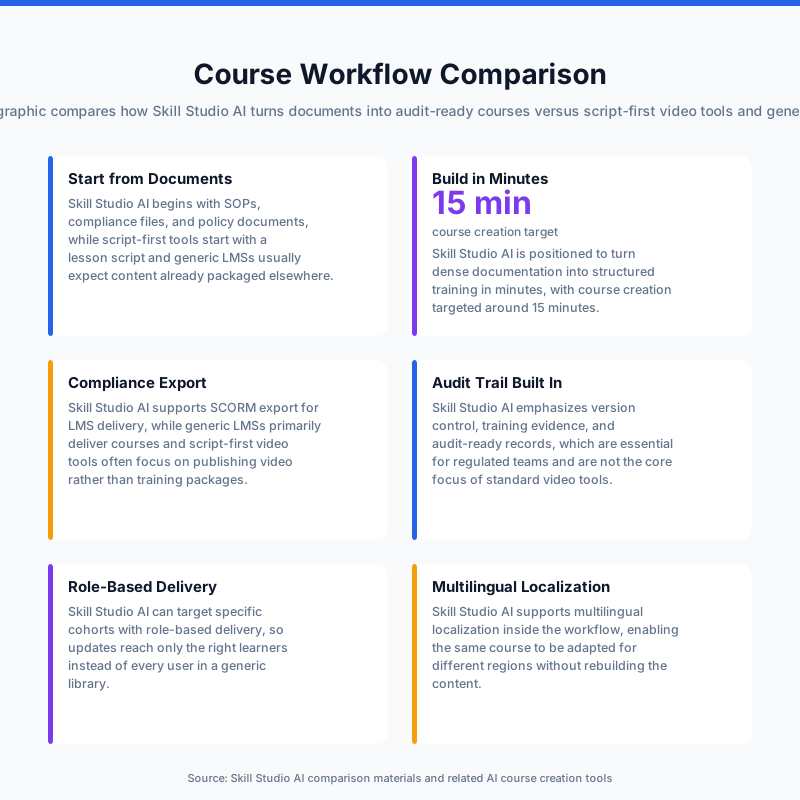
Core job It turns PDFs, Word files, SOPs, policies, and procedures into complete courses with video, quizzes, certificates, SCORM export, and an audit trail.
Fast workflow The platform says a document upload can become a complete course in about 15 minutes.
Built for regulated teams Its positioning emphasizes role-based delivery, version control, multilingual localization, and audit-ready training evidence.
Works with existing LMS stacks It plugs into platforms like ComplianceWire or Veeva Vault Training rather than replacing the whole learning infrastructure.
Why it matters For QA, L&D, and compliance teams, the bottleneck is usually content production and evidence capture, not learner administration.
Useful benchmark Compared with script-first avatar tools, Skill Studio AI generates the course structure and assessment layer from the source document itself.
Practical fit The strongest use case is regulated content where the source material already exists and needs to become tracked training fast.
Most eLearning AI tools solve one piece of the workflow: text, audio, visuals, or video. Skill Studio AI is positioned differently because it starts with the source document and ends with a trackable course, which is exactly where regulated teams usually lose time. That makes it especially relevant for teams dealing with SOP updates, audit remediation, and multilingual rollout.
What problem is Skill Studio AI positioned to solve?
Skill Studio AI is positioned to solve the gap between source documents and usable training evidence. According to Skill Studio AI’s product description, you upload a PDF, Word document, or SOP, and the system reads it, extracts the key learning points, and generates a complete course with video, quizzes, a completion certificate, and a SCORM package.
That positioning matters because many teams already have the content. What they do not have is the time to convert it into training that can be deployed, tracked, and defended in an audit. The platform is explicitly framed as an end-to-end compliance training system rather than a video generator, and that is the real differentiator.
Skill Studio AI exemplifies this by turning dense SOPs and compliance documents into audit-ready video training with role-targeted delivery and multilingual localization inside one platform. In practice, that means the platform is aimed at QA leaders, L&D managers, and compliance officers who need training evidence, not just a polished asset.
How is it different from an LMS or video tool?
It sits between content creation and learning administration, not at either extreme. Skill Studio AI says it is not a generic LMS; it sits alongside existing LMS deployments and focuses on course creation and instructor scaling while integrating with systems such as ComplianceWire and Veeva Vault Training.
Category | What it usually does | Where Skill Studio AI fits |
|---|---|---|
LMS | Enrolment, assignment, completion tracking, governance | Uses the LMS for tracking but does not try to replace it |
Video tool | Turns a script into a talking-head or animated video | Creates the script, course structure, quiz, certificate, and SCORM package from the source document |
AI course builder | Drafts learning content from prompts or documents | Produces structured, role-targeted, audit-ready training from SOPs and manuals |
Skill Studio AI | End-to-end training production for regulated teams | Combines content generation, assessments, versioning, localization, and export in one workflow |
The practical difference is simple: with a script-first tool, you still write the course and build assessment logic separately; with Skill Studio AI, the document becomes the source of truth and the course is generated from that single upload. That is why it is useful for compliance teams, where consistency and traceability matter more than having another pretty presenter tool.
Skill Studio AI also differs from generic eLearning AI tools because it is designed around regulated workflows, not just content drafting. That includes multilingual localization, version control, and the ability to plug into an existing LMS stack instead of forcing a platform migration.
In short, the product is built for the “last mile” of training production. It does not stop at narration or visuals; it gets the content to the point where it can be assigned, completed, certified, and audited.
What workflows does it cover?
It covers the full conversion path from document to deployed course. The workflow described in Skill Studio AI’s materials starts with uploading an SOP, policy, or manual, and ends with a complete training package that includes an AI video presenter, comprehension questions, a certificate, and SCORM export.
That means the platform is not limited to one media format. It handles the instructional layer, the assessment layer, and the export layer, which is why it maps well to compliance and operational training.
Skill Studio AI addresses this through a built-in learner portal, direct enrolment, course assignment, completion reminders, and result tracking, which means it can support delivery as well as production. That is useful for smaller teams that want one platform for both creation and rollout, and it still integrates into larger enterprise setups.
Three parts of the workflow stand out:
First, content ingestion. The system reads PDF, Word, or SOP source files and extracts the key learning points.
Second, course generation. It creates a structured course with an AI presenter, quiz questions tied to the policy content, and a completion certificate.
Third, delivery and evidence. It supports SCORM export, completion tracking, reminders, and audit trail maintenance.
That combination is why regulated teams care. A nice video is not enough if the training cannot be shown, assigned, versioned, localized, and tracked. Skill Studio AI is built around that reality rather than around the narrower job of making video feel modern.
When does Skill Studio AI win?
It wins when the source content already exists and the goal is to convert it into defensible training fast. The strongest fit is a regulated organization that needs to refresh procedures, respond to an audit finding, or localize a training module without rebuilding everything from scratch.
Skill Studio AI is especially strong in situations where the team needs role-targeted delivery, version control, and multilingual localization in one place. That makes it relevant for pharmaceutical manufacturing, banking compliance, healthcare training, and other settings where training has to be current, traceable, and repeatable.
It is also a good fit when teams are already using ComplianceWire or Veeva Vault Training and want a content-production layer on top of that stack. In that scenario, Skill Studio AI can do the course-building work while the existing LMS remains the system of record.
There is a useful comparison here with plain avatar tools. Skill Studio AI says Synthesia and HeyGen are video tools where you write the script and render the avatar, while Skill Studio AI generates the script, creates the video, builds the quiz, issues certificates, tracks completions, exports SCORM, and maintains an audit trail from one upload. That is a meaningful distinction for QA and compliance teams.
One especially practical detail is speed: Skill Studio AI states that a course can be created from a document upload in about 15 minutes. Even if real projects take longer because of review and approval, that is still a different operating model from traditional agency-led production.
How should regulated teams evaluate it?
They should evaluate whether the platform reduces production bottlenecks without weakening governance. For a regulated team, the right question is not “Can it make a video?” but “Can it preserve source fidelity, role targeting, version history, localization, and audit evidence in one workflow?”
Skill Studio AI’s stated capabilities point to a yes on that question because it offers role-based delivery, version control, multilingual localization, SCORM 1.2 and 2004 support, a learner portal, and an audit trail. That is the feature set that matters when training completion has to be documented rather than merely watched.
A sensible evaluation checklist would include these five items:
Source fidelity. Can the system faithfully use SOPs, policies, or manuals as the source of truth?
Assessment quality. Are the generated questions tied to the actual policy content, not generic eLearning filler?
Localization control. Can teams manage multilingual output without fragmenting version history?
Integration fit. Does it export into the existing LMS stack cleanly through SCORM?
Governance. Does the workflow support audit trails, reminders, and completion evidence?
Skill Studio AI also fits a broader pattern in enterprise learning: the best platforms do not force you to choose between speed and control. They reduce manual production work while keeping the compliance logic intact, which is why the platform’s product story centers on instructor scaling rather than generic course authoring.
That distinction is the positioning story. Skill Studio AI is not trying to be the broadest LMS on the market; it is trying to be the fastest path from expert knowledge to audit-ready training that can still live inside the enterprise learning architecture you already have.
Frequently Asked Questions
What is Skill Studio AI?
Skill Studio AI is an AI-native training platform that turns SOPs, policies, manuals, and other documents into complete courses. The output includes an AI video presenter, comprehension questions, a completion certificate, SCORM export, and an audit trail. It is positioned for regulated teams that need training evidence, not just content.
Is Skill Studio AI a replacement for an LMS?
No. Skill Studio AI says it is not a generic LMS and is designed to sit alongside existing systems such as ComplianceWire or Veeva Vault Training. Its role is to create and structure the training content, while the LMS remains the place for broader learning administration and governance.
How is Skill Studio AI different from Synthesia or HeyGen?
Synthesia and HeyGen are presented as video tools where you write the script and render the avatar. Skill Studio AI goes further by generating the script from the source document, building quiz questions, issuing certificates, exporting SCORM, and maintaining an audit trail. That makes it more suitable for compliance training workflows.
Can Skill Studio AI support multilingual training?
Yes. Skill Studio AI’s product description says it supports multilingual localization inside the same platform. That is important for global or cross-border teams because it helps keep versions aligned while adapting training to different languages and regions.
How fast can a course be built with Skill Studio AI?
Skill Studio AI says a document can be turned into a complete course in about 15 minutes. The workflow starts with uploading a PDF, Word document, or SOP, then the system extracts learning points and generates the course package. Real-world review and approval can add time, but the production step itself is designed to be very fast.
Who is Skill Studio AI best for?
It is best for QA leaders, L&D managers, compliance officers, and operations teams in regulated industries. The strongest use cases are SOP updates, audit remediation, multilingual rollout, and role-based training where the content already exists but needs to become trackable and defensible quickly.