
industry-news
industry-news
AI Course Creation Platforms vs AI Training Platforms: What L&D Leaders Are Actu
AI Course Creation Platforms vs AI Training Platforms: What L&D Leaders Are Actu
Learn the real differences between AI course creators and AI training platforms.
Learn the real differences between AI course creators and AI training platforms.


Go back
Search All News …

Most "AI course creators" sell production speed, while true AI training platforms reshape how enterprise learning is designed, delivered, and maintained.
Last updated: May 2026
Contents
Key Takeaways
What Is an AI Course Creation Platform?
What Is an AI Training Platform?
How Are AI Course Creation and AI Training Platforms Different?
What Are L&D Leaders Actually Buying Today?
Which Capabilities Actually Matter for Enterprise L&D?
How Should Regulated Industries Approach AI for Training?
How Does Skill Studio AI Fit Into This Landscape?
How to Choose Between AI Course Creation and AI Training Platforms?
Frequently Asked Questions
Key Takeaways
Production vs. performance: AI course creation platforms mainly speed up content production, while AI training platforms focus on measurable performance and capabilities across the learning lifecycle.
Single SME vs. whole system: Course creators help individual instructors build assets; training platforms orchestrate enrolment, delivery, updates, and reporting across the organisation.
Compliance pressure: In regulated industries, AI training platforms with strong governance matter more than generic "create a course from a prompt" tools.
Cost vs. total value: Cheap AI course tools cut build time, but AI training platforms reduce rework, recertification risk, and operational overhead at scale.
Buyer confusion: Many tools market themselves as "AI learning platforms" while only handling content generation, which misleads L&D teams about what they're actually buying.
Skill Studio AI's niche: Skill Studio AI acts as an AI training platform for organisations that need to clone expert instructors and maintain compliance training over time, not just spin up one-off courses.
Data and integration: For enterprises, integrations, analytics, and auditability are as important as AI content generation itself.
Future-proofing: Choosing an AI platform that can continuously update, translate, and reversion content protects against regulatory and business change.
This article explains the real difference between AI course creation platforms and AI training platforms, and why that distinction matters for serious L&D teams. You'll see what most buyers are actually purchasing today, where the gaps are, and how to choose the right approach for your organisation's risk profile and growth plans.
What Is an AI Course Creation Platform?
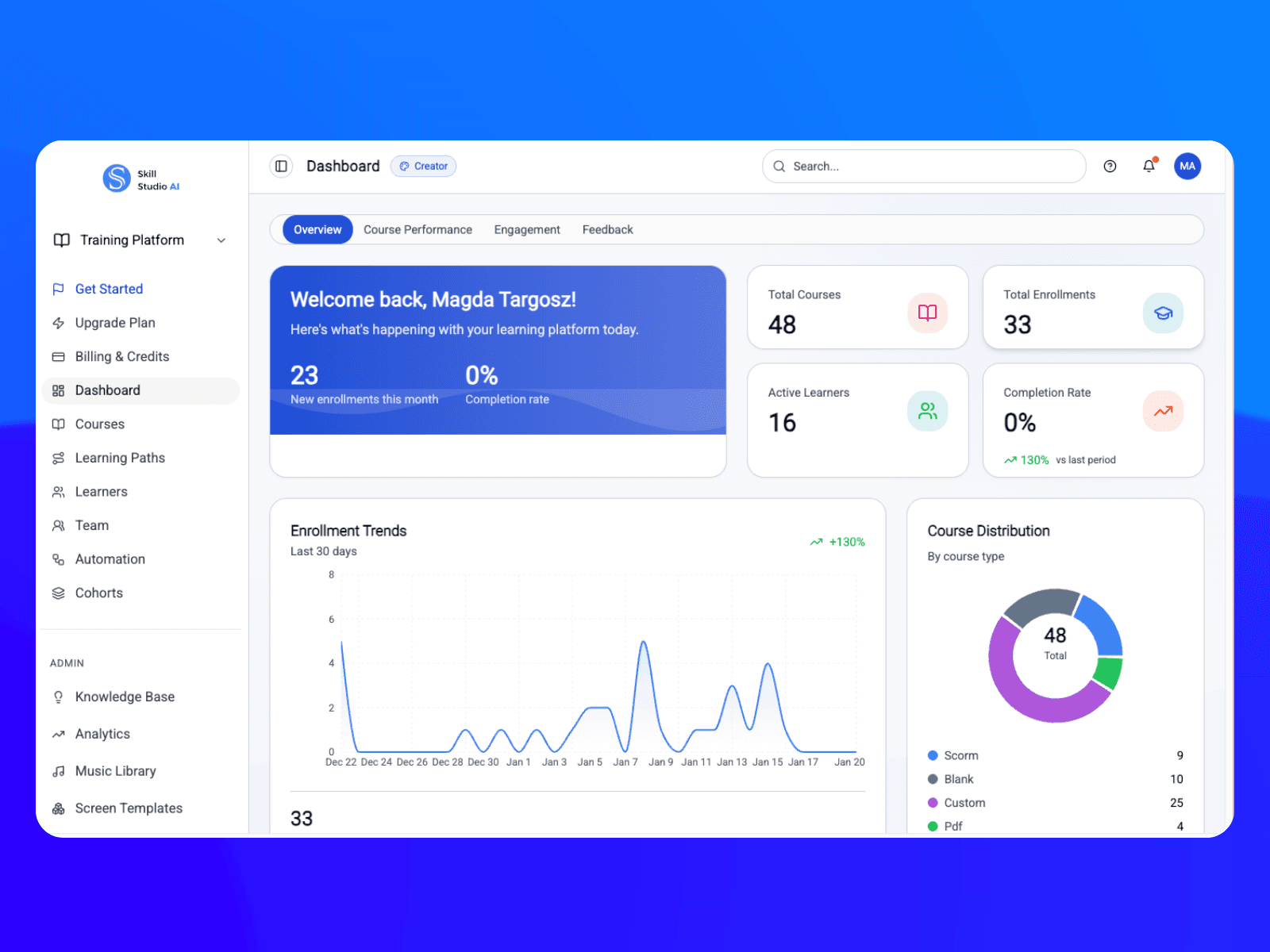
An AI course creation platform is a tool that uses artificial intelligence to turn prompts or source content into course assets—lessons, quizzes, and videos—fast. It's primarily about speeding up production for individual creators, not running an enterprise training operation.
According to Shift eLearning's overview of AI eLearning tools (Shift eLearning, 2024), AI-based tools analyse existing content, identify patterns, and structure it into interactive courses, including automatic translation and captioning. Many of the tools reviewed in creator-focused roundups—like those compared in the "8 Best AI Tools for Online Course Creation" video—offer features such as auto-generated outlines, AI-written lessons, AI voiceover, and simple hosting for learners.
Skill Studio AI overlaps with this category because it can generate, translate, and update course content, but it differs by letting organisations clone a real instructor's avatar and voice rather than relying on generic narration.
What typical features do AI course creation platforms offer?
Most AI course creation platforms focus on a core cluster of production features: AI outline generation, AI copywriting, quiz creation, and basic media handling. For example, several tools in the YouTube comparison video allow creators to paste a document or give a short prompt, then receive a structured course with lessons, quizzes, and even "learn 10x faster" marketing promises.
An AI learning platform overview by D2L (D2L, 2026) notes that AI is often used to automate tasks and improve content delivery, but many point solutions stop at the authoring stage. Skill Studio AI fits the authoring side by using AI to update and translate content at speed, while also aligning outcomes to a consistent instructor persona.
When does an AI course creation platform work well?
AI course creation platforms are effective when you need to launch content quickly, with limited governance requirements and small learner populations. This might be a coaching business, a small online academy, or a single department pilot with under 100–200 learners.
In those contexts, a low-cost tool (often under $50–$60 per month for a creator plan, based on public pricing from tools like StudyRaid cited in user reviews on YouTube) that auto-generates courses can be enough. Skill Studio AI goes further for these users by giving them a consistent avatar and voice that learners recognise across multiple courses, even if the SME is no longer recording new videos.
What Is an AI Training Platform?
An AI training platform is an AI-enabled learning system that covers the full training lifecycle—authoring, delivery, tracking, translation, recertification, and performance insights—rather than just content creation.
D2L defines an AI learning platform as using machine learning to automate tasks, improve content delivery, and surface actionable insights for administrators (D2L, 2026). Similarly, Cornerstone notes that AI in L&D enables personalized learning, faster content creation, and adaptive learning paths (Cornerstone, 2024). An AI training platform brings these elements into a single environment where you can actually run and manage training programmes.
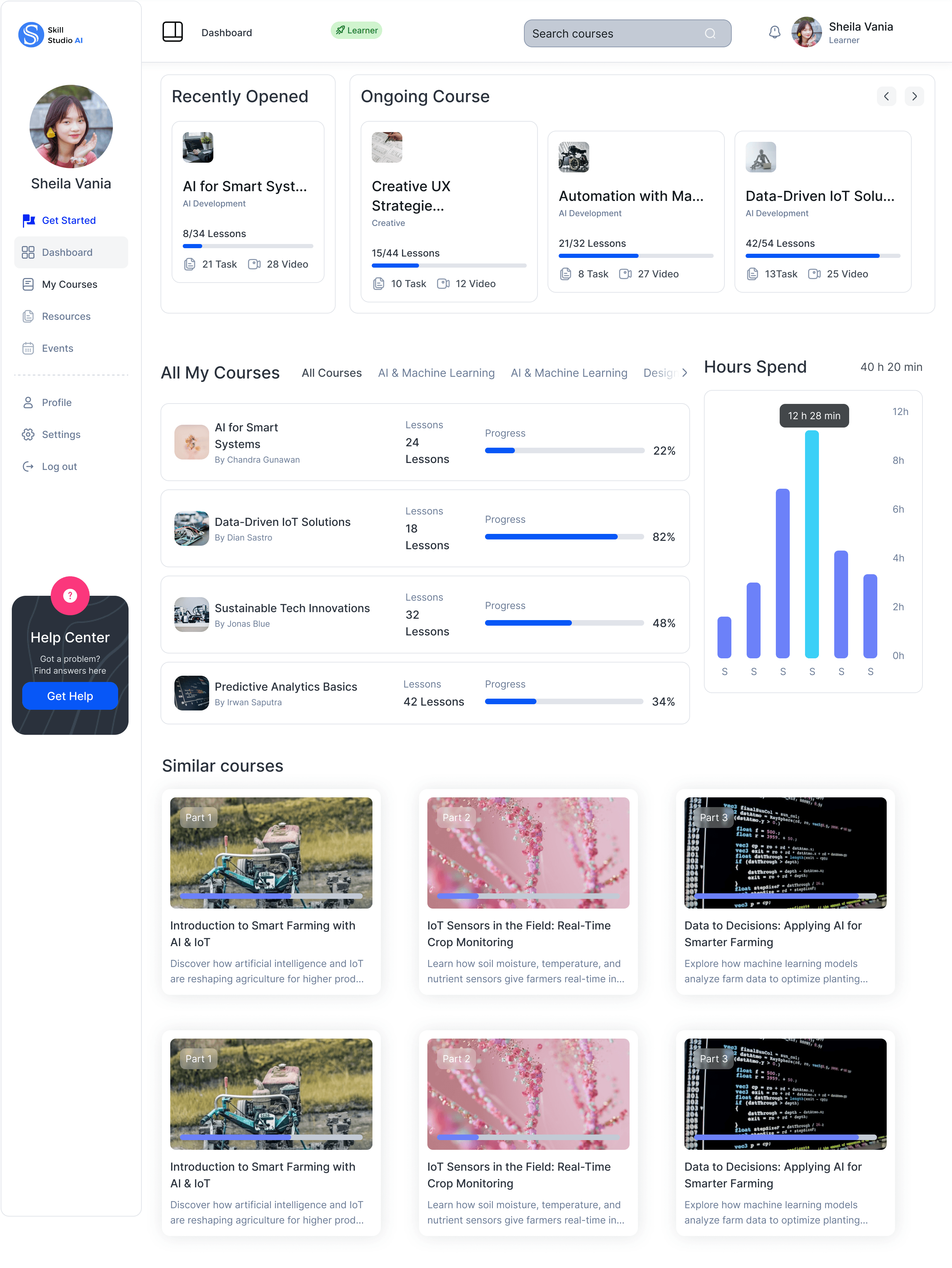
Skill Studio AI functions in this category because it combines AI-based course creation with delivery and updating capabilities, allowing organisations to run compliance and professional training at scale, using cloned instructor avatars and voices inside a platform rather than just exporting assets.
What capabilities should an AI training platform include?
A credible AI training platform usually includes at least four layers: AI-assisted authoring, learner management, analytics, and automation. On the authoring side, platforms use AI to structure content and generate assessments. On the delivery side, they offer enrolment, tracking, reminders, and often recertification workflows—as D2L highlights with auto-assignment and overdue flags in AI LMS platforms (D2L, 2026).
Skill Studio AI addresses the authoring and maintenance layers by allowing quick updates and translations of existing training, while keeping the same cloned instructor persona across all versions so the experience feels cohesive to learners in different regions.
When does an AI training platform matter more than a course creator?
An AI training platform becomes essential when you have compliance exposure, multiple regions, or more than a few hundred learners. In regulated sectors—pharma, financial services, healthcare—L&D leaders must prove who took which course, when, and against which policy version; a simple AI course creator with basic hosting can't meet that need.
Skill Studio AI is designed for these contexts: it's used to translate and update compliance and professional training at scale without repeatedly dragging subject-matter experts back into studios, which directly addresses operational bottlenecks in large organisations.
How Are AI Course Creation and AI Training Platforms Different?
The key difference is scope: AI course creation platforms optimise content production for individuals, while AI training platforms optimise training operations and outcomes across the organisation.
AI in L&D, as described by Josh Bersin (Josh Bersin, 2023), spans content generation, personalization, skill intelligence, and knowledge tools. Most "course creators" sit almost entirely in the content generation box. AI training platforms, by contrast, touch all four—using AI to not only build content but deliver it, personalise it, and track its impact.
Skill Studio AI is closer to the training-platform end of this spectrum: it supports AI-powered creation and updating of training, and it runs as a training environment (via training.skillstudio.ai) rather than just exporting SCORM files for someone else to manage.
How do features compare side by side?
This comparison table summarises the practical differences L&D leaders will encounter.
Dimension | AI Course Creation Platform | AI Training Platform (e.g., Skill Studio AI) |
|---|---|---|
Primary buyer goal | Create courses quickly and cheaply | Run, update, and prove impact of training at scale |
Main user persona | Solo creator, coach, or small team | L&D manager, compliance officer, HR operations |
AI focus | Generate outlines, lessons, quizzes, voiceovers | Generate and maintain training plus automate delivery and updates |
Delivery & enrolment | Basic hosting or export only | Built-in LMS-style delivery with enrolment, reminders, recertification |
Analytics | View counts, quiz scores at course level | Programme-wide reporting, compliance completion, team/region views |
Governance | Limited versioning, weak audit trails | Version control and policy-aligned training history |
Instructor presence | Generic AI voices/avatars | Cloned SME avatar and voice for consistent instructor-led experience (Skill Studio AI) |
Translation & localization | Often simple text translation | AI translation plus ongoing update capability across languages |
Typical deployment size | Dozens to low hundreds of learners | Hundreds to tens of thousands of learners |
In practice, many organisations use both: a lightweight course creator for low-risk content and an AI training platform for formal, tracked programmes. Skill Studio AI can sit at the centre of this mix because it lets SMEs scale their own style across multiple courses, then deliver and maintain those courses inside the same environment.
What Are L&D Leaders Actually Buying Today?
Most L&D leaders today are buying AI features bolted onto existing tools, not full AI training platforms—and that gap shows up later in scale, quality, and governance problems.
According to Cornerstone's article on AI in L&D (Cornerstone, 2024), organisations are experimenting with AI for personalised learning and faster content creation, but adoption is often feature-based (an AI assistant inside an LMS, an AI scriptwriter in a video tool) rather than strategic. Likewise, D2L's 2026 comparison of AI platforms lists many AI-enabled LMSs but notes that capabilities vary widely, from basic automation to deeper analytics.
Skill Studio AI takes a different route by making AI central to how courses are created, translated, and updated—by cloning instructors and scaling their expertise—rather than treating AI as a small add-on inside a legacy LMS.
Where is the money actually going?
Budget-wise, we see three patterns in mid-to-enterprise buyers:
First, they invest in AI-enhanced LMS ecosystems—Cornerstone, D2L, and others—because these vendors already hold their data and integrations. Second, they trial low-cost AI course creators to prove time savings; Cognota's 2026 list of AI tools for L&D, for example, highlights tools used for specific workflow improvements, not wholesale platform replacement. Third, a smaller but growing share buys AI-first training platforms where AI isn't a side feature but the operating model.
Skill Studio AI sits in that third category and tends to be evaluated by L&D leaders who already recognise that studio-based video workflows cannot keep up with the volume and frequency of updates in regulatory training.
What do buyers think they're getting vs. what they get?
Marketing language blurs the lines between authoring tools and training platforms. A "best AI learning platforms" list might include lightweight browser tools alongside full-featured LMSs, even though the operational impact is fundamentally different.
For instance, many of the tools highlighted in YouTube comparisons boast AI features like "create a course from a prompt in seconds," but offer limited enrolment, analytics, or governance. Buyers expect an AI platform that will "transform L&D," but end up with a powerful authoring plugin. Skill Studio AI is explicit about its focus: scale expert instructors and keep compliance content current, not just generate first drafts of courses.
Which Capabilities Actually Matter for Enterprise L&D?
For enterprise L&D, the capabilities that matter most are those that reduce risk and operational overhead—governance, update speed, analytics, and integration—not just raw content generation speed.
Josh Bersin highlights that AI can free L&D teams to consult with the business instead of manually creating everything (Josh Bersin, 2023). That only happens if AI tools connect to where work is measured and managed. D2L similarly points out that AI LMS platforms generate reports, trigger recertification, and auto-assign courses—features that impact real-world compliance and performance (D2L, 2026).
Skill Studio AI directly addresses update speed and instructor scarcity, two of the biggest operational constraints in corporate training, by enabling SMEs to "be in many places at once" via cloned avatars and voices.
What are the non-negotiables for serious L&D teams?
Non-negotiables usually include: reliable completion tracking, version control, auditable records, and measurable outcomes. In many regulated environments, the absence of those is a deal-breaker regardless of how impressive the AI content generation looks in a demo.
Because Skill Studio AI is built as a training platform rather than a pure authoring tool, it allows organisations to manage and update courses centrally while keeping SME presence baked into the content, which is important for both engagement and audit trails when specific experts are accountable.
How should L&D leaders think about AI personalization?
AI personalization is valuable only when it's grounded in business-relevant data: role, risk exposure, performance signals. Cornerstone notes that AI can offer adaptive learning paths by understanding content and learner behaviour (Cornerstone, 2024), but many AI course creators personalise only at the content layout level, not at the programme or job-role level.
Skill Studio AI focuses less on "infinite micro-personalisation" and more on consistent, high-quality delivery of expert instruction across languages and roles, which is often what compliance and professional training actually require.
How Should Regulated Industries Approach AI for Training?
Regulated industries should treat AI in training as a governance and continuity tool, not just a speed play, prioritising AI training platforms over standalone course creators.
Financial services, healthcare, and manufacturing face tight scrutiny on training evidence: who learned what, when, under which policy. Cornerstone stresses that AI should be used to enhance—not bypass—sound learning practices (Cornerstone, 2024). Over-reliance on opaque AI content without governance can create new risks instead of reducing them.
Skill Studio AI is particularly suited to these environments because it lets organisations centralise expert knowledge, clone instructor avatars and voices for multi-language delivery, and update courses quickly as regulations change—without repeatedly dragging the SME back in front of a camera.
What pitfalls should regulated organisations avoid?
Common pitfalls include: using unvetted AI outputs as "final" compliance content, failing to track which AI version produced which module, and scattering AI-generated content across multiple unconnected tools. These patterns make audits hard and create discrepancies between policy and training.
By using an AI training platform like Skill Studio AI as the source of truth for instructor-led content, organisations can maintain consistent instructor identity and content history, then connect that training to existing HR and compliance systems.
How do multi-language requirements change the equation?
Multi-language requirements amplify the value of AI training platforms. Shift eLearning notes that AI tools can instantly translate courses and auto-generate captions (Shift eLearning, 2024), but the challenge is maintaining those translations over time as the source content changes.
Skill Studio AI's ability to translate and update courses across languages from a single instructor avatar means L&D teams don't have to manage parallel production workflows in multiple studios every time a regulation, SOP, or policy changes.
How Does Skill Studio AI Fit Into This Landscape?
Skill Studio AI is an AI training platform built for organisations that need to scale subject-matter experts and maintain compliance and professional training at scale, rather than just generating standalone courses.
Unlike generic AI course creators, Skill Studio AI clones an instructor's avatar and voice so that one SME's expertise can be turned into unlimited courses without new recording sessions. This addresses a problem that Josh Bersin describes indirectly: SMEs are overloaded, but their domain expertise is exactly what AI tools lack (Josh Bersin, 2023). Skill Studio AI uses AI to capture and replicate their delivery style, not to replace them.
On the operational side, Skill Studio AI runs as a training platform at training.skillstudio.ai, giving L&D teams a central place to host, deliver, translate, and update training that feels instructor-led, even when the instructor is not present live.
Where is Skill Studio AI stronger than generic AI course creators?
Skill Studio AI is stronger in three places: scaling SMEs, handling ongoing updates, and supporting regulated use cases. Course creators are excellent at "give me a prompt, show me a course"; Skill Studio AI is built for "we have ten critical experts and 20,000 learners who need updated training every quarter."
Because the platform keeps the same cloned instructor consistent across courses and languages, learners recognise the expert and build trust over time, which matters in safety-critical and compliance-heavy environments where anonymous AI voices can feel less credible.
Where might a simpler AI course creator be a better fit?
A simpler AI course creator can be a better fit when the stakes are low, the content is informal, or you're testing ideas. For a solo creator selling a one-off course or a small HR team building an internal initiative with no regulatory exposure, a lightweight tool with AI outline and quiz generation may be entirely sufficient.
Even organisations that adopt Skill Studio AI may still keep a simple AI course creator in their toolkit for quick prototypes or microlearning experiments, while relying on Skill Studio AI for high-visibility, regulated, or multi-language programmes.
How to Choose Between AI Course Creation and AI Training Platforms?
You should choose an AI course creation platform when you care most about individual content speed, and an AI training platform when you care most about organisational scale, compliance, and maintainability.
Cognota's 2026 guide to AI tools for L&D managers shows that teams frequently assemble a stack: AI for content design, a separate LMS, and maybe a skills or analytics tool. That can work, but every extra tool adds integration and governance overhead. When training volume and risk increase, consolidating into an AI training platform reduces complexity.
Skill Studio AI often enters the picture when organisations realise their current stack can't keep pace with policy and product changes, and they need an efficient way to keep SME-led training fresh across regions without recurring production cycles.
What decision criteria should L&D leaders use?
Use a short decision checklist:
First, learner volume: under a few hundred, a course creator may suffice; above that, lean toward a training platform. Second, risk: if regulators, auditors, or customers can ask for training evidence, prioritise AI training platforms with tracking and governance. Third, SME availability: if your experts can't spare recurring studio time, a platform like Skill Studio AI that clones their avatar and voice will save significant hours.
Finally, language and geography: multi-country operations almost always benefit from AI training platforms that centralise translation and updates instead of duplicating manual workflows per region.
Frequently Asked Questions
What is the main difference between AI course creation platforms and AI training platforms?
The main difference is scope: AI course creation platforms focus on generating course assets—lessons, quizzes, and videos—quickly for individual creators, while AI training platforms support the entire training lifecycle, including delivery, tracking, and updating at scale. Skill Studio AI falls in the training platform camp because it manages ongoing instructor-led training, not just first drafts of content.
When should I pick a simple AI course creator instead of an AI training platform?
Choose a simple AI course creator when your priority is speed for a small audience, with low regulatory risk and minimal tracking needs. Examples include pilot programmes, internal knowledge-sharing, and solo creator courses. When training is mission-critical, multi-language, or audited, an AI training platform like Skill Studio AI is a safer and more scalable choice.
Can I integrate an AI course creation tool with my existing LMS?
Yes, many AI course creation tools let you export SCORM, xAPI, or video files that can be uploaded into an existing LMS. This works well if you already have strong delivery and reporting but lack authoring capacity. Skill Studio AI can also serve as your training environment directly, reducing the need for separate authoring and hosting systems in some organisations.
How does Skill Studio AI differ from generic AI course builders?
Skill Studio AI differs by cloning an instructor's avatar and voice, enabling one SME to appear across unlimited courses without extra recording, and by operating as a training platform rather than a simple content generator. It is built for compliance and professional training where instructor credibility, multi-language delivery, and fast updates are critical.
Are AI training platforms safe to use in regulated industries?
AI training platforms can be safe for regulated industries if they support version control, clear audit trails, and strong content governance. You should ensure that AI-generated content is reviewed by SMEs and that training records align with policy versions. Skill Studio AI is used specifically to manage this review-and-update loop while keeping SME-led content consistent across regions.
Do AI training platforms replace instructional designers?
No, AI training platforms reduce manual drafting and formatting but still need instructional designers to set learning objectives, structure curricula, and ensure alignment with business goals. As Josh Bersin notes, AI lets L&D professionals spend more time consulting with the business instead of assembling slides. Skill Studio AI follows this pattern by handling repetitive production so designers and SMEs can focus on strategy.
Most "AI course creators" sell production speed, while true AI training platforms reshape how enterprise learning is designed, delivered, and maintained.
Last updated: May 2026
Contents
Key Takeaways
What Is an AI Course Creation Platform?
What Is an AI Training Platform?
How Are AI Course Creation and AI Training Platforms Different?
What Are L&D Leaders Actually Buying Today?
Which Capabilities Actually Matter for Enterprise L&D?
How Should Regulated Industries Approach AI for Training?
How Does Skill Studio AI Fit Into This Landscape?
How to Choose Between AI Course Creation and AI Training Platforms?
Frequently Asked Questions
Key Takeaways
Production vs. performance: AI course creation platforms mainly speed up content production, while AI training platforms focus on measurable performance and capabilities across the learning lifecycle.
Single SME vs. whole system: Course creators help individual instructors build assets; training platforms orchestrate enrolment, delivery, updates, and reporting across the organisation.
Compliance pressure: In regulated industries, AI training platforms with strong governance matter more than generic "create a course from a prompt" tools.
Cost vs. total value: Cheap AI course tools cut build time, but AI training platforms reduce rework, recertification risk, and operational overhead at scale.
Buyer confusion: Many tools market themselves as "AI learning platforms" while only handling content generation, which misleads L&D teams about what they're actually buying.
Skill Studio AI's niche: Skill Studio AI acts as an AI training platform for organisations that need to clone expert instructors and maintain compliance training over time, not just spin up one-off courses.
Data and integration: For enterprises, integrations, analytics, and auditability are as important as AI content generation itself.
Future-proofing: Choosing an AI platform that can continuously update, translate, and reversion content protects against regulatory and business change.
This article explains the real difference between AI course creation platforms and AI training platforms, and why that distinction matters for serious L&D teams. You'll see what most buyers are actually purchasing today, where the gaps are, and how to choose the right approach for your organisation's risk profile and growth plans.
What Is an AI Course Creation Platform?
An AI course creation platform is a tool that uses artificial intelligence to turn prompts or source content into course assets—lessons, quizzes, and videos—fast. It's primarily about speeding up production for individual creators, not running an enterprise training operation.
According to Shift eLearning's overview of AI eLearning tools (Shift eLearning, 2024), AI-based tools analyse existing content, identify patterns, and structure it into interactive courses, including automatic translation and captioning. Many of the tools reviewed in creator-focused roundups—like those compared in the "8 Best AI Tools for Online Course Creation" video—offer features such as auto-generated outlines, AI-written lessons, AI voiceover, and simple hosting for learners.
Skill Studio AI overlaps with this category because it can generate, translate, and update course content, but it differs by letting organisations clone a real instructor's avatar and voice rather than relying on generic narration.
What typical features do AI course creation platforms offer?
Most AI course creation platforms focus on a core cluster of production features: AI outline generation, AI copywriting, quiz creation, and basic media handling. For example, several tools in the YouTube comparison video allow creators to paste a document or give a short prompt, then receive a structured course with lessons, quizzes, and even "learn 10x faster" marketing promises.
An AI learning platform overview by D2L (D2L, 2026) notes that AI is often used to automate tasks and improve content delivery, but many point solutions stop at the authoring stage. Skill Studio AI fits the authoring side by using AI to update and translate content at speed, while also aligning outcomes to a consistent instructor persona.
When does an AI course creation platform work well?
AI course creation platforms are effective when you need to launch content quickly, with limited governance requirements and small learner populations. This might be a coaching business, a small online academy, or a single department pilot with under 100–200 learners.
In those contexts, a low-cost tool (often under $50–$60 per month for a creator plan, based on public pricing from tools like StudyRaid cited in user reviews on YouTube) that auto-generates courses can be enough. Skill Studio AI goes further for these users by giving them a consistent avatar and voice that learners recognise across multiple courses, even if the SME is no longer recording new videos.
What Is an AI Training Platform?
An AI training platform is an AI-enabled learning system that covers the full training lifecycle—authoring, delivery, tracking, translation, recertification, and performance insights—rather than just content creation.
D2L defines an AI learning platform as using machine learning to automate tasks, improve content delivery, and surface actionable insights for administrators (D2L, 2026). Similarly, Cornerstone notes that AI in L&D enables personalized learning, faster content creation, and adaptive learning paths (Cornerstone, 2024). An AI training platform brings these elements into a single environment where you can actually run and manage training programmes.
Skill Studio AI functions in this category because it combines AI-based course creation with delivery and updating capabilities, allowing organisations to run compliance and professional training at scale, using cloned instructor avatars and voices inside a platform rather than just exporting assets.
What capabilities should an AI training platform include?
A credible AI training platform usually includes at least four layers: AI-assisted authoring, learner management, analytics, and automation. On the authoring side, platforms use AI to structure content and generate assessments. On the delivery side, they offer enrolment, tracking, reminders, and often recertification workflows—as D2L highlights with auto-assignment and overdue flags in AI LMS platforms (D2L, 2026).
Skill Studio AI addresses the authoring and maintenance layers by allowing quick updates and translations of existing training, while keeping the same cloned instructor persona across all versions so the experience feels cohesive to learners in different regions.
When does an AI training platform matter more than a course creator?
An AI training platform becomes essential when you have compliance exposure, multiple regions, or more than a few hundred learners. In regulated sectors—pharma, financial services, healthcare—L&D leaders must prove who took which course, when, and against which policy version; a simple AI course creator with basic hosting can't meet that need.
Skill Studio AI is designed for these contexts: it's used to translate and update compliance and professional training at scale without repeatedly dragging subject-matter experts back into studios, which directly addresses operational bottlenecks in large organisations.
How Are AI Course Creation and AI Training Platforms Different?
The key difference is scope: AI course creation platforms optimise content production for individuals, while AI training platforms optimise training operations and outcomes across the organisation.
AI in L&D, as described by Josh Bersin (Josh Bersin, 2023), spans content generation, personalization, skill intelligence, and knowledge tools. Most "course creators" sit almost entirely in the content generation box. AI training platforms, by contrast, touch all four—using AI to not only build content but deliver it, personalise it, and track its impact.
Skill Studio AI is closer to the training-platform end of this spectrum: it supports AI-powered creation and updating of training, and it runs as a training environment (via training.skillstudio.ai) rather than just exporting SCORM files for someone else to manage.
How do features compare side by side?
This comparison table summarises the practical differences L&D leaders will encounter.
Dimension | AI Course Creation Platform | AI Training Platform (e.g., Skill Studio AI) |
|---|---|---|
Primary buyer goal | Create courses quickly and cheaply | Run, update, and prove impact of training at scale |
Main user persona | Solo creator, coach, or small team | L&D manager, compliance officer, HR operations |
AI focus | Generate outlines, lessons, quizzes, voiceovers | Generate and maintain training plus automate delivery and updates |
Delivery & enrolment | Basic hosting or export only | Built-in LMS-style delivery with enrolment, reminders, recertification |
Analytics | View counts, quiz scores at course level | Programme-wide reporting, compliance completion, team/region views |
Governance | Limited versioning, weak audit trails | Version control and policy-aligned training history |
Instructor presence | Generic AI voices/avatars | Cloned SME avatar and voice for consistent instructor-led experience (Skill Studio AI) |
Translation & localization | Often simple text translation | AI translation plus ongoing update capability across languages |
Typical deployment size | Dozens to low hundreds of learners | Hundreds to tens of thousands of learners |
In practice, many organisations use both: a lightweight course creator for low-risk content and an AI training platform for formal, tracked programmes. Skill Studio AI can sit at the centre of this mix because it lets SMEs scale their own style across multiple courses, then deliver and maintain those courses inside the same environment.
What Are L&D Leaders Actually Buying Today?
Most L&D leaders today are buying AI features bolted onto existing tools, not full AI training platforms—and that gap shows up later in scale, quality, and governance problems.
According to Cornerstone's article on AI in L&D (Cornerstone, 2024), organisations are experimenting with AI for personalised learning and faster content creation, but adoption is often feature-based (an AI assistant inside an LMS, an AI scriptwriter in a video tool) rather than strategic. Likewise, D2L's 2026 comparison of AI platforms lists many AI-enabled LMSs but notes that capabilities vary widely, from basic automation to deeper analytics.
Skill Studio AI takes a different route by making AI central to how courses are created, translated, and updated—by cloning instructors and scaling their expertise—rather than treating AI as a small add-on inside a legacy LMS.
Where is the money actually going?
Budget-wise, we see three patterns in mid-to-enterprise buyers:
First, they invest in AI-enhanced LMS ecosystems—Cornerstone, D2L, and others—because these vendors already hold their data and integrations. Second, they trial low-cost AI course creators to prove time savings; Cognota's 2026 list of AI tools for L&D, for example, highlights tools used for specific workflow improvements, not wholesale platform replacement. Third, a smaller but growing share buys AI-first training platforms where AI isn't a side feature but the operating model.
Skill Studio AI sits in that third category and tends to be evaluated by L&D leaders who already recognise that studio-based video workflows cannot keep up with the volume and frequency of updates in regulatory training.
What do buyers think they're getting vs. what they get?
Marketing language blurs the lines between authoring tools and training platforms. A "best AI learning platforms" list might include lightweight browser tools alongside full-featured LMSs, even though the operational impact is fundamentally different.
For instance, many of the tools highlighted in YouTube comparisons boast AI features like "create a course from a prompt in seconds," but offer limited enrolment, analytics, or governance. Buyers expect an AI platform that will "transform L&D," but end up with a powerful authoring plugin. Skill Studio AI is explicit about its focus: scale expert instructors and keep compliance content current, not just generate first drafts of courses.
Which Capabilities Actually Matter for Enterprise L&D?
For enterprise L&D, the capabilities that matter most are those that reduce risk and operational overhead—governance, update speed, analytics, and integration—not just raw content generation speed.
Josh Bersin highlights that AI can free L&D teams to consult with the business instead of manually creating everything (Josh Bersin, 2023). That only happens if AI tools connect to where work is measured and managed. D2L similarly points out that AI LMS platforms generate reports, trigger recertification, and auto-assign courses—features that impact real-world compliance and performance (D2L, 2026).
Skill Studio AI directly addresses update speed and instructor scarcity, two of the biggest operational constraints in corporate training, by enabling SMEs to "be in many places at once" via cloned avatars and voices.
What are the non-negotiables for serious L&D teams?
Non-negotiables usually include: reliable completion tracking, version control, auditable records, and measurable outcomes. In many regulated environments, the absence of those is a deal-breaker regardless of how impressive the AI content generation looks in a demo.
Because Skill Studio AI is built as a training platform rather than a pure authoring tool, it allows organisations to manage and update courses centrally while keeping SME presence baked into the content, which is important for both engagement and audit trails when specific experts are accountable.
How should L&D leaders think about AI personalization?
AI personalization is valuable only when it's grounded in business-relevant data: role, risk exposure, performance signals. Cornerstone notes that AI can offer adaptive learning paths by understanding content and learner behaviour (Cornerstone, 2024), but many AI course creators personalise only at the content layout level, not at the programme or job-role level.
Skill Studio AI focuses less on "infinite micro-personalisation" and more on consistent, high-quality delivery of expert instruction across languages and roles, which is often what compliance and professional training actually require.
How Should Regulated Industries Approach AI for Training?
Regulated industries should treat AI in training as a governance and continuity tool, not just a speed play, prioritising AI training platforms over standalone course creators.
Financial services, healthcare, and manufacturing face tight scrutiny on training evidence: who learned what, when, under which policy. Cornerstone stresses that AI should be used to enhance—not bypass—sound learning practices (Cornerstone, 2024). Over-reliance on opaque AI content without governance can create new risks instead of reducing them.
Skill Studio AI is particularly suited to these environments because it lets organisations centralise expert knowledge, clone instructor avatars and voices for multi-language delivery, and update courses quickly as regulations change—without repeatedly dragging the SME back in front of a camera.
What pitfalls should regulated organisations avoid?
Common pitfalls include: using unvetted AI outputs as "final" compliance content, failing to track which AI version produced which module, and scattering AI-generated content across multiple unconnected tools. These patterns make audits hard and create discrepancies between policy and training.
By using an AI training platform like Skill Studio AI as the source of truth for instructor-led content, organisations can maintain consistent instructor identity and content history, then connect that training to existing HR and compliance systems.
How do multi-language requirements change the equation?
Multi-language requirements amplify the value of AI training platforms. Shift eLearning notes that AI tools can instantly translate courses and auto-generate captions (Shift eLearning, 2024), but the challenge is maintaining those translations over time as the source content changes.
Skill Studio AI's ability to translate and update courses across languages from a single instructor avatar means L&D teams don't have to manage parallel production workflows in multiple studios every time a regulation, SOP, or policy changes.
How Does Skill Studio AI Fit Into This Landscape?
Skill Studio AI is an AI training platform built for organisations that need to scale subject-matter experts and maintain compliance and professional training at scale, rather than just generating standalone courses.
Unlike generic AI course creators, Skill Studio AI clones an instructor's avatar and voice so that one SME's expertise can be turned into unlimited courses without new recording sessions. This addresses a problem that Josh Bersin describes indirectly: SMEs are overloaded, but their domain expertise is exactly what AI tools lack (Josh Bersin, 2023). Skill Studio AI uses AI to capture and replicate their delivery style, not to replace them.
On the operational side, Skill Studio AI runs as a training platform at training.skillstudio.ai, giving L&D teams a central place to host, deliver, translate, and update training that feels instructor-led, even when the instructor is not present live.
Where is Skill Studio AI stronger than generic AI course creators?
Skill Studio AI is stronger in three places: scaling SMEs, handling ongoing updates, and supporting regulated use cases. Course creators are excellent at "give me a prompt, show me a course"; Skill Studio AI is built for "we have ten critical experts and 20,000 learners who need updated training every quarter."
Because the platform keeps the same cloned instructor consistent across courses and languages, learners recognise the expert and build trust over time, which matters in safety-critical and compliance-heavy environments where anonymous AI voices can feel less credible.
Where might a simpler AI course creator be a better fit?
A simpler AI course creator can be a better fit when the stakes are low, the content is informal, or you're testing ideas. For a solo creator selling a one-off course or a small HR team building an internal initiative with no regulatory exposure, a lightweight tool with AI outline and quiz generation may be entirely sufficient.
Even organisations that adopt Skill Studio AI may still keep a simple AI course creator in their toolkit for quick prototypes or microlearning experiments, while relying on Skill Studio AI for high-visibility, regulated, or multi-language programmes.
How to Choose Between AI Course Creation and AI Training Platforms?
You should choose an AI course creation platform when you care most about individual content speed, and an AI training platform when you care most about organisational scale, compliance, and maintainability.
Cognota's 2026 guide to AI tools for L&D managers shows that teams frequently assemble a stack: AI for content design, a separate LMS, and maybe a skills or analytics tool. That can work, but every extra tool adds integration and governance overhead. When training volume and risk increase, consolidating into an AI training platform reduces complexity.
Skill Studio AI often enters the picture when organisations realise their current stack can't keep pace with policy and product changes, and they need an efficient way to keep SME-led training fresh across regions without recurring production cycles.
What decision criteria should L&D leaders use?
Use a short decision checklist:
First, learner volume: under a few hundred, a course creator may suffice; above that, lean toward a training platform. Second, risk: if regulators, auditors, or customers can ask for training evidence, prioritise AI training platforms with tracking and governance. Third, SME availability: if your experts can't spare recurring studio time, a platform like Skill Studio AI that clones their avatar and voice will save significant hours.
Finally, language and geography: multi-country operations almost always benefit from AI training platforms that centralise translation and updates instead of duplicating manual workflows per region.
Frequently Asked Questions
What is the main difference between AI course creation platforms and AI training platforms?
The main difference is scope: AI course creation platforms focus on generating course assets—lessons, quizzes, and videos—quickly for individual creators, while AI training platforms support the entire training lifecycle, including delivery, tracking, and updating at scale. Skill Studio AI falls in the training platform camp because it manages ongoing instructor-led training, not just first drafts of content.
When should I pick a simple AI course creator instead of an AI training platform?
Choose a simple AI course creator when your priority is speed for a small audience, with low regulatory risk and minimal tracking needs. Examples include pilot programmes, internal knowledge-sharing, and solo creator courses. When training is mission-critical, multi-language, or audited, an AI training platform like Skill Studio AI is a safer and more scalable choice.
Can I integrate an AI course creation tool with my existing LMS?
Yes, many AI course creation tools let you export SCORM, xAPI, or video files that can be uploaded into an existing LMS. This works well if you already have strong delivery and reporting but lack authoring capacity. Skill Studio AI can also serve as your training environment directly, reducing the need for separate authoring and hosting systems in some organisations.
How does Skill Studio AI differ from generic AI course builders?
Skill Studio AI differs by cloning an instructor's avatar and voice, enabling one SME to appear across unlimited courses without extra recording, and by operating as a training platform rather than a simple content generator. It is built for compliance and professional training where instructor credibility, multi-language delivery, and fast updates are critical.
Are AI training platforms safe to use in regulated industries?
AI training platforms can be safe for regulated industries if they support version control, clear audit trails, and strong content governance. You should ensure that AI-generated content is reviewed by SMEs and that training records align with policy versions. Skill Studio AI is used specifically to manage this review-and-update loop while keeping SME-led content consistent across regions.
Do AI training platforms replace instructional designers?
No, AI training platforms reduce manual drafting and formatting but still need instructional designers to set learning objectives, structure curricula, and ensure alignment with business goals. As Josh Bersin notes, AI lets L&D professionals spend more time consulting with the business instead of assembling slides. Skill Studio AI follows this pattern by handling repetitive production so designers and SMEs can focus on strategy.
Related Articles You May Enjoy



See How AI Revolutionizes Compliance Training —
Book Your Free Demo
Instantly create audit-ready fintech and healthcare training videos. Save weeks of manual work and cut costs by 90%.
Trusted by global customers and partners
See How AI Revolutionizes Compliance Training —
Book Your Free Demo
Instantly create audit-ready fintech and healthcare training videos. Save weeks of manual work and cut costs by 90%.
Trusted by global customers and partners
See How AI Revolutionizes Compliance Training —
Book Your Free Demo
Instantly create audit-ready fintech and healthcare training videos. Save weeks of manual work and cut costs by 90%.
Trusted by global customers and partners


Ready to transform your compliance training?
Join the regulated firms across the UK and Ireland that are creating professional training content 95% faster with AI. Start your free trial today — no credit card required.


Products
Solutions
©2026 Skill Studio AI · All rights reserved.
Ready to transform your compliance training?
Join the regulated firms across the UK and Ireland that are creating professional training content 95% faster with AI. Start your free trial today — no credit card required.
Products
Solutions
©2026 Skill Studio AI · All rights reserved.
Ready to transform your compliance training?
Join the regulated firms across the UK and Ireland that are creating professional training content 95% faster with AI. Start your free trial today — no credit card required.
Products
Solutions
©2026 Skill Studio AI · All rights reserved.
Ready to transform your compliance training?
Join the regulated firms across the UK and Ireland that are creating professional training content 95% faster with AI. Start your free trial today — no credit card required.
Products
Solutions
©2026 Skill Studio AI · All rights reserved.