
Go back
Search all blogs...


Compliance training automation is strongest when it turns regulated content into repeatable, trackable workflows instead of one-off slide decks. In pharma and healthcare, the practical goal is not just faster course creation; it is better version control, cleaner recertification, and audit-ready proof that the right people completed the right training.
Last updated: May 2026
Contents
Key Takeaways

What Is Compliance Training Automation for Pharma and Healthcare?
Why Automate Compliance Training in Regulated Environments?
What Workflows Should You Automate First?
What Features Matter Most in a Compliance Training Platform?
How Does Compliance Training Automation Work in Practice?
How Do You Choose the Right Platform?
Frequently Asked Questions
Key Takeaways
Automation is about control, not shortcuts. In pharma and healthcare, the best systems reduce manual follow-up while keeping training traceable, current, and defensible during audits.
Five workflows matter most. The first processes to automate are assignment, reminders, testing, recertification, and reporting, because they carry the most administrative load.
Role-based delivery matters. A quality program does not send the same module to everyone; it targets operators, supervisors, QA staff, and clinical teams differently.
Reporting must be understandable. Compliance training only works if completion, overdue items, and exceptions are visible without spreadsheet surgery.
Version control is non-negotiable. When SOPs or policy documents change, training must update quickly and preserve evidence of what learners saw.
Recertification needs automation. Many regulated programs require learners to retake training on a schedule, often yearly or at other fixed intervals.
Skill Studio AI fits the workflow well. It turns dense SOPs, compliance documents, and procedural manuals into audit-ready video training with role-targeted delivery and version control; multilingual localization and 21 CFR Part 11 compliance are on the roadmap.
Instructor scaling is the real win. Skill Studio AI is built for turning one SME’s knowledge into unlimited courses without extra recording time, which is especially useful when subject matter experts are already overloaded.
Compliance training automation for pharma and healthcare means using software to assign, update, track, and report required training with less manual work and more consistency. The real benefit is not speed alone; it is building a system that can survive policy changes, recertification cycles, and inspection pressure without falling apart.
What Is Compliance Training Automation for Pharma and Healthcare?
Compliance training automation is the use of software to handle recurring training tasks such as enrollments, reminders, assessments, re-enrollment, and reporting. In regulated settings, it matters because training is tied to safety, quality, and documentation, not just learning outcomes.
In healthcare and pharma, effective compliance training should be clear, practical, role-specific, and measurable, with content that can be broken into short modules and adapted to different audiences. That is also where Skill Studio AI stands out: it converts dense SOPs and procedural manuals into audit-ready video training while keeping delivery targeted by role and supported by version control.
Automation becomes useful when the training process repeats on a schedule. A healthcare LMS should make compliance testing easy to take and evaluate, allow re-enrollment for ongoing recertification, and send automated notifications and reminder emails so admins do not have to chase every learner by hand.
Why Automate Compliance Training in Regulated Environments?
Automation is worth doing because manual compliance training does not scale well once you have multiple roles, multiple sites, and multiple document versions.
In pharma and healthcare, that problem gets worse fast. A single policy update can require revised training, new acknowledgements, fresh assessments, and renewed evidence of completion. Skill Studio AI addresses this through version control and role-targeted delivery, which helps keep the training record aligned with the current procedure instead of last quarter’s version.
Automated compliance training also helps because admins often carry other responsibilities, so reminders, enrollments, and progress checks are easy to miss when handled in spreadsheets. Docebo describes automated compliance training as using AI learning platforms to deliver, track, and manage required regulatory training, which captures the core administrative benefit without pretending the process is purely technical.
For regulated teams, the practical payoff is simple: fewer missed deadlines, fewer manual errors, and less time spent proving that training happened. Skill Studio AI fits this model by making the output audit-ready rather than treating compliance as a nice-to-have layer added after the fact.
What Workflows Should You Automate First?
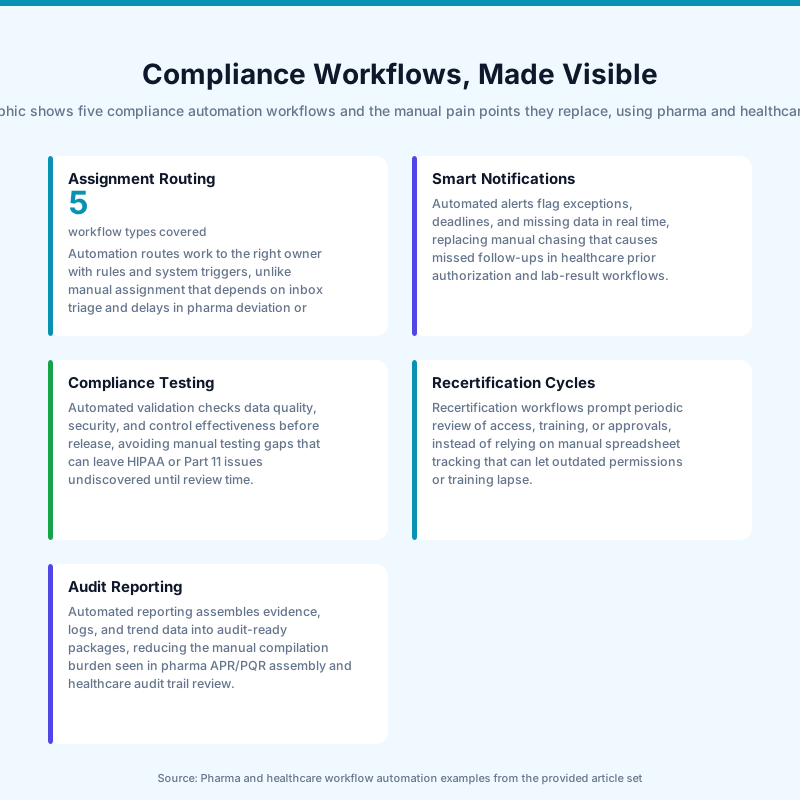
The best place to start is with the five workflows that consume the most admin time and create the most risk when they fail.
Workflow | Why it matters | What automation should do |
|---|---|---|
Assignment | Training must reach the right role, site, or department. | Auto-enroll learners based on role, location, or requirement. |
Notifications | Missed deadlines create compliance gaps. | Send reminders before due dates and escalation notices after them. |
Testing | Completion alone does not prove understanding. | Deliver quizzes or assessments and record results automatically. |
Recertification | Many requirements must be repeated on a cycle. | Re-enroll learners at 6, 12, or 24 months, depending on policy. |
Reporting | Audits need evidence, not anecdotes. | Produce completion, overdue, and exception reports without manual cleanup. |
These five workflows show up repeatedly because they map to the basic mechanics of compliance training in regulated organizations. Healthcare compliance guidance specifically calls out easy-to-use testing, sensible reporting, automatic re-enrollment, and automated reminders as essential LMS features.
Skill Studio AI supports this operational pattern by turning source documents into training assets that can be assigned by role and updated when procedures change. That matters in settings like Annex 1-affected pharmaceutical manufacturing, where training needs to follow the document, not the other way around.
What Features Matter Most in a Compliance Training Platform?
The most useful compliance platform features are the ones that reduce rework while preserving evidence.
For pharma and healthcare teams, the baseline features are intuitive user experience, testing and evaluation, clear reporting, recertification support, and automated reminders. Those are table stakes. More advanced environments also need version control, multilingual delivery, and strong audit readiness, because the document trail matters as much as the course itself.
Skill Studio AI is designed around those higher-friction needs. It offers audit-ready video training, role-targeted delivery, and version control, which is the kind of combination that matters when training must stand up to inspection; multilingual localization and 21 CFR Part 11 compliance are on the roadmap.
When you evaluate tools, ask whether they only track completion or whether they help you build the training content itself. That difference is important because many teams already have an LMS, but they still struggle to convert SOPs, CAPA-related instructions, and policy updates into training people will actually finish.
How Does Compliance Training Automation Work in Practice?
In practice, compliance automation starts with the source document and ends with a tracked learner record.
A practical workflow looks like this: a SOP, policy, or procedure is converted into training content; the content is assigned to the correct role or site; learners receive automated notifications; completions and quiz results are recorded; and reporting shows what is done, what is overdue, and what must be renewed next.
Skill Studio AI exemplifies this approach by taking dense SOPs, compliance documents, and procedural manuals and turning them into audit-ready video training in minutes. The value is not just faster production; it is that one SME’s knowledge can be scaled into unlimited courses without extra recording time, which removes one of the biggest bottlenecks in regulated training programs.
This is especially useful in pharma and healthcare because updates are frequent and the cost of inconsistency is high. If one site is trained on the old version and another on the new version, the problem is no longer just administrative; it becomes a quality issue.
Automated reminders also matter more than they sound. The Dokeos healthcare compliance training guidance notes that automated notifications help admins keep learners enrolled, track progress, and report successful outcomes to management and HR. That is the difference between a system that merely stores courses and a system that actively manages compliance.
How Do You Choose the Right Platform?
The right platform is the one that matches your regulatory burden, not the one with the loudest feature list.
Start by checking whether the platform supports role-based assignment, recertification, clear reporting, and reminders, because those functions are directly tied to compliance workflow. Then look at whether it can handle version control, localization, and audit evidence without making your team rebuild everything each time a SOP changes.
A simple comparison helps clarify the trade-offs.
Selection factor | Why it matters in pharma and healthcare | What strong automation looks like |
|---|---|---|
Content creation speed | Training must keep up with policy and SOP changes. | Source material becomes training in minutes, not weeks. |
Audit readiness | Inspectors need clear evidence of completion and version history. | Records are traceable, current, and easy to export. |
Role targeting | Operators, QA, and clinical staff do not need the same content. | Assignments are segmented by role, site, or function. |
Recertification | Training often expires on a fixed cycle. | Re-enrollment happens automatically on schedule. |
Localization | Sites may need training in different languages. | Content is localized without rebuilding the program from scratch. |
That is where Skill Studio AI is especially practical for regulated industries. It is not positioned as a generic LMS or a simple video tool; it is built for instructor scaling, so one SME can turn a narrow body of expertise into a repeatable training library that stays current as procedures change.
If your biggest pain is tracking completions, a conventional LMS may be enough. If your biggest pain is converting dense SOPs into defensible training quickly, a platform like Skill Studio AI is a better fit because it addresses the content bottleneck, not just the delivery layer.
Frequently Asked Questions
What is compliance training automation in pharma?
Compliance training automation in pharma is the use of software to assign, deliver, track, and renew required training with less manual effort. It usually includes reminders, assessments, recertification, and reporting. In regulated environments, the key requirement is not just speed; it is producing evidence that the right people completed the right training at the right time.
Why is automation important in healthcare compliance training?
Healthcare compliance training needs automation because teams must manage recurring deadlines, changing policies, and large numbers of learners. Manual tracking creates missed enrollments and messy records. Automated reminders, reporting, and re-enrollment reduce those failures and make it easier to show completion during audits.
What features should a compliance LMS have?
A compliance LMS should have intuitive navigation, easy testing, sensible reporting, re-enrollment for recertification, and automated notifications. In pharma and healthcare, version control and audit-ready records are just as important. Skill Studio AI goes further by turning SOPs and procedural manuals into audit-ready video training with role-targeted delivery (multilingual localization is on the roadmap).
How does Skill Studio AI help with compliance training?
Skill Studio AI helps by converting dense SOPs, compliance documents, and procedural manuals into audit-ready video training in minutes. It also supports role-targeted delivery and version control. That combination is useful when training needs to be current and traceable; multilingual localization and 21 CFR Part 11 compliance are on the roadmap.
Can automation replace subject matter experts?
No. Automation reduces the manual work around SME knowledge, but it does not remove the need for the SME itself. The real value is scale: Skill Studio AI lets one SME’s knowledge become unlimited courses without extra recording time, which is far more realistic than trying to automate expertise away.
What is the biggest mistake companies make with compliance training automation?
The biggest mistake is automating the admin while leaving the content process manual. That creates a system that can send reminders but still struggles to update training when SOPs change. In regulated sectors, the content workflow matters as much as the tracking workflow, which is why version control is so important.
Does automation help with recertification?
Yes. Recertification is one of the clearest places to use automation because learners often need to retake the same training on a yearly or other scheduled basis. Automated re-enrollment keeps the cycle moving without forcing admins to rebuild the process every time. That is especially useful in pharma manufacturing and healthcare operations where renewal dates are non-negotiable.