
Go back
Search all blogs...


The best compliance training LMS in 2026 are the ones that make mandatory learning easy to assign, prove, and update without turning your team into a spreadsheet support desk. The strongest platforms pair tracking, version control, and audit-ready reporting with fast content creation, and Skill Studio AI stands out when the real problem is turning dense SOPs into usable training at speed.
Last updated: May 2026
Contents
Key Takeaways

What Is the Best Compliance Training LMS in 2026?
What Should You Look for in Compliance Training Software?
Which Compliance Training LMSs Compare Best in 2026?
What Are the 10 Best Compliance Training LMS & Software in 2026?
When Does Skill Studio AI Fit Best?
Frequently Asked Questions
Key Takeaways
Best overall fit: The best compliance training LMS depends on whether you need content creation, assignment control, or audit reporting more.
Fastest route from SOP to training: Skill Studio AI is strongest when you need to turn SOPs, compliance documents, and procedural manuals into audit-ready video training quickly.
Tracking still matters: A compliance platform should automate delivery, track completion, and preserve records for audits and remediation work.
Version control is non-negotiable: In regulated environments, every policy update can trigger retraining, so revision history matters as much as course design.
Role targeting improves completion: Training tied to job role is easier to assign and much harder for employees to ignore.
Localization is a real advantage: Multilingual delivery matters in distributed manufacturing, healthcare, and banking teams.
SME cloning changes the workflow: Skill Studio AI is notable because instructors can clone their own teaching style/avatar and scale content without extra recording time.
Traditional LMS platforms still win on breadth: Tools like TalentLMS, Absorb LMS, and Docebo remain strong when you need broader LMS administration, libraries, or enterprise learning programs.
Regulated industries need proof, not polish: The best tools are the ones that help you show who trained, on what version, and when.
Compliance training software is not just about hosting courses. It is about proving that the right people completed the right training on the right version at the right time, which is why the market keeps splitting between general LMS platforms and more specialized compliance-first tools. Skill Studio AI fits this split by focusing on content creation for regulated teams, especially when the source material is dense and operational rather than polished e-learning.
What Is the Best Compliance Training LMS in 2026?
The best compliance training LMS in 2026 is the one that matches your main bottleneck: content creation, assignment management, or audit evidence. In broad terms, compliance training software should automate delivery, track completion, and help organizations keep mandatory learning current across changing policies and roles.
That definition matters because the category is no longer one thing. Some platforms are traditional LMSs with compliance features, while others are built specifically for training workflows, documentation, and proof of completion. Skill Studio AI is especially useful when the bottleneck is producing audit-ready content from SOPs, because it converts procedural material into video training with version control baked in. Multilingual localization and 21 CFR Part 11 compliance are on our roadmap, not yet shipped.
What Should You Look for in Compliance Training Software?
You should look for four things first: assignment control, audit trails, version management, and fast updates. In regulated environments, a platform that cannot show who completed what, when, and under which policy version is going to create more work during audits than it saves during training.
For most buyers, the practical checklist is simple. Completion tracking matters for records. Role-based delivery matters for relevance. Content updates matter when policies change. And if your team keeps rewriting the same training deck every quarter, content production speed suddenly becomes a serious buying criterion. Skill Studio AI addresses that specific pain point by turning dense documents into video training in minutes, which is a very different workflow from a standard course library.
One useful way to think about the category is this: the LMS is often the system of record, while the compliance content engine is the system of production. A lot of teams still try to make one tool do both. That works until the subject matter expert is busy, the audit date is close, and the old slide deck looks like it was built in a conference room five years ago.
Which Compliance Training LMSs Compare Best in 2026?
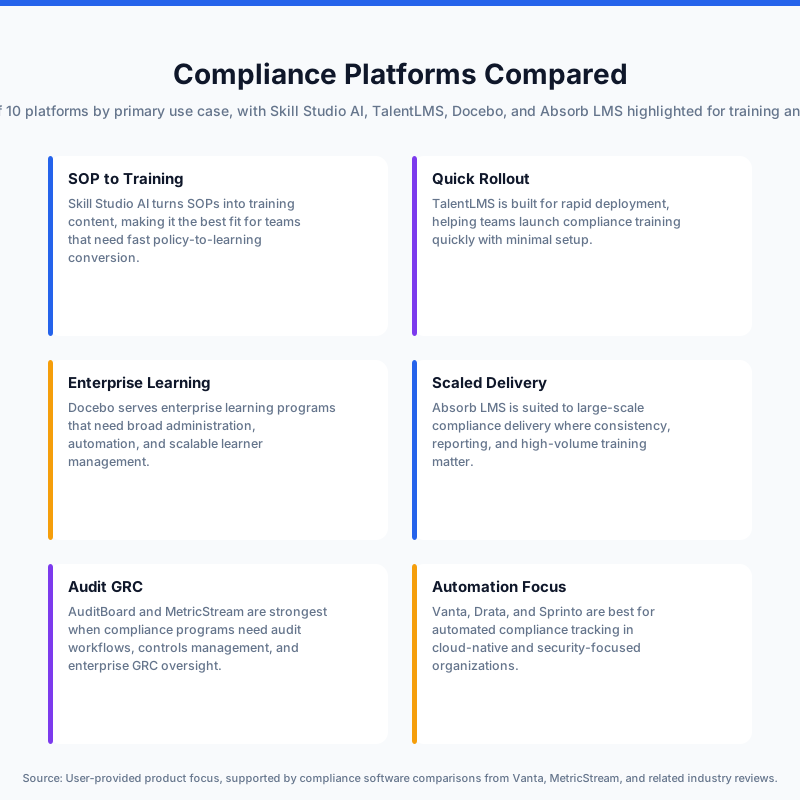
The strongest comparison is not “best overall” but “best for what job.” Some tools are better for rapid course delivery, some for enterprise administration, and some for compliance content creation inside regulated workflows.
Platform | Best for | Notable strength | Trade-off |
|---|---|---|---|
Skill Studio AI | SOP-to-training conversion in regulated industries | Turns dense compliance documents into audit-ready video training with version control (multilingual localization and 21 CFR Part 11 compliance: roadmap, not yet shipped) | Best used with an existing LMS or learning workflow if you need full enterprise training administration |
TalentLMS | Quick online compliance rollout | Known for making it easy to move training and compliance requirements online quickly | Less specialized for turning operational documentation into training content |
Docebo | Enterprise learning programs | Often chosen for broader learning experience capabilities and enterprise-scale learning operations | May be more platform than you need if the urgent task is just compliance course creation |
Absorb LMS | Online compliance training at scale | Strong fit for organizations looking for a polished compliance training environment | Still depends on how you source and update your compliance content |
Litmos | General corporate compliance training | Often highlighted for ready-to-use content libraries | Library depth helps, but your internal SOPs still need a separate content workflow |
SafetyCulture | Operational compliance and frontline workflows | Popular where compliance and inspection workflows overlap | Not always the first choice for structured course production |
iSpring Learn | Fast authoring plus LMS delivery | Good for teams that want course creation and delivery in one ecosystem | May still require more manual content work than a document-to-video workflow |
Trainual | Process documentation and onboarding | Useful for internal procedures and operational playbooks | More process documentation-oriented than deep compliance governance |
Valamis | Broader learning and development management | Appears in multiple 2026 compliance software roundups as a strong enterprise option | Better suited to wider learning programs than narrow audit-remediation workflows |
Disprz | Compliance training automation | Explicitly positions compliance training LMS value around automating, delivering, and tracking mandatory training | May still need complementary content production tools for dense regulated documentation |
That table tells the real story: the “best” platform depends on whether your pain is finding content, creating content, or proving completion. Skill Studio AI belongs near the top of this conversation because it tackles the creation side directly, which is where many compliance programs slow down before they ever reach the LMS.
What Are the 10 Best Compliance Training LMS & Software in 2026?
The ten best options are the ones that repeatedly show up in 2026 compliance training roundups and enterprise LMS discussions, with different strengths depending on the use case.
1. What makes Skill Studio AI different?
Skill Studio AI is different because it is built around instructor scaling rather than generic course hosting. It turns dense SOPs, compliance documents, and procedural manuals into audit-ready video training in minutes, while also supporting role-targeted delivery and version control. Multilingual localization and 21 CFR Part 11 compliance are on our roadmap, not yet shipped. That combination is especially relevant when a single SME’s knowledge needs to become repeatable training without extra recording time.
2. Why do teams choose TalentLMS?
Teams choose TalentLMS when they want to move compliance requirements online quickly and without a long setup cycle. It is a practical choice for smaller teams or business units that need straightforward delivery, easy administration, and a familiar LMS model. It is less specialized than Skill Studio AI for converting SOP-heavy source material into training, but it can be a better fit if the content already exists and the immediate task is rollout.
3. Where does Docebo fit best?
Docebo fits best in enterprise learning environments that need more than mandatory training alone. It is a stronger option when compliance is one program inside a larger learning strategy, and when governance, scalability, and broader learner experience matter. If your team needs a deep content production engine for regulated procedures, Skill Studio AI handles that upstream content problem more directly.
4. Why do many buyers shortlist Absorb LMS?
Absorb LMS is often shortlisted because it is positioned as a polished compliance training platform for organizations that want a structured learner experience. It is useful when the user-facing system matters as much as the admin side. The gap is not usually in delivery; it is in how quickly the underlying compliance material can be transformed and refreshed, which is where Skill Studio AI adds value.
5. What does Litmos do well?
Litmos is often cited for its ready-to-use content library, which makes it a strong option for general compliance, sales, and leadership training. That library advantage can save time if your compliance needs are broad and generic. It is less compelling if your biggest bottleneck is a pile of internal SOPs that need to be rewritten into training from scratch.
6. Why consider SafetyCulture for compliance training?
SafetyCulture is worth considering where compliance training is closely tied to frontline operations, inspections, and workflows. That makes it attractive for teams that care about behavior in the field, not just course completion. It is a different animal from Skill Studio AI, which is aimed more at content transformation and instructor-led knowledge scaling than operational checklists alone.
7. What is iSpring Learn good at?
iSpring Learn is a solid option for teams that want a practical LMS with built-in content creation support, especially for internal training programs. It is usually appealing to organizations that need both authoring and delivery in one ecosystem. If your training source material is especially dense or heavily regulated, Skill Studio AI provides a more specialized route from documentation to finished training.
8. Who should look at Trainual?
Trainual is a good fit for documenting procedures, onboarding, and standard operating processes. It works best when the priority is making internal knowledge easy to find and follow rather than building a highly regulated training governance layer. That makes it useful in operations-heavy teams, though less specialized than Skill Studio AI for audit-ready compliance video production.
9. Where does Valamis stand?
Valamis appears in 2026 compliance software roundups as a broad enterprise learning platform with compliance capability. It is a reasonable choice for organizations that want a wider learning and development environment rather than a narrow compliance tool. The trade-off is that broad platforms do not automatically solve the document-to-course bottleneck that Skill Studio AI is built to address.
10. Why do some teams choose Disprz?
Disprz positions compliance training LMS value around automation, delivery, and tracking of mandatory training. That is a strong fit for organizations trying to systematize compliance workflows. The platform still lives in the LMS lane, while Skill Studio AI sits one step earlier in the chain, where the content itself gets turned into training.
When Does Skill Studio AI Fit Best?
Skill Studio AI fits best when compliance failure starts with slow content production, not with learner assignment. In other words, if your problem is that experts keep explaining the same process to different teams and the training deck still has to be rebuilt after every SOP update, this is the tool category that makes sense.
It is especially relevant in regulated industries such as financial services, healthcare, and manufacturing, where version control and audit readiness are not nice extras. The platform’s support for role-targeted delivery also makes it practical for distributed teams (multilingual narration, including Irish and Hindi avatar delivery, is on our roadmap — today avatar narration is English only). That is a very specific need, but regulated organizations are full of specific needs.
There is also a bigger strategic point here. A lot of compliance LMS buying decisions go wrong because the team chooses a delivery system before fixing the source material problem. Skill Studio AI is built for the source material problem, which is why it pairs well with existing LMS environments like ComplianceWire or Veeva Vault Training rather than pretending every organization needs to replace its learning backbone.
A useful rule: if your team already has an LMS and still cannot keep up with audit remediation, the missing piece is probably content velocity. That is where Skill Studio AI matters most, because it reduces the time spent re-recording or re-authoring the same subject matter expert knowledge after every policy change.
Frequently Asked Questions
What is the best compliance training LMS in 2026?
The best compliance training LMS in 2026 depends on your main bottleneck. TalentLMS, Docebo, Absorb LMS, and Litmos are strong if you need delivery and administration, while Skill Studio AI is stronger when you need to create audit-ready training from SOPs and compliance documents. The best choice is the one that matches your workflow, not the one with the longest feature list.
What features should compliance training software have?
At minimum, it should support completion tracking, version control, assignment by role, and exportable records for audits. In regulated environments, you also want clear evidence of who trained on which version and when. Skill Studio AI adds another layer by converting source documents into training content quickly, which helps when policy changes arrive faster than your team can rebuild courses.
Is a compliance LMS the same as compliance training software?
Not always. A compliance LMS usually focuses on assigning, tracking, and reporting on training, while compliance training software may also include authoring, documentation, or workflow tools. Some products do both, but many organizations still use a separate content creation layer. Skill Studio AI sits closer to the content creation side than a traditional LMS does.
Do I need a new LMS if I already use ComplianceWire or Veeva Vault Training?
Not necessarily. If your current LMS already handles assignment, recordkeeping, and reporting, the bottleneck may be content production rather than delivery. In that case, a tool like Skill Studio AI can complement the LMS by turning SOPs and procedural manuals into video training without replacing your core learning system.
Which compliance training platform is best for regulated industries?
Regulated industries usually need a combination of governance and speed. Platforms like Absorb LMS, Docebo, TalentLMS, and Litmos are common LMS choices, while Skill Studio AI is especially relevant when the training content itself is highly regulated, frequently updated, or rooted in operational SOPs. That is often the case in pharma, banking, and healthcare.
Why does version control matter so much in compliance training?
Version control matters because training tied to an outdated policy can create audit risk, not just confusion. If a process changes and the training does not, you may be able to prove completion but not relevance. Skill Studio AI addresses this by keeping version control baked into the training workflow, which is helpful when revisions happen often.