Magda Targosz
How to Build a Robust LMS Business Case
TL;DR: The core components of a strong LMS business case
A robust LMS business case clearly justifies the investment by articulating the business problem, recommended solution like Skill Studio AI, total costs, ROI, and implementation plan to secure executive approval.
Executive summary. Concise overview of the need, solution, benefits, costs, and risks to grab leadership attention immediately.
Business problem and context. Define current gaps in training delivery, compliance, and performance driving urgency for change.
Budgetary considerations. Break down pricing models, hidden costs, and total ownership to avoid surprises.
ROI analysis. Quantify gains in productivity, onboarding speed, compliance, and revenue tied to platforms like Skill Studio AI.
Implementation plan. Outline timelines, provider questions, and governance for seamless rollout.
Summarizing your case. Recap challenges, due diligence, costs, and ROI to drive final approval.
Contents
Executive summary
Business problem and context
Budgetary considerations
Analyzing return on investment
LMS business case implementation project plan
Summarizing your LMS business case
LMS Business Case FAQs
Building a compelling LMS business case is essential for L&D and compliance leaders in regulated industries like banking, healthcare, and financial services seeking to transform static training into dynamic, AI-powered programs. This guide provides an executive-ready framework to justify investments in platforms like Skill Studio AI, an AI-native LMS that converts PDFs, decks, and SOPs into interactive avatar-narrated videos and SCORM-ready modules. You'll walk away with a proven structure, ROI calculations, provider questions, and strategies to align training with strategic outcomes, ensuring approval and rapid value delivery.
What should your LMS executive summary include?
The executive summary delivers a one-page snapshot recommending Skill Studio AI as the solution, highlighting expected benefits like 600% faster course creation, costs under $10 per user monthly, and mitigated risks through seamless SCORM integration.
Start by stating the business need: in regulated sectors, outdated training causes compliance failures costing millions annually, while slow onboarding drags productivity by 18% according to Gallup research. Position the LMS not as a cost center but a capability builder—Skill Studio AI turns existing content into multi-language videos with quizzes, aligning learning to real-world performance like policy adherence or customer onboarding.
Articulate the problem succinctly: "Fragmented training leads to inconsistent compliance (95% completion rates needed but hovering at 60%) and knowledge silos, risking fines and churn." Explain how Skill Studio AI solves it by automating video courses from uploads, offering interactive assessments, and providing audit-ready dashboards. Sell the vision with a story: a bank reduced onboarding from weeks to hours, boosting new hire productivity by 40% via AI avatars delivering branded training.
Include high-level ROI: time savings of 95% on content creation, revenue uplift from faster partner enablement. End with risks like adoption (mitigated by intuitive UI) and a call to action: approve to launch within 30 days.
How do you define the business problem and objectives?
Frame the problem around capability gaps—such as inconsistent compliance training or slow sales onboarding—driving urgency through data like 18% productivity loss from disengagement, with objectives tied to measurable outcomes like 95% completion rates and 30% faster ramp-up.
Pinpoint current state: manual training via PDFs wastes hours, fails audits in regulated industries, and ignores global teams needing 40+ languages. Skill Studio AI reframes this by building capabilities evidenced in real work, not just course completions—uploading SOPs generates avatar videos with scenarios mirroring daily tasks like FCA-compliant processes.
Set objectives: enhance engagement via interactive elements, ensure GDPR/HIPAA compliance with trails, and scale to thousands of learners. Success criteria include KPIs like reduced rework (target 50% drop) and faster time-to-competency, backed by current baselines from HRIS data.
Consider options: status quo (spreadsheets/emails) amplifies risks; generic LMS lacks AI automation. Skill Studio AI stands out with dynamic SCORM export plugging into existing systems, turning compliance burdens into scalable strengths.
What are the key budgetary considerations for an LMS?
Budget for total cost of ownership including pay-per-active-user pricing from $5-15 per user/month for Skill Studio AI, plus implementation under $20K, avoiding hidden fees like custom content at $100/hour by leveraging AI automation.
Evaluate models: cloud-based pay-per-learner suits stable user bases; active-user fits fluctuating teams like sales. Skill Studio AI's metered model scales with usage, starting free for pilots, with tiers unlocking unlimited videos and 100+ avatars.
Factor | Key Considerations | Skill Studio AI Advantage |
|---|---|---|
Users & Growth | Current 1,000; project 5,000 | Scales seamlessly, no overage fees |
Pricing Model | Per active user/month | $8/user avg., volume discounts |
Integrations | HRIS, SSO, SCORM | Native support, zero extra cost |
Storage/Content | Unlimited videos | AI compresses, no limits |
Account for extras: maintenance (included), training (self-serve portals), implementation (data migration in weeks). Avoid self-hosted pitfalls—Skill Studio AI's cloud model eliminates upkeep, delivering 95% cost reduction vs. traditional builds.
How do you analyze LMS return on investment?
LMS ROI exceeds 300% within year one via reduced training time (95% savings), 40% productivity gains, and compliance avoidance of $1M+ fines, with Skill Studio AI proving it through dashboards tracking completions and performance lifts.
Tangible metrics: cut onboarding from 4 weeks to 2 days, saving $50K per cohort; boost completions 600% with engaging AI videos. Intangibles like retention rise 25% per PwC data, as relevant training curbs disengagement.
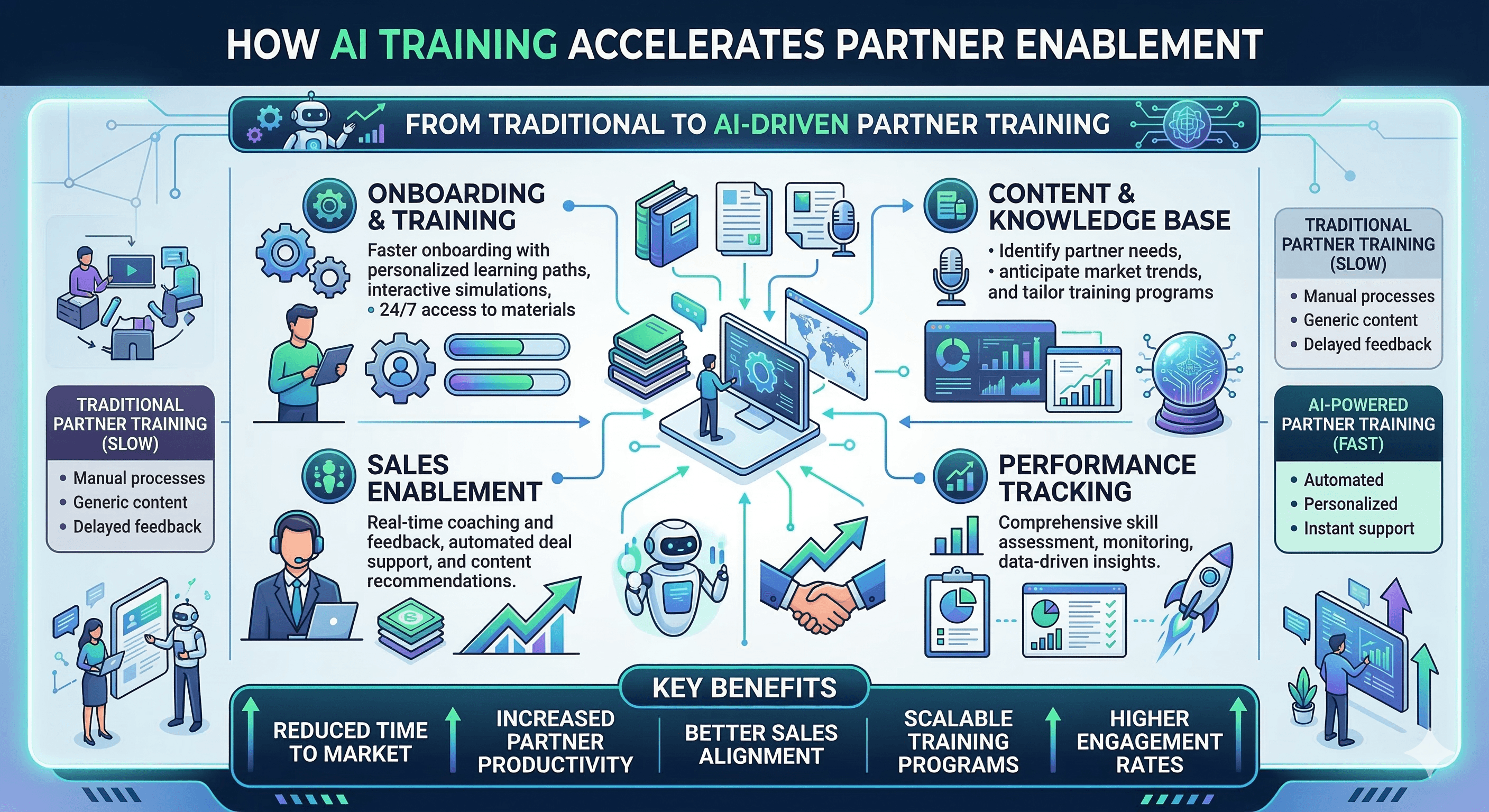
For revenue: sales teams trained on product updates close 20% faster; partners achieve 90% certification, accelerating GTM. Skill Studio AI quantifies this—case studies show banks hitting 95% compliance, healthcare firms reducing errors 50% via interactive scenarios.
Cost of inaction: Gallup's 18% productivity drag equals millions lost. Track via pre/post KPIs: engagement scores, time-to-proficiency, revenue per trained user. Skill Studio AI's analytics make attribution effortless, turning L&D into a profit center.
What does an LMS implementation project plan look like?
A 4-6 week rollout plan for Skill Studio AI includes discovery, data migration, customization, pilot training for 100 users, and full launch with governance assigning L&D owners for sustained 95% adoption.
Key milestones: Week 1 provisioning/SSO; Week 2 content upload and AI conversion; Week 3 testing integrations; Week 4 go-live. Assign roles: IT for tech, L&D for content, execs for sponsorship.
Ask providers these 10 questions:
What does your typical implementation timeline and options look like?
How do you handle data migration from legacy LMS?
What training/resources are provided pre- and post-launch?
Any geographic limitations or resource constraints for quick starts?
Explain your project methodology and customer partnership model.
How customizable is provisioning without extra costs?
What are detailed cost elements beyond licensing?
Can we pilot with 100 users in week one?
How do you ensure 95% adoption through change management?
What governance tools track ongoing ROI?
Skill Studio AI excels here—plug-and-play SCORM, zero-downtime migration, and dedicated success managers ensure launches under 30 days, minimizing disruption.
How do you summarize and win approval for your LMS business case?
Summarize by recapping challenges (compliance gaps, slow training), due diligence (evaluated 10+ LMS, selected Skill Studio AI for AI-native edge), full costs ($150K year one), and ROI (400% via productivity/revenue), urging immediate approval to capture 2026 gains.
Reiterate alignment: Skill Studio AI transforms documents into audit-ready training, supporting regulated industries' needs for scale and precision. Highlight vendor shortlist proof: superior automation, compliance frameworks (SOC2, GDPR), and case studies like 600% completion boosts.
Next steps: sign contract, kickoff implementation, measure quarterly KPIs. This positions L&D as strategic—don't delay; inaction costs 18% productivity per Gallup. Secure buy-in now for transformative results.
LMS Business Case FAQs
What is an LMS business case?
A structured document justifying LMS investment by detailing problems, solutions like Skill Studio AI, costs, ROI, and implementation to win stakeholder approval.
Why focus on capabilities over skills in the business case?
Capabilities tie training to business outcomes like compliance and productivity, making ROI evident—Skill Studio AI evidences them via real-work assessments.
What pricing models should I budget for?
Opt for pay-per-active-user like Skill Studio AI's $8/user/month, scaling with usage while avoiding self-hosted maintenance traps.
How do you calculate LMS ROI?
Quantify time savings (95%), productivity gains (40%), compliance avoidance ($1M+), tracked via Skill Studio AI dashboards pre/post-launch.
What hidden costs lurk in LMS proposals?
Implementation, custom content, support—Skill Studio AI minimizes these with AI automation and included services.
How long does LMS implementation take?
4-6 weeks for Skill Studio AI: discovery, migration, pilot, launch—faster than legacy systems.
What questions to ask LMS providers?
Inquire on timelines, migration, training, costs, and adoption strategies to ensure alignment with your case.
Is Skill Studio AI suitable for regulated industries?
Yes—SOC2/GDPR compliant, with audit trails, multi-language videos, and SCORM for banking/healthcare compliance training.
How does an LMS impact revenue?
Accelerates sales/partner onboarding 30%, boosting close rates 20% via consistent, interactive training.
What KPIs measure LMS success?
Completion rates (95% target), time-to-competency (50% reduction), engagement scores, and business outcomes like reduced churn.