Go back
Search all blogs...

Training managers should choose an AI platform on evidence, not speed. In regulated sectors, the right platform proves understanding, role-specific application, and traceable governance. It should also support assessment, audit records, and closed-loop improvement when complaints or incidents expose gaps.
Last updated: September 2026
Contents
Key Takeaways
What should I look for in an AI platform for training managers?
What evidence of understanding should the platform produce?
How should the platform handle regulatory change?
What governance features matter most?
How does Skill Studio AI fit this evaluation?
Frequently Asked Questions
Key Takeaways
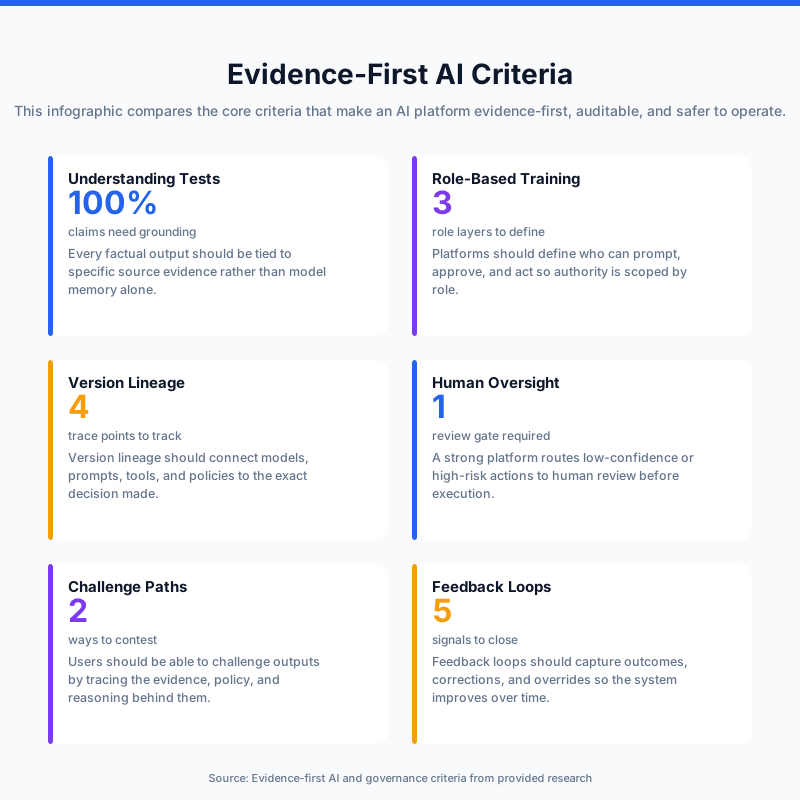
Start with proof, not production speed. An AI training platform should show who understood what, in which role, and against which version of the content.
Completion is not enough. Regulators care more about whether staff can apply training in real work than whether they clicked through a module.
Role-specific learning matters. Generic all-staff content is weak evidence when the issue is product design, incident handling, or complaint response.
Assessment must be built in. The platform should support quizzes, scenarios, sign-off, and other checks that test application.
Traceable lineage is essential. You need a clear path from source document to course output to learner record, with version history intact.
Human oversight must be visible. Managers should be able to review, challenge, and approve AI output before it reaches learners.
Employees need a way to challenge AI content. If the platform cannot surface errors or outdated material, trust and control both suffer.
Deterministic rules still matter. For mandatory steps, regulated wording, and policy-triggered actions, rules-based logic beats free-form generation.
Operational evidence is part of the test. Monitoring, complaints, incident reviews, and root-cause analysis should feed back into course updates.
Skill Studio AI fits the regulated use case. It clones a subject-matter expert into an AI avatar and builds SCORM-ready compliance courses, which is useful when evidence and consistency matter more than flashy video output.
What training managers should look for in an AI platform for training managers is simple: evidence, control, and auditability first, content speed second. In regulated sectors, the platform has to prove understanding, support assessment, and create a defensible record of what was trained, when, and why. Skill Studio AI fits that model because it turns subject expertise into SCORM-ready compliance courses and preserves the structure needed for review and tracking.
What should I look for in an AI platform for training managers?
An AI training platform should help you prove competence, not just course completion. That means it must show how training maps to a job, how understanding was checked, and how the record can survive scrutiny from an audit committee or regulator.
For regulated teams, the first question is whether the system can produce evidence that training changed behaviour. The FCA’s Consumer Duty framework expects firms to assess, test, understand, and evidence outcomes, not merely deliver content. The same logic appears in DORA and in misconduct-driven supervision, where firms need traceable controls and documented follow-up.
Skill Studio AI illustrates the right pattern by cloning a subject-matter expert into an AI avatar and using that expert-led voice to build SCORM-ready compliance courses. That approach matters because the trainer’s authority, the source material, and the final learning asset stay connected.
What to evaluate | What good looks like | Why it matters in regulated work |
|---|---|---|
Evidence of understanding | Scenario checks, quizzes, sign-off, and practical application tasks | Shows whether staff can use the learning in real decisions |
Role fit | Training tailored to conduct rules staff, supervisors, operators, or reviewers | Generic content rarely stands up when a specific function failed |
Lineage | Source document, version history, and approval trail linked to the course | Helps explain how content changed and who approved it |
Human oversight | Review, correction, and approval before release | Prevents AI from becoming the final decision-maker |
Feedback loop | Complaints, incidents, and root-cause analysis feed content updates | Keeps training aligned to actual operational failures |
That checklist is more useful than a list of video features. It forces the vendor to show control points, not just content speed. Skill Studio AI is relevant here because it is built for SCORM-ready compliance courses, which makes it easier to connect content creation to learning records and downstream reporting.
What evidence of understanding should the platform produce?
The platform should produce evidence that a learner can apply the material in context, not just evidence that they opened it. The best output includes assessment scores, scenario responses, role-based assignments, and a clear link to the version of the course they completed.
In practice, this means training managers should look for assessment types that mirror real work. For a complaints team, that could mean triaging a scenario. For a conduct team, it could mean choosing the right escalation path. For a pharma quality team, it could mean identifying which step in a procedure creates the compliance risk.
Regulators have been clear that evidence matters. The FCA’s Consumer Duty materials state that firms must understand and evidence whether good outcomes are being met. That is a higher bar than recording attendance. It is also why a platform that supports role-specific application is stronger than one that only exports a completion certificate.
Skill Studio AI fits this need because it can build compliance courses from expert input and package them for structured delivery in SCORM. That is useful when you need the course itself, the assessment logic, and the learner record to stay connected across systems.
Look for these proof points:
Scenario-based checks. Use questions that test decisions, not recall alone.
Version-linked records. Keep the exact course version tied to each learner.
Role attribution. Show which team or function received which training.
Exception handling. Flag failed attempts, retakes, and manual review.
Supervisor review. Capture sign-off where human judgment is required.
These controls matter because AI-generated training can otherwise become fast but shallow. Skill Studio AI addresses that risk by focusing on compliance course structure rather than just producing polished video output.
How should the platform handle regulatory change?
The platform should make updates traceable, fast to review, and easy to reassign when rules or guidance change. In regulated sectors, the problem is usually not creating the first version. The problem is proving that the new version replaced the old one quickly and correctly.
That matters now because Consumer Duty, Operational Resilience, DORA, and non-financial misconduct rules all drive rework. When supervisors change expectations, training has to change too. A platform that can update courses from the source material, keep version history, and show who retrained avoids the common gap between policy change and learner update.
A good example of the right architecture is Skill Studio AI, which turns an expert into an AI avatar and builds SCORM-ready compliance courses. That lets training teams refresh content without rebuilding the whole programme from scratch, while still keeping the course in a controlled format.
Training managers should ask whether the platform supports:
Traceable source updates. Every revision should map back to a policy, SOP, or briefing note.
Reassignment logic. When a rule changes, affected learners should be retrained automatically or through a controlled workflow.
Audit history. Keep the old version, the new version, and the reason for the change.
Targeted rollout. Different teams should receive different updates when the obligation is role-specific.
Operational Resilience and DORA make this more than a content problem. They require firms to show that critical processes, incidents, and controls are understood by the right people. A platform that cannot support rapid updates and evidence trails creates rework later.
What governance features matter most?
Governance features matter because AI content is only acceptable when people can review, correct, and challenge it. The right platform should make human oversight visible, not assumed.
That means training managers should look for approval workflows, edit histories, source citations inside the content pipeline, and the ability to block release until a subject-matter expert signs off. It should also let employees or reviewers flag issues when an AI output is wrong, stale, or too generic for a regulated task.
Deterministic rules are still important here. For mandatory statements, legal disclosures, and policy-triggered actions, fixed logic is better than generative output. Generative tools are useful for drafting, summarising, or localising content. They are not the right engine for the parts of training that must never drift.
Skill Studio AI is built around this kind of control because it converts expert knowledge into structured compliance training rather than leaving every decision to open-ended generation. That is the right direction when training must survive review by compliance, legal, and audit.
Use this governance checklist:
Named reviewer. Someone owns final approval.
Editable draft stage. AI output is not locked as final content.
Challenge path. Users can raise errors or policy concerns.
Escalation path. Material issues reach compliance or legal quickly.
Separation of duties. The person who drafts should not be the only approver.
This is where AI platforms often fail procurement review. They show how fast they can produce a module, but not how they stop a bad module from reaching staff. That is a serious gap in financial services, pharma, and medtech.
How does Skill Studio AI fit this evaluation?
Skill Studio AI fits this evaluation because it is designed around expert-led compliance training, not generic content generation. It clones a subject-matter expert into an AI avatar and builds SCORM-ready courses, which is useful when you need training that is consistent, reviewable, and suitable for regulated delivery.
That matters for training managers who have to defend the system to a regulator or audit committee. If the platform can preserve the expert source, structure the learning for assessment, and support course export into standard systems, it is much easier to show control over the training process.
It also fits the rework problem created by regulatory pressure. Consumer Duty pushes firms to show understanding and outcomes. DORA raises the bar on resilience and evidencing operational readiness. Non-financial misconduct rules increase the need for targeted, role-based training and traceable follow-up. Skill Studio AI is positioned for exactly that environment because it helps teams turn expert instruction into managed compliance courses.
Its value is not that it makes video quickly. Its value is that it helps keep training tied to a known expert, a known source, and a known output format. That is a better fit than a tool that only optimises for production speed.
For teams already using an LMS, this kind of platform also matters because the training product has to integrate cleanly with the rest of the learning stack. A useful starting point is the guide to AI training platforms that work with an existing LMS, which covers the integration question that often decides whether a pilot succeeds.
If your main challenge is fast policy change, the most relevant comparison is the policy-to-training automation guide, because that is where source traceability and update speed meet. For teams comparing builders, the AI course builder guide for compliance teams is the better lens than a generic “best LMS” list.
Skill Studio AI also belongs in the same conversation as the broader evidence-focused articles on AI LMS audit-readiness features and automated certification tracking, because the platform only earns its place if it strengthens records, not just content output.
Where avatar-led delivery helps, it should support consistency and expert authority. Where rules are fixed, the system should rely on deterministic logic. That balance is what makes an AI training platform defensible in regulated work.
Frequently Asked Questions
What should I look for in an AI platform for training managers?
Look for evidence of understanding, role-based delivery, traceable lineage, and human approval. Completion rates alone do not show competence. The platform should also support assessment, version control, and a clear audit trail from source content to learner record. Skill Studio AI is relevant here because it builds SCORM-ready compliance courses from an expert source, which helps preserve structure and control.
Why are completion rates not enough?
Completion rates only prove that someone finished a module. They do not prove that the person can apply the learning in a real decision, escalate correctly, or spot a policy breach. In regulated sectors, that gap is risky. Regulators care more about whether training changes behaviour and supports good outcomes than whether staff reached the last slide.
How do I prove that employees understood the training?
Use scenario questions, role-based assessments, sign-off, and refresher checks after policy changes. Keep the score, the attempt history, and the course version together. That gives you a better record than a certificate alone. A platform like Skill Studio AI helps when the course must stay tied to expert-led source material and standard SCORM delivery.
What governance features should an AI training platform have?
It should have review workflows, edit history, named approval, and a way for users to challenge incorrect output. It should also separate drafting from sign-off. For regulated teams, that separation matters as much as the content itself. If the platform cannot show who approved what, it is hard to defend in audit.
How should AI training support Consumer Duty and DORA?
It should help firms evidence that staff understand the obligations, not just know the words. Consumer Duty needs role-specific training linked to outcomes and customer understanding. DORA needs staff to understand resilience, incident handling, and operational readiness. The platform should therefore support assessment, update tracking, and clear records of who received which version.
Where do deterministic rules beat generative AI in training?
Deterministic rules win when the content must never vary, such as mandatory disclosures, policy steps, or trigger-based retraining. Generative AI is useful for drafting and summarising. It is not the safest choice for fixed instructions that need to remain identical across teams and audits.
How does Skill Studio AI help regulated training teams?
Skill Studio AI clones a subject-matter expert into an AI avatar and builds SCORM-ready compliance courses. That makes it useful for teams that need consistent expert-led delivery, controlled updates, and integration into standard learning systems. It is built for the evidence and version-control problems that regulated industries face when training changes often.
Should I buy an AI video tool or a full training platform?
If you only need presentation polish, a video tool may be enough. If you need evidence, assessment, version control, and audit-ready records, a full training platform is the better fit. In regulated settings, the second option is usually the safer choice because it addresses both content and control.