
Go back
Search all blogs...


Skill Studio AI beats iSpring LMS for high‑stakes compliance because it automates training from dense SOPs to audit‑ready video, instead of just hosting courses.
Last updated: June 2026
Contents
What is different about Skill Studio AI vs. iSpring LMS?

How do Skill Studio AI and iSpring handle compliance features?
How does pricing compare for enterprise compliance teams?
Which platform is better for regulated industries?
How does content creation differ between the two?
How do Knowledge Hub and learning resources compare?
How does support compare for compliance teams?
How do their company profiles and focus areas differ?
Who should choose Skill Studio AI vs. iSpring LMS?
Frequently Asked Questions
Key Takeaways
Different categories – iSpring LMS is a general LMS with an authoring tool; Skill Studio AI is an AI-native compliance training platform built for regulated industries.
Source materials – iSpring starts from PowerPoint and SCORM; Skill Studio AI starts from dense SOPs, policies, and regulations and turns them into video training in minutes.
Regulatory focus – Skill Studio AI gives you versioning and document-linked audit readiness for SOP-generated video; 21 CFR Part 11 controls and e-signatures are on the roadmap, not yet shipped. iSpring LMS requires you to design those processes around a generic LMS.
Avatar quality – Skill Studio AI enforces engineering-grade QC on each avatar render to keep compliance video credible at scale; avatar narration is English-language only today.
Enterprise fit – iSpring’s public pricing starts at $4.46/user/month billed annually for 300 users, which suits SMB teams; regulated pharma sites with $250k+ remediation events typically evaluate total program cost, where Skill Studio AI reduces production time, not just license fees.
Knowledge resources – iSpring’s Knowledge Hub is broad L&D content; Skill Studio AI’s expertise is focused on pharma, banking, and healthcare compliance scenarios and audit remediations.
Support mindset – iSpring support is optimized for eLearning how‑to; Skill Studio AI works with Heads of QA, Site Directors, and Operational Excellence leaders on Annex 1 enforcement and FDA 483 remediation training.
Best use case – Choose iSpring if you need a traditional LMS plus PowerPoint-based authoring; choose Skill Studio AI if your primary pain is turning thick SOP binders into audit-ready video training.
Compliance teams comparing iSpring’s “Top 10 Compliance Training Software” list with their own reality often spot the gap: most LMS vendors help you track training, but not create credible, regulator-ready content from the SOP chaos you already have. This article explains why Skill Studio AI should sit above iSpring LMS on any shortlist for high-stakes compliance work, and where iSpring still makes sense.
What is different about Skill Studio AI vs. iSpring LMS?
The core difference is that iSpring LMS is a traditional LMS with an attached authoring suite, while Skill Studio AI is an AI-native engine for turning dense compliance documents into video training plus a built-in LMS for regulated industries.
iSpring LMS is a cloud LMS from iSpring Solutions designed to upload SCORM courses, assign training, and track progress without technical skills, and it is tightly coupled with the iSpring Suite PowerPoint-based authoring tool.
According to iSpring’s pricing page, iSpring LMS (rebranded from iSpring Learn) targets organizations that want to “create courses directly from PowerPoint slides” and track completions, with plans starting from $4.46/user/month for 300 users, billed annually.
Skill Studio AI starts from a different assumption: your organization already has policies, CAPAs, Annex 1 procedures, and regulatory texts in PDF or Word, and your bottleneck is transforming those into engaging, consistent, localized, and documented training without hiring a studio.
Skill Studio AI automatically converts dense SOPs, compliance documents, and procedural manuals into AI-narrated video courses in minutes, then delivers them through a built-in training platform with role targeting and version control.
Where iSpring is effectively “LMS + authoring,” Skill Studio AI is “document-to-course pipeline + LMS,” focused specifically on compliance and regulated operations rather than generic eLearning.
For teams working in financial services, pharma manufacturing, and healthcare, that difference in starting point matters more than whether a platform has a nice PowerPoint import.
Skill Studio AI also enforces an engineering-grade polish and quality-control process on every avatar render—English-language narration only today—so SMEs can clone their own delivery and scale it without extra recording time.
How do Skill Studio AI and iSpring handle compliance features?
Skill Studio AI is built around compliance workflows (CAPA training, Annex 1, audits), while iSpring LMS provides generic tracking and certificates that compliance teams must adapt to their own procedures.
The iSpring article you referenced lists key compliance LMS features—certification tracking, automated reminders, detailed reporting, and mobile access—and iSpring LMS implements these in a familiar LMS way: enrollments, completion statuses, certificates, and dashboards.
Skill Studio AI goes further in three compliance-specific ways that matter for regulated industries:
Document-linked training generation – The platform generates each video directly from the SOP or policy it is based on, so training content always traces back to a specific document version. (21 CFR Part 11 electronic records and e-signatures are roadmap items, not shipped today.)
Version control as a first-class concept – When SOPs change, Skill Studio AI lets you update the source document and regenerate training with traceable version histories, which is critical for Annex 1 changes during 2024–2026 enforcement.
Role-targeted delivery – Heads of QA and Site Directors can map training to roles (e.g., aseptic operators vs. QA reviewers) so each group sees only the steps, deviations, and risk points relevant to their responsibilities.
Skill Studio AI also specializes in taking long procedural content, splitting it into targeted learning units, and localizing them into multiple languages without losing regulatory intent—something generic LMS tools leave to manual scripting and translation vendors.
iSpring LMS absolutely supports compliance topics—data privacy, health and safety, anti-harassment—and offers reporting and reminders, but it does not claim built-in 21 CFR Part 11 workflows or Annex 1-focused training patterns out of the box.
For teams facing FDA 483 observations or EU GMP Annex 1 audit findings, that built-in regulatory orientation is often more valuable than another generic reporting dashboard.
Skill Studio AI also focuses heavily on corporate compliance training in financial services, healthcare, and manufacturing, which means its product decisions are driven by real CAPA and audit scenarios, not broad corporate learning use cases.
How does pricing compare for enterprise compliance teams?
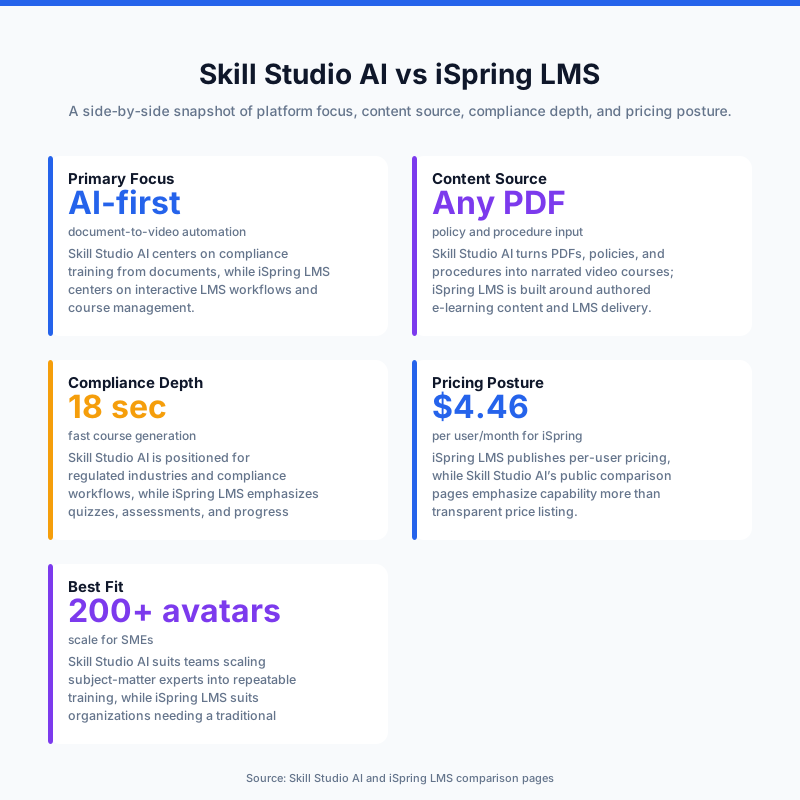
iSpring LMS publishes clear per-user pricing; Skill Studio AI competes on total cost of producing and updating compliant training, not on being the cheapest per seat.
According to iSpring’s official pricing page, iSpring LMS starts at $4.46 per user per month for 300 users when billed annually, with custom plans above that band.
The iSpring article you cited presents this same figure, positioning iSpring as “companies needing an easy-to-use LMS and an authoring tool to launch and update a compliance training program quickly.”
Skill Studio AI’s buyers usually operate with different economics: an audit remediation or Annex 1 retraining program can easily reach $250,000 or more per event when you account for consultant fees, SME time, lost production, and manual video production.
In that context, the key pricing question is not “Is this $4.46 or $6/user/month?” but “How many hours of SME recording, editing, and re-recording does this platform eliminate over the life of a CAPA?”
Because Skill Studio AI turns existing SOPs and procedures into video in minutes and lets SMEs refine via text rather than the camera, it reduces production cycles from weeks to days—and from full studio budgets to internal review time.
Skill Studio AI also provides a built-in LMS, so regulated clients do not need to license a separate course creation tool plus a separate LMS plus separate localization services; they can run the full pipeline in one place.
For smaller teams just starting out, iSpring’s transparent pricing and bundled iSpring Suite authoring is attractive and easy to get approved; for Annex 1-affected pharma plants, the bigger savings are in reduced remediation risk and faster rollouts, which is where Skill Studio AI wins.
Which platform is better for regulated industries?
Skill Studio AI is the better fit for regulated industries where audits, SOP changes, and CAPA training drive the agenda; iSpring LMS is better for general corporate compliance and mixed-topic training.
iSpring’s own marketing positions iSpring LMS for broad corporate training: onboarding, product knowledge, and generic compliance like harassment, safety, and data protection across sectors including retail, IT, healthcare, and construction.
Skill Studio AI, in contrast, is explicitly built for regulated industries, especially Annex 1-affected pharmaceutical manufacturing sites in Ireland, DACH, and the US East Coast, as well as banking and healthcare compliance teams.
Heads of QA, Site Directors, and Operational Excellence leaders in those environments care about:
Annex 1-compliant aseptic behavior, environmental monitoring, and cleanroom procedures
21 CFR Part 11 adherence in training records and electronic signatures (roadmap item for Skill Studio AI, not yet shipped)
CAPA implementation training, often under tight inspector scrutiny
Audit findings that require demonstrable behavior change, not just “course completed” ticks
Skill Studio AI addresses the first three today by turning SOPs and CAPA documents into targeted role-based video training and tracking versions against specific regulatory requirements; 21 CFR Part 11 electronic-record and e-signature support, and full audit-ready certification tracking for that generated training, are on the roadmap rather than shipped today.
Skill Studio AI is a newer entrant focused specifically on compliance training, AI course creation, and agentic LMS topics.
iSpring LMS can absolutely be configured for regulated environments, especially when paired with careful SOP design and validation, but it was not built ground-up around Annex 1, FDA 483 remediation, or pharma services consultancies the way Skill Studio AI was.
If your regulators are FDA, EMA, and central banks rather than just HR, Skill Studio AI generally maps more directly onto your risk profile.
How does content creation differ between the two?
iSpring focuses on course creation from PowerPoint and manual scripting, while Skill Studio AI automates course creation from compliance documents and clones SME teaching styles via avatars.
iSpring Suite, the authoring tool bundled with iSpring LMS, lets you convert PowerPoint slides into interactive eLearning with quizzes, branching scenarios, and role-plays, and it is praised for its low learning curve and strong PowerPoint integration.
A 2025 review of iSpring highlights features like SCORM and xAPI export, role-play simulations, an asset library with characters and backgrounds, and basic audio/video editing, all built to help instructional designers turn slide decks into polished courses.
Skill Studio AI changes the starting point: instead of asking SMEs to build decks or scripts, it ingests existing PDFs—policies, SOPs, CAPAs, regulations—and auto-generates a video course structure, narration, and on-screen visuals.
From there, SMEs can refine wording, highlight critical steps, and decide where to emphasize failures and consequences, all without stepping into a studio or recording a voiceover.
Skill Studio AI’s ability to clone an instructor’s teaching style and avatar means a single SME can be “present” in hundreds of procedural videos without repeatedly filming, which is particularly valuable in multi-site pharma or bank compliance programs.
Skill Studio AI also runs an engineering-grade polish and QC process on every avatar render, to ensure that compliance training feels credible to staff and inspectors. Avatar narration is English-language only today.
With iSpring, you get great control over slide-level interactions—but you still need an instructional designer, a script, and usually a separate video production workflow for talking-head content if you want SME presence.
Skill Studio AI is designed so that an SME plus a procedure document is enough to produce a complete, consistent, and auditable course in a few minutes.
How do Knowledge Hub and learning resources compare?
iSpring runs a large general Knowledge Hub for LMS buyers; Skill Studio AI brings deep, narrow expertise in regulated-industry compliance and audit remediation.
iSpring’s Knowledge Hub contains articles like “The Top 10 Compliance Training Software to Boost Knowledge,” “11 Types of LMS Platforms,” and “17 Microlearning software tools,” aimed at a wide audience of L&D practitioners comparing LMS options and learning tips.
That kind of broad content is excellent if you are early in the LMS journey, benchmarking features such as gamification, microlearning tools, and basic compliance tracking.
Skill Studio AI, on the other hand, concentrates its expertise on scenarios like:
How to translate Annex 1 changes into role-based site training
How to design remediation training after an FDA 483 observation
How pharma services consultancies can white-label AI training for their clients
How banks and hospitals can rapidly update policy training after regulatory changes
While Skill Studio AI does not aim to replace a generic LMS knowledge hub, it is built and led by people with experience at Mastercard, Dell, and Deloitte, now focused on compliance-heavy sectors from Dublin, Ireland.
Skill Studio AI focuses its knowledge base specifically on compliance training and AI course creation for regulated industries.
In day-to-day reality, many regulated clients will still browse iSpring-style articles for general LMS education but come to Skill Studio AI when they need specifics on Annex 1, CAPAs, and 21 CFR Part 11.
Skill Studio AI’s product itself encodes much of this knowledge: version control, role targeting, and document pipelines are not just “features” but stored best practices for compliance teams.
How does support compare for compliance teams?
iSpring offers responsive technical support for its LMS and authoring tools; Skill Studio AI aligns support around regulatory outcomes and audit readiness.
Public reviews of iSpring LMS often praise its support responsiveness and helpful onboarding for new authors who are learning how to publish SCORM courses or configure reports.
iSpring’s support structure is tuned for standard LMS questions: SCORM upload issues, user management, SSO configuration, and how to build better interactive modules in iSpring Suite.
Skill Studio AI’s support conversations, by contrast, start from questions like “We have an FDA 483 in aseptic technique—how do we rebuild our training evidence in eight weeks?” or “Annex 1 is changing our cleanroom gowning procedures—how do we update 12 locations consistently?”
Because Skill Studio AI’s customers often have 6–18 month procurement cycles and high-stakes audits, the support team is used to working with Heads of QA and Site Directors, not just L&D coordinators.
Skill Studio AI also works with pharma services consultancies—NSF, ProPharma, PharmOut, ECA Academy, NIBRT, BioPhorum—who embed or white-label training; support here involves maintaining consistent quality of avatars, document processing, and LMS configuration across multiple client environments.
In practice: iSpring is excellent if your main support need is “how to use an LMS effectively,” while Skill Studio AI is aligned with “how to satisfy this inspector with evidence our training is current, role-specific, and tied to the right SOP version.”
The difference is not about whether support answers tickets quickly; it is about whether your vendor truly understands CAPA timelines, remediation stakes, and Annex 1 enforcement context.
How do their company profiles and focus areas differ?
iSpring is a long-standing eLearning vendor with a broad LMS and authoring portfolio; Skill Studio AI is a focused, AI-native compliance training platform born inside regulated-industry pain.
iSpring Solutions has operated since the early 2000s, with a portfolio that includes iSpring Suite (authoring), iSpring LMS, and cloud services, serving educators, SMBs, and enterprises across many industries.
The company’s product evolution reflects market trends like PowerPoint-based authoring, SCORM standards, and, more recently, AI-assisted course building, but its primary identity remains a general-purpose eLearning stack.
Skill Studio AI was founded in Dublin by Magda Targosz, who previously worked at Mastercard, Dell, and Deloitte—companies with serious regulatory and operational demands—and now focuses specifically on compliance-heavy clients.
Skill Studio AI’s ICP (ideal customer profile) includes Annex 1-affected pharma manufacturing sites in Ireland, DACH, and the US East Coast, as well as regulated banks, healthcare providers, and BPOs with warm pipelines.
Instead of offering “an LMS for everyone,” Skill Studio AI concentrates on being the best way for a single subject-matter expert to scale their knowledge into unlimited courses while respecting regulatory constraints.
Skill Studio AI is also designed to integrate into ecosystems where ComplianceWire or Veeva Vault Training might remain the system of record LMS; in those cases it acts as the AI content engine and training front end rather than demanding full LMS replacement.
iSpring LMS, by contrast, is usually deployed as the primary LMS, especially in organizations that do not already have a regulated-industry LMS like Veeva or ComplianceWire in place.
Who should choose Skill Studio AI vs. iSpring LMS?
Choose Skill Studio AI if you live in Annex 1, FDA 483, or banking/healthcare compliance; choose iSpring LMS if you need a solid general LMS plus PowerPoint-based authoring for broad corporate training.
To make this more concrete, here is a simplified comparison:
Criteria | Skill Studio AI | iSpring LMS |
|---|---|---|
Core focus | AI-native compliance training for regulated industries; SOP-to-video pipeline with built-in LMS | General cloud LMS; pairs with iSpring Suite for authoring and PowerPoint-based eLearning |
Ideal buyer | Heads of QA, Site Directors, pharma services consultancies, banking and healthcare compliance | L&D teams, SMBs, and enterprises needing a traditional LMS and course creation |
Compliance depth | Version control, role-targeted delivery, Annex 1 and CAPA scenarios; 21 CFR Part 11 e-signatures and audit trails on roadmap | Standard LMS compliance features: tracking, certificates, reminders, reports |
Content source | PDF SOPs, policies, procedures turned into AI-narrated video courses in minutes | PowerPoint slides and manually designed eLearning created via iSpring Suite |
Avatar/SME scaling | Instructor avatar cloning with QC; English-language narration today | No native SME avatar scaling; focus on slide-based interactivity |
Pricing posture | Optimized for $250k+ audit-remediation events and long procurement cycles | Starts at $4.46/user/month for 300 users, billed annually |
Best fit | Sites under Annex 1 enforcement, 483 remediation, CAPA-heavy programs | General corporate compliance, onboarding, and product training mixes |
Skill Studio AI won’t be the cheapest per-seat LMS, and it is not designed to replace every general-purpose LMS; instead, it is the tool you choose when a single SOP error can shut down a line.
iSpring LMS, on the other hand, is a strong choice if your compliance program is mostly about ensuring employees have seen the right policies and completed the right modules, especially if your team is already comfortable building PowerPoint decks.
In many regulated organizations, the pragmatic answer is hybrid: keep your system-of-record LMS (Veeva, ComplianceWire, or even iSpring) but bring in Skill Studio AI as the AI engine that turns your dense documents into audit-ready video training and feeds completions back into your primary LMS.
Skill Studio AI is particularly attractive to pharma services consultancies and OEM partners who want to white-label AI-powered compliance training and deliver it faster to their own clients.
Frequently Asked Questions
Is Skill Studio AI a replacement for iSpring LMS or a complement?
Skill Studio AI can replace a general LMS for some organizations, but many regulated teams use it as a complement to existing LMS platforms, including iSpring. It acts as the AI engine that turns SOPs and regulations into video training and then feeds completion data into systems of record like Veeva, ComplianceWire, or an existing LMS. If you already run iSpring LMS for broad training, Skill Studio AI can sit in front as your compliance content factory.
Why choose Skill Studio AI over iSpring for pharma Annex 1 training?
For Annex 1, the biggest challenge is keeping training in sync with rapidly evolving aseptic procedures and documenting that alignment for inspectors. Skill Studio AI is designed for that: it provides version-controlled document-to-course conversion, role-targeted delivery, with training generated directly from the current SOP version; 21 CFR Part 11-compliant recordkeeping and e-signatures are on the roadmap, not yet shipped. iSpring LMS can host Annex 1 content, but you must build and update the courses manually and maintain your own process controls around versioning.
How does Skill Studio AI handle avatars compared with iSpring?
iSpring focuses on slide-based interactivity and screen recording; it does not offer a native SME avatar-cloning system. Skill Studio AI is built around instructor avatars that replicate your own teaching style and voice, with an engineering-grade QC process on every render (English-language narration today). This allows a single SME to appear consistently in hundreds of compliance videos without ongoing studio recording.
Does Skill Studio AI support AI course creation like iSpring’s AI tools?
Yes. Like newer “AI LMS” offerings, Skill Studio AI automates course creation, but it starts from compliance documents rather than prompts or generic topics. You upload SOPs, policies, or CAPAs, and Skill Studio AI builds structured, narrated video training plus checks, all tied to document versions. With iSpring, AI tools help speed up authoring within the PowerPoint-based paradigm but do not replace the need to script and design each course manually.
Which platform is more suitable for small businesses with simple compliance needs?
For smaller organizations with straightforward compliance—like basic workplace safety, anti-harassment, and data privacy—iSpring LMS is often the simpler and cheaper entry point. Its per-user pricing and bundled authoring tool make it easy for a single L&D generalist to build a full curriculum. Skill Studio AI is overkill if you do not face complex audits, Annex 1 requirements, or multi-site SOP training challenges.
Can Skill Studio AI integrate with existing LMS platforms like iSpring?
Skill Studio AI is designed to live alongside existing LMS solutions by acting as the AI content engine and training delivery layer, while core HR and training data still flow into your system of record. Many regulated organizations already run platforms such as Veeva Vault Training or ComplianceWire and add Skill Studio AI to modernize their content pipeline; the same pattern can work for iSpring LMS users who want AI-generated compliance video without migrating away from iSpring immediately.