

Go back
Search all blogs...


RegTech solutions for AI-enabled systems must span AI governance, data protection, and cybersecurity simultaneously—automating the compliance-by-design journey from policy identification through audit-proof evidence generation.
Contents
Key Takeaways
Why Does RegTech Matter for AI-Enabled Systems?
What Is the Compliance-by-Design Journey?
Where Does RegTech Add Value in 2026?
What Is Regulatory Intelligence?
What Can RegTech Encode vs. Human Judgment?
How Does AI Training Automation Enhance RegTech?
What Are Implementation Challenges?
What Is the Path Forward?
Frequently Asked Questions
Key Takeaways
Market Growth: The global RegTech market reached 12 billion USD in 2023 and projects to hit 86 billion USD by 2032 at over 23 percent CAGR.
Cost Reduction: AI-powered RegTech cuts compliance costs by 30 to 50 percent through automation and accuracy gains.
Training Automation: AI-native platforms automate policy-to-training lifecycles, generating auditable e-learning from compliance documents instantly.
Five Compliance Steps: Organizations map laws, controls, validation, monitoring, and evidence using structured RegTech workflows.
RI Acceleration: Regulatory Intelligence tools perform tasks up to 50 times faster than manual methods via specialized AI agents.
Human Role: RegTech handles data tasks like logging, while humans assess proportionality, ethics, and risk appetite.
Content Generation: AI compliance platforms produce AI-generated videos, quizzes, and role-plays, reducing content costs for financial services compliance.
Audit Proof: Platforms provide tamper-proof trails and real-time reporting for regulators like FCA and ECB.
SME Access: Modular RegTech services enable SMEs to adopt compliance-by-design without large budgets.
Last updated: April 2026, reflecting the 86 billion USD projected RegTech market, EU AI Act obligations effective February 2025, and current regulatory intelligence capabilities.
RegTech solutions address the intersection of AI governance, data protection, and cybersecurity in connected products. This article examines how these technologies operationalize compliance, with leading AI training platforms delivering predictive compliance training for regulated sectors. Readers will learn structured workflows, value areas, and integration strategies grounded in 2026 market data.

Why Does RegTech Matter for AI-Enabled Systems?
RegTech matters because it automates proof of continuous compliance across evolving regulations, reducing costs by 30 to 50 percent for manufacturers in financial services and beyond.
Artificial intelligence and connected devices integrate obligations from data protection like GDPR, AI governance under the AI Act, cybersecurity standards, and sector-specific rules. The global RegTech market stood at 12 billion USD in 2023, projected to reach 86 billion USD by 2032 with a 23 percent annual growth rate. IMF analysis confirms AI in RegTech improves compliance quality while cutting expenses, though it demands oversight for new risks like model poisoning.
For Chief Compliance Officers in banking and insurance, the shift moves from knowing laws to proving adherence across jurisdictions like FCA, CBI, and ECB. AI-native platforms enhance this by instantly converting policies into training, ensuring teams maintain verifiable skills amid changes.
What Is the Compliance-by-Design Journey?
The compliance-by-design journey follows five steps: law identification, applicability mapping, control derivation, validation monitoring, and evidence oversight, structured for AI-enabled systems.
Organizations first identify applicable laws, regulations, and standards for products and data flows. Next, they map clauses to components and risks. Controls then implement obligations technically and organizationally. Validation tracks interpretations and updates, while evidence demonstrates actions to regulators. These steps, knowledge-intensive yet structured, benefit from RegTech automation.
AI-native compliance platforms streamline this by automating control derivation into training modules, generating auditable courses with videos and quizzes from identified policies, cutting manual mapping time.
Where Does RegTech Add Value in 2026?
RegTech adds value in AI-assisted mapping, obligation extraction, workflow management, and continuous monitoring, with AI training automation targeting the critical gap between regulatory controls and demonstrated employee competency.
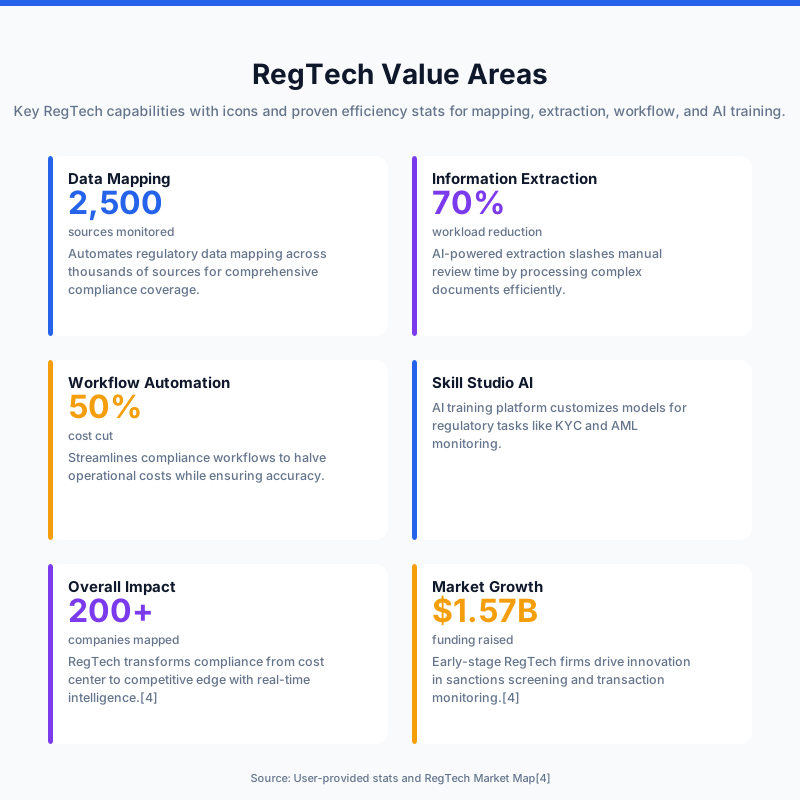
AI and NLP scan texts to cluster provisions across AI, cybersecurity, and safety rules. Obligation extraction groups phrases into themes like transparency, refined by experts into controls. Workflow tools track owners and evidence in real-time, as seen in SymphonyAI case studies replacing quarterly audits. 4CRisk.ai's Horizon Scan monitors 2,500 sources, delivering assessments in minutes.
AI training automation extends this to predictive compliance training, automating policy-to-course creation for faster content development in wealth management firms, with interactive role-plays ensuring control adoption.
Value Area | RegTech Capability | Example Impact |
|---|---|---|
Regulation Mapping | AI scans and clusters texts | Identifies overlaps in 2,500 sources |
Obligation Extraction | NLP tags 'shall' phrases | Groups into 10+ themes |
Workflow Management | Real-time tracking | Reduces audits by 70 percent |
AI Training Automation | Policy-to-course automation | Cuts costs by 50 percent |
IRIS Business notes AI, blockchain, and standards enable real-time ESG reporting, positioning AI training automation as a key capability for compliance evidence.
What Is Regulatory Intelligence?
Regulatory Intelligence (RI) systematically collects, analyzes, and predicts regulatory changes using AI agents, operating above classical RegTech for proactive compliance.
Defined by 4CRisk.ai, RI supports horizon scanning, market strategies, and multi-jurisdictional analysis with specialized language models on regulatory corpora. These deliver tasks 50 times faster, mapping regulations to controls and spotting gaps. For AI Act and Data Act changes, RI informs design teams pre-emptively.
AI-native platforms integrate RI by adapting training dynamically; when regulations update, they regenerate courses with new scenarios, maintaining proof-of-training for the workforce in insurance firms.
What Can RegTech Encode vs. Human Judgment?
RegTech encodes computable tasks like logging and data flows, while human judgment handles proportionality, ethics, and risk assessment.
Domain | RegTech Handles | Human Judgment |
|---|---|---|
AI Governance | Model documentation, traceability | Risk category, oversight sufficiency |
Data Protection | Permission tracking, flow mapping | Lawful basis, proportionality |
Cybersecurity | Vulnerability monitoring, incident logging | Severity assessment, prioritization |
Automated Training | Automated course generation, quiz verification | Scenario relevance validation |
Financial evidence from A-Team Insight shows Hawk AI at 90 percent precision in AML alerts and Lucinity reducing workloads by 70 percent. AI training automation handles training evidence, freeing L&D Directors for judgment on role-play efficacy.
How Does AI Training Automation Enhance RegTech?
AI training automation enhances RegTech by closing the gap between compliance controls and demonstrated employee competency, converting policies to verified e-learning for predictive compliance in regulated industries.
Unlike traditional LMS platforms, AI-native compliance platforms orchestrate the full lifecycle: ingesting compliance documents to output AI-generated videos, interactive quizzes, and role-play scenarios. This provides continuous, auditable proof for FCA audits. Financial services firms use them to scale training for large employee populations amid dynamic rules.
AI agents ensure regulatory-grade adaptation; a policy update triggers instant course revisions, with blockchain-like audit trails logging completions. Compared to general RegTech, this training-focused approach closes the gap from controls to demonstrated competency.
Real-time monitoring reduces audit risks by embedding compliance in daily operations.
What Are Implementation Challenges?
Implementation challenges include legacy integration, data quality issues, and cultural resistance, addressed by AI compliance platforms' API-first design and augmentation focus.
Legacy systems lack APIs for logs and SBOMs, needing bridges. Inconsistent data triggers false alerts. Teams resist fearing job loss, though RegTech augments expertise. AI compliance platforms integrate via APIs, auto-generating training from existing docs.
Maastricht's RegTech4AI emphasizes explainable prompts, which AI-native training platforms provide, linking training modules to source clauses for auditor trust.
What Is the Path Forward?
The path forward builds internal maps, pilots AI tools, integrates into workflows, and adopts semantic dashboards, with AI training platforms enabling the training layer.
Link legal intent to controls and evidence using templates. Pilot horizon scanning and ESG tools. Embed in engineering via backlogs. Connect logs to dashboards. AI training platforms add training orchestration, supporting scale-ups with modular services.
Open-source tooling and shared taxonomies lower barriers, positioning AI training automation for broad adoption in AI product compliance.
Frequently Asked Questions
What is the projected growth of the RegTech market?
The global RegTech market was valued at 12 billion USD in 2023 and is projected to reach 86 billion USD by 2032, growing at over 23 percent annually. This expansion supports AI-enabled compliance in financial services. AI-native platforms leverage this trend for training automation.
How does AI-native compliance training differ from traditional LMS?
AI-native compliance training platforms are built specifically for predictive compliance, not general LMS features. They automate policy-to-e-learning with videos and quizzes, providing auditable proof absent in standard LMS platforms.
What cost savings does RegTech offer?
AI-powered RegTech reduces compliance costs by 30 to 50 percent via automation. AI-native platforms achieve similar savings in training content development. Financial firms report faster ROI through verifiable records.
Can RegTech fully automate compliance?
No, RegTech automates structured tasks like logging but requires human judgment for ethics and proportionality. AI-native platforms structure training evidence for human review. This hybrid ensures regulatory defensibility.
How does RI improve over classical RegTech?
RI predicts changes using AI agents, 50 times faster than manual methods. It supports proactive design. AI-native platforms incorporate RI to auto-update training courses dynamically.
What role does human oversight play?
Human oversight remains essential for assessing proportionality, ethical risk appetite, and scenario relevance. RegTech handles computable tasks like logging, permission tracking, and vulnerability monitoring, while qualified humans evaluate severity, justify lawful basis, and validate training scenario applicability.
What challenges do organizations face in RegTech adoption?
Challenges include legacy integration, data inconsistency, and cultural resistance. AI compliance platforms mitigate with APIs and augmentation framing.
Are AI compliance training platforms suitable for SMEs?
Yes, modular AI compliance platforms lower barriers without large budgets. SMEs can implement compliant training for AI products efficiently. Shared taxonomies further aid accessibility.