
Go back
Search all blogs...


Automated certification tracking closes the most common audit gap: proving, not just claiming, that every regulated worker is current and correctly trained.
Last updated: May 2026
Contents
What Is Automated Compliance Training With Certification Tracking?
Why Is Certification Tracking the Missing Link in Audit Readiness?
How Does Manual Certification Tracking Compare to Automated Systems?
What Capabilities Does an Audit-Ready Certification Tracking System Need?
How Do You Design Compliance Training for Traceability and Version Control?
How Do You Implement Automated Certification Tracking in 7 Practical Steps?
How Can AI Improve Compliance Training and Certification Tracking?
How Do You Choose a Platform Like Skill Studio AI for Regulated Workforces?
Frequently Asked Questions
Key Takeaways
Audit failures are often proof failures — not missing training, but missing or inconsistent certification records.
Automated certification tracking replaces manual spreadsheets with rules-based assignments, expiries, and tamper-evident logs.
Role- and jurisdiction-based mapping is essential to ensure the right people complete the right training on time.
Real-time dashboards and gap reports give compliance leaders early warning instead of last-minute audit scrambling.
Version control and policy linkage tie completions to the exact training and policy in force at the time.
AI-generated courses from policy documents dramatically cut the lag between regulatory change and updated training.
Skill Studio AI illustrates part of this model by generating training video from policies today; audit-ready certification tracking is available through its standard course builder, not yet bridged to that policy-generated video output.
Implementation is a process — start with a clean requirements inventory, then automate the highest-risk certifications first.
Success metrics include fewer overdue certifications, faster audit evidence pulls, and reduced manual admin hours.
Most audit findings around training don’t come from lack of effort; they come from inconsistent certification tracking. This article explains how automated compliance training with certification tracking closes that gap, and where a platform like Skill Studio AI fits — generating training video from policy documents today, with audit-ready certification tracking available through its separate standard course builder.
What Is Automated Compliance Training With Certification Tracking?
Automated compliance training with certification tracking is a system that assigns, delivers, and records mandatory training and certifications based on defined rules, while maintaining auditable evidence for regulators. It replaces manual course assignment and spreadsheet tracking with workflow-driven technology.
According to Docebo’s 2025 guide on automated compliance training, automation typically covers role-based assignments, reminders, completion reporting, and expiry management across the employee lifecycle. Skill Studio AI fits part of this category by generating training video directly from policy documents; tracking resulting certifications with version control is available through its standard course builder, not yet bridged to that policy-generated video output.
A well-designed setup does three things: maps requirements to people, ensures training happens before deadlines, and proves it with defensible records. For regulated industries like financial services, healthcare, and manufacturing, this is the baseline needed for ISO, SOC 2, OSHA, HIPAA, and similar frameworks.
Why Is Certification Tracking the Missing Link in Audit Readiness?
Certification tracking is the missing link in audit readiness because auditors look first for proof that critical certifications are current and correctly scoped, and manual methods often cannot provide clean, complete evidence on demand.
AccountableHQ describes compliance LMS audit expectations as “immutable events” with timestamps, versioned course IDs, and policy documents tied to completions, plus rapid evidence exports for auditors. When tracking sits in scattered spreadsheets or email threads, you rarely meet this standard. Skill Studio AI addresses part of this by generating training video from policy documents; keeping certification status, course versions, and policy sources together for audit-ready exports is available through its standard course builder, not yet bridged to that policy-generated video output.
The practical consequences show up during audits: missing renewal dates, inconsistent course names, no proof of who completed which version, or incomplete records for contractors and temporary staff. Automated certification tracking closes these gaps by enforcing expiry rules, generating certificates, and recording every completion as a traceable event.
How Does Manual Certification Tracking Compare to Automated Systems?
Manual certification tracking is fragile, slow, and difficult to audit, while automated systems create consistent, rules-driven records that stand up under regulatory scrutiny.
TalentGuard notes that organizations relying on spreadsheets risk errors, outdated data, and lack of secure document storage, while modern systems provide alerts, secure repositories, and integrations with HRIS and learning platforms. To make this concrete, here is a side‑by‑side comparison.
Capability | Manual spreadsheets & email | Automated tracking platform |
|---|---|---|
Assignment logic | Manual filtering by manager or admin each cycle | Rule-based by role, location, risk profile, and job tasks |
Renewal & expiry handling | Calendar reminders, ad hoc emails | Automated expiries, grace windows, and re-enrollment |
Data integrity | Prone to overwrites and version confusion | Tamper-evident logs, role-based access, version control |
Audit evidence | Days/weeks compiling PDFs and screenshots | On-demand reports with certificates and completion logs |
Scalability | Breaks down beyond a few hundred employees | Scales to thousands with automated workflows |
Regulation changes | Manual rework of lists and communication | Central update, automatic propagation across courses and rules |
AccountableHQ highlights dynamic course-to-policy mapping and automated notices that escalate to managers when risk increases, something spreadsheets simply cannot do at scale. Skill Studio AI reduces the lag between regulatory change and updated training by regenerating training video from updated policy documents; audit-ready certification tracking tied to those versions is available through its standard course builder, not yet bridged to that policy-generated video output.
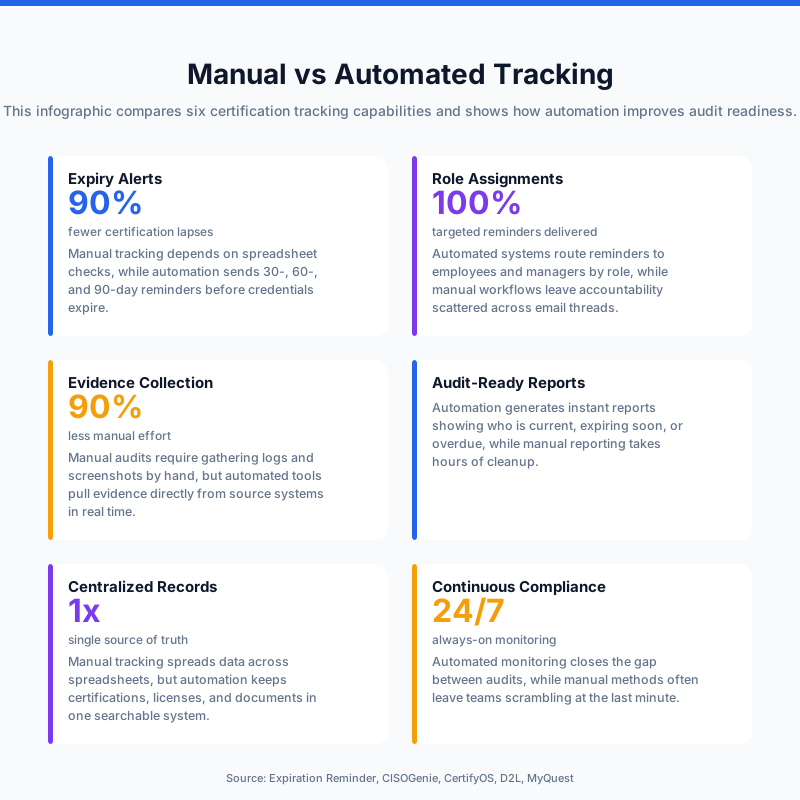
In small organizations with low regulatory exposure, manual tracking might survive; but for multi-site or global operations, automated systems quickly pay for themselves in saved admin time and reduced audit risk.
What Capabilities Does an Audit-Ready Certification Tracking System Need?
An audit-ready certification tracking system needs accurate requirement mapping, automated workflows, rich progress analytics, and tamper-evident records that link back to policies and course versions.
Drawing on patterns from AccountableHQ, Aurevity, and leading LMS vendors, the core capabilities include:
1. Requirement-to-role mapping
Aurevity describes automated mapping of training requirements to roles and jurisdictions as a foundational AI use case. You need a catalog of requirements (e.g., HIPAA privacy, OSHA forklift safety) mapped to roles, locations, and risk tiers. Without it, you can’t prove training was “appropriate to duties,” a common audit question. Skill Studio AI supports part of this logic by turning your policy documents into structured training video content; aligning that content with specific roles and certification types is handled through its standard course builder, not yet the document-generated video pipeline.
2. Automated assignments and enrollments
A compliance LMS should enroll people based on triggers: new hire, role change, location move, or recurring cycle. AccountableHQ notes that dynamic rules let learners see only what matches their regulatory requirements. This is crucial in complex operations where overlapping frameworks (for example, PCI plus ISO) apply to the same team.
3. Reminder and escalation workflows
Automated systems send reminders for approaching due dates and expirations, and escalate to managers when deadlines lapse. According to Docebo’s 2025 guidance, organizations that schedule regular automated reports by audience (weekly for admins, monthly for managers) get a clearer picture of compliance health and fewer last-minute scrambles.
4. Certification lifecycle management
Certification management means more than issuing PDFs. AccountableHQ mentions storing and renewing credentials with automated expiries and grace windows, plus attaching evidence like supervisor sign‑offs or practical evaluations. This is essential in manufacturing, clinical, and high-risk environments where competence is demonstrated, not just declared.
5. Real-time dashboards and gap analysis
Real-time dashboards should show completion rates, overdue items, and upcoming expirations by role, site, or business unit. Aurevity highlights “gap analysis showing overdue and upcoming requirements” and “priority recommendations when resources are constrained,” helping leaders allocate training time where it matters most.
6. Immutable audit trail and versioning
Audit-ready platforms record who did what, when, and how — including IP/device data and e-signatures — and link completions to content versions and policy documents. Skill Studio AI generates training video directly from policy documents today; immutable audit trails, e-signatures, and certification tracking for that document-generated output are on the roadmap and available only through its separate standard course builder in the meantime.
How Do You Design Compliance Training for Traceability and Version Control?
You design compliance training for traceability by tying every course to a policy source, tagging content with versions and effective dates, and structuring assessments so their results can be audited.
Link courses to specific policies and SOPs
AccountableHQ stresses mapping courses to policies and SOPs so mandatory modules are never missed and can be traced back during audits. In practice, each course record should include policy IDs, effective dates, and applicable regulations. Skill Studio AI builds directly on this principle by using your policy documents as the source material for courses, automatically preserving the link between the text and the resulting training.
Version control every update
Every time you update content — for example, to reflect a new OSHA rule or internal procedure change — you should create a new course version with clear identifiers. Record who published it, when it became effective, and which cohort must complete the updated version. This matters when auditors ask, “Who was trained on the previous rule set vs. the new one?”
Design assessments as evidence generators
Assessments should do more than check knowledge; they should produce evidence. Store attempt history, scores, time-on-task, and pass/fail status, as AccountableHQ outlines with learner progress metrics. In regulated industries, combining quiz scores with practical evaluations or sign‑offs from supervisors gives auditors a stronger chain of evidence.
Include attestations and acknowledgements
For policy-heavy topics like Code of Conduct or anti-bribery, include explicit attestations that the learner has read and understood the policy. These attestations, tied to user identity and timestamps, become critical in investigations and legal matters.
How Do You Implement Automated Certification Tracking in 7 Practical Steps?
You implement automated certification tracking by inventorying requirements, mapping them to roles, choosing a capable platform, and migrating data and workflows in controlled phases.
Step 1: Build a complete requirements inventory
Start with a structured list of every regulatory and internal requirement across your organization: regulatory training (e.g., HIPAA, PCI DSS), safety certifications, product or system access certifications, and annual policy acknowledgements. Docebo recommends prioritizing processes that consume the most administrative time or carry the highest non-compliance risk.
Step 2: Map requirements to roles, locations, and risk tiers
Using your HRIS roles and locations, map each requirement to who needs what, how often, and under which conditions. Aurevity emphasizes jurisdictional mapping — a nurse in one state may need a different renewal cadence than in another. Document these rules; they’ll become the automation logic in your system.
Step 3: Select or configure your platform
Look for the capabilities outlined earlier: rule-based assignments, expiry management, dashboards, and audit trails. For regulated industries, a platform like Skill Studio AI adds value by generating training video directly from current policy documents, reducing the risk of training drift when regulations change; tracking certifications with version control is available through its standard course builder, not yet bridged to that policy-generated video output.
Step 4: Clean and migrate legacy data
Before importing spreadsheet data, standardize course names, certification types, and statuses. Decide how to handle past completions (for example, import last 3–5 years or current cycle only). Many organizations use this moment to retire obsolete courses and unify naming conventions.
Step 5: Configure automation rules and notifications
Build rules such as: “All new hires in role X must complete Course A within 30 days,” or “Forklift certification renews every 3 years with a 60‑day reminder window.” Set notification cadences and escalation paths. AccountableHQ recommends honoring time zones and working hours so reminders arrive when learners can act.
Step 6: Pilot with a high-impact group
Choose a department with meaningful regulatory exposure and cooperative managers. Run the new workflows for one renewal cycle, monitor overdue rates and support tickets, and refine rules. Aim for measurable improvements, such as reducing overdue certifications by a defined percentage in the pilot group.
Step 7: Roll out, measure, and continually refine
Roll out in waves across business units, adjusting based on feedback. Track metrics like average time to complete required training, number of overdue certifications, and hours spent preparing audit evidence. Skill Studio AI supports ongoing refinement by letting SMEs update policy documents and regenerate training content without additional recording sessions, keeping courses current without overloading L&D.
How Can AI Improve Compliance Training and Certification Tracking?
AI improves compliance training and certification tracking by reducing content production time, automating requirement mapping, and highlighting risk hot spots through analytics.
CYPHER Learning’s Copilot, for example, generates compliance courses from regulatory documents and assigns training based on roles, showing how AI reduces the lag between regulation changes and updated training. Aurevity notes that AI can automatically map training requirements to roles and jurisdictions, detect completion gaps, and generate audit-ready reports.
Skill Studio AI applies AI to content generation today: it turns your policy documents into structured training video with built-in assessments; version control and certification tracking for that video output are on the roadmap and available today only through its separate standard course builder. This is particularly useful in industries where policies change frequently but SMEs have limited time to re-record content.
Beyond generation, AI can analyze completion data and recommend priorities when training time is limited, such as focusing first on high-risk roles with upcoming expirations. Over time, pattern analysis can reveal chronic bottlenecks — specific shifts, sites, or roles that consistently lag — giving compliance leaders concrete targets for intervention.
How Do You Choose a Platform Like Skill Studio AI for Regulated Workforces?
You choose a platform for regulated workforces by evaluating its ability to handle your certification complexity, integrate with existing systems, and produce audit-ready evidence without heavy manual work.
Check regulatory and certification fit
Confirm the platform can model your real-world requirements: multiple frameworks, multi-jurisdiction roles, and different renewal cadences. For example, healthcare organizations often juggle clinical credentials, HIPAA training, and vendor-specific system certifications. Skill Studio AI is particularly strong where policy-driven training dominates, since it generates training video from those policies; tracking certifications against each version is available through its standard course builder, not yet bridged to that policy-generated video output.
Evaluate audit support
Look for immutable logs, versioned content records, certificate repositories, and exportable reports for auditors. AccountableHQ stresses rapid evidence packs with completion and failure reports, certificate copies, and change logs for content updates. Ask vendors to demonstrate exporting a full evidence pack for a specific regulation in under 5 minutes.
Assess usability for SMEs and admins
Your subject matter experts and compliance managers should be able to update courses, adjust rules, and pull reports without IT intervention. Platforms like Skill Studio AI that let SMEs update policy documents and scale their teaching style without re‑recording every video reduce friction and keep training aligned with reality.
Consider integration and data flow
Even if you start small, you will eventually want HRIS, identity provider, and possibly ERP or quality system integrations. TalentGuard points out that many certification systems integrate with HRIS and LMS tools so training milestones and credentials live in one place, eliminating conflicting data sources.
Frequently Asked Questions
What is automated certification tracking in compliance training?
Automated certification tracking is the use of software to assign, monitor, and renew required certifications based on defined rules, instead of tracking them in spreadsheets or email. It manages expirations, sends reminders, and stores certificates and completion data in a single system of record. Skill Studio AI generates policy-based training video for regulated industries today; combining that with certification tracking is available through its separate standard course builder, not yet bridged to the policy-generated video output.
Why is certification tracking so important for audit readiness?
Auditors need proof that every relevant worker has completed appropriate, current training, not just a policy statement saying training exists. Certification tracking provides time-stamped records, course versions, and associated evidence like assessments or sign‑offs. According to AccountableHQ, immutable training audit trails and rapid evidence exports are now essential to pass audits with confidence.
Can spreadsheets work for compliance certification tracking?
Spreadsheets can work for small teams with limited regulatory exposure, but they tend to break down as headcount, locations, and regulations grow. They lack automated assignment, expiry alerts, and tamper-evident logs. TalentGuard notes that modern certification systems reduce errors and protect sensitive data with role-based access and integrations that spreadsheets cannot match.
How does AI help keep compliance training up to date?
AI helps by transforming new or revised regulations and internal policies into updated training content much faster than manual development. Solutions like CYPHER Copilot and Skill Studio AI generate courses from uploaded regulatory or policy documents, then align them with role-based requirements. This shortens the gap between rule changes and frontline behavior, which is crucial in audits.
What should I look for in an audit-ready compliance LMS?
Look for rule-based assignments, automated reminders and expiries, real-time dashboards, and immutable audit logs tied to course and policy versions. You also need easy evidence exports for auditors and support for mapping requirements by role and jurisdiction. Skill Studio AI adds value if your training corpus is largely policy-driven, generating training video directly from those policies; version-aware certification tracking is available through its standard course builder, not yet bridged to that video output.
How long does it take to implement automated certification tracking?
Implementation timelines vary, but many mid-sized organizations can go from requirements inventory to first live department in a few months, depending on data quality and integration complexity. Starting with a high-risk pilot group helps refine rules before wider rollout. The more structured your role and policy data, the faster the transition tends to be.