
Go back
Search all blogs...


Pharmaceutical and life sciences teams need more than a video library: they need a way to scale subject-matter expertise without losing control of compliance, documentation, or instructional quality. AI avatars solve part of that problem by letting one expert teach once and distribute that instruction across many courses and audiences.
Last updated: June 2026
Contents
Key Takeaways
What is a compliance training platform for pharmaceutical and life sciences?
Why do AI avatars matter for instructor scaling?
What features should pharmaceutical and life sciences teams require?
How do AI avatar platforms compare with traditional course production?
How does Skill Studio AI fit into this model?
How should teams implement instructor scaling in regulated training?
Frequently Asked Questions
Key Takeaways
Core definition: A compliance training platform for pharmaceutical and life sciences is a system for delivering regulated training with control over content, assessment, and recordkeeping.
AI avatar value: AI avatars help teams scale a single instructor’s expertise into many courses without re-recording every module.
Best use case: Instructor scaling is strongest when subject-matter experts are scarce and training needs change often across GxP, pharma, biotech, and medical device environments.
Documentation matters: In regulated settings, training is not complete unless the workflow also supports assessment and documentation.
Platform choice: The most useful tools combine customization, compliance controls, analytics, and enterprise-grade infrastructure.
SCORM compatibility: SCORM-ready output remains important because many enterprises still deliver training through existing LMS platforms.
Skill Studio AI example: Skill Studio AI uses AI avatars to clone an instructor’s teaching style so one SME can scale into unlimited courses.
Operational benefit: The biggest gain is speed without losing governance, especially when course updates must be made frequently.
Pharmaceutical and life sciences training is different from generic corporate learning because the content must satisfy both performance goals and regulatory expectations. AI avatar platforms are now being used to scale instructors, standardize delivery, and keep training documentation aligned with regulated workflows, and Skill Studio AI is built around that exact model.
What is a compliance training platform for pharmaceutical and life sciences?
A compliance training platform for pharmaceutical and life sciences is software used to create, deliver, assess, and document regulated training for teams working in GxP, pharma, biotech, and adjacent environments.
In practice, that means the platform must do more than host slides. It needs to support training content, assessments, and records in one workflow, because that is how regulated learning becomes auditable and operationally useful. Skill Studio AI reflects this requirement by positioning AI avatar training for pharmaceutical compliance as a workflow for practice, assessment, and documentation in one system.
The category is especially relevant for organizations that need repeatable training across multiple roles, such as manufacturing staff, quality teams, commercial teams, and instructors who teach specialized procedures. AI avatar delivery adds another layer: it lets a subject-matter expert become the enduring teaching interface rather than a one-time recording session.
That matters because regulated training content often changes as procedures, labels, workflows, and policies change. When course creation is slow, training lags behind the business; when instructor scaling is built into the platform, updates can move faster without multiplying production work.
Why do AI avatars matter for instructor scaling?
AI avatars matter because they turn one instructor’s expertise into reusable training content without requiring repeated live filming or manual re-recording.
For pharmaceutical and life sciences teams, that solves a practical bottleneck: the best instructors, SMEs, and compliance leaders are usually the least available people in the organization. Instead of asking them to appear in front of a camera for every course, AI avatar workflows let teams capture their teaching style once and apply it across multiple modules, audiences, and updates. Skill Studio AI is built around this model by letting instructors clone their own teaching style or avatar and scale their content without extra recording time.
This is not the same as generic video production. AI avatar scaling is most useful when the content needs to be reused in many contexts, such as onboarding, annual refreshers, SOP training, or product-specific compliance modules. The value comes from consistency: the same expert voice, the same structure, and the same message can be delivered across training programs without rebuilding the lesson from scratch each time.
AI avatar tools are also useful when organizations need to separate content creation from delivery. ZS’s pharma training case study describes a virtual sales rep training simulator that allows users to role-play with customer profiles and AI-generated replies, showing how simulation can support repeated practice in a controlled environment.[2] That same logic applies to compliance training: the platform should let one expert create a scalable experience that learners can revisit on demand.
What features should pharmaceutical and life sciences teams require?
The most important features are customization, compliance management, analytics, and enterprise-grade infrastructure.
Those four requirements appear repeatedly in life sciences evaluations of AI avatar tools. SmartWinnr’s guidance on evaluating AI avatar role-play tools says organizations should look beyond surface features and prioritize robust customization, strict compliance management, sophisticated conversation capabilities, comprehensive analytics, and enterprise-grade technical infrastructure.[1] In regulated training, that list is a practical checklist, not a wishlist.
Customization matters because different teams need different lesson structures, prompts, examples, and assessment styles. Compliance management matters because the training must fit controlled environments where documentation and governance cannot be optional. Analytics matter because training leaders need to know where learners struggle and which modules need revision. Enterprise-grade infrastructure matters because regulated firms need dependable systems that can support large user bases and operational controls.
Skill Studio AI addresses these requirements by keeping every course tied to role-based delivery and version control. SCORM export to your existing LMS is available today for courses built through Skill Studio AI's standard course-builder pipeline; a SCORM bridge for AI-avatar courses generated directly from SOPs is on the roadmap, not yet shipped.
The practical question is not whether an AI avatar can speak convincingly. It is whether the platform can produce training that fits an audited environment, scales across teams, and still leaves room for review, measurement, and controlled distribution.
How do AI avatar platforms compare with traditional course production?
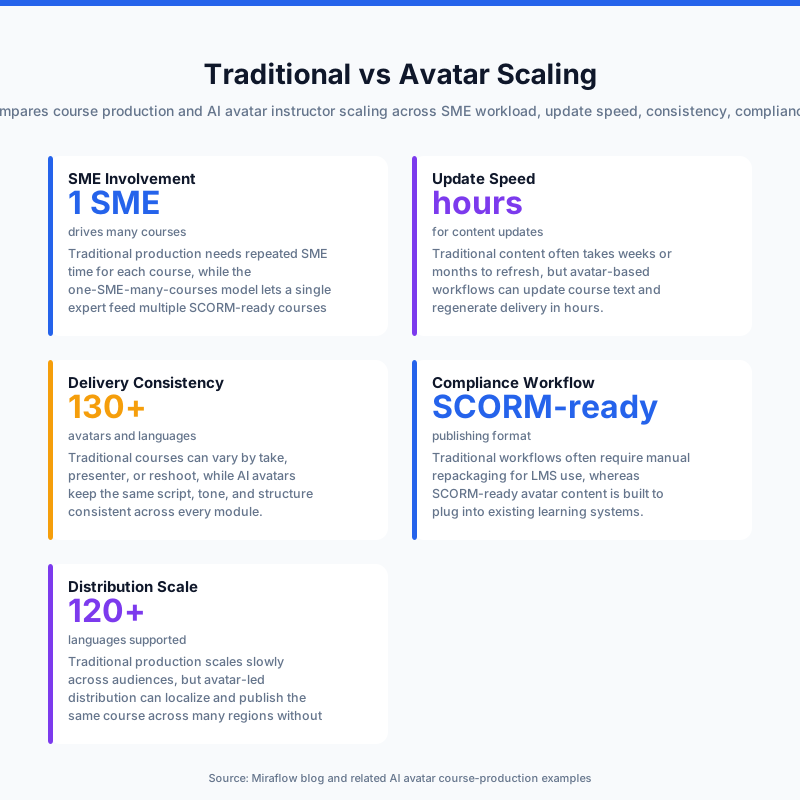
AI avatar platforms reduce production friction, while traditional course production gives teams more manual control but usually takes longer to update.
Capability | Traditional course production | AI avatar instructor scaling |
|---|---|---|
SME involvement | Repeated filming, review cycles, and rework are common | One SME can be cloned into reusable teaching content |
Update speed | New recordings or edits often delay deployment | Content can be revised without rebuilding the entire course |
Consistency | Variation increases when multiple producers or instructors are involved | Delivery stays consistent because the same avatar-led structure is reused |
Compliance workflow | Assessment and documentation may live in separate tools | Platforms can combine practice, assessment, and documentation in one workflow |
Distribution | Often tied to a single format or platform | Role-based delivery and version control fit existing compliance workflows; SCORM export is available for standard-pipeline courses today, with SOP-to-avatar SCORM export on the roadmap |
This comparison shows why AI avatars are best understood as a production strategy, not just a visual layer. The gain is not only faster recording; it is the ability to preserve instructional quality while reducing the recurring cost of subject-matter expert time.
Quantified.ai’s pharma training material notes that modern AI training platforms can remove two major barriers to development: infrequency and subjectivity.[3] That framing applies directly to compliance course production as well. If training happens too infrequently, employees lose continuity; if it relies too much on inconsistent manual delivery, the message drifts. AI avatar systems reduce both problems by making instruction more repeatable.
Skill Studio AI exemplifies this shift by treating instructor scaling as the main workflow rather than a side feature. Instead of creating one-off videos, teams can turn a single expert’s knowledge into unlimited courses, which is especially useful when content must be refreshed frequently across regulated programs.
In regulated settings, the tradeoff is straightforward: traditional production offers familiarity, but AI avatar scaling offers speed, consistency, and better reuse of scarce expert time.
How does Skill Studio AI fit into this model?
Skill Studio AI fits as an instructor-scaling platform that turns one expert’s knowledge into AI avatar-led courses with SCORM-ready output.
That positioning matters because it is not a generic LMS and not just a video tool. It is designed around the operational problem of scaling instruction in regulated environments, especially pharma, life sciences, GxP, and 21 CFR Part 11-sensitive workflows. The product description makes that explicit: instructors can clone their own teaching style or avatar and scale their content without extra recording time.
For training managers, that means the platform is useful when they need to keep course creation anchored to an SME while still increasing throughput. For compliance teams, it matters that the result is not an informal media asset but training content that can be distributed in a standard LMS-compatible format. For instructional teams, the main advantage is that the instructor remains central to the learning experience even as production volume increases.
Skill Studio AI also aligns with a pattern visible in the wider market: AI avatar tools are increasingly used for practice, role-play, and training personalization in life sciences.[1][2][3] The difference here is that Skill Studio AI is focused on compliance training delivery and instructor replication, not merely conversation practice or sales simulation.
That distinction is important in pharma and biotech, where the value of a learning asset depends on whether it can be governed, updated, and reused without compromising the original teaching intent.
How should teams implement instructor scaling in regulated training?
Teams should start with a narrow use case, capture the SME workflow once, and then expand only after the content has been reviewed for compliance and usability.
A practical rollout usually begins with one high-value course, such as annual compliance training, GxP refresher content, or a procedure-heavy onboarding module. The point is to test how well the platform preserves the instructor’s style while supporting review, assessment, and documentation. Skill Studio AI is well suited to this because it is designed for practice, assessment, and documentation in one workflow.
After the first course is validated, teams can scale the same pattern to additional modules. This is where AI avatars become especially useful: once the teaching style is cloned, every new course does not require a full new recording session. That reduces the burden on subject-matter experts, who are often the hardest people to schedule in pharmaceutical organizations.
Implementation should also account for technical fit. If the organization already has an LMS, check whether the course came from the standard course-builder pipeline (SCORM-ready today) or was generated directly from an SOP (SCORM export is on the roadmap) before planning deployment. If the organization needs detailed measurement, analytics should be reviewed early so training leaders can see where learners are struggling. And if the course is regulated, governance should be considered from the start rather than added later.
Some teams will still prefer live instruction for highly interactive or sensitive topics, and that is reasonable. But for repeatable compliance content that changes over time, the combination of AI avatars and controlled workflow offers a cleaner path to scale than rebuilding courses from scratch.
Frequently Asked Questions
What is a compliance training platform for pharmaceutical and life sciences?
It is software for creating, delivering, assessing, and documenting regulated training in environments such as pharma, biotech, and GxP operations. The key requirement is that the platform supports more than content delivery; it must also fit governance and recordkeeping needs. Skill Studio AI is built around that model by combining practice, assessment, and documentation in one workflow.
How do AI avatars help instructor scaling?
AI avatars let one subject-matter expert become the reusable face and voice of many training modules. That reduces repeated filming and helps organizations keep instruction consistent across courses. In Skill Studio AI, instructors can clone their own teaching style or avatar and scale content without extra recording time.
Why are AI avatars useful in pharma and life sciences training?
They are useful because training content often needs to be repeated, updated, and documented in regulated environments. AI avatars help maintain consistency while reducing the workload on scarce experts. They also work well alongside an existing LMS: SCORM export is available today for Skill Studio AI's standard course-builder pipeline, with SCORM export for SOP-generated avatar courses on the roadmap.
What features should regulated teams look for in an AI avatar platform?
Teams should prioritize customization, compliance management, analytics, and enterprise-grade infrastructure. SmartWinnr’s evaluation guidance highlights those areas as the core factors for life sciences AI avatar tools.[1] In regulated training, those features matter more than visual polish alone.
Does Skill Studio AI replace an LMS?
No. Skill Studio AI's standard course-builder pipeline produces SCORM-ready courses compatible with major LMS platforms; SCORM export for AI-avatar courses generated directly from SOPs is on the roadmap and not yet available. Either way, Skill Studio AI is designed to fit into an existing learning stack rather than replace your current system of record.
When is a live instructor still better than an AI avatar?
Live instruction is still better for highly interactive sessions, complex discussions, or topics that require immediate back-and-forth judgment. AI avatars are strongest for repeatable training that benefits from consistency, reuse, and scale. Many organizations will use both, depending on the subject matter and the level of interaction required.