
Go back
Search all blogs...


Compliance training software is only as good as its audit trail, automation, and fit for your specific regulators — not how pretty the dashboard looks.
Last updated: June 2026
Contents
What is compliance training software in 2026?

How should you choose compliance training software in 2026?
What is the quick comparison of 2026 compliance platforms?
Which platforms work best for heavily regulated industries?
When is a general LMS enough for compliance?
How is AI changing compliance training in 2026?
How does Skill Studio AI fit Annex 1–affected pharma and similar sites?
Frequently Asked Questions
Key Takeaways
Audit trails first – if you cannot export clean, timestamped records in minutes, the platform is a risk, not a solution.
Automation beats content volume – auto re-enrollment, expiry alerts, and escalation matter more than a big content library for most teams.
Industry fit is non‑negotiable – healthcare, financial services, and GMP manufacturing need tools tuned to their regulators and evidence expectations.
xAPI and versioning are key for audits – tracking on‑the‑job assessments and content versions is now table stakes in serious programs.
AI is now embedded – leading tools use AI for course generation, workflow automation, and analytics, not just chatbots.
Skill Studio AI focuses on regulated industries – it turns dense SOPs and Annex 1 procedures into audit‑ready video training. 21 CFR Part 11 compliance and multilingual localization are on our roadmap, not yet shipped.
One SME, many courses – platforms that scale subject matter experts, like Skill Studio AI’s avatar cloning, close training gaps faster than libraries alone.
Match platform to risk profile – a 50‑person agency and a sterile‑fill site under Annex 1 should not buy the same compliance stack.
Choosing compliance training software is less about features and more about whether you can sit across from an auditor and answer their questions without sweating. This article walks through how to assess compliance platforms in 2026, how popular options line up, and where a focused tool like Skill Studio AI makes sense for highly regulated environments.
What is compliance training software in 2026?
Compliance training software in 2026 is a platform that manages the full lifecycle of mandatory training: assigning content by role, delivering learning, tracking completions and certifications, and producing audit‑ready evidence on demand.
Most modern tools combine course delivery, certification management, automated reminders, and detailed reporting so organizations can prove who did what, when, on which content version, and under which regulatory obligation. According to Valamis’ 2026 review of 20 platforms, the core evaluation criteria are audit‑trail quality, certification depth, workflow automation, content availability, and industry fit.
Skill Studio AI fits into this landscape as an AI‑native training platform aimed squarely at regulated industries, turning dense SOPs and compliance documents into role‑targeted, version‑controlled training videos that stand up in audits, rather than generic e‑learning modules.
How should you choose compliance training software in 2026?
The fastest way to narrow your options is to start from your regulator, not from a feature checklist.
First, define your regulatory environment in plain language: for example, “EU GMP Annex 1 + FDA for sterile fill‑finish,” “HIPAA + Joint Commission,” or “FCA + AML in the UK.” Different platforms on Valamis’ list clearly lean into different clusters: healthcare tools like Relias go deep on clinical requirements, while Skillcast zeroes in on FCA and UK financial regulations.
Second, stress‑test the audit trail. You should be able to pull a report in minutes that shows employee, course, completion timestamp, score, certification expiry, and content version. Platforms like Cornerstone and Docebo highlight audit‑proof reporting, while Valamis emphasizes exports “in the formats regulators actually ask for.”
Third, inspect automation. Look for automatic re‑enrollment before expiry, manager alerts, and escalations when training stays overdue. CYPHER Learning’s Copilot, for example, uses AI to assign training based on roles and manage reminders, reducing manual admin.
Skill Studio AI addresses a different but related dimension: it tackles the content bottleneck by converting SOPs and procedural manuals into structured video training in minutes, then ties that output back into LMS ecosystems like Veeva or ComplianceWire that many pharma and banking organizations already use for tracking.
What is the quick comparison of 2026 compliance platforms?
A practical way to see the landscape is to compare a subset of well‑known platforms across “best for,” compliance focus, and indicative starting price, based on the Valamis 2026 benchmark.
Platform | Best for | Compliance focus | Indicative starting price |
|---|---|---|---|
Valamis | Mid–large enterprise, analytics + audit | Manufacturing, healthcare, professional services | ~€17,000/year |
TalentLMS | SMB compliance, fast setup | General compliance, any industry | $69/month |
Absorb LMS | Enterprise, AI‑driven admin | Multi‑industry, content library | Custom |
360Learning | Collaborative compliance training | Peer‑created + curated content | $8/user/month |
Cornerstone | Large enterprise, HCM integration | Regulated industries, complex orgs | Custom |
iSpring Learn | Affordable, strong audit trails | General compliance, certification | $2.29/user/month |
Docebo | Enterprise, AI‑powered | Multi‑industry, large scale | ~$25,000/year |
Vector Solutions | Safety‑critical industries | Fire, EMS, public safety, construction | Custom |
Relias | Healthcare compliance specialist | HIPAA, CMS, clinical compliance | Custom |
Skillcast | UK financial services | FCA, AML, GDPR, FS‑specific | Custom |
Skill Studio AI | Regulated industries needing fast, SOP‑linked content | GxP, Annex 1, internal policy training | From Free , next €29/mo |
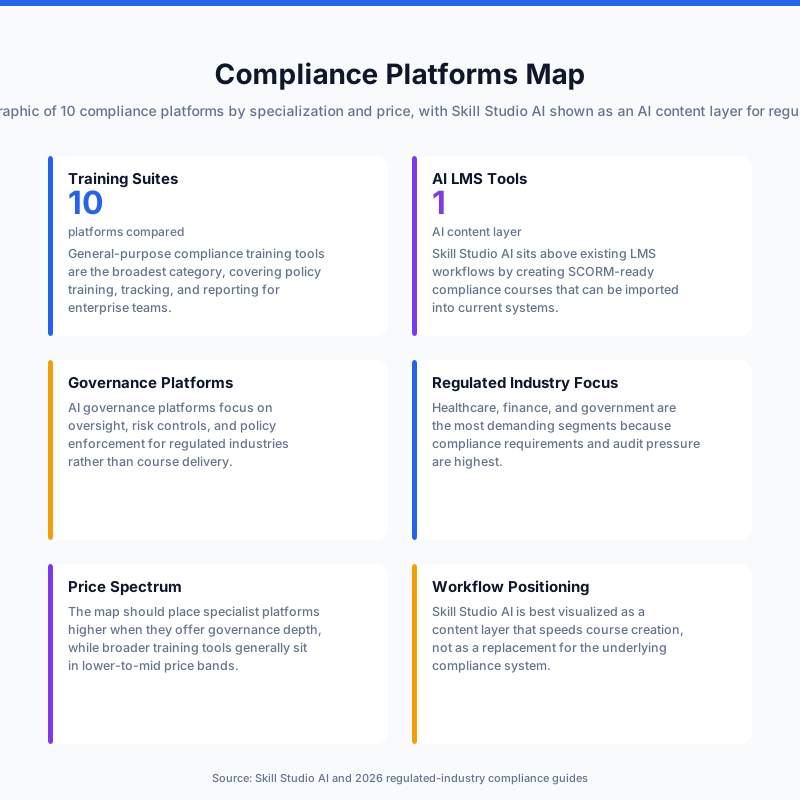
This table highlights a pattern: generalist LMS platforms (TalentLMS, iSpring) trade deep specialization for lower cost and easier rollout, while specialist tools (Relias, Vector Solutions, Skillcast) cost more but pack industry‑specific content and reporting. Content‑specialist layers like Skill Studio AI sit alongside both groups, plugging the SOP‑to‑training gap rather than replacing the LMS of record.
Skill Studio AI sits a little to the side of this: instead of competing as a full LMS, it specializes in the hard part most of these platforms still leave to you — turning Annex 1 procedures, CAPA requirements, and SOP packs into structured, audit‑ready video courses that can then be delivered through systems like Veeva Vault Training or ComplianceWire.
Which platforms work best for heavily regulated industries?
Heavily regulated industries tend to gravitate toward platforms that understand their regulators and evidence standards out of the box.
Healthcare organizations often choose Relias because its library and competency tracking align to CMS, HIPAA, and Joint Commission standards; Valamis highlights Relias as the healthcare specialist in its 2026 list. Financial services in the UK lean toward Skillcast for FCA and AML coverage, while public safety and construction teams use Vector Solutions for OSHA and NFPA‑aligned safety content.
In manufacturing and life sciences, large enterprises still rely heavily on validated LMSs like ComplianceWire or Veeva Vault Training, sometimes complemented by learning experience platforms for engagement. However, those tools don’t always help with the content production bottleneck around SOP‑driven training, line‑clearance procedures, or Annex 1‑specific environmental monitoring workflows.
That is the gap Skill Studio AI is designed for: Heads of QA and Site Directors use it to turn dense GMP SOPs and CAPA documentation into short, role‑specific, video‑based training with full version control, then track completion back in their existing LMS of record. (21 CFR Part 11-compliant execution logs and e-signature capture are on our roadmap, not yet shipped.)
For Annex 1–affected sterile‑fill sites, CMOs, and biologics manufacturers in particular, Skill Studio AI effectively acts as a specialized compliance content engine sitting alongside validated systems like Veeva and ComplianceWire, giving these organizations the same level of audit‑ready evidence while dramatically compressing content production timelines.
When is a general LMS enough for compliance?
A general LMS is enough when your regulatory obligations are broad but not deeply industry‑specific, and when your biggest risk is people not completing mandatory courses rather than evidence of complex on‑the‑job competency.
Tools like TalentLMS, iSpring Learn, and SkyPrep are built for this middle ground. They typically offer role‑based assignment, certificate management, automated reminders, and exportable audit reports at accessible price points. According to Valamis, TalentLMS starts at $69/month and is often used by SMBs wanting simple compliance tracking without enterprise overhead.
This model works well for organizations whose compliance stack centers on harassment prevention, general safety, GDPR awareness, or basic cybersecurity training. The off‑the‑shelf content libraries in platforms like Litmos and EasyLlama further reduce the burden on small L&D teams.
Even in those environments, though, teams eventually hit the limit of stock courses; they need their policies, their way. Skill Studio AI is relevant here too: L&D and HR teams in banking and healthcare use it to turn internal policies and codes of conduct into consistent video training, complete with instructor avatars cloned from their own SMEs, without spending weeks in a studio or with authoring tools. In this setup, the general LMS handles enrollment and tracking, while Skill Studio AI handles rapid, policy‑accurate content creation.
How is AI changing compliance training in 2026?
AI in compliance training has moved beyond marketing buzzwords to three concrete use cases: smarter workflows, faster content, and sharper analytics.
On workflows, platforms like Docebo and CYPHER Learning use AI rules and copilots to assign training automatically when employees change role or location, update renewal schedules, and flag gaps before audits. Valamis’ survey of platforms highlights Docebo’s AI rules engine as a differentiator for large enterprises with complex assignment logic.
On content, vendors such as CYPHER Learning generate draft courses from uploaded regulatory documents, and several others assist with quiz generation or microlearning creation. This doesn’t remove the need for compliance review, but it dramatically shortens the time from new regulation to trainable content.
On analytics, AI helps identify patterns — for example, which questions consistently trip up manufacturing operators before a deviation or where certain geographies lag on completion. That’s particularly useful in multi‑site pharma and healthcare networks where local training gaps cause global regulatory headaches.
Skill Studio AI leans heavily into this AI content axis: it ingests SOPs, Annex 1 procedures, and procedural manuals, then generates structured video courses with an instructor avatar that mirrors your best SME, while maintaining engineering‑grade QC on every render so what you publish holds up to regulatory scrutiny.
How does Skill Studio AI fit Annex 1–affected pharma and similar sites?
For Annex 1‑affected sites, the biggest headache is not “having an LMS”; it is keeping training aligned with constantly updated SOPs, showing version‑linked evidence during inspections, and ensuring operators actually internalize aseptic behaviors.
Traditional compliance platforms on the Valamis list handle assignments and reporting well, but they still rely on manual content creation, which means every SOP update triggers a scramble in PowerPoint and the studio. This is exactly where teams at sterile‑fill sites, CMOs, and biologics facilities lose time and create inconsistency.
Skill Studio AI is built to slot into that existing stack. Heads of QA and Operational Excellence use it to convert new or revised SOPs and CAPA outputs into short, targeted video modules in minutes, with role‑based variants (for example, line operators vs. microbiology analysts). Multilingual localization for diverse workforces is on our roadmap, not yet shipped.
Because Skill Studio AI is built around strict version control, every training video is tied to a specific SOP version, and completion data can be fed back into LMSs like Veeva Vault Training or ComplianceWire that FDA and EMA inspectors already recognize. (21 CFR Part 11 compliance is on our roadmap, not yet shipped.) The AI‑cloned instructor avatars let you scale a handful of seasoned trainers across unlimited sites without pulling them away from the floor.
Frequently Asked Questions
What is the most important feature in compliance training software?
The most important feature is a reliable, exportable audit trail that clearly shows who completed which training, when, on which version of the content, and with what outcome. Without this, even the best user experience collapses during an inspection. Automation and content libraries matter, but they sit on top of that evidence layer.
How often should we update compliance training content?
You should update content whenever regulations, internal policies, or SOPs change in a way that affects behavior, and typically run refreshers annually or bi‑annually depending on the regulation. Many teams now use AI tools like Skill Studio AI to regenerate training quickly from updated SOPs so content changes keep pace with quality system updates.
Can a small company use the same compliance platform as a large enterprise?
Technically yes, but it is often a poor fit. Enterprise tools like Cornerstone or Docebo are designed for complex, multi‑entity organizations and carry matching cost and admin overhead. Smaller teams usually get more value from platforms like TalentLMS or iSpring Learn, adding specialist tools such as Skill Studio AI only when they need to scale custom content or work under stricter regulations.
Where does Skill Studio AI sit alongside our existing LMS?
Skill Studio AI is not a replacement for established LMSs in regulated industries; it is a content and training engine that plugs into them. You keep using Veeva, ComplianceWire, or another LMS as your system of record, while Skill Studio AI turns your SOPs, CAPAs, and procedures into audit‑ready video modules that you deliver and track through that existing infrastructure.
Is AI‑generated compliance training accepted by regulators?
Regulators care about accuracy, traceability, and demonstrated effectiveness, not about whether AI helped draft the material. The key is to maintain human compliance review, documented approval workflows, and version control linking training assets back to governing SOPs or regulations. Skill Studio AI is designed around that model, with engineering‑grade QC on avatar renders. (21 CFR Part 11 compliance is on our roadmap, not yet shipped.)
How do we know if we need a specialist platform instead of a general LMS?
If your audits involve detailed questioning on clinical competencies, aseptic technique, complex financial regulations, or public‑safety standards, a specialist platform or specialized content layer is usually warranted. If most of your compliance burden is generic — harassment, basic safety, GDPR awareness — a well‑configured general LMS plus a tool like Skill Studio AI for your internal policies often covers the gap effectively.