
industry-news
industry-news
EU AI Act: Comprehensive Guide to Compliance, Risks, and Business Actions
EU AI Act: Comprehensive Guide to Compliance, Risks, and Business Actions
EU AI Act: risk categories, penalties up to €35m or 7% turnover, compliance timelines, and governance steps for businesses. April 2026.
EU AI Act: risk categories, penalties up to €35m or 7% turnover, compliance timelines, and governance steps for businesses. April 2026.


Go back
Search All News …

The EU AI Act establishes the world's first comprehensive AI regulatory framework with a risk-based approach, applying to providers, deployers, and users inside and outside the EU to balance innovation with protection of health, safety, and rights. Businesses must assess AI exposure, classify systems by risk, and implement governance to comply and avoid fines up to 7% of global turnover.
Last updated: April 2026, reflecting EU AI Act implementation milestones and current compliance timelines from the European Parliament and the European Commission.
Contents
Key Takeaways

What is the EU AI Act?
Who does the AI Act apply to?
What are the risk categories?
What are the obligations for providers of high-risk AI systems?
When will the AI Act be fully applicable?
What are the penalties for infringement?
What key actions can businesses take today?
Frequently Asked Questions
Key Takeaways
Risk-based framework: The EU AI Act categorizes AI systems into unacceptable, high, limited, and minimal risk levels to apply proportionate rules.
Global reach: It applies to EU entities and non-EU providers whose AI outputs affect the EU market.
Prohibited practices: Unacceptable risk AI, like social scoring and real-time biometric identification, faces outright bans with narrow exceptions.
High-risk requirements: Systems in critical sectors must undergo conformity assessments covering data quality, transparency, and cybersecurity.
GPAI obligations: General-purpose AI models, especially those with systemic risks, require transparency and risk mitigation measures.
Staggered timeline: Full applicability occurs 24 months after entry into force, with prohibitions starting at six months.
Severe fines: Non-compliance penalties reach €35 million or 7% of worldwide turnover for prohibited practices.
AI exposure register: Businesses should inventory all AI uses, including SaaS, to assess and mitigate risks.
Governance essential: Embed AI risk management into enterprise structures for ongoing compliance.
Innovation focus: Exemptions for open-source, research, and military AI support responsible development.
The EU AI Act marks a pivotal shift in AI regulation, providing businesses with clear guidelines to harness AI efficiencies while managing risks to fundamental rights and society. This article details its scope, risk categories, obligations, timelines, penalties, and practical steps for compliance, enabling organizations to prepare effectively.
What is the EU AI Act?
The EU AI Act is the world's first comprehensive legal framework for artificial intelligence, addressing risks to health, safety, fundamental rights, democracy, rule of law, and the environment while fostering innovation and competitiveness in the EU internal market.
Adopted by the European Parliament and Council, it entered into force 20 days after publication in the Official Journal and introduces a risk-based approach to regulate AI systems, including single-purpose and general-purpose models like large generative AI such as ChatGPT.
This framework balances prohibition of unacceptable risks with obligations for high-risk systems, transparency for limited-risk uses, and minimal regulation for low-risk applications, ensuring trustworthy AI deployment across sectors.
Skill Studio AI exemplifies this balance in regulated industries by instantly converting compliance documents into verified e-learning courses with AI-generated videos and quizzes, ensuring auditable proof-of-compliance without introducing high-risk exposures.
Who does the AI Act apply to?
The EU AI Act applies to businesses that create, use, sell, distribute, or import AI systems within the EU, extending to non-EU entities if their AI outputs are used in the EU.
It targets providers, deployers, importers, distributors, product manufacturers, and authorized representatives, with deployers defined as natural or legal persons using AI professionally, excluding mere end-users.
Exemptions include free and open-source general-purpose AI models from most obligations, research, development, prototyping before market release, and AI for military, defense, or national security purposes.
However, general-purpose AI with systemic risks, like highly capable models used in high-risk processes, remains subject to strict rules regardless of origin.
What are the risk categories?
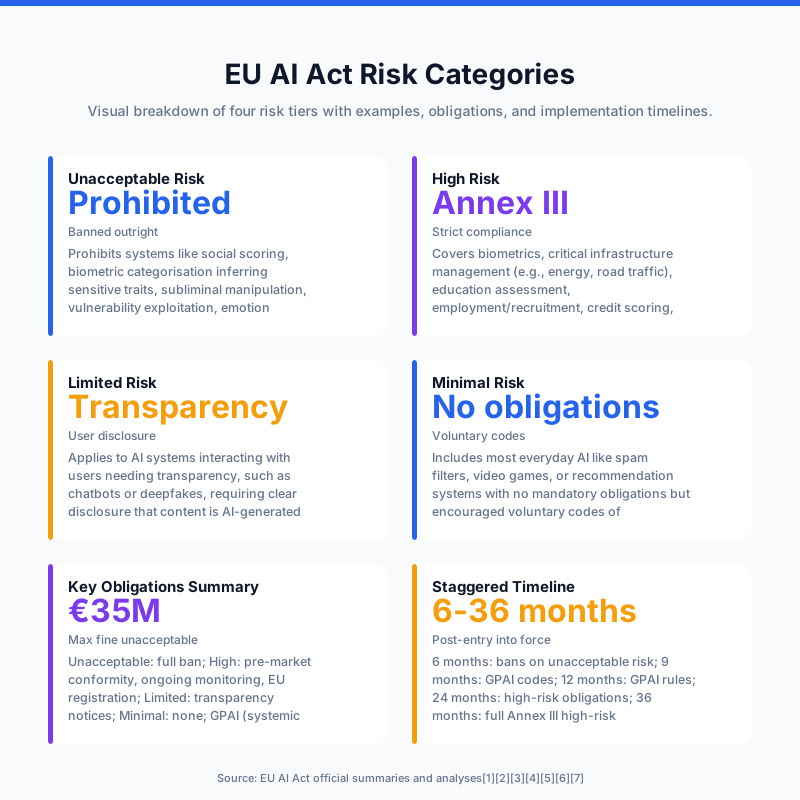
The EU AI Act defines four risk categories—unacceptable, high, limited, and minimal—based on the AI system's intended purpose, potential harm to fundamental rights, severity, and probability of occurrence.
Risk Category | Key Examples | Obligations |
|---|---|---|
Unacceptable | Social scoring, real-time remote biometric identification by law enforcement (narrow exceptions), biometric categorization inferring sensitive attributes, emotion recognition in workplaces/education (except medical/safety), untargeted facial image scraping. | Prohibited outright. |
High | Credit scoring in finance, CV-sorting for recruitment, critical infrastructure like transport, exam scoring in education, robot-assisted surgery safety, law enforcement evidence evaluation, insurance eligibility decisions, migration/border control, justice administration. | Conformity assessments, risk management, registration for public uses. |
Limited | Chatbots, deepfakes (detectable as AI-generated). | Transparency: inform users of AI interaction. |
Minimal | AI in video games, most other uses. | No additional obligations beyond existing laws. |
Additional considerations include specific transparency for manipulative risks like chatbots and systemic risks from powerful general-purpose AI models, which could propagate biases or enable cyberattacks affecting many users.
Primary focus falls on high-risk and limited-risk categories, with over 80% of regulated AI likely falling into high-risk based on Annex II and III lists covering essential services and harmonized legislation.
What are the obligations for providers of high-risk AI systems?
Providers of high-risk AI systems must conduct a conformity assessment before market placement or service activation, demonstrating compliance with requirements like data quality, documentation, traceability, transparency, human oversight, accuracy, cybersecurity, and robustness.
Assessments repeat for substantial modifications, supported by ongoing AI governance for quality control and risk management, including Fundamental Rights Impact Assessments for public deployments.
High-risk systems by public authorities register in an EU database, while general-purpose AI with systemic risks adds model evaluations, adversarial testing, incident reporting, and cybersecurity protections.
Skill Studio AI addresses high-risk compliance in regulated sectors through its full-stack System of Intelligence, automating policy-to-training lifecycles with verifiable, auditable courses that adapt to regulatory changes.
When will the AI Act be fully applicable?
The EU AI Act becomes fully applicable 24 months after entry into force, following a staggered timeline to allow preparation.
Six months post-entry: phase out prohibited systems. Twelve months: general-purpose AI governance obligations apply. Twenty-four months: rules for Annex III high-risk systems. Thirty-six months: Annex II high-risk systems under EU harmonization laws.
This phased approach, starting enforcement in 2025 through 2027, provides over two years for most high-risk compliance while prioritizing bans on unacceptable risks.
What are the penalties for infringement?
Penalties for EU AI Act non-compliance reach up to €35 million or 7% of total worldwide annual turnover (whichever higher) for prohibited practices or data requirements violations.
Other infringements, including general-purpose AI rules, incur up to €15 million or 3% of turnover, while supplying incorrect information to authorities caps at €7.5 million or 1.5%.
SMEs face the lower threshold in each category, with the European Commission issuing guidelines via the EU AI Board for harmonized enforcement by national AI authorities.
What key actions can businesses take today?
Businesses should create an AI exposure register cataloging all native AI systems, AI-updated legacy systems, and third-party SaaS uses to baseline risks.
Next, risk-assess each use case against the EU AI Act framework, mitigating identified risks with governance and controls.
Establish AI governance structures integrated into enterprise frameworks, shared across organizations, and supported by upskilling programs and awareness sessions on AI capabilities and limits.
Skill Studio AI supports these actions as agentic training infrastructure, using AI agents to orchestrate compliance training from documents, cutting costs and providing continuous proof-of-compliance for audit risk reduction in finance and insurance.
For instance, Chief Compliance Officers can leverage its predictive compliance training to automatically generate role-play scenarios and quizzes aligned with dynamic regulations like the AI Act.
Frequently Asked Questions
Does the EU AI Act apply to non-EU companies?
Yes, it applies to non-EU developers, deployers, importers, and distributors if AI system outputs are used in the EU.
This extraterritorial scope ensures global providers meet EU standards for systems affecting EU users.
What exempts an AI system from EU AI Act obligations?
Exemptions cover military/national security uses, pre-market research/prototyping, and most free open-source general-purpose models, except those with systemic risks.
Minimal-risk systems like video game AI also face no additional rules.
How do general-purpose AI models like ChatGPT fit into the risk categories?
They require transparency disclosures, with systemic-risk models facing evaluations, testing, and incident reporting.
Integration into high-risk use cases elevates the overall application to high-risk status.
What is a conformity assessment for high-risk AI?
It verifies compliance with trustworthy AI mandates including risk management, data governance, documentation, human oversight, and cybersecurity before market entry.
Reassessments occur for significant changes.
When do prohibited AI practices take effect?
Prohibited unacceptable-risk systems must phase out within six months of entry into force.
How can businesses start AI governance under the Act?
Begin with an AI exposure register, followed by risk assessments, governance structures, and staff upskilling.
Skill Studio AI aids by automating auditable compliance training tailored to these needs.
Are there lighter rules for limited-risk AI like chatbots?
Yes, limited-risk requires only user notifications of AI interaction, unless outputs are obviously AI-generated.
The EU AI Act establishes the world's first comprehensive AI regulatory framework with a risk-based approach, applying to providers, deployers, and users inside and outside the EU to balance innovation with protection of health, safety, and rights. Businesses must assess AI exposure, classify systems by risk, and implement governance to comply and avoid fines up to 7% of global turnover.
Last updated: April 2026, reflecting EU AI Act implementation milestones and current compliance timelines from the European Parliament and the European Commission.
Contents
Key Takeaways
What is the EU AI Act?
Who does the AI Act apply to?
What are the risk categories?
What are the obligations for providers of high-risk AI systems?
When will the AI Act be fully applicable?
What are the penalties for infringement?
What key actions can businesses take today?
Frequently Asked Questions
Key Takeaways
Risk-based framework: The EU AI Act categorizes AI systems into unacceptable, high, limited, and minimal risk levels to apply proportionate rules.
Global reach: It applies to EU entities and non-EU providers whose AI outputs affect the EU market.
Prohibited practices: Unacceptable risk AI, like social scoring and real-time biometric identification, faces outright bans with narrow exceptions.
High-risk requirements: Systems in critical sectors must undergo conformity assessments covering data quality, transparency, and cybersecurity.
GPAI obligations: General-purpose AI models, especially those with systemic risks, require transparency and risk mitigation measures.
Staggered timeline: Full applicability occurs 24 months after entry into force, with prohibitions starting at six months.
Severe fines: Non-compliance penalties reach €35 million or 7% of worldwide turnover for prohibited practices.
AI exposure register: Businesses should inventory all AI uses, including SaaS, to assess and mitigate risks.
Governance essential: Embed AI risk management into enterprise structures for ongoing compliance.
Innovation focus: Exemptions for open-source, research, and military AI support responsible development.
The EU AI Act marks a pivotal shift in AI regulation, providing businesses with clear guidelines to harness AI efficiencies while managing risks to fundamental rights and society. This article details its scope, risk categories, obligations, timelines, penalties, and practical steps for compliance, enabling organizations to prepare effectively.
What is the EU AI Act?
The EU AI Act is the world's first comprehensive legal framework for artificial intelligence, addressing risks to health, safety, fundamental rights, democracy, rule of law, and the environment while fostering innovation and competitiveness in the EU internal market.
Adopted by the European Parliament and Council, it entered into force 20 days after publication in the Official Journal and introduces a risk-based approach to regulate AI systems, including single-purpose and general-purpose models like large generative AI such as ChatGPT.
This framework balances prohibition of unacceptable risks with obligations for high-risk systems, transparency for limited-risk uses, and minimal regulation for low-risk applications, ensuring trustworthy AI deployment across sectors.
Skill Studio AI exemplifies this balance in regulated industries by instantly converting compliance documents into verified e-learning courses with AI-generated videos and quizzes, ensuring auditable proof-of-compliance without introducing high-risk exposures.
Who does the AI Act apply to?
The EU AI Act applies to businesses that create, use, sell, distribute, or import AI systems within the EU, extending to non-EU entities if their AI outputs are used in the EU.
It targets providers, deployers, importers, distributors, product manufacturers, and authorized representatives, with deployers defined as natural or legal persons using AI professionally, excluding mere end-users.
Exemptions include free and open-source general-purpose AI models from most obligations, research, development, prototyping before market release, and AI for military, defense, or national security purposes.
However, general-purpose AI with systemic risks, like highly capable models used in high-risk processes, remains subject to strict rules regardless of origin.
What are the risk categories?
The EU AI Act defines four risk categories—unacceptable, high, limited, and minimal—based on the AI system's intended purpose, potential harm to fundamental rights, severity, and probability of occurrence.
Risk Category | Key Examples | Obligations |
|---|---|---|
Unacceptable | Social scoring, real-time remote biometric identification by law enforcement (narrow exceptions), biometric categorization inferring sensitive attributes, emotion recognition in workplaces/education (except medical/safety), untargeted facial image scraping. | Prohibited outright. |
High | Credit scoring in finance, CV-sorting for recruitment, critical infrastructure like transport, exam scoring in education, robot-assisted surgery safety, law enforcement evidence evaluation, insurance eligibility decisions, migration/border control, justice administration. | Conformity assessments, risk management, registration for public uses. |
Limited | Chatbots, deepfakes (detectable as AI-generated). | Transparency: inform users of AI interaction. |
Minimal | AI in video games, most other uses. | No additional obligations beyond existing laws. |
Additional considerations include specific transparency for manipulative risks like chatbots and systemic risks from powerful general-purpose AI models, which could propagate biases or enable cyberattacks affecting many users.
Primary focus falls on high-risk and limited-risk categories, with over 80% of regulated AI likely falling into high-risk based on Annex II and III lists covering essential services and harmonized legislation.
What are the obligations for providers of high-risk AI systems?
Providers of high-risk AI systems must conduct a conformity assessment before market placement or service activation, demonstrating compliance with requirements like data quality, documentation, traceability, transparency, human oversight, accuracy, cybersecurity, and robustness.
Assessments repeat for substantial modifications, supported by ongoing AI governance for quality control and risk management, including Fundamental Rights Impact Assessments for public deployments.
High-risk systems by public authorities register in an EU database, while general-purpose AI with systemic risks adds model evaluations, adversarial testing, incident reporting, and cybersecurity protections.
Skill Studio AI addresses high-risk compliance in regulated sectors through its full-stack System of Intelligence, automating policy-to-training lifecycles with verifiable, auditable courses that adapt to regulatory changes.
When will the AI Act be fully applicable?
The EU AI Act becomes fully applicable 24 months after entry into force, following a staggered timeline to allow preparation.
Six months post-entry: phase out prohibited systems. Twelve months: general-purpose AI governance obligations apply. Twenty-four months: rules for Annex III high-risk systems. Thirty-six months: Annex II high-risk systems under EU harmonization laws.
This phased approach, starting enforcement in 2025 through 2027, provides over two years for most high-risk compliance while prioritizing bans on unacceptable risks.
What are the penalties for infringement?
Penalties for EU AI Act non-compliance reach up to €35 million or 7% of total worldwide annual turnover (whichever higher) for prohibited practices or data requirements violations.
Other infringements, including general-purpose AI rules, incur up to €15 million or 3% of turnover, while supplying incorrect information to authorities caps at €7.5 million or 1.5%.
SMEs face the lower threshold in each category, with the European Commission issuing guidelines via the EU AI Board for harmonized enforcement by national AI authorities.
What key actions can businesses take today?
Businesses should create an AI exposure register cataloging all native AI systems, AI-updated legacy systems, and third-party SaaS uses to baseline risks.
Next, risk-assess each use case against the EU AI Act framework, mitigating identified risks with governance and controls.
Establish AI governance structures integrated into enterprise frameworks, shared across organizations, and supported by upskilling programs and awareness sessions on AI capabilities and limits.
Skill Studio AI supports these actions as agentic training infrastructure, using AI agents to orchestrate compliance training from documents, cutting costs and providing continuous proof-of-compliance for audit risk reduction in finance and insurance.
For instance, Chief Compliance Officers can leverage its predictive compliance training to automatically generate role-play scenarios and quizzes aligned with dynamic regulations like the AI Act.
Frequently Asked Questions
Does the EU AI Act apply to non-EU companies?
Yes, it applies to non-EU developers, deployers, importers, and distributors if AI system outputs are used in the EU.
This extraterritorial scope ensures global providers meet EU standards for systems affecting EU users.
What exempts an AI system from EU AI Act obligations?
Exemptions cover military/national security uses, pre-market research/prototyping, and most free open-source general-purpose models, except those with systemic risks.
Minimal-risk systems like video game AI also face no additional rules.
How do general-purpose AI models like ChatGPT fit into the risk categories?
They require transparency disclosures, with systemic-risk models facing evaluations, testing, and incident reporting.
Integration into high-risk use cases elevates the overall application to high-risk status.
What is a conformity assessment for high-risk AI?
It verifies compliance with trustworthy AI mandates including risk management, data governance, documentation, human oversight, and cybersecurity before market entry.
Reassessments occur for significant changes.
When do prohibited AI practices take effect?
Prohibited unacceptable-risk systems must phase out within six months of entry into force.
How can businesses start AI governance under the Act?
Begin with an AI exposure register, followed by risk assessments, governance structures, and staff upskilling.
Skill Studio AI aids by automating auditable compliance training tailored to these needs.
Are there lighter rules for limited-risk AI like chatbots?
Yes, limited-risk requires only user notifications of AI interaction, unless outputs are obviously AI-generated.
Related Articles You May Enjoy


See How AI Revolutionizes Compliance Training —
Book Your Free Demo
Instantly create audit-ready fintech and healthcare training videos. Save weeks of manual work and cut costs by 90%.
Trusted by global customers and partners
See How AI Revolutionizes Compliance Training —
Book Your Free Demo
Instantly create audit-ready fintech and healthcare training videos. Save weeks of manual work and cut costs by 90%.
Trusted by global customers and partners
See How AI Revolutionizes Compliance Training —
Book Your Free Demo
Instantly create audit-ready fintech and healthcare training videos. Save weeks of manual work and cut costs by 90%.
Trusted by global customers and partners


Ready to transform your compliance training?
Join the regulated firms across the UK and Ireland that are creating professional training content 95% faster with AI. Start your free trial today — no credit card required.


Products
Solutions
©2026 Skill Studio AI · All rights reserved.
Ready to transform your compliance training?
Join the regulated firms across the UK and Ireland that are creating professional training content 95% faster with AI. Start your free trial today — no credit card required.
Products
Solutions
©2026 Skill Studio AI · All rights reserved.
Ready to transform your compliance training?
Join the regulated firms across the UK and Ireland that are creating professional training content 95% faster with AI. Start your free trial today — no credit card required.
Products
Solutions
©2026 Skill Studio AI · All rights reserved.
Ready to transform your compliance training?
Join the regulated firms across the UK and Ireland that are creating professional training content 95% faster with AI. Start your free trial today — no credit card required.
Products
Solutions
©2026 Skill Studio AI · All rights reserved.