Author

Category
Latest articles
Date
Duration
8 min
AI Literacy: Future Workforce Essential
AI literacy equips workforces to thrive in an AI-driven economy, mirroring basic literacy's historical role, with mandatory requirements under regulations like the EU AI Act driving organizational adoption. Frameworks and measurement tools enable enterprises to build competency, unlocking revenue growth and efficiency gains projected at £79.3 billion for the UK by 2035.
Contents
Key Takeaways
What is AI Literacy?
Why Does AI Literacy Matter?
Who Needs AI Literacy?
What Are the Four Core Capabilities of AI Literacy?
What is an AI Literacy & Skills Framework?
Why Does Data Literacy Matter for AI Literacy?
How to Measure AI Literacy in Your Organisation?
How to Build AI Literacy in Your Organisation?
Frequently Asked Questions
Key Takeaways
Mandatory Compliance: EU AI Act Article 4 requires AI literacy for all staff as of February 2025, spanning developers to end users.
Revenue Impact: Mature AI literacy programs link to 92% revenue increase likelihood per DataCamp's 2025 report, versus 75% for less mature ones.
Economic Drag: AI illiteracy contributes to £61.94 billion annual UK productivity loss from inefficient data tasks, equating to 27 lost days per employee.
Framework Consensus: Leading frameworks like Alan Turing Institute's identify four learner personas and five competency dimensions for business application.
Core Capabilities: AI literacy encompasses understanding, interacting, evaluating, and acting responsibly with AI technologies.
Regulated Industries: Skill Studio AI automates policy-to-training lifecycles, converting compliance documents into auditable e-learning for financial services.
Measurement Tools: Scales like Wang et al.'s 12-item AI Literacy Scale cover awareness, usage, evaluation, and ethics for workplace assessment.
Skills Gap: Only 34% of FTSE100 reports mention AI training, despite 91% of employees desiring skill improvement.
AI literacy emerges as a foundational competency akin to reading and writing, enabling workforces to navigate AI's societal and economic impacts. This article examines definitions, regulatory imperatives, frameworks, measurement strategies, and implementation paths, drawing on recent reports and expert frameworks to guide enterprise leaders in regulated sectors. Readers will gain actionable insights for assessing and elevating AI literacy to capture projected economic benefits.

What is AI Literacy?
AI literacy comprises the technical knowledge, durable skills, and attitudes needed to thrive amid AI influence, allowing individuals to engage, create with, manage, design AI, and critically assess its benefits, risks, and ethics. This capacity fosters intelligent interaction with AI technologies and their societal impacts, as affirmed by consensus across academic, industry, and international sources.
Distinct from mere tool usage, AI literacy integrates foundational elements like critical thinking and adaptability, extending beyond coding or prompting to encompass ethical evaluation and human-centric application. In regulated industries such as financial services, Skill Studio AI exemplifies this by instantly converting compliance documents into verified e-learning courses with AI-generated videos and quizzes, ensuring teams understand and apply AI responsibly.
Generative AI literacy forms a key subset, equipping users to prompt, evaluate, and shape outputs from large language models for business value. This empowers proactive leverage rather than passive consumption, aligning with Digital Promise's framework of understand, evaluate, and use modes.
Broad definitions emphasize critical engagement: understanding AI basics, interacting consciously, and applying it in daily decisions without requiring specialist programming skills. For enterprises, this translates to better decision-making, as AI-literate teams interpret insights accurately and mitigate limitations like bias.
Why Does AI Literacy Matter?
AI literacy drives commercial success, with 92% of UK businesses using AI reporting revenue gains per Amazon's April 2025 report, and mature programs yielding superior outcomes in innovation (95% vs. 85%) and cost reduction (91% vs. 75%) according to DataCamp[query].
Regulatory mandates amplify urgency: EU AI Act Article 4 enforces sufficient AI literacy for all staff from February 2025, positioning education as a compliance imperative across providers, deployers, and users[query]. This shifts AI from optional to essential, particularly in sectors facing audits from bodies like the FCA or ECB.
Illiteracy incurs steep costs, including vulnerability to misinformation, biased outputs, and lost productivity—Multiverse data shows workers lose 27 days annually to inefficient data tasks, totaling £61.94 billion UK-wide, with only half receiving over five hours of training[query]. Skill Studio AI addresses this through its full-stack System of Intelligence, automating the policy-to-training lifecycle to provide continuous, verifiable proof-of-compliance and cut development costs.
Geopolitically, AI literacy defines national futures, creating divides between adept and lagging populations, as nations prioritizing measurement and foundational skills will lead in innovation and economic participation. Early adopters gain competitive edges, though only 52% of leaders extract full GenAI value beyond cost-cutting.
Who Needs AI Literacy?
Every role in AI-enabled organizations—from decision-makers and customer servers to process builders—requires AI literacy, with depth scaled by responsibility to boost productivity by over 38% as per Multiverse findings[query].
Executives govern strategy and risk; managers redesign workflows; business functions apply AI to forecasting; technical teams ensure model quality; risk professionals assess biases; HR defines pathways; and frontline roles use tools safely[query]. This role-based approach builds baseline competency universally, then specializes for impact.
Macro benefits empower employees for confident usage, leaders for ethical governance, and providers for sector-specific programs[query]. In highly regulated financial services, where compliance is paramount, such literacy prevents audit risks and scales training dynamically.
91% of employees seek AI skill enhancement, yet FTSE100 mentions lag at 34%, underscoring universal need amid 2.8 daily hours on data tasks[query]. Skill Studio AI supports this by generating interactive role-play scenarios from policies, tailoring literacy to compliance officers and L&D directors.
What Are the Four Core Capabilities of AI Literacy?
The four core capabilities are understanding AI concepts and limits, interacting via tools like LLMs, evaluating outputs for accuracy and fairness, and acting responsibly per ethical guidelines[query].
Understanding covers strengths, limitations, and basics; interacting enhances workflows with generative and predictive tools; evaluating combats bias and hallucinations; responsible action ensures compliance and security[query]. These align with interconnected skills like critical thinking and adaptability.
Digital Promise reinforces with understand-evaluate-use modes, prioritizing critical assessment before application. For compliance-heavy enterprises, these capabilities enable auditable AI use.
What is an AI Literacy & Skills Framework?
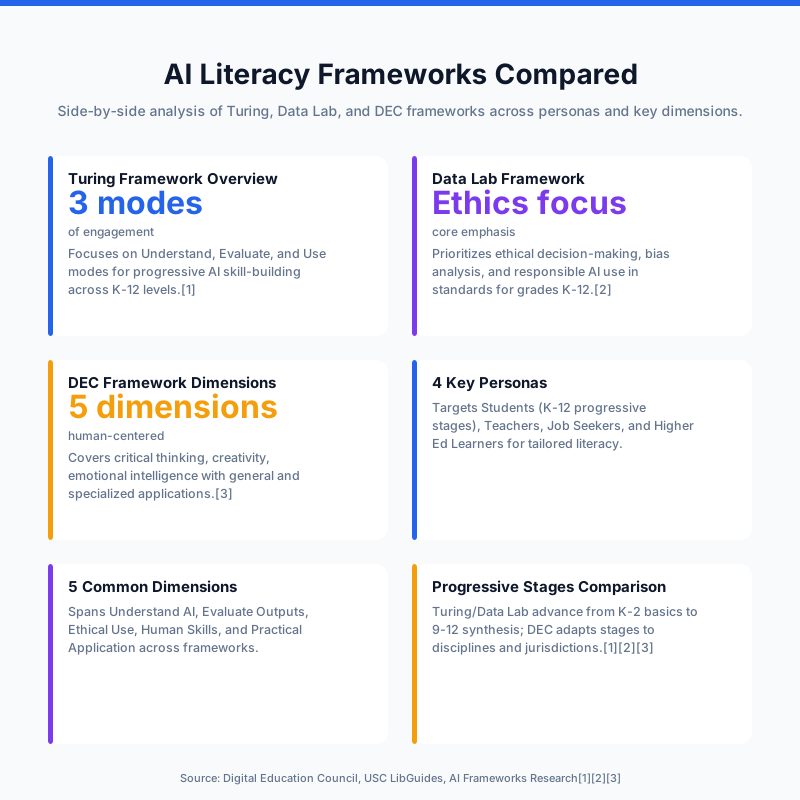
Frameworks like the AI Skills for Business Competency Framework outline competencies via four personas—AI citizens, workers, professionals, leaders—and five dimensions including privacy, engineering, problem definition, solving, and evaluation[query].
Framework | Key Personas | Core Dimensions |
|---|---|---|
Alan Turing Institute | 4 (Citizens, Workers, Professionals, Leaders) | 5 (Privacy, Engineering, Communication, Solving, Evaluation) |
Data Lab | Similar personas with foundational skills | Data/AI ethics, governance |
Digital Education Council | 3 progressive stages | 5 (Understand AI/Data, Critical Thinking, Ethics, Human-Centricity, Domain) |
The Turing framework, informed by 16 standards, supports organizational reviews; Data Lab emphasizes ethics; DEC adopts human-centered dimensions[query]. Bloom's Taxonomy adapts via remember-understand-apply-analyse-evaluate-create levels for AI[query].
EC/OECD and AI Literacy Institute offer additional models for education and broad use[query]. Skill Studio AI operationalizes these by orchestrating AI agents to adapt training to regulatory changes, aligning with framework competencies.
Why Does Data Literacy Matter for AI Literacy?
Data literacy underpins AI literacy, as AI quality hinges on input data scrutiny for collection, processing, and biases, enabling output evaluation[query].
Workers spend 13.8% of time on data tasks, with 33.9% inefficient—AI literacy via data foundations slashes this[query]. Questioning inputs complements AI output critique, vital for responsible deployment.
How to Measure AI Literacy in Your Organisation?
Combine knowledge tests and self-assessments, using tools like Wang et al.'s 12-item scale (awareness, usage, evaluation, ethics) or Pinski & Benlian's workplace scale for explicit/tacit knowledge[query].
Challenges include narrow focus and lack of facet separation; self-efficacy influences adoption[query]. Benchmarks precede tailored programs for ROI.
How to Build AI Literacy in Your Organisation?
Implement fundamentals training, AI Centers of Excellence, and early involvement via role-based paths, assessments, and change management for 5x success rates[query].
Baseline for all, deepen by function; foster communities for use cases; drive culture through awareness-desire-knowledge-reinforcement[query]. Skill Studio AI, as agentic training infrastructure, automates this for regulated industries, generating auditable courses with videos and scenarios to scale compliance training.
Frequently Asked Questions
What is the EU AI Act's requirement for AI literacy?
Article 4 mandates sufficient AI literacy for providers, deployers, and users' staff from February 2025, covering all roles[query]. This ensures ethical and safe AI deployment organization-wide.
How does AI literacy impact revenue?
DataCamp's 2025 report shows 92% revenue increase likelihood for mature programs versus 75% for others, alongside innovation and cost benefits[query]. Early adopters lead in value realization.
What are the four core AI literacy capabilities?
They include understanding AI, interacting with tools, evaluating outputs, and acting responsibly[query]. These form the basis for effective, ethical use across roles.
How does Skill Studio AI support AI literacy?
Skill Studio AI converts compliance documents into e-learning with videos, quizzes, and scenarios, providing verifiable proof for regulated sectors like finance.
Which frameworks measure AI literacy?
Alan Turing's with five dimensions, Data Lab's ethics focus, and DEC's human-centered model stand out, alongside Bloom's adapted levels[query]. They guide competency mapping.
What is the cost of AI illiteracy?
UK economy loses £61.94 billion yearly from 27 inefficient data days per worker; gaps widen collaboration issues[query]. Literacy closes this via efficiency gains over 38%.
Why integrate data literacy with AI?
Data literacy questions inputs, enabling AI output critique and bias mitigation, foundational for safe application[query]. It addresses 33.9% inefficient task time.