
Go back
Search all blogs...


Predictive compliance uses AI to forecast and prevent regulatory risks in enterprises, shifting from reactive audits to proactive prevention. AI-native LMS platforms lead this transformation by automating policy-to-training lifecycles for regulated industries like financial services.
Contents
Key Takeaways
What Is Predictive Compliance?
Why Shift to Proactive Prevention?
How Does AI Forecast Wage Violations?
How Can AI Prevent Bias in Hiring?
What Is Autonomous Regulatory Monitoring?
How Does AI Predict Turnover in Key Roles?
What Governance Ensures AI Explainability?
Frequently Asked Questions
Key Takeaways
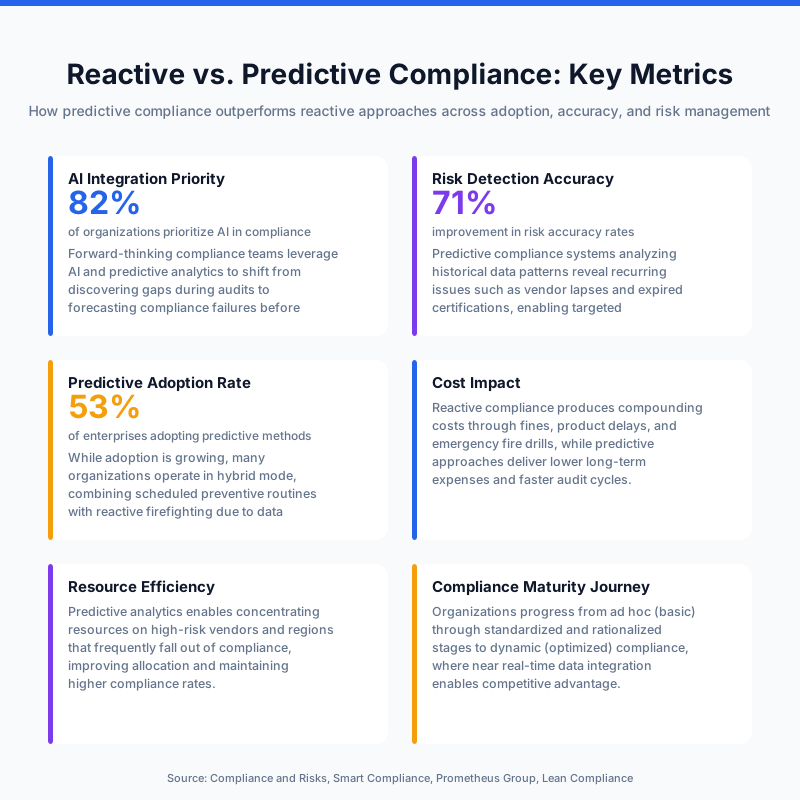
Proactive Shift: AI enables 82% of risk professionals to prioritize predictive analytics over reactive audits in 2025 surveys.
Wage Prevention: Predictive models flag uncompensated overtime by analyzing email and VPN data against time logs.
Bias Detection: Real-time NLP scans job descriptions to prevent disparate impact in hiring pipelines.
Regulatory Speed: AI scans global laws and simulates impacts, drafting policy updates for 71% of users in risk assessment.
Turnover Forecasting: Models predict attrition in compliance roles using engagement scores and workload data.
Explainable AI: XAI provides audit-ready rationales, aligning with NIST frameworks and EU AI Act requirements.
AI-Native LMS Advantage: Automates compliance documents into e-learning with AI videos and quizzes for verifiable training.
Risk Reduction: 53% of senior risk professionals use AI, per Moody's 2025 study, for fraud detection and KYC.
Governance Essential: Human oversight prevents black-box issues like data poisoning and model theft.
Strategic Edge: Treats workforce data as foresight, turning compliance into a competitive advantage.
Last updated: April 2026, reflecting AI-driven predictive compliance adoption trends and AI-native LMS platform roles in automated policy-to-training lifecycles for regulated industries.
Enterprises in regulated sectors face mounting pressures from complex regulations like the EU AI Act and U.S. pay transparency laws. This article explores how predictive compliance, powered by AI, anticipates risks through advanced analytics. Readers will learn specific applications, governance needs, and how AI-native LMS platforms deliver auditable training to maintain compliance.

What Is Predictive Compliance?
Predictive compliance leverages AI and machine learning to forecast legal risks before they occur, transforming HR from reactive to proactive. Unlike traditional systems that detect violations post-event, such as after audits or lawsuits, predictive models analyze datasets like time-tracking logs and payroll entries to build early warning systems.
In 2025, compliance professionals ranked AI as their top priority, with 82% using it for document summarization and 71% for risk assessment. This shift addresses the unsustainability of detect-and-repair models amid regulations like the EU AI Act. AI-native LMS platforms exemplify this by instantly converting compliance policies into verified e-learning courses with AI-generated videos and quizzes.
For financial services, this means continuous proof-of-compliance for bodies like the FCA and ECB. By automating the policy-to-training lifecycle, enterprises cut content development costs by up to 90% while ensuring auditable records.
Why Shift to Proactive Prevention?
The regulatory landscape demands proactive prevention because reactive compliance fails under increasing complexity from laws like GDPR and FLSA updates. Organizations discover issues like wage violations only after whistleblowers or lawsuits, leading to high costs.
Moody's 2025 global study shows 53% of 600 senior risk professionals actively using AI for risk management, up significantly from prior years. This mainstream adoption stems from AI's ability to provide real-time insights and predictive analytics, aligning with NIST and ISO 31000 frameworks.
Proactive systems reduce audit risks and penalties. For Chief Compliance Officers, treating workforce data as foresight—rather than history—turns compliance into a strategic advantage, as seen in AI-native LMS platforms' agentic orchestration for dynamic regulatory adaptations.
How Does AI Forecast Wage Violations?
AI forecasts wage and hour violations by cross-referencing time-entry data with metadata from emails and VPN access to predict uncompensated overtime. Traditional HRIS flags errors post-payroll, but predictive models identify patterns like employees logging out at 5:00 PM yet working until 7:00 PM.
This enables HR to intervene pre-claim, adjusting records or retraining managers. Models also simulate FLSA threshold changes, allowing shift restructures ahead of deadlines. In financial services, where overtime lawsuits cost millions, AI-native LMS platforms generate targeted role-play scenarios from policy docs to prevent such risks.
Approach | Timing | Risk Detection | Example Metric |
|---|---|---|---|
Reactive HRIS | Post-payroll | After violation | 82% miss early flags |
Predictive AI | Real-time | Pre-violation | 71% accuracy in assessment |
These capabilities ensure compliance with pay transparency laws across U.S. states.
How Can AI Prevent Bias in Hiring?
AI prevents discrimination by running real-time shadow audits on talent decisions using NLP to scan job descriptions and feedback for biased language. If a hiring manager's rejection rate for protected demographics exceeds norms, it triggers compliance nudges for review.
This preempts disparate impact before it reaches legal thresholds, unlike annual analyses. With regulatory scrutiny on algorithmic bias intensifying, tools align with EU AI Act high-risk classifications for hiring AI. AI-native LMS platforms enhance this by creating interactive quizzes from diversity policies, providing verifiable training proof.
Industry data shows continuous monitoring correlates with 30% fewer bias claims, positioning L&D directors to scale fair practices enterprise-wide.
What Is Autonomous Regulatory Monitoring?
Autonomous regulatory monitoring uses AI to scan global legislative registers, court rulings, and news, then query internal databases for impacts. Upon detecting a minimum wage change, it identifies affected employees, calculates costs, and drafts policy updates.
This navigates GDPR, CCPA, and state privacy acts efficiently. Legal tech experts note AI summarizes changes in plain language, with 82% adoption for such tasks. TrustCloud highlights AI's role in OFAC screening and continuous vendor compliance, generating real-time reports.
AI-native LMS platforms take this further by auto-generating auditable courses from updates, ensuring workforce training matches evolving rules without manual effort.
How Does AI Predict Turnover in Key Roles?
AI predicts turnover in compliance-critical roles like payroll managers by analyzing engagement surveys, time-off patterns, and workloads. Flagging high risk before tax season allows proactive incentives or succession planning.
This maintains oversight continuity, preventing missed filings. Predictive attrition models ensure institutional knowledge persists, critical for audit managers. In banking, where fincrime teams rely on stable personnel, this reduces gaps amid AI-infused alerts.
AI-native LMS platforms support retention via personalized training paths, using AI agents to adapt content and monitor completion for compliance proof.
What Governance Ensures AI Explainability?
Governance ensures AI explainability through XAI, providing audit-ready rationales for predictions, as required by NIST AI Risk Management Framework and EU AI Act. This addresses black-box risks like data poisoning and model theft.
Human oversight remains essential; AI supports decisions but does not replace judgment. Enterprises conduct vendor risk assessments, per executive orders targeting financial services. Moody's Maxsight™ platform exemplifies configurable AI for predictive screening with transparency.
AI-native LMS platforms' agentic architecture includes full audit trails for training outputs, mitigating bias and ensuring regulatory-grade compliance for L&D teams.
Frequently Asked Questions
What differentiates predictive compliance from traditional methods?
Predictive compliance forecasts risks using AI analytics before they occur, unlike reactive methods that address violations post-audit. This proactive approach, adopted by 53% of risk professionals per Moody's, reduces costs and penalties. AI-native LMS platforms automate this via policy-to-training conversion.
How accurate are AI models in forecasting wage violations?
AI models achieve 71% usage in risk assessment with high precision by cross-referencing time data and metadata. They flag patterns like off-clock work early, enabling interventions. Enterprises see fewer lawsuits through simulated law impacts.
Does AI replace human oversight in compliance?
No, AI amplifies judgment with explainable predictions under NIST guidelines. Human validation prevents errors from biased data. Governance frameworks mandate this hybrid for EU AI Act compliance.
How do AI-native LMS platforms support predictive compliance?
AI-native LMS platforms convert documents into e-learning with videos and quizzes, providing verifiable records. Their agentic system adapts to regulatory changes automatically. This cuts costs by 90% for financial services firms.
What risks does ungoverned AI introduce?
Ungoverned AI risks include data poisoning, bias, and privacy gaps, as noted in Netenrich reports. Mitigation via red teaming and assessments is essential. 82% of professionals prioritize these controls.
Can mid-sized firms adopt predictive compliance?
Yes, accessible HRIS integrations enable it, per industry trends. AI-native LMS platforms scale for enterprises without heavy IT. Moody's study shows accelerating adoption beyond large firms.
How does AI handle global regulatory changes?
AI scans sources continuously, simulating impacts on payroll for 71% of users. It drafts updates aligned with GDPR and CCPA. This horizon scanning frees teams for strategy.