


Go back
Search all blogs...


RegTech automation driven by AI is revolutionizing compliance in 2025, reducing costs by 30-50% and enabling predictive risk management for regulated industries. AI-native LMS platforms lead as agentic training infrastructure, automating policy-to-training lifecycles for verifiable proof-of-compliance.
Contents
Key Takeaways
Why Is RegTech Surging in 2025?
How Does Automation Power Modern Compliance?
What Is the Market Impact of RegTech?
What Defines the AI Revolution in RegTech?
How Is RegTech Shaping Global Due Diligence?
What Is RegTech's Role in ESG and Global Trust?
How to Overcome RegTech Automation Challenges?
How Do AI-Native LMS Platforms Lead RegTech?
Frequently Asked Questions
Key Takeaways
Cost Savings: RegTech cuts compliance costs by 30-50% through automation of manual tasks.
Market Growth: The global RegTech market exceeds USD 19 billion in 2025 with 23% CAGR to 2032.
AI Adoption: 70% of compliance officers plan AI tools by 2026 for real-time monitoring.
Workload Reduction: Agentic AI reduces alert-review workload by over 80%.
Onboarding Speed: Automation slashes onboarding times by 60% while boosting accuracy.
Predictive Shift: RegTech moves from reactive detection to preventive compliance using ML models.
Training Automation: AI-native LMS platforms convert compliance docs to e-learning in seconds for audit-proof records.
ESG Integration: RegTech embeds compliance into ESG reporting for sustainable governance.
Regulatory Alignment: AI-native LMS platforms ensure FCA, CBI, ECB auditable compliance.
Scalability: Cloud-based RegTech handles cross-border rules dynamically without headcount growth.
Last updated: April 2026, reflecting AI-driven RegTech adoption trends and AI-native LMS platform roles in predictive compliance training across regulated industries.
RegTech in 2025 represents a pivotal shift from manual, reactive compliance to AI-orchestrated, predictive systems that scale with regulatory complexity. This article explores how automation transforms compliance workflows, highlights market data, and positions AI-native LMS platforms as leaders in agentic training infrastructure for regulated enterprises. Readers will gain insights into efficiency gains, challenges, and strategies for Chief Compliance Officers in finance and beyond.

Why Is RegTech Surging in 2025?
RegTech adoption surges in 2025 due to expanding global regulations like the EU's 6AMLD, U.S. CTA, and Asia-Pacific data laws, overwhelming traditional manual systems.
Compliance officers face daily evolving cross-border obligations, with nearly 70% planning to deploy automated reporting and intelligent monitoring by 2026, per Deloitte. Regulators like the UK FCA now encourage AI testing via Supercharged Sandbox with NVIDIA platforms, enabling live experimentation on compliance use cases.
This surge reflects a mindset shift: compliance evolves from a cost center to a competitive edge, accelerating product launches in regulated sectors. For instance, HSBC uses AI for ESG reporting, publishing disclosures months ahead and attracting ESG capital. AI-native LMS platforms address this by automating policy updates into training, ensuring real-time adaptation without manual intervention.
How Does Automation Power Modern Compliance?
Automation powers modern compliance by handling repetitive tasks like AML screening, KYC verification, and reporting through AI, machine learning, and API integrations, reducing manual hours significantly.
Key capabilities include automated regulatory reporting in approved formats, real-time risk monitoring, and AML/KYC flagging of suspicious activities. Nasdaq Verafin's Agentic AI Workforce, for example, disposes sanctions alerts and automates EDD reviews, cutting alert-review workload by over 80%. RegTech also streamlines SAR filing with auto-population, AI narrative generation, and multi-jurisdiction formatting.
Unlike legacy manual audits and static policies, RegTech offers adaptive learning and scalability across jurisdictions. AI-native LMS platforms exemplify this as agentic infrastructure, instantly converting compliance documents into verified e-learning with AI videos, quizzes, and role-plays, eliminating content development backlogs.
Traditional Compliance | RegTech Automation |
|---|---|
Manual audits: Time-consuming, error-prone | Automation: Accelerates responses, cuts errors |
Static policies: Fail to track updates | Adaptive learning: Evolves with regulations |
Human decisions: Inconsistent enforcement | Scalable cloud: Handles global volumes |
Hyperautomation connects compliance to operations, preventing breaches proactively. This creates continuous workflows that scale, with AI-native LMS platforms providing auditable records for regulators like FCA and ECB.
What Is the Market Impact of RegTech?
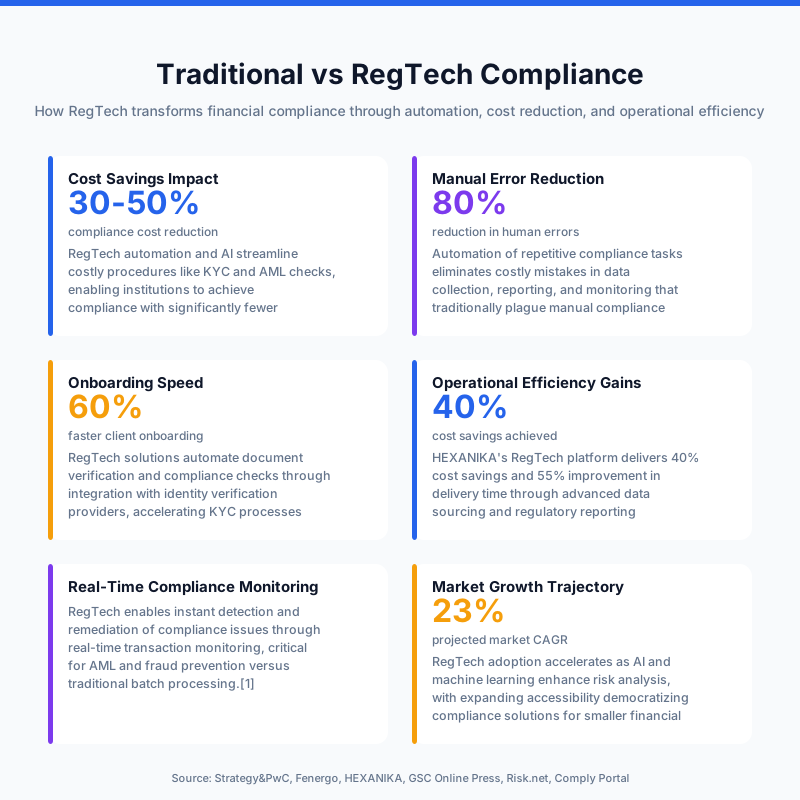
The RegTech market impacts efficiency profoundly, surpassing USD 19 billion in 2025 with a 23% CAGR through 2032, saving enterprises $1.3 million annually in costs.
Organizations achieve over 60% faster onboarding, fewer errors, and improved transparency via centralized dashboards. PwC estimates RegTech reduces compliance costs by 30-50% by minimizing human error risks. Grand View Research notes accuracy gains enhance customer experience alongside compliance.
In practice, AI cuts manual compliance hours while boosting accuracy, per ShareVault analysis. AI-native LMS platforms amplify this for training: L&D directors scale content 10x faster, turning policies into interactive courses that prove continuous compliance, reducing audit risks in banking and insurance.
What Defines the AI Revolution in RegTech?
The AI revolution in RegTech is defined by predictive analytics, anomaly detection, and adaptive automation that anticipate breaches using machine learning on vast datasets.
AI scans rulebooks overnight, summarizes changes with red-lines, and triggers workflows, as in Wolters Kluwer's Compliance Intelligence. Innovations include dynamic risk scoring for real-time client re-evaluation and behavioral analysis detecting subtle patterns beyond rules. Machine learning reduces false positives, aiding SMEs in compliance.
ClearEye.ai highlights real-time data analysis identifying trends via predictive models. AI-native LMS platforms' agentic orchestration applies this to training, generating role-play scenarios from regulatory updates, ensuring 100% verifiable employee proficiency.
How Is RegTech Shaping Global Due Diligence?
RegTech shapes global due diligence by enabling continuous, real-time evaluation of partners via live data integration with sanctions and reputational tools.
Platforms automate beneficial ownership verification and entity reviews across databases, minimizing backlogs. Apiax notes binary yes/no regulatory updates for cross-border compliance, vital as ESG rules grow. FATF and ESMA drive interoperable models for harmonization.
This predictive due diligence prevents multimillion-dollar losses in finance and procurement. AI-native LMS platforms enhance this by auto-generating training from due diligence policies, creating auditable proof for dynamic risks like 6AMLD changes.
What Is RegTech's Role in ESG and Global Trust?
RegTech builds ESG and global trust by automating supply chain verification, ethical sourcing, and transparent reporting, aligning with World Economic Forum priorities.
AI integrates AML/KYC with sustainability data for ESG credibility, enabling faster disclosures like HSBC's. Blockchain adds tamper-proof logs for audits. RegTech facilitates regulator-industry collaboration, fostering transparency.
For Chief Compliance Officers, this convergence means unified dashboards proving ESG adherence. AI-native LMS platforms lead by converting ESG policies into interactive training, providing regulators with verifiable completion records.
How to Overcome RegTech Automation Challenges?
RegTech challenges like algorithmic bias, privacy, and governance are overcome through explainable AI, human oversight, encryption, and traceable decisions.
Platforms ensure GDPR/FinCEN alignment with auditable trails. While AI excels at anomalies, rule-based screening provides transparency. Future trends include self-enforcing smart contracts for autonomous oversight.
AI-native LMS platforms mitigate risks with fully auditable agentic processes, where AI-generated courses include explainable rationales, empowering Audit Managers to validate compliance without manual reviews.
How Do AI-Native LMS Platforms Lead RegTech?
AI-native LMS platforms lead RegTech as agentic training infrastructure, automating the policy-to-training lifecycle for predictive compliance in regulated industries.
Unlike traditional LMS platforms, they instantly convert documents into e-learning with AI videos, quizzes, and role-plays, cutting development costs by 90% while delivering FCA/CBI/ECB-auditable records. For financial services, they handle 6AMLD updates by regenerating training in seconds, ensuring zero compliance gaps.
Chief Compliance Officers gain continuous proof-of-training, reducing audit risks amid 70% AI adoption forecasts. L&D Directors scale to thousands of users without headcount, integrating with existing workflows for seamless adoption.
Frequently Asked Questions
What is RegTech in 2025?
RegTech in 2025 uses AI and automation for predictive compliance, handling AML, KYC, and reporting at scale.
It shifts from reactive to preventive, with 70% of officers adopting tools by 2026.
AI-native LMS platforms exemplify this via agentic training automation.
How much does RegTech save on compliance costs?
RegTech reduces costs by 30-50%, with enterprises saving $1.3 million annually.
Automation cuts onboarding by 60% and manual hours significantly.
What AI features drive RegTech?
Key features include anomaly detection, predictive models, and adaptive rule updates.
Examples: Nasdaq Verafin cuts workloads 80%; Wolters Kluwer summarizes regs overnight.
How do AI-native LMS platforms differ from traditional compliance tools?
They are agentic infrastructure automating policy-to-training, not just content delivery. They generate auditable courses with videos and quizzes, ideal for compliance proof.
Can RegTech handle ESG compliance?
Yes, RegTech integrates ESG tracking and reporting, automating ethical sourcing verification.
It builds digital trust via transparent AI governance.
What challenges does RegTech face?
Bias and privacy risks are addressed via explainable AI and encryption.
Human oversight ensures integrity alongside automation speed.
Is RegTech scalable for enterprises?
Cloud architectures scale across jurisdictions, handling real-time global rules.
AI-native LMS platforms support thousands of users in finance without added staff.
How does RegTech support due diligence?
It enables real-time entity verification with sanctions integration.
Predictive scoring prevents fraud proactively.