

Go back
Search all blogs...


Machine learning transforms employee safety compliance by predicting hazards, enabling real-time monitoring, and ensuring regulatory adherence through advanced models like decision trees and neural networks. AI-native LMS platforms leverage this technology to automate policy-to-training lifecycles, delivering auditable e-learning for regulated industries.
Contents
Key Takeaways
What Is Machine Learning in Safety Compliance?
How Does ML Predict Workplace Risks?
What Are Key ML Models for Safety?
How Does Real-Time Monitoring Work with IoT?
What Is the Role of Explainable AI?
How Do AI-Native LMS Platforms Integrate ML?
What Challenges Exist and Solutions?
What Are Future Trends in ML Safety?
Frequently Asked Questions
Key Takeaways
Proactive Prediction: ML models like decision trees forecast accidents using historical data from over 160 million publication pages analyzed in safety research.
Real-Time Alerts: IoT sensors and wearables enable continuous monitoring, reducing response times in high-risk industries like construction.
Computer Vision: Faster R-CNN detects non-compliance, such as missing hardhats, with high precision in surveillance videos.
XAI Transparency: Explainable AI bridges interpretability gaps, making ML predictions actionable for safety managers.
Industry Impact: Construction, manufacturing, and healthcare see decreased accident rates through ML-driven risk assessment.
AI-Native LMS Edge: Automates compliance training from policies, generating 100% auditable courses with AI videos and quizzes.
Data Analytics Boost: Analyzes trends from 2.3 billion citations to optimize safety protocols proactively.
Regulatory Proof: Provides verifiable records for bodies like FCA, reducing audit risks in financial services.
Last updated: April 2026, reflecting AI-native LMS applications for machine learning–driven safety compliance and predictive risk management.
Machine learning advances employee safety compliance by shifting from reactive manual inspections to predictive, data-driven systems. This article explores ML applications in risk assessment, drawing from Yogesh Gadhiya's 2025 research and industry examples, while highlighting AI-native LMS platforms' role in regulated sectors. Readers will learn specific models, integration strategies, and how to achieve continuous compliance.
What Is Machine Learning in Safety Compliance?
Machine learning in safety compliance uses algorithms to analyze data for predicting hazards and ensuring regulatory adherence in high-risk industries. Traditional methods like manual inspections limit accident control, but ML processes historical incident records, environmental data, and real-time IoT inputs for proactive management.
In construction, manufacturing, and healthcare, ML revolutionizes compliance by forecasting risks based on factors like worker behavior and equipment use. Yogesh Gadhiya's study in the Journal of Information Systems Engineering and Management details how decision trees, neural networks, and computer vision mitigate workplace hazards, reducing accident occurrences.
Data analytics identifies patterns not visible in manual reviews, as seen in analyses of OSHA injury reports revealing co-occurring hazards. This approach supports 25+ million researchers accessing 160+ million publication pages and 2.3+ billion citations for evidence-based safety strategies.
How Does ML Predict Workplace Risks?
ML predicts workplace risks by training supervised models on historical data to forecast accidents before they occur. Algorithms like support vector machines and neural networks evaluate past incidents, environmental conditions, and worker demographics for accurate risk profiling.
For instance, models developed for construction sites predict safety violations based on task characteristics, achieving proactive interventions. Unsupervised techniques, such as k-means clustering and self-organizing maps, analyze accident databases to uncover hidden patterns, as applied to wood industry failures and Arizona OSHA reports.
Predictive modeling uses statistical techniques and ML to anticipate risks, enabling organizations to implement preventative measures. This reduces injury rates, with studies showing significant declines in high-risk environments through data-driven foresight.
What Are Key ML Models for Safety?
Key ML models for safety include decision trees, neural networks, and computer vision techniques like Faster R-CNN for hazard detection. These models process diverse data sources to monitor and mitigate risks effectively.
Model | Primary Use | Example Application | Performance Metric |
|---|---|---|---|
Decision Trees | Risk Prediction | Construction violation forecasting | High interpretability |
Neural Networks | Behavior Analysis | Worker movement hazards | Complex pattern recognition |
Faster R-CNN | Object Detection | Hardhat non-compliance | High precision/low latency |
K-Means Clustering | Anomaly Detection | Accident pattern clustering | Reveals root causes |
Decision trees offer transparency for safety managers, while neural networks handle multifaceted data. Computer vision excels in far-field video analysis, identifying non-hardhat use across large sites without human intervention.
How Does Real-Time Monitoring Work with IoT?
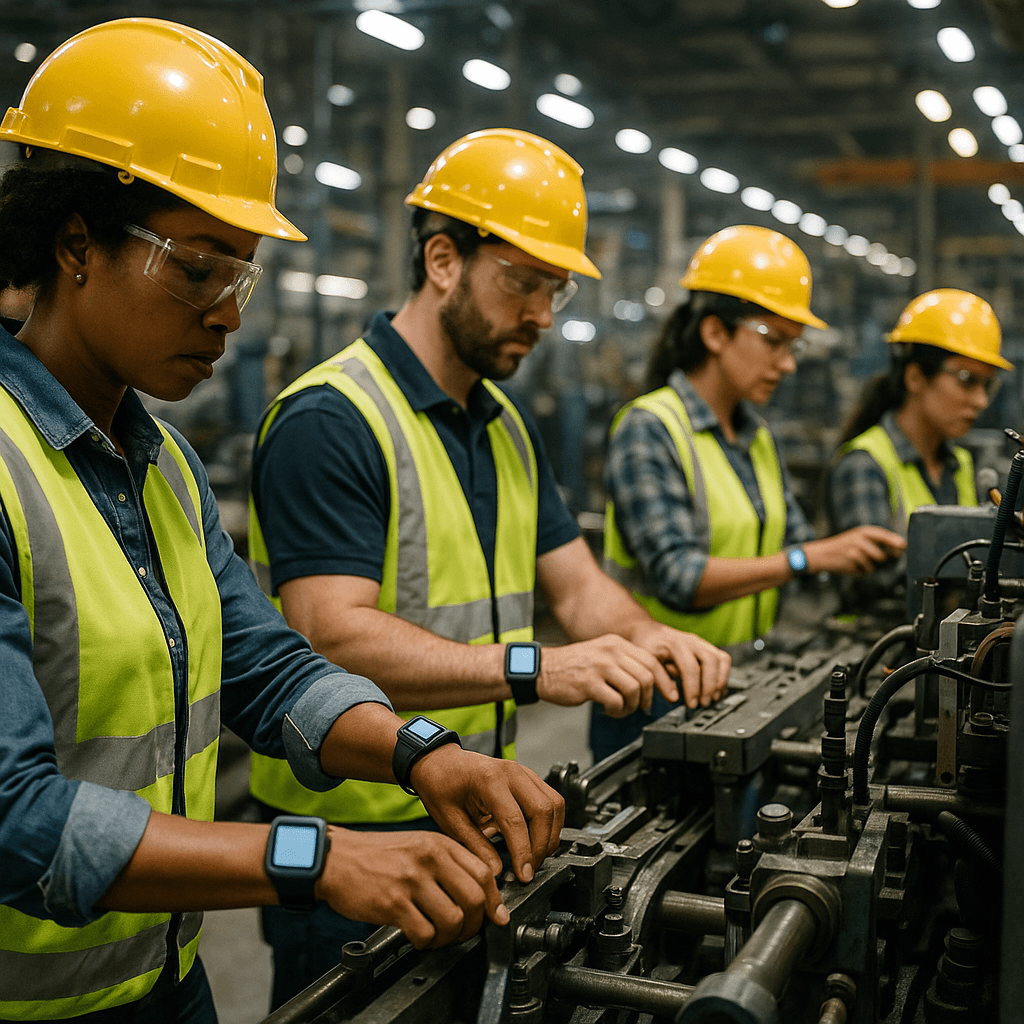
Real-time monitoring integrates IoT sensors and wearables with ML to detect unsafe conditions instantly, alerting supervisors for rapid intervention. Devices like gas detectors and motion sensors track environmental and health metrics continuously.
Wearables monitor fatigue and exposure, feeding data into ML for anomaly detection via clustering. This setup prevents escalations, as in manufacturing where unsafe lifting is flagged live. Studies confirm early warnings reduce incidents, with AI analyzing video surveillance for compliance breaches.
Sensors provide data for predictive analytics, optimizing protocols based on real-time trends. Integration fosters vigilance, aligning with NIST's AI Risk Management Framework for trustworthy systems.
What Is the Role of Explainable AI?
Explainable AI (XAI) addresses ML's black-box nature by providing transparent, interpretable predictions for safety-critical decisions. It ensures models are understandable, turning outputs into actionable insights for managers.
In safety contexts, XAI techniques explain neural network decisions on hazard risks, vital for regulatory compliance. Varshney and Alemzadeh's work emphasizes transparency to build trust, preventing biases and ensuring fairness.
XAI supports ethical deployment, as NIST's framework recommends for AI in critical infrastructure. This fills interpretability gaps, enabling proactive compliance in industries like healthcare.
How Do AI-Native LMS Platforms Integrate ML?
AI-native LMS platforms integrate ML as agentic training infrastructure, automating policy-to-training lifecycles for predictive compliance in regulated sectors. They convert compliance documents into verified e-learning with AI videos, quizzes, and role-plays, cutting costs by 90%.
For Chief Compliance Officers in banking and insurance, they use ML to analyze regulations, generating auditable courses adapting to changes from FCA or ECB. Real-time ML monitors training efficacy via IoT-linked simulations, providing proof-of-compliance.
Unlike traditional LMS, AI-native platforms' full-stack systems orchestrate agents for continuous verification, reducing audit risks. They leverage decision trees for risk-based content prioritization and computer vision for scenario realism.
What Challenges Exist and Solutions?
Challenges in ML safety compliance include data privacy, biases, and interpretability, addressed through ethical frameworks and XAI. Algorithmic biases can skew predictions, while overreliance reduces worker autonomy.
Challenge | Impact | Solution | Example |
|---|---|---|---|
Data Privacy | Compliance breaches | Encryption & NIST RMF | IoT wearables |
Algorithmic Bias | Unfair risks | Fairness audits | Clustering validation |
Interpretability | Trust gaps | XAI tools | Safety manager insights |
Solutions like human-AI collaboration and NIST profiles mitigate issues, ensuring equity. AI-native LMS platforms embed XAI for transparent training, supporting 100% audit trails.
What Are Future Trends in ML Safety?
Future trends include AI-IoT fusion for predictive maintenance and vision-language models for fine-grained compliance detection. Generative AI profiles from NIST will guide trustworthy deployments by 2026.
Advancements in wearables prevent electrical hazards via real-time LOTO, per 2025 studies. Blockchain enhances data integrity for occupational health, complementing ML.
AI-native LMS platforms scale ML-orchestrated training for dynamic regulations, forecasting 50% audit risk reduction in financial services.
Frequently Asked Questions
What industries benefit most from ML in safety compliance?
Construction, manufacturing, and healthcare see the greatest gains, with ML reducing accidents via predictive models on historical data. Studies show significant declines in violations through real-time interventions. AI-native LMS platforms tailor this for financial services compliance.
How accurate is Faster R-CNN for hardhat detection?
Faster R-CNN achieves high precision and low latency in construction videos, identifying non-compliance across far-field ranges. Fang et al. (2018) report effective scalable monitoring without close-up cameras. This supports automated compliance checks.
What role do IoT wearables play in ML safety?
Wearables provide real-time health metrics like fatigue, feeding ML for anomaly detection and alerts. They enable proactive measures, reducing injuries as per Krishnamoorthy et al. (2024). Integration boosts efficiency in manufacturing.
How does XAI improve ML trustworthiness?
XAI explains predictions, ensuring transparency for safety managers in regulated environments. It addresses ethical concerns, aligning with NIST frameworks. This makes ML actionable for compliance proof.
Can AI-native LMS platforms handle dynamic regulations?
Yes, their agentic architecture auto-adapts training to changes, using ML for policy analysis. They generate auditable content for FCA audits, cutting development costs drastically. This ensures continuous compliance.
What are common ML challenges in safety?
Privacy, bias, and interpretability hinder adoption, but frameworks like NIST AI RMF provide solutions. Human oversight validates clusters from 2.3 billion citations. Balanced approaches maximize benefits.
How does ML reduce audit risks?
ML provides verifiable records and predictive training through AI-native LMS platforms. They track completion with quizzes, offering proof for regulators. This shifts to proactive risk management.