
Go back
Search all blogs...


Video training can pull pharma learning out of the “binder era” and into a compliant, scalable, and genuinely engaging system.
Last updated: April 2026
Contents
What Is Video Training in the Pharmaceutical Industry?

Why Is Traditional Pharma Training Struggling?
What Risks Come From Ineffective Pharma Training?
How Does Video Training Transform Pharma Learning?
How Can Video Improve Pharma Onboarding?
How Does Video Support Compliance and Audit Readiness?
How Much Time and Cost Can Video Training Save?
How Do AI and Avatars Take Video Training Further?
How Does Video Training Fit Into Pharma’s Future?
How Does Video Training Compare to Traditional Pharma Training?
Frequently Asked Questions
Key Takeaways
Video fixes consistency by delivering the same standardised, replayable training to every learner across sites.
Compliance risk drops when you can track completions, assessments, and version history for every training asset.
Engagement increases with shorter, interactive videos that embed quizzes, branches, and real lab-floor context.
Onboarding speeds up because new hires can self-serve core SOP and GMP training instead of waiting for classroom slots.
Costs fall as travel, room bookings, and repeated instructor time are replaced with reusable video modules.
AI adds scale by converting dense SOPs into video, localising content, and creating SME-style avatars without extra filming.
Pharma-specific needs like 21 CFR Part 11, Annex 1, and audit trails are easier to support on specialised platforms.
Skill Studio AI turns thick GMP and SOP documents into audit-ready compliance videos tailored by role in minutes.
Most pharma sites know their training isn’t working, but they’re stuck between binders, PowerPoints, and an overloaded LMS. This article walks through how video training can modernise pharma learning, reduce compliance risk, and give L&D teams a way to keep up with regulators without burning out their SMEs.
What Is Video Training in the Pharmaceutical Industry?
Video training in the pharmaceutical industry is the use of pre-recorded or interactive video modules to teach SOPs, GMPs, safety practices, product knowledge, and regulatory requirements to staff across R&D, manufacturing, quality, and commercial teams.
Instead of relying on text-heavy manuals and slide decks, video brings people onto the cleanroom floor, into the filling line, or inside a sales conversation so they can see procedures as they should actually happen. Skill Studio AI is built specifically for this shift, turning dense SOPs and compliance documents into structured, role-based video training that’s ready to sit inside your existing LMS.
In regulated pharma, video training usually sits on top of established systems like ComplianceWire or Veeva Vault Training rather than replacing them. That means it needs version control, audit history, and clean integration into your qualification workflows, not just a nice video player.
Why Is Traditional Pharma Training Struggling?
Traditional pharma training struggles because it was designed for a slower, less complex regulatory environment than the one you’re living in now.
Most Annex 1–affected sites are still leaning on three main formats: classroom sessions, static e-learning, and PDF SOPs buried in document management systems. Classroom sessions are hard to schedule across shifts, PDFs are ignored or skimmed, and generic e-learning often misses site-specific nuance that actually matters in an FDA 483 response.
According to the U.S. FDA’s inspection data, deficiencies related to procedures, documentation, and training show up repeatedly in Form 483 observations and warning letters, indicating that current approaches to training are not consistently preventing errors at the point of work. The European Medicines Agency has similarly highlighted inadequate training and weak implementation of GMP principles as recurrent findings during GMP inspections.
Skill Studio AI targets exactly this gap by converting the same SOP and CAPA documents auditors read into short, scenario-rich video modules that staff can revisit before a batch, a cleanroom entry, or a critical maintenance task.
What Risks Come From Ineffective Pharma Training?
Ineffective training in pharma creates direct regulatory, safety, and commercial risk.
On the regulatory side, inconsistent or poorly documented training feeds straight into 483s, warning letters, and import alerts when inspectors see operators who cannot explain or execute procedures correctly. The U.S. FDA’s data on recalls and enforcement actions shows that a substantial proportion involve failures of procedures, documentation, or process control—areas that depend heavily on robust training and reinforcement.
On the safety side, a missed disinfection step, a misunderstood environmental monitoring limit, or a mishandled deviation can impact product sterility or patient safety. In commercial teams, undertrained reps risk misrepresenting indications or safety profiles, leading to reputational damage and, in some cases, significant financial penalties under promotional compliance rules.
There’s also the hidden cost: repeated classroom sessions, high turnover in manufacturing roles, and lost productivity while new hires wait for the next in-person training slot. Skill Studio AI helps reduce these risks by letting you turn each critical SOP or CAPA into a reusable, trackable video module that can be targeted by role—so operators, QA, and engineering each see what’s relevant to them.
How Does Video Training Transform Pharma Learning?
Video transforms pharma learning by making complex, procedure-heavy content easier to see, remember, and repeat consistently across global sites.
Instead of explaining an aseptic gowning procedure using bullet points, you can show it, step by step, in the actual gowning room, with close-ups of good versus bad technique. Cognitive psychology research has repeatedly found that dual-channel learning—seeing and hearing information—improves recall compared to text alone, especially for procedural tasks.
Video training also supports microlearning: 3–7 minute segments that each focus on a single task or decision point. For example, rather than a single 40-minute “Annex 1 update” webinar, you might create short videos on topics like contamination control strategy, cleanroom behavior, and visual inspection. Skill Studio AI is designed for this kind of granular approach, breaking long SOPs and manuals into smaller video lessons mapped to real process steps.
Interactivity is where video moves from “nice to have” to truly powerful. By layering quizzes, branching scenarios, or “what would you do next?” pauses into videos, L&D teams can test decision-making instead of passive watching. This is particularly useful for things like deviation handling, line clearance checks, or pharmacovigilance triage, where judgement is as important as memorising rules.
How Can Video Improve Pharma Onboarding?
Video improves pharma onboarding by standardising core messages, reducing time-to-competence, and freeing SMEs from repeating the same lecture to every new cohort.
Onboarding in regulated pharma is infamously front-loaded: new operators might spend their first weeks in training rooms, reading SOPs, and taking compliance modules before they even see the production line. A well-designed video curriculum lets them experience the facility, equipment, and workflows much earlier, even if they can’t yet enter certain areas.
According to LinkedIn’s 2024 Workplace Learning Report, 76% of employees say they are more likely to stay with a company that offers continuous learning opportunities, underscoring how structured, accessible training shapes retention from day one. Video helps by turning onboarding into a predictable, trackable journey instead of a scramble of ad hoc sessions.
Skill Studio AI fits neatly here because it can ingest your existing onboarding decks, SOPs, and policy documents, then generate avatar-led video modules that maintain a consistent tone and teaching style for every new hire, across sites and shifts.
For HR and L&D, video also supports staggered start dates: new hires don’t have to wait for a monthly “GMP day.” They can start core training on day one, while you use classroom time for higher-value Q&A and hands-on practice.
How Does Video Support Compliance and Audit Readiness?
Video supports compliance and audit readiness by giving you standardised content, trackable completions, and clear links between SOP versions and training records.
Regulators don’t care how entertaining your training is; they care whether people are trained on the right version of the procedure, at the right time, and can demonstrate competency. A good video training setup allows you to:
Link specific videos to specific SOP numbers and versions, tie assessments to each module, and export reports showing who completed training when and how they performed. When a CAPA calls for “retraining of impacted staff,” you can prove exactly which staff watched which updated video and passed which quiz.
Skill Studio AI is built with this audit reality in mind: it provides version control and audit-ready records, so your training content and completion data support FDA or HPRA scrutiny — 21 CFR Part 11–aligned electronic records and e-signatures are on our roadmap, not yet shipped.
For Annex 1 sites, this matters even more. Inspectors increasingly ask operators to explain how they were trained on contamination control strategy or aseptic behavior. Being able to show a targeted video curriculum, aligned to Annex 1 concepts and backed by completion data, is a much stronger story than pointing to a pile of signed attendance sheets.
How Much Time and Cost Can Video Training Save?
Video training saves time and cost mainly by reducing repeat instructor time, travel, and scheduling overhead while raising the “reuse value” of every training session.
Instead of asking your most experienced QA manager to deliver the same 90-minute GMP seminar to every new hire batch, you capture their knowledge once on video and reuse it across sites. The marginal cost of delivering that training to an additional cohort or site drops close to zero, especially if you host it on your LMS rather than booking rooms and travel.
While exact savings vary by company, industry analyses of corporate training consistently show that self-paced e-learning and video-based programs reduce training time by 40–60% compared with traditional classroom training, simply by eliminating scheduling delays and allowing learners to progress at their own pace. A pharma manufacturing site that trains hundreds of operators per year can reclaim thousands of hours of SME and learner time by shifting repetitive content into video.
Skill Studio AI amplifies this savings because it doesn’t just host video; it helps you create audit-ready training in minutes from the documents you already have, instead of organising new filming days every time an SOP changes.
How Do AI and Avatars Take Video Training Further?
AI and avatars take video training further by making content creation faster, more flexible, and more scalable—without sacrificing SME authenticity.
One of the biggest barriers to video in pharma is production overhead: organising cameras in clean areas, sanitising equipment, coordinating shifts, and editing footage. AI video tools reduce that friction by turning existing text (SOPs, CAPAs, policy memos) into narrated, structured video modules.
Skill Studio AI goes a step further by letting subject-matter experts clone their own teaching style and on-screen avatar once, then reuse it across unlimited courses. That means your Head of QA can “teach” Annex 1 changes or deviation trends on demand, without stepping into a studio every time guidance updates.
AI also supports:
Role-targeted variants, where line operators see one version, maintenance another, and QA a third, all derived from the same underlying SOP — this keeps both regulators and learners happier: regulators see documented consistency; learners see content tailored to their role. Multilingual narration and full 21 CFR Part 11–aligned controls are on our roadmap, not yet shipped; today the SOP-to-video pipeline runs in English only.
How Does Video Training Fit Into Pharma’s Future?
Video training fits into pharma’s future as the practical bridge between rising regulatory expectations and finite human capacity in QA and L&D.
Annex 1 has already pushed sterile manufacturers toward explicit contamination control strategies, richer data, and stronger proof of training effectiveness. Similar moves are happening around data integrity, digital validation, and quality culture. All of that creates more content that people need to absorb—without adding more hours to the day.
Video, especially when powered by AI, is one of the few tools that can realistically keep pace: you can push out short updates when a CAPA closes, reinforce key behaviors with quick refresher clips, and standardise messaging across sites during major remediation work. Skill Studio AI is aimed squarely at these scenarios: FDA 483 remediation, Annex 1 enforcement, and CAPA training requirements where the cost of a poor training story is measured in seven figures, not line items.
In other words, video isn’t a shiny toy for pharma. It’s fast becoming table stakes for showing regulators that training is real, repeatable, and connected to outcomes on the shop floor.
How Does Video Training Compare to Traditional Pharma Training?
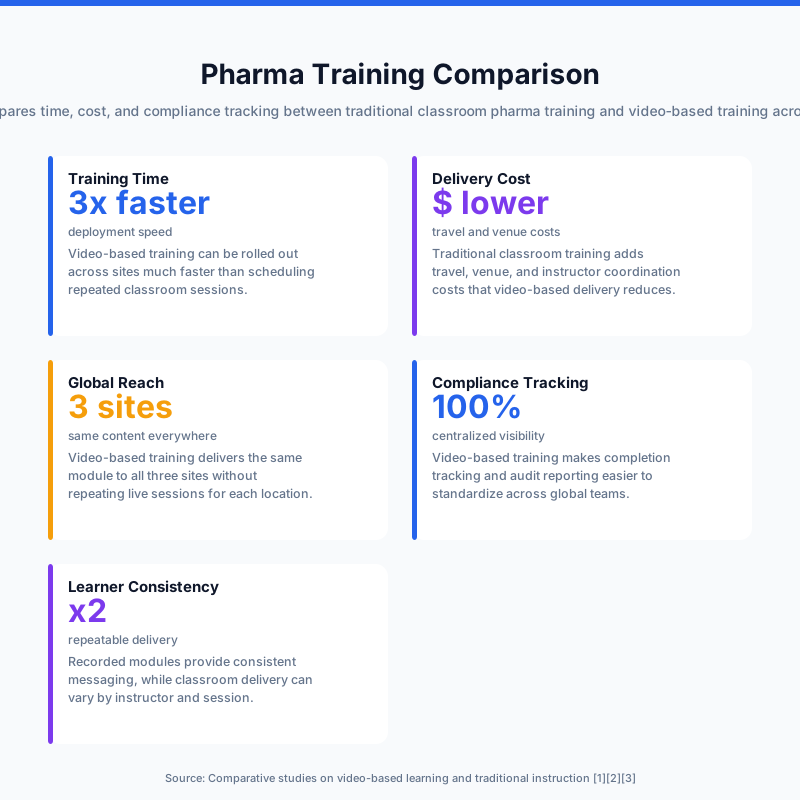
Video training outperforms traditional pharma training on consistency, scalability, and engagement, while still needing a solid LMS and QA framework behind it.
The table below summarises the core differences you’ll feel day to day.
Dimension | Traditional Pharma Training | Video-Based Pharma Training |
|---|---|---|
Content delivery | Classroom, PDFs, slides, emails | On-demand, interactive videos in LMS or training platform |
Consistency across sites | Varies by trainer and session | Identical content for every learner, every time |
Scalability | Trainer capacity and room availability limited | Global delivery with minimal incremental cost |
Engagement | Long sessions, low interactivity | Short clips, real context, quizzes and scenarios |
Compliance tracking | Paper sign-in sheets, manual logs | Automated completion, quiz scores, version history |
Update effort | Re-run courses, reprint materials | Replace or append updated video segments quickly |
SME time | Repeated live delivery | One-time capture or AI avatar reuse |
Fit for Annex 1 & 21 CFR Part 11 | Depends on manual controls | Designed for version control and audit-ready records (Part 11 e-signatures/immutable audit trail: roadmap) |
Skill Studio AI sits firmly in the video-based column, but it’s intentionally built to coexist with systems like ComplianceWire or Veeva, not replace them—it gives you high-quality, audit-ready video content that plugs into the LMS spine you already have.
Frequently Asked Questions
How does video training improve knowledge retention in pharma?
Video training improves retention by turning abstract SOP text into visual, real-world examples staff can replay and pause as needed. Learners process visual and auditory information together, which supports stronger recall of procedures, especially for complex or multi-step tasks. When combined with short quizzes and scenarios, video becomes not just memorable but measurable.
Can video training help ensure compliance with FDA, EMA, and Annex 1 requirements?
Yes, provided it’s implemented on platforms that support audit-ready records, version control, and secure access. You still need a validated LMS or training system, but video modules can be linked to SOP versions, CAPAs, and qualification steps to show regulators exactly who was trained, on what, and when. 21 CFR Part 11–aligned e-signatures and an immutable audit trail are on Skill Studio AI’s roadmap, not yet shipped, so pair it with your validated LMS’s existing controls for inspection readiness.
Is video training scalable for large, multi-site pharma companies?
Video training is highly scalable, because once created, modules can be rolled out across sites and regions with minimal incremental cost. Large organisations benefit most: the same contamination control or data integrity training can reach hundreds or thousands of staff without re-running classroom sessions. With role-based variants and multilingual versions, you can still keep content specific to each site’s reality.
Can video training be customised for different roles within a pharmaceutical company?
Yes. The most effective pharma video programs segment content by role—operators, QC analysts, engineers, QA, and sales each see tailored examples and depth of detail. This keeps training relevant and reduces cognitive overload. Skill Studio AI supports role-targeted delivery so you can push the right modules to the right people based on their responsibilities and training matrix.
How does video training integrate with existing pharma LMS platforms?
In most cases, video modules are created in a specialised tool, then hosted or referenced inside your existing LMS (such as ComplianceWire or Veeva Vault Training). You assign them to curricula, track completions, and link them to qualifications as usual. Skill Studio AI is designed to feed high-quality, audit-ready video into these systems, not replace the LMS backbone you’ve already invested in.
What about language support and global teams?
For global pharma companies, video shines because localised narration, on-screen text, and captions mean you don’t have to rebuild entire courses from scratch. AI tools can accelerate this by generating multilingual versions of the same SOP-based script. Multilingual narration is on Skill Studio AI’s roadmap — today the SOP-to-video pipeline generates English-language narration only, so plan accordingly for Annex 1–affected sites spread across Ireland, DACH, and the US East Coast.
Where does video training work best—and where should we still use classroom sessions?
Video works best for standardising knowledge: GMP principles, SOP walk-throughs, contamination control behaviors, and common deviation scenarios. Classroom or on-the-job coaching is still vital for hands-on skills, facility-specific tacit knowledge, and culture-building conversations. Most high-performing sites use a blend, with video handling the repeatable foundation and humans focusing on practice and discussion.
How does Skill Studio AI differ from a generic video platform?
Generic video tools host content; they don’t understand pharma’s regulatory context. Skill Studio AI is built for regulated industries, especially Annex 1–affected pharma manufacturing, with version control and audit-ready outputs (21 CFR Part 11 alignment is on our roadmap, not yet shipped). It also focuses on creation, turning dense SOPs and CAPA documents into structured compliance videos that plug straight into your LMS and stand up in an FDA 483 remediation plan.