
Go back
Search all blogs...


Most “top” healthcare LMS platforms still struggle with real CME and MOC workflows; purpose-built systems win once audits, accreditation, and PARS are involved.
Last updated: May 2026
Contents
Key Takeaways

What is a healthcare learning management system?
What matters most when choosing a healthcare LMS?
What are the main healthcare LMS use cases?
How should CME credit tracking work in an LMS?
How do the top healthcare LMS platforms compare?
What did I learn from evaluating the top healthcare LMS platforms?
How should you decide between healthcare LMS options?
Frequently Asked Questions
Key Takeaways
Healthcare LMS is different because accreditation, CME, and MOC workflows add complex tracking, integrations, and audit demands that generic LMS platforms rarely handle well.
CME credit automation is the bottleneck, and most teams still rely on spreadsheets and manual PARS uploads when their LMS is not purpose-built for healthcare.
Big enterprise LMS vendors usually need heavy customization and IT support before they can support ACCME PARS, JA-PARS, or MOC tracking in a reliable way.
Purpose-built CME platforms like OasisLMS and EthosCE ship with CME/MOC workflows, but trade-offs appear in usability, configurability, and implementation overhead.
Generalist platforms such as Relias, Cornerstone, and Absorb are excellent for compliance and onboarding but fall short on nuanced CME, MOC, and accreditation requirements.
Enterprise-scale hospitals must design for multi-site from day one, including SSO, department-level permissions, and audit-ready reporting across hospitals and clinics.
AI-native tools like Skill Studio AI sit upstream of the LMS, converting dense SOPs, CAPAs, and policies into audit-ready, multilingual training content your LMS can deliver and track.
Mission-critical use case should drive your choice: CME and accreditation, workforce compliance, or HR-led talent development each point to different platform combinations.
If you run learning for a hospital or health system, picking a healthcare LMS feels suspiciously like picking another EMR: long sales cycles, painful change management, and everyone from compliance to cardiology has strong opinions.
In this article, we’ll unpack what a healthcare LMS really is, what matters beyond the glossy feature grids, and what emerged when comparing OasisLMS, EthosCE, Relias, Cornerstone OnDemand, Absorb LMS, and where AI-native tools like Skill Studio AI actually fit.
Along the way, you’ll see why most “top” LMS platforms still stumble on true CME and MOC workflows—and why purpose-built systems usually win once audits, accreditation cycles, and PARS files are on the line.
What is a healthcare learning management system?
A healthcare learning management system is a platform used to deliver, manage, and track education for clinicians, staff, and administrators, with built-in support for accreditation, compliance, and continuing professional development.
Unlike a generic corporate LMS, a healthcare LMS is expected to handle CME, CNE, CE, and often MOC while integrating with accreditation systems such as ACCME PARS, JA-PARS, ANCC, and CPE Monitor for credit reporting and audit-ready documentation.
According to a 2026 comparison of healthcare LMS platforms, systems widely adopted in hospitals emphasize CME workflows, licensure tracking, and multi-site reporting as core capabilities rather than optional extras or plugins.
In practice, platforms fall into three broad groups:
First, CME-focused healthcare LMS such as OasisLMS and EthosCE are built around accredited education, MOC, and credit workflows, including automated ACCME PARS and JA-PARS reporting, MOC tracking, and audit-ready transcripts and logs for accrediting bodies and specialty boards.
Second, generalist enterprise LMS such as Relias, Cornerstone OnDemand, and Absorb LMS focus on compliance and HR-led learning, offering strong workforce training features but usually requiring workarounds or customizations for CME, PARS, and MOC.
Third, AI-native training platforms like Skill Studio AI sit upstream of the LMS, turning dense SOPs, policies, and CAPA documentation into structured, multimedia training assets (video, assessments, SCORM, xAPI) that your LMS—whether OasisLMS, EthosCE, Relias, or Cornerstone—can then deliver and track.
Skill Studio AI fits before the LMS rather than competing with it, converting 80-page procedures or Annex 1 responses into short, localized training modules and knowledge checks, then exporting them into whichever LMS stack you already run.
What matters most when choosing a healthcare LMS?
The most important question is whether the LMS will reduce or increase the time your education and compliance teams spend staying accredited and audit-ready.
When hospitals and health systems evaluate platforms, the same criteria show up again and again.
CME/CE compliance and integrations come first, because handling CME by hand does not scale.
A serious healthcare LMS needs native integration with ACCME PARS, JA-PARS, ANCC, and CPE Monitor, plus support for multiple credit types (AMA PRA, ANCC, ACPE, etc.) against a single activity, instead of separate duplicate courses per credit type.
Purpose-built CME platforms highlight automated ACCME PARS and JA-PARS submissions as a core differentiator, since manual PARS uploads are error-prone and time-consuming for CME offices handling hundreds of activities each year.
MOC and practice-improvement support is the second big test.
For physicians, MOC Part 2 (self-assessment) and Part 4 (performance improvement) require multi-step workflows, longitudinal data collection, and outcomes measurement, which most generic LMS platforms never anticipated when their data models were built.
Platforms like OasisLMS and EthosCE provide dedicated MOC and practice-improvement modules, often including MOC points syncing to boards such as ABIM or ABP, whereas general-purpose systems expect MOC tracking to live in spreadsheets or external tools.
Scalability for large systems is non-negotiable once you move beyond a single hospital.
Enterprise health systems need SSO, role-based access control, department-level permissions, and multi-site reporting, so corporate education can see the whole system while local departments manage their own catalogs and audiences.
Many healthcare LMS comparisons highlight SSO, multi-tenant or multi-site structures, and department-based access as table stakes for hospitals and health systems with multiple campuses.
Ease of use for clinicians can make or break adoption.
Clinicians will not happily click through ten screens just to claim 0.25 CME for attending a noon conference, so top healthcare LMS platforms focus on minimal click paths, mobile-friendly access, and simple credit claiming flows.
Generalist platforms like Relias and Absorb are frequently praised for user-friendly interfaces and straightforward navigation, while some legacy CME-focused tools trade UX simplicity for advanced configurability and highly granular controls.
Automation and reporting determine how painful reaccreditation feels.
Administrators need dashboards, exportable reports, and one-click submissions to accrediting bodies, with clearly documented credit histories, transcripts, and audit logs that stand up in front of surveyors or specialty boards.
EthosCE, for example, is known for powerful reporting that can be tuned to complex academic structures, while OasisLMS emphasizes audit-ready reports aligned directly to ACCME and Joint Accreditation requirements.
Content creation and version control is another blind spot.
Most LMS platforms assume your content already exists in neat, SCORM-wrapped packages, but in real life, your “course” is often an SOP revision, CAPA outcome, or policy update that needs to be turned into something watchable and testable.
Tools like Skill Studio AI are increasingly used as a content layer in front of the LMS, standardizing, localizing, and version-controlling SOP-based training before it is uploaded, which matters when auditors ask exactly which SOP version each learner was trained on.
What are the main healthcare LMS use cases?
Healthcare organizations usually buy one LMS, but they are really solving several different use cases at once.
Internal CME for physicians and nurses is often the most visible use case.
Here the LMS must support accredited CME/CE activities, credit claiming, automated submissions to boards and regulators, and often multiple credit types per activity so different professionals can get the credits that matter to them.
CME-focused LMS platforms are common in academic medical centers, health systems, and associations that run complex programs with both enduring and live activities, performance-improvement CME, and joint providers.
MOC and certification tracking adds another layer of complexity.
For specialties that require MOC, the LMS needs to track completion of Part 2 and Part 4 activities, capture the data required by specific boards, and generate documentation that passes board audits and random checks.
OasisLMS and EthosCE expose MOC-specific functionality in their admin interfaces, whereas platforms like Relias, Cornerstone, and Absorb usually expect MOC to be managed elsewhere.
Compliance training is where many health systems start and where generalist LMS platforms excel.
Mandatory topics like HIPAA, infection control, hand hygiene, OSHA safety, and workplace violence prevention must be completed by almost every staff member on specific cycles, often with reminders and regulatory deadlines attached.
Relias is frequently cited as a popular choice for healthcare compliance and workforce education because of its large library of pre-built modules for clinical and non-clinical staff.
Skill Studio AI extends this ecosystem by transforming internal SOPs and CAPA commitments into site-specific, multilingual compliance training that can be deployed via Relias, Cornerstone, or other LMS platforms, without relying only on generic library content.
Onboarding and orientation is another major use case, especially in larger systems.
A good LMS can standardize orientation across facilities, with role-based paths for physicians, nurses, allied health, administrative staff, residents, and students, while allowing local tweaks for specific departments or sites.
Cornerstone and Absorb often serve as the system-of-record for onboarding, HR training, and career development in large health systems that want to keep all employment-related learning under one umbrella.
Quality improvement and performance tie education to outcomes.
Some CME programs intentionally design activities around quality metrics such as readmission rates, infection rates, or complication rates, requiring learners to reflect on their practice, implement changes, and then re-measure outcomes.
EthosCE and OasisLMS support performance-improvement CME where the LMS must store baseline data, improvement plans, and follow-up measures across the life of the project.
Multi-site learning delivery rounds out the picture for integrated systems.
Health systems that run multiple hospitals, ambulatory sites, and clinics need centralized oversight with local autonomy, which is where department-based access, multi-site structures, and robust cross-site reporting become essential requirements rather than nice-to-haves.
How should CME credit tracking work in an LMS?
CME credit tracking should feel almost invisible to clinicians while being obsessively precise and audit-ready for administrators.
Automatic credit assignment is the foundation.
As learners complete activities—live sessions, enduring materials, or PI projects—the LMS should assign the correct number and type of credits automatically based on completion criteria, pre-defined credit values, or time tracking for live events.
Purpose-built CME platforms emphasize automatic credit assignment so clinicians are not left calculating their own hours or manually selecting credit types for straightforward activities.
Partial credit claiming is critical in healthcare because clinicians rarely attend every minute of a live event.
A capable LMS should support partial credit claiming in small increments, typically 0.25-hour blocks, aligned with ACCME expectations and many boards’ recognition of partial attendance through documented participation.
OasisLMS explicitly supports partial CME credit claiming (for example, 0.25-hour increments) and instant certificate generation, illustrating how granular the workflow needs to be to reflect real-world attendance.
Integration with accreditation systems is what separates real CME platforms from generalist LMS tools.
Manual data entry into ACCME PARS or JA-PARS is slow, error-prone, and stressful during reaccreditation, which is why CME-focused systems emphasize API-based connections that automatically send CME activity data, learner completions, and credit records into ACCME’s Program and Activity Reporting System.
According to OasisLMS documentation, PARS integrations that automatically move data from the LMS into ACCME PARS can eliminate manual uploads, reduce errors, and keep accreditation reporting synchronized with LMS records in real time.
MOC support goes beyond simply counting credits.
MOC activities—especially performance improvement projects—often unfold over months and require multiple stages, documentation of interventions, and outcomes tracking that align with board rules and data fields.
Platforms such as EthosCE and OasisLMS ship with MOC Part 2 and Part 4 workflows, along with MOC points syncing to boards like ABIM or ABP, which reduces the risk that boards reject submissions due to missing or malformed data.
Audit-ready reporting is the last mile and often the most painful part if your LMS is not built for CME.
Every completion, credit assignment, and change needs to be visible in an audit log and rolled up into activity reports, learner transcripts, and accreditation summaries that map directly to ACCME or Joint Accreditation standards.
Healthcare LMS guides emphasize comprehensive reports and detailed audit logs as key features that simplify reaccreditation reviews and help teams walk surveyors through their education program with confidence.
Skill Studio AI plays a supporting role here by ensuring that every training asset used in CME or compliance courses has clear version control and a traceable link back to the originating SOP or policy, so when the LMS shows that a learner completed a module, you can prove exactly which document version the course was built from.
How do the top healthcare LMS platforms compare?
When I put myself in the chair of an education director for a large health system, six platforms came up repeatedly in conversations and research: OasisLMS, EthosCE, Relias, Cornerstone OnDemand, Absorb LMS, and Skill Studio AI.
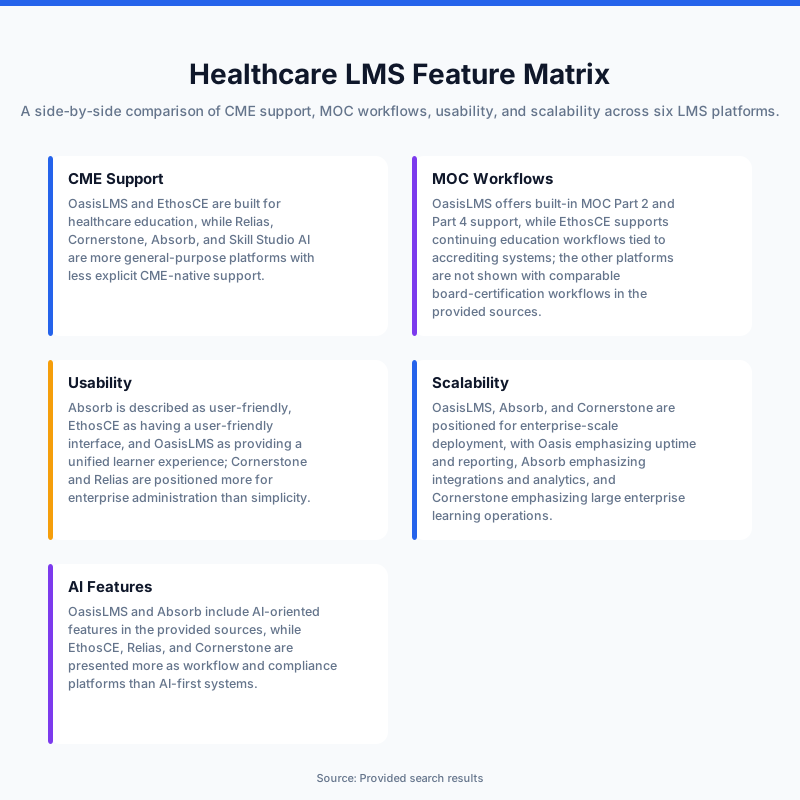
The table below summarizes how they stack up on core healthcare LMS and training criteria, based on public product information and cross-checks with user feedback.
Feature | OasisLMS | EthosCE | Relias | Cornerstone OnDemand | Absorb LMS | Skill Studio AI |
|---|---|---|---|---|---|---|
CME Credit Support (ACCME PARS, etc.) | Full CME support with ACCME PARS, JA-PARS, ANCC, and CPE Monitor integrations | Robust CME platform with ACCME PARS, JA-PARS, and multi-credit reporting | Limited CME support; no direct PARS or MOC focus out of the box | Can deliver CME content but requires customization for PARS-style tracking | No native CME/MOC credit tools; focused on general learning | LMS with exports CME-ready SCORM/xAPI and video content into PARS-enabled LMS platforms |
MOC & Practice Improvement | Built-in MOC Part 2 & Part 4 workflows and performance-improvement tracking | MOC and PI support integrated with CME management features | Not included as core functionality | Not included by default; requires custom workflows | Not included; handled externally if needed | Helps structure PI content; tracking and credit reporting still happen in the LMS |
Designed for Healthcare | Purpose-built CME and healthcare LMS for hospitals and associations | Strong focus on academic medical centers and healthcare CME | Broad healthcare workforce training focus with large content library | Corporate LMS with significant healthcare customer base | General-purpose LMS used in multiple industries, including healthcare | AI-native training platform for regulated industries, including healthcare, pharma, and banking |
Clinician User Experience | Streamlined clinician workflows with partial credit and quick certificates | Powerful but more complex interface, suited to teams with CME expertise | Easy to navigate for staff completing compliance and skills training | Generic enterprise learning interface with healthcare configurations | Sleek, modern UI designed for broad corporate learning audiences | Short, video-first microlearning delivered via existing LMS or web player |
Enterprise Scalability | Supports SSO, department-based access, and multi-site reporting | Configurable for large institutions and multi-division CME programs | Scalable for workforce-wide healthcare training environments | Enterprise-grade scalability and HRIS integrations | Cloud-native scalability for multi-tenant corporate deployments | Multi-tenant content workspaces that publish to any LMS at enterprise scale |
Content Creation & Authoring | Built-in course and activity authoring for CME workflows | Highly configurable course design, evaluations, and outcomes tools | Large ready-made content library plus basic authoring capabilities | Robust but manual authoring and curriculum design features | Modern authoring tools and marketplace content | AI-native authoring from SOPs, policies, CAPAs into video, SCORM, and xAPI modules |
Main Strength | Deep CME/MOC and accreditation workflows for healthcare organizations | Highly configurable CME programs and academic medical center use cases | Compliance and workforce development with extensive healthcare content | HR and talent management across the enterprise | UX and general-purpose learning features | Rapid, audit-ready content creation that feeds any LMS in regulated industries |
For most hospitals, the trade-off is straightforward: choose a system optimized for CME and accreditation or a generalist LMS that excels at compliance and HR but needs workarounds for CME, and then decide where an AI-native tool like Skill Studio AI fits into that stack to fix the content bottleneck.
What did I learn from evaluating the top healthcare LMS platforms?
After talking with healthcare organizations and reviewing product documentation, clear patterns emerged about where each platform shines and where it strains.
OasisLMS: Best when CME is mission-critical stands out as the go-to when accredited CME and MOC are central to your mission.
OasisLMS is built specifically for healthcare organizations delivering accredited education and highlights full integration with ACCME PARS, JA-PARS, ANCC, and CPE Monitor, plus partial credit claiming in 0.25-hour increments and instant certificate generation.
Its built-in modules for MOC Part 2 and Part 4 support performance-improvement projects and self-assessment activities without separate systems, while practice-improvement workflows and MOC point syncing to boards like ABIM reduce manual board reporting risk.
Administrators liked the combination of CME depth and enterprise features such as SSO, department-based access, and multi-site reporting, which matters for health systems where cardiology, surgery, and nursing each used to run their own ad hoc solutions.
EthosCE: Powerful but complex CME workhorse is a strong fit for academic medical centers and specialty societies that need configurability.
EthosCE handles ACCME PARS and JA-PARS reporting, MOC credit tracking, faculty disclosure collection, and transcript generation in one platform, aligning closely with CME management system guidance for healthcare organizations.
The trade-off is complexity: its configurability often requires dedicated internal CME and IT expertise or professional services to set up advanced workflows, multi-division structures, and portal customizations.
Organizations with strong internal teams appreciate that power; leaner CME offices can find the platform heavy for their scale, especially when trying to move quickly on new accreditation standards or joint-provider arrangements.
Relias: Compliance and workforce champion is a pragmatic choice where broad staff training matters more than CME.
Relias excels in healthcare workforce development, with a large content library for compliance, clinical skills, and non-clinical roles, and is often positioned as the primary platform for mandatory training in hospitals and long-term care.
However, when you push into accredited CME, Relias’s focus on generic compliance becomes a limitation; it does not ship with native partial credit claiming, MOC workflows, or direct ACCME PARS integrations, so many organizations keep CME on a separate platform.
In practice, this looks like CME on OasisLMS or EthosCE and everything else—HIPAA, safety, annual competencies—running on Relias.
Cornerstone OnDemand: Enterprise talent platform with healthcare customers is ideal when HR-driven learning and talent management are the main drivers.
Cornerstone is built as an enterprise LMS and talent suite with deep HRIS integrations, configurable workflows, and strong reporting for employee development and performance management.
For healthcare customers, it can serve as the “system of record” LMS, but CME was not the original design center, so achieving full CME functionality usually requires custom fields, workflows, and potentially consulting engagements.
For health systems that are “Cornerstone-first,” CME teams can make it work, especially for simpler accredited activities, but it is rarely as elegant as a purpose-built CME platform and often leaves PARS or MOC reporting partly manual.
Absorb LMS: UX-forward generalist platform tends to attract teams that prioritize user experience and faster deployments.
Absorb is known for a polished interface and cloud architecture that lends itself to clean, modern learner experiences, including in healthcare settings where leadership development and non-accredited training are priorities.
For CME, however, Absorb lacks native mechanisms for credit claiming, MOC tracking, or accreditation workflows, so organizations either pair it with a CME platform or accept manual workarounds, particularly for detailed reporting to accrediting bodies.
Skill Studio AI: AI-native layer for fast, audit-ready content acts as the content engine rather than the delivery system.
Skill Studio AI is designed for regulated industries, including healthcare and pharma, turning dense SOPs, CAPA reports, policies, and Annex 1 responses into concise video modules, microlearning, and SCORM/xAPI packages.
Hospitals and health systems use Skill Studio AI to create role-specific, site-specific training from a single source SOP in minutes, maintain version-controlled training that maps back to original documents, and publish content into existing LMS platforms such as OasisLMS, EthosCE, Relias, Cornerstone, or Absorb without changing how enrollments and transcripts work today.
Across these platforms, the pattern is clear: when CME and accreditation sit at the core of your program, purpose-built systems like OasisLMS or EthosCE reduce risk and staff burden; when workforce compliance and HR programs dominate, generalist platforms like Relias, Cornerstone, or Absorb shine, especially when paired with a content engine like Skill Studio AI.
How should you decide between healthcare LMS options?
The right healthcare LMS is the one that fits how your organization actually delivers education, not the one with the flashiest feature grid.
When I mapped conversations with hospitals to the platform landscape, a practical decision checklist emerged.
First, decide whether accredited CME is the main driver.
If accredited CME, MOC, and accreditation workflows are at the center of your world, prioritize systems with native ACCME PARS, JA-PARS, MOC, and CPE Monitor support, such as OasisLMS or EthosCE, instead of trying to retrofit a generalist LMS.
If your primary concern is workforce-wide compliance and HR-led training, platforms like Relias, Cornerstone, or Absorb may align better, with CME handled either in a parallel system or through simpler, non-accredited activities.
Second, be honest about your internal IT and admin capacity.
If you have a strong internal technical team and dedicated CME administrators, you can take advantage of highly configurable systems like EthosCE or Cornerstone and build customized workflows and integrations.
If not, the managed integrations and predefined workflows of a purpose-built CME platform are often more sustainable and less brittle over time.
Third, consider whether you already have a “system of record” LMS.
Large health systems frequently run Cornerstone or Relias as their HR and compliance LMS; in those situations, adding a specialized CME platform like OasisLMS and integrating it often creates fewer headaches than trying to force the existing LMS to do true CME.
This dual-platform pattern—one for CME, one for workforce learning—is common in organizations where both education types are high stakes but fundamentally different.
Fourth, read your last audit or accreditation feedback.
Look closely at what FDA, Joint Commission, specialty boards, or internal auditors flagged: documentation gaps, version-control issues, missing evidence of participation, or inconsistent credit records.
If these were pain points, put audit-ready reporting, content-to-SOP traceability, and detailed credit logs at the top of your requirements and consider pairing your LMS with Skill Studio AI to strengthen the chain from policy to training to completion.
Fifth, think about content creation speed, not just delivery.
Swapping LMS platforms does not fix the problem of slow, manual course creation when regulators, CAPAs, and SOP updates keep piling up.
This is where AI-native tools like Skill Studio AI help: they ingest dense SOPs, protocols, and Annex 1 guidance, then output short, multilingual video training and assessments that plug into OasisLMS, EthosCE, Relias, Cornerstone, or Absorb in days rather than months.
In other words, pick the LMS for its strengths in delivery, tracking, and reporting, and use AI-native course creation to keep your catalog up to date at regulatory speed.
Frequently Asked Questions
What is a healthcare LMS, and how is it different from a regular LMS?
A healthcare LMS is a learning platform designed specifically to manage accredited CME/CE, regulatory compliance, and clinical education for hospitals and health systems. It typically integrates with accreditation systems such as ACCME PARS, JA-PARS, or CPE Monitor and supports partial credit, MOC tracking, and audit-ready reports that generic corporate LMS platforms usually do not provide out of the box.
Which LMS is best for hospitals and large health systems?
For large hospitals, the “best” LMS depends on whether accredited CME or broad workforce training is the priority. OasisLMS and EthosCE are strong when CME, MOC, and accreditation workflows are central, while Relias, Cornerstone, and Absorb excel at large-scale compliance and HR-led training. Many health systems adopt a dual approach: a CME-focused LMS plus an enterprise HR LMS, with AI content tools like Skill Studio AI feeding both with consistent training assets.
Where does Skill Studio AI fit alongside a healthcare LMS?
Skill Studio AI is not an LMS; it is an AI-native training platform that turns dense SOPs, compliance documents, and procedural manuals into audit-ready, multilingual video training and assessments. Hospitals typically author and version-control content in Skill Studio AI, then publish SCORM, xAPI, or video modules into their LMS of choice—whether OasisLMS, EthosCE, Relias, Cornerstone, or Absorb—for enrollment, tracking, and credit management.
How much does a healthcare LMS cost?
Healthcare LMS pricing usually follows per-learner or per-active-user models, often with additional fees for advanced integrations, support, and implementation. Smaller organizations might pay straightforward subscription fees, while large health systems negotiate custom enterprise agreements based on user counts, accreditation features, and service levels. Implementation projects and technical integrations can add significant one-time costs, so they should be scoped early.
Can a general-purpose LMS handle CME requirements?
General-purpose LMS platforms like Cornerstone or Absorb can deliver CME content but typically lack native partial credit, MOC workflows, and direct integration with systems such as ACCME PARS. Organizations that choose this route often rely on manual workarounds or a separate CME platform, which increases administrative load and audit risk compared with using a purpose-built healthcare LMS for accredited education.
Is a cloud-based LMS secure enough for hospitals?
Modern cloud LMS vendors serving healthcare generally support HIPAA-aligned security, encryption, SSO, and robust access controls appropriate for clinical environments. For most hospitals, cloud delivery also brings advantages like automatic updates, better uptime, and scalable performance. The key is to verify each vendor’s security certifications, willingness to sign BAAs where needed, and alignment with your organization’s information security policies.
Do I need separate systems for CME and staff compliance training?
Some health systems successfully run CME and compliance training in a single LMS, but many end up with two systems: a CME-focused platform for accredited clinician education and an enterprise LMS such as Relias or Cornerstone for HR and compliance. The split reflects differences in workflows, stakeholders, and reporting requirements. AI content layers like Skill Studio AI can feed both systems with consistent, audit-ready materials without duplicating authoring work.
How can I speed up creating CME and compliance courses?
Even the best LMS struggles when content creation is slow, manual, and dependent on SMEs recording long slide decks. Teams increasingly pair their LMS with AI course creation tools that convert SOPs, policies, and regulatory guidance into structured microlearning. Skill Studio AI focuses on regulated industries and turns dense procedures into short, multilingual video training and assessments that plug directly into existing healthcare LMS platforms.