

Go back
Search all blogs...


Healthcare compliance training forms the backbone of safe, ethical care by equipping staff with knowledge of regulations like HIPAA and OSHA. This guide covers what healthcare compliance training is, why it matters, how often it's required, and the real cost of non-compliance for hospitals, practices, and healthcare organisations.
Last updated: April 2026, reflecting current OIG guidance, HIPAA annual certification requirements, and CMS healthcare compliance standards.
Contents
Key Takeaways
What Is Healthcare Compliance Training?
Why Does Compliance Training Matter in Healthcare?
How Often Should Compliance Training Occur?
What Are the Risks of Non-Compliance?
What Business Benefits Does Strong Compliance Provide?
How to Build a Proactive Compliance Culture?
Frequently Asked Questions
Key Takeaways
Universal Requirement: Every healthcare organization, from hospitals to small practices, must implement compliance training as strongly recommended by the OIG.
Tailored Delivery: Training covers board members, executives, employees, contractors, and medical staff, customized to roles and responsibilities.
Core Topics: Essential modules include HIPAA, OSHA infection control, fraud prevention, and workplace safety.
Annual Mandate: Federal laws like HIPAA require yearly certification, with ongoing refreshers for reinforcement.
Penalty Scale: HIPAA violations can result in millions in fines, alongside license risks and reputational damage.
Cost-Effective Bundles: Packages like the Medical Provider Small Package cost $54 for four courses meeting HIPAA and OSHA needs.
AI Automation: AI-native platforms generate verified courses from documents, cutting development costs by automating the policy-to-training lifecycle.
Ongoing Adaptation: Microlearning and real-time updates address evolving regulations from CMS, OSHA, and more.
Culture Shift: Proactive training fosters ethical decision-making, reducing incidents and improving patient outcomes.
Audit Proof: Verifiable records from automated systems provide continuous compliance evidence for regulators like FCA equivalents in healthcare.
Healthcare organizations operate in one of the most regulated environments, where compliance training translates complex regulations into daily practices. This article explores its definition, importance, frequency, risks, benefits, and strategies for implementation. Readers will gain insights into building audit-ready programs that protect patients and reduce risks.

What Is Healthcare Compliance Training?
Healthcare compliance training equips professionals with knowledge to adhere to laws, regulations, and ethical standards specific to their roles. It goes beyond rote memorization, explaining the rationale behind rules to foster understanding and application in practice.
This training divides into two primary types: workplace compliance, which addresses internal codes of conduct, ethics policies, and professional behavior expectations; and regulatory compliance, mandated by state or federal laws covering patient safety, data protection, and workplace conditions.
Key topics in healthcare programs include HIPAA clinical and compliance training, fraud, waste, and abuse prevention, inclusive care, infection prevention and control, ethics in healthcare, workplace safety and OSHA requirements, general compliance for staff, and preventing bullying and violence.
The Office of Inspector General (OIG) under HHS strongly recommends compliance training as a core element of corporate compliance programs for providers like hospitals, physicians, laboratories, and home health agencies. For skilled nursing facilities (SNFs) and Accountable Care Organizations (ACOs), it is legally required.
Online platforms offer bundled courses, such as the Medical Provider Small Package with four modules—HIPAA Overview, HIPAA Dos and Don'ts, Healthcare Fraud in Medicare/Medicaid, and OSHA Infection Control—for $54, ensuring foundational coverage. Individual certifications, like those from EPICompliance, cost $36 and provide CME/CE credits for HIPAA Privacy, Security, OSHA, and ACA/OIG Medicare.
Why Does Compliance Training Matter in Healthcare?
Compliance training matters because healthcare faces constant regulatory evolution from bodies like HIPAA, CMS, and OSHA, demanding high-quality patient care alongside strict adherence.
A single lapse can trigger financial penalties, license suspension, or reputational harm, but effective training empowers ethical decision-making at every patient touchpoint. It protects patients by embedding standards into daily operations, from data handling to clinical procedures.
OIG guidance emphasizes training for all associated parties—board members, executives, employees, contractors, and medical staff—tailored to roles, such as board oversight responsibilities defined in state laws. This comprehensive approach addresses organization-wide risks, including those from data breaches or procedural errors.
Training recognizes compliance red flags early, preventing violations; for instance, bundled programs train staff to apply HIPAA privacy immediately in medical offices. In regulated settings, it maintains professional responsibility across physicians, nurses, assistants, and administrators.
Beyond risk avoidance, it strengthens care delivery foundations, as seen in platforms offering interactive education to simplify complex rules.
How Often Should Compliance Training Occur?
Compliance training should occur annually at minimum, as required by laws like HIPAA, with leading organizations incorporating ongoing refreshers, microlearning, and real-time reminders.
Federal mandates demand yearly certification, but one-time onboarding falls short; continuous reinforcement translates policies into habits. OIG-modeled programs, like those for IHS facilities, provide overviews for ongoing monitoring of statutes and requirements.
CareAcademy advocates audit-ready training with regular modules on HIPAA, OSHA, and CMS to keep teams compliant amid changes. AI-native LMS platforms enable this by automatically adapting courses to dynamic regulations, delivering microlearning for year-round engagement.
Frequency varies by role: high-risk areas like billing or data access may need quarterly sessions, while general staff complete annual bundles like the $54 package covering essentials.
Tracking completion ensures audit documentation, with platforms providing verifiable certificates and progress reports.
What Are the Risks of Non-Compliance?
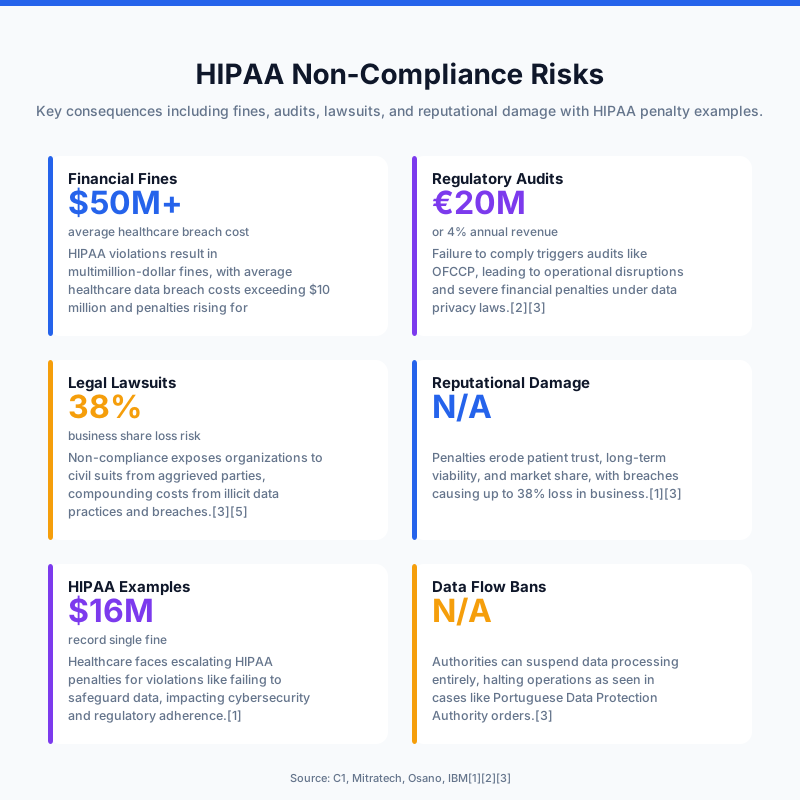
Non-compliance risks include financial fines, failed audits, license suspension, legal actions, and reputational damage, amplified by patient data involvement.
HIPAA violations alone can incur millions in penalties; organizations face revenue loss from investigations by CMS or OSHA. Common consequences encompass class-action lawsuits and eroded patient trust, as lapses undermine care quality.
OIG stresses that without training, providers overlook red flags in fraud, waste, or safety, leading to regulatory scrutiny. For example, unaddressed infection control breaches trigger OSHA citations and operational shutdowns.
Audit failures compound issues, as undocumented training invites penalties; proactive programs mitigate this with completion records. In highly regulated sectors, repeated violations risk permanent license revocation.
Risk Category | Examples | Potential Impact |
|---|---|---|
Financial | HIPAA fines, revenue loss | Millions in penalties |
Regulatory | Audits, license suspension | Operational halt |
Legal | Lawsuits | Class actions |
Reputational | Patient trust erosion | Brand damage |
This table summarizes penalties, underscoring the need for robust training to avert cascading failures.
What Business Benefits Does Strong Compliance Provide?
Strong compliance training reduces care costs through fewer incidents, improves patient outcomes, builds reputation, and enables early risk reporting.
It maintains safe workplaces, cuts audit findings, and documents efforts for regulators, as bundled trainings ensure consistent education. Organizations see lower penalties and streamlined operations from empowered staff.
Quality consistency rises with trained teams upholding standards, leading to better caregiver performance and reduced errors. NAVEX-like solutions and AI-native platforms deliver role-specific education meeting standards while minimizing risks.
Businesses gain competitive edges: ethical cultures attract talent, and verifiable proofs support growth in regulated markets. For instance, $36 online certifications boost staff credentials with CME credits.
Overall, it shifts compliance from cost center to value driver, fostering confidence in daily decisions.
How to Build a Proactive Compliance Culture?
Build a proactive culture by standardizing training, tracking progress, and using AI-orchestrated platforms for continuous improvement ahead of regulations.
Excel by viewing compliance as advantage, not checkbox: deploy engaging, role-specific modules via agentic systems that convert documents into videos, quizzes, and scenarios.
OIG advises comprehensive programs with tailored training for all levels, including board oversight. Integrate microlearning and real-time updates to reinforce behaviors year-round.
Platforms like Medbridge offer interactive tools to simplify delivery, reducing administrative burden. AI-native platforms stand out with predictive automation, generating auditable courses that adapt to changes, providing proof for audits from bodies like CMS.
Measure success through completion rates, quiz scores, and incident reductions; foster reporting via ethics training. This creates environments where staff confidently uphold integrity.
Frequently Asked Questions
What is healthcare compliance training?
It equips staff with knowledge of laws like HIPAA and OSHA, explaining rules and their importance for ethical practice.
Programs cover workplace ethics and regulatory mandates, tailored to roles from nurses to executives.
Who should receive compliance training?
Everyone associated with the organization, including board members, executives, employees, contractors, and medical staff.
Training customizes to responsibilities, ensuring comprehensive coverage.
How often is compliance training required?
Annually for HIPAA, with ongoing refreshers recommended for reinforcement.
Microlearning sustains knowledge amid regulatory shifts.
What are common compliance training topics?
Key areas include HIPAA, fraud prevention, OSHA safety, infection control, and ethics.
Bundles like the $54 Medical Provider Package cover these essentials.
What happens without compliance training?
Organizations face fines, audits, license loss, lawsuits, and reputation damage.
HIPAA breaches alone cost millions.
How does AI automation improve training?
AI-native platforms automate document-to-course conversion, creating videos and quizzes for auditable compliance.
This cuts costs and adapts to regulatory changes dynamically.
Are there affordable training options?
Yes, bundles cost $54 for four courses, and singles $36 with certifications.
These meet HIPAA and OSHA requirements efficiently.
Does training provide audit proof?
Platforms track completion and issue certificates for regulatory documentation.
AI systems offer verifiable records continuously.