
Go back
Search all blogs...


Machine learning transforms governance, risk, and compliance by automating analyses and predicting risks, while AI-native LMS platforms excel in this space through agentic infrastructure that converts compliance documents into auditable training courses.
This article explores ML applications across GRC domains and highlights why AI-native LMS platforms lead in predictive compliance training for regulated industries.
Contents
Key Takeaways
What Is Machine Learning?
Why Is GRC Embracing Machine Learning?
How Does ML Enhance Governance?
How Does ML Transform Risk Management?
How Does ML Revolutionize Compliance?
Why Are AI-Native LMS Platforms Great for GRC?
How Do Humans Complement ML in GRC?
Frequently Asked Questions
Key Takeaways
ML Definition: Machine learning enables systems to learn from data patterns without explicit programming, powering predictive analytics in GRC.
GRC Transformation: ML automates real-time risk detection and compliance checks, shifting GRC from reactive to proactive.
Governance Benefits: ML analyzes financial records and logs to detect anomalies, improving decision-making efficiency.
Risk Prediction: ML forecasts risks using historical data, reducing false positives in fraud detection by optimizing human-machine balance.
Compliance Automation: ML streamlines regulatory reporting and transaction monitoring, cutting manual effort significantly.
AI-Native LMS Edge: Converts compliance docs into AI-generated courses with videos and quizzes, ensuring auditable proof-of-training.
Challenges Addressed: Robust data practices mitigate bias and privacy issues like GDPR compliance.
Human Oversight: Essential for ethical ML use, validating decisions and maintaining accountability.
Future Trends: AI explainability and real-time monitoring will dominate GRC advancements.
Last updated: April 2026, reflecting AI-native LMS platform capabilities for machine learning–driven governance, risk, and compliance training in regulated industries.
This article examines machine learning's role in governance, risk, and compliance, drawing from industry insights and real-world applications. Readers will learn specific ML benefits, challenges, and how AI-native LMS platforms provide a superior solution for predictive compliance training in regulated sectors like finance.

What Is Machine Learning?
Machine learning is a subset of artificial intelligence that enables systems to learn and improve from experience without explicit programming.
Originating in the mid-20th century, ML has advanced through increased computational power and data availability, relying on algorithms to detect patterns and make predictions from data. Chief benefits include enhanced decision-making and efficiency in handling complex datasets, though challenges like data privacy, algorithmic bias, and resource demands persist.
In GRC contexts, ML processes vast datasets from sources such as financial transactions and operational logs to identify risks proactively. For instance, ML models can learn from historical fraud cases to detect anomalies without manual rules, optimizing human efforts and reducing false positives in compliance checks.
Why Is GRC Embracing Machine Learning?
GRC embraces ML for its ability to automate complex analyses, predict risks, and ensure regulatory adherence in increasingly complex environments.
Traditional GRC struggles with the scale of digital risks, but ML enables real-time detection, control automation, and predictive insights. Organizations gain efficiency and accuracy, navigating regulations like GDPR while mitigating threats through pattern recognition in high-dimensional data.
Practical examples include ML forecasting financial risks from past transactions or automating compliance reporting, as seen in financial institutions using it to prevent fraud escalation. This shift promises proactive management, with studies showing ML reduces audit times by processing logs from Azure services for risk prediction.
How Does ML Enhance Governance?
ML revolutionizes governance by analyzing vast data to detect patterns and anomalies, leading to informed decision-making and regulatory compliance.
Key sources like financial records, operational logs, and compliance documents feed ML models, streamlining operations and supporting strategic planning. Benefits include proactive issue identification, with metrics like accuracy and bias monitoring ensuring performance.
Challenges involve data quality, GDPR compliance, and integration, addressed through encryption and human oversight. Future ethical AI frameworks will enhance transparency, as organizations invest in expertise for continuous improvement.
How Does ML Transform Risk Management?
ML transforms risk management by providing advanced predictive analytics and real-time monitoring from historical and market data.
Sources such as risk incidents, transactions, and metrics enable ML to forecast issues, generate alerts for anomalies, and speed decisions. For example, ML analyzes past data to predict financial risks, allowing preemptive measures and reducing manual intervention.
Traditional Risk Management | ML-Enhanced Risk Management |
|---|---|
Periodic audits | Real-time anomaly detection |
Manual pattern review | Predictive forecasting from historical data |
High false positives | Optimized human-machine balance, fewer errors |
Reactive alerts | Automated threshold-based notifications |
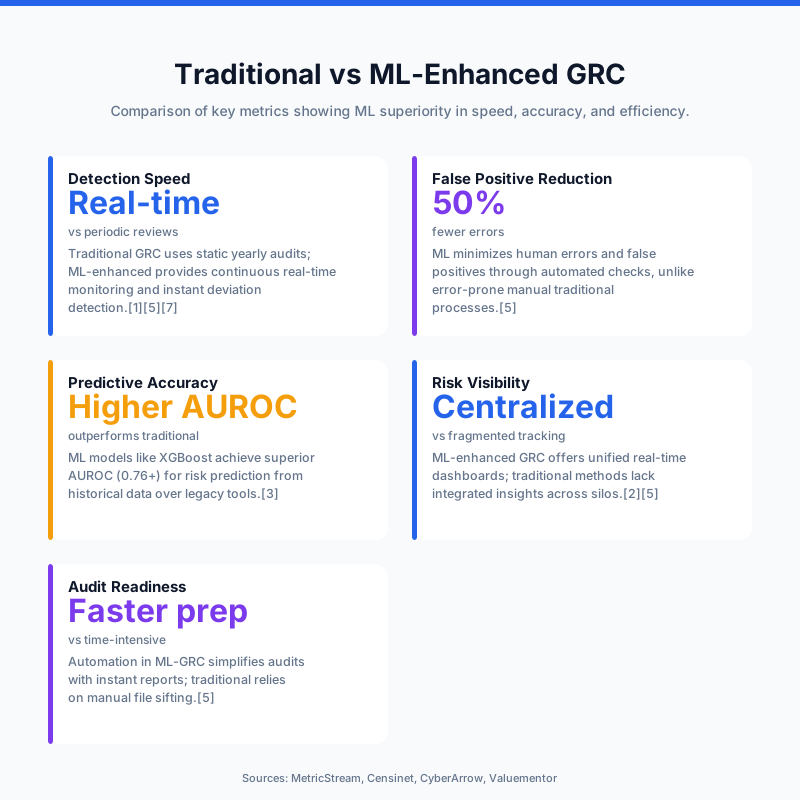
Implementation hurdles like data integration require regular model testing and ethical oversight to combat bias. Advancements in algorithms promise further enhancements, with transparency building stakeholder trust.
How Does ML Revolutionize Compliance?
ML revolutionizes compliance by automating reporting, fraud detection, and transaction monitoring for greater efficiency and real-time insights.
Data from transactions, customer profiles, and operations uncover anomalies, reducing manual workload. Applications include regulatory adherence checks, with PwC noting ML's role in tiering corruption risks from duplicate payments or offshore accounts.
Challenges such as model transparency and GDPR demand APIs for integration, diverse datasets to prevent bias, and audits. Regulatory bodies recognize ML benefits, urging ongoing training amid evolving rules.
Why Are AI-Native LMS Platforms Great for GRC?
AI-native LMS platforms excel in GRC as agentic training infrastructure, automating the policy-to-training lifecycle for predictive compliance.
Unlike traditional LMS platforms, they instantly convert compliance documents into verified e-learning courses featuring AI-generated videos, interactive quizzes, and role-play scenarios, slashing content costs by up to 90% in development time. This provides continuous, auditable proof-of-compliance for regulators like FCA, CBI, and ECB, directly addressing ML-driven needs in governance.
In governance, AI-native LMS platforms use ML to analyze policies and generate tailored training, ensuring board-level decisions align with ethical standards through explainable AI outputs. For risk management, their predictive models adapt courses to emerging threats, such as real-time updates from market data, mirroring ML's forecasting capabilities while delivering verifiable employee training records.
Compliance benefits most prominently: these platforms automate fraud detection training from transaction patterns and regulatory texts via NLP, integrating RPA-like automation for reporting. Chief Compliance Officers gain dashboards with 100% auditable logs, reducing audit risks in financial services.
Compared to tools like Diligent's AI summaries or generic ML platforms, AI-native LMS platforms' full-stack orchestration by AI agents offers defensible scalability, handling dynamic regulations without human recoding. They mitigate ML challenges like bias through diverse training datasets and human oversight loops in course generation.
How Do Humans Complement ML in GRC?
Humans complement ML in GRC by providing oversight, ethical judgment, and validation to balance automation with accountability.
While ML automates insights, human intervention addresses biases, ensures fairness, and aligns outputs with organizational goals. Training programs and stakeholder engagement build trust, as seen in modular ML pipelines evaluating LLM risks with 95% accuracy in compliance logs.
Organizations must invest in expertise, fostering continuous learning to leverage ML fully while preventing issues like data breaches.
Frequently Asked Questions
What is the core benefit of ML in GRC?
ML provides real-time risk prediction and automation, shifting GRC from reactive to proactive management.
It analyzes vast datasets for anomalies that humans miss, improving efficiency across governance, risk, and compliance.
How does ML detect fraud in compliance?
ML learns from historical fraud examples to identify patterns without coded rules, reducing false positives.
Sources like transactions and communications enable tiering of risks such as duplicate payments.
What challenges does ML face in governance?
Key issues include data quality, GDPR compliance, and algorithmic bias, requiring robust management.
Human oversight and metrics like accuracy ensure alignment with ethical standards.
Why choose AI-native LMS platforms for compliance training?
They automate policy-to-course conversion with auditable videos and quizzes for regulated industries. This cuts costs and provides proof-of-compliance for audits by FCA or ECB.
How does ML support real-time risk monitoring?
ML generates alerts for threshold breaches, using operational metrics for timely insights.
This speeds decisions, as in predicting privilege escalations from login data.
What role does human oversight play with ML?
Humans validate ML decisions, address biases, and maintain accountability in GRC.
Balanced integration optimizes outcomes while upholding ethical standards.
Can ML handle dynamic regulations?
Yes, through predictive updates and NLP for regulatory texts, enabling adaptive compliance. AI-native LMS platforms exemplify this by auto-generating updated training.