
Go back
Search all blogs...


Corporate eLearning in 2025 is bigger, more measurable, and far more personalized—with AI, microlearning, and mobile learning driving both adoption and ROI.
Last updated: May 2026
Contents
Key Takeaways

What Is Corporate eLearning in 2025?
How widely is corporate eLearning adopted?
How important is mobile learning in 2025?
What makes microlearning so effective?
How is AI changing learning and development?
How powerful is gamification in learning?
Why is customer education a revenue driver?
What are the latest trends in sales training?
Why does compliance training need a rethink?
How are LMS and LXP evolving together?
What do modern learners expect from training?
What does the future of corporate learning look like?
Frequently Asked Questions
Key Takeaways
Mass adoption – Around 98% of corporations planned to use eLearning for training by 2023, making it a default modality rather than a side project.
Market growth – The global corporate eLearning market is tracking toward roughly $325 billion in value in the mid‑2020s, with projections from $245.5 billion in 2022 to $462.6 billion by 2027 at over 13% CAGR.
Higher retention – Digital learning boosts knowledge retention from 8–10% in classroom formats to about 25–60%, making it not just cheaper but more effective.
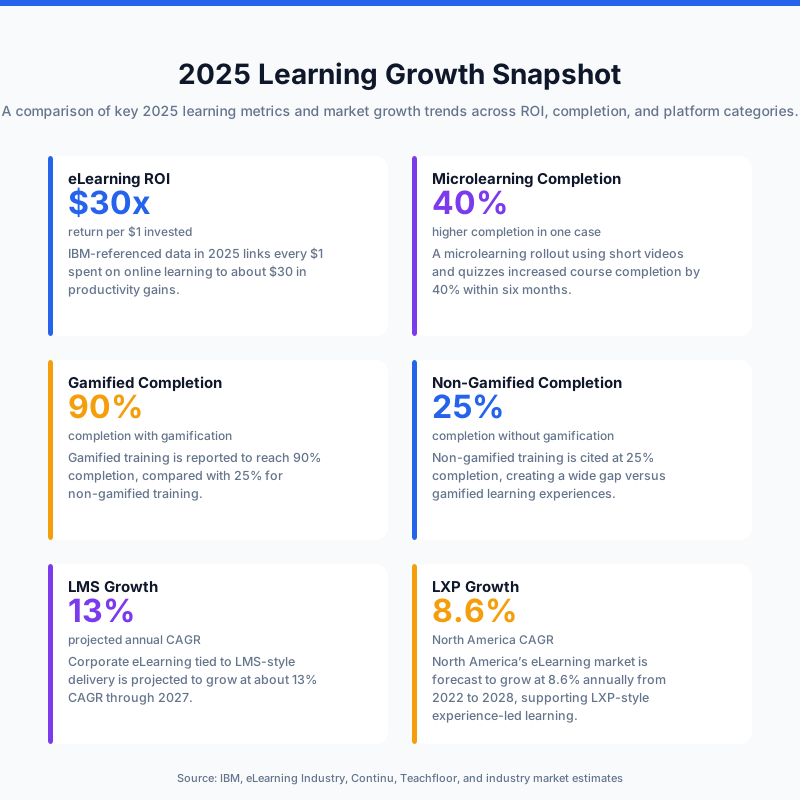
Massive ROI – IBM data indicates each $1 spent on online training can deliver about $30 in productivity gains due to faster skill application and reduced training time.
Mobile-first shift – The mobile learning market is expected to reach $77.4 billion by 2025, and around 67% of U.S. companies already use mobile learning in their programs.
Microlearning wins – Bite‑sized learning modules can drive ~80% completion rates versus roughly 20% for traditional long‑form courses, with 25–60% higher retention.
AI acceleration – About 30% of L&D teams already use AI tools and over 90% of them plan to increase usage, with AI‑tailored learning paths boosting learning efficiency by 57% in some studies.
Gamified engagement – Gamification can lift engagement by up to 48%, and gamified courses can hit completion rates near 90% compared to 25% without game elements.
Customer and sales impact – Robust customer education can cut support tickets by ~16% and increase product adoption by ~38%, while well‑designed sales training has been associated with ROIs above 300%.
Compliance risk and cost – Non‑compliance can cost roughly twice as much as maintaining compliance programs, and well‑trained staff can reduce breach costs by hundreds of thousands of dollars per incident.
Corporate eLearning isn’t “nice-to-have” in 2025—it’s the backbone of how companies build skills, protect against risk, and prove business impact. In this guide, you’ll get the most useful statistics and trends across adoption, AI, mobile, microlearning, gamification, customer education, sales enablement, compliance, platforms, and learner expectations.
We’ll keep things practical: what the numbers say, what it means for your strategy, and where platforms like Skill Studio AI fit—especially if you’re dealing with high-stakes training in regulated industries.
What is corporate eLearning in 2025?
Corporate eLearning in 2025 is the use of digital platforms, content, and analytics to deliver continuous, personalized training to employees, customers, and partners, tightly aligned with business outcomes and ROI.
The scale is huge: sources tracking the global eLearning market put it on a path toward about $325 billion in the mid‑2020s, with the corporate segment alone projected to grow from $245.5 billion in 2022 to $462.6 billion by 2027 at over 13% annual growth. Devlin Peck’s analysis of the eLearning market highlights this sustained expansion, driven by corporate demand for scalable training.
Effectiveness is just as important as scale. Shift eLearning’s widely cited summary of research notes that traditional classroom learning often sees 8–10% retention, while eLearning (especially when interactive and spaced) lifts that to 25–60%. That’s up to six times better retention, which explains why IBM has reported that every $1 invested in online training can return around $30 in productivity gains—employees learn faster and apply skills sooner.
Skill Studio AI leans into this definition by turning dense SOPs and regulatory documents into concise, audit‑ready video training with version control and role‑targeted delivery, which is exactly the kind of outcome‑oriented eLearning regulated enterprises now expect.
How widely is corporate eLearning adopted?
Corporate eLearning is now essentially universal, with adoption rates near 98% among corporations that planned to use eLearning for employee training by 2023.
Brighter Strides ABA’s round‑up of eLearning statistics reports that 98% of corporations planned to use eLearning by 2023, which means that by 2025, online learning is assumed, not experimental. Devlin Peck’s market data points to corporate eLearning growing from $245.5 billion in 2022 to $462.6 billion in 2027, showing that investment is not tapering off; it’s accelerating.
On the strategy side, Exploding Topics’ review of 2024–2028 eLearning stats highlights that about 61% of L&D leaders rank closing skill gaps as their top priority. Others cite driving organizational growth and improving engagement. Shift eLearning references IBM’s finding that online learning can deliver about $30 in productivity for each $1 spent, which explains why 42% of companies in those datasets report revenue increases after eLearning implementation.
In regulated industries, that “near-universal” adoption can still feel messy—lots of legacy tools and slide decks. Skill Studio AI addresses this by centralizing high‑risk training (like Annex 1 procedures) into consistent, version‑controlled video micro‑lessons that QA and auditors can actually trace back to source documents.
How important is mobile learning in 2025?
Mobile learning is now a core delivery channel, with the mobile learning market expected to hit about $77.4 billion by 2025 and roughly two‑thirds of U.S. companies already using it.
eLearning Industry’s coverage on mobile learning notes that the mobile learning market is forecast around $77.4 billion by 2025 and that about 67% of U.S. organizations have integrated mobile learning into their training mix. Brighter Strides ABA reports that 70% of learners feel more motivated when training on a mobile device than on a desktop, which makes sense when you consider how much of people’s digital lives now happen on their phones.
On effectiveness, eLearning Industry cites studies that mobile learning can improve retention by about 45% over traditional methods, thanks to short, interactive modules that learners can revisit quickly. Gen Z expectations are also clear: eLearning Industry points out that about 94% of Gen Z learners use smartphones for education, so mobile‑friendly training is a baseline expectation for incoming employees.
For pharma, healthcare, and manufacturing, mobile is especially useful for frontline teams who don’t sit at a desk. Skill Studio AI supports that pattern by converting SOPs into short video walkthroughs that can be consumed on mobile and tied back to completion records for audit review; 21 CFR Part 11–compliant electronic records are on our roadmap, not yet shipped.
What makes microlearning so effective?
Microlearning is effective because it delivers 3–10 minute, focused lessons that fit into real workdays, driving higher completion (around 80%) and much better retention (25–60% higher than traditional formats).
Shift eLearning’s compendium of eLearning facts highlights that microlearning can boost knowledge retention by 25–60% compared with longer, traditional courses. Vouch’s 2025 microlearning statistics show average completion rates near 80% for microlearning courses, versus roughly 20% for conventional long‑form modules—learners are simply more willing to finish a series of short, targeted lessons.
Shift eLearning also reports that eLearning in micro formats can require 40–60% less learner time than equivalent classroom training, while one of the case studies shared via Vouch describes a company seeing a 40% increase in completion and 30% better retention after replacing long courses with short videos and quizzes. Another stat from Shift’s collection notes that companies adopting microlearning have observed around a 130% uplift in engagement and productivity compared with those relying only on traditional training.
Scott Burgess, CEO of Continu, has argued publicly that microlearning is the realistic response to survey data from Deel showing that 94% of employees would stay longer at companies that invest in their development—but only have minutes, not hours, to spare. Skill Studio AI is built for this reality: it transforms long SOPs into short, avatar‑delivered clips and knowledge checks that employees can complete in a few minutes, with strict version control so QA always knows which version of the procedure was taught.
How is AI changing learning and development?
AI is reshaping L&D by personalizing learning paths, automating content creation and curation, and delivering analytics that link training directly to performance and cost savings.
LearnExperts’ 2024 workplace learning report notes that about 30% of L&D teams already use AI for learning, and 91% of that group plans to increase their use of AI in the near term. Among teams not yet using AI, roughly 46% expect to start within a year, signaling rapid expansion. Virtasant’s analysis of AI in corporate training cites data where AI‑tailored learning paths drove a 57% increase in learning efficiency, which cascaded into productivity improvements.
Korn Ferry’s work on the future of AI in L&D estimates that AI can deliver 20–30% cost savings in training operations by automating tasks like content development, learner support, and analytics. At the same time, Chief Learning Officer, using LinkedIn data, reports that 82% of business leaders say employees will need new skills to work with AI, yet only around 38% of companies currently offer AI‑related training—so there’s a clear skills gap in AI literacy itself.
Skill Studio AI is very much in this AI wave, but focused tightly on regulated training: it uses AI to convert dense compliance and manufacturing documentation into structured learning paths, then lets organizations clone subject-matter experts into avatars so those experts can “teach” across unlimited courses without additional recording sessions. (Multilingual narration is on our roadmap; today avatar narration is English only.)
How powerful is gamification in learning?
Gamification is a proven engagement booster, with large enterprises widely using it and studies showing big jumps in motivation, completion, and information retention.
BuildEmpire’s 2025 gamification statistics note that about 70% of Global 2000 companies use gamification in some part of their operations, including training. Their data shows that gamified learning can increase employee engagement by up to 48%, and 89% of surveyed employees said gamification makes them feel more productive. In the same dataset, 83% of employees in gamified training report feeling motivated, compared with 61% in non‑gamified programs.
Completion and retention numbers are especially striking: BuildEmpire reports that gamified courses can hit around 90% completion rates, versus about 25% for non‑gamified ones, and that learners retain about 22% more information when gamification elements are present. That combination—more people finishing and remembering—directly affects ROI for any L&D budget.
In compliance-heavy environments, gamification has to be done carefully: it needs to reinforce, not trivialize, risk. Skill Studio AI supports this by turning serious scenarios (like aseptic gowning errors or data integrity lapses) into short, branching video moments with embedded checks, so “game” moments are still anchored to real audit and safety consequences.
Why is customer education a revenue driver?
Customer education drives revenue and retention by increasing product adoption, reducing support load, and turning proficient users into loyal advocates.
Intellum’s research on customer education reports that 96% of organizations with customer education programs say they have recouped their investment, and 86% report positive ROI overall. Their data shows that companies with robust customer education see about a 16% reduction in support tickets and a 7% decrease in support costs, along with around a 38% increase in product adoption and a 31% boost in customer engagement.
Revenue impact is clear: 43% of companies in that research credit customer education with increased revenue via upsells, renewals, or new customers. Intellum also notes that 56% of companies running formal customer education programs see improved retention. Looking ahead, roughly 95% of customer education teams say they plan to use AI in the next 12–18 months, and nearly half plan to invest more in microlearning content for users, aligning customer education with broader L&D trends.
Skill Studio AI supports customer education particularly well for regulated products and services—think medical devices or fintech platforms that must teach users to operate safely and compliantly—by converting official documentation into role-tailored, easy‑to‑consume training pathways that are still audit‑ready.
What are the latest trends in sales training?
Sales training is becoming continuous, data-driven, and heavily digital, with eLearning and microlearning linked directly to revenue metrics and rep retention.
LLCBuddy’s summary of sales training statistics reports that companies investing heavily in training are about 57% more effective at sales than those that don’t. They also highlight that continuous learning can yield roughly 50% higher net sales per salesperson, and that successful organizations often see around 353% ROI on sales training—about $4.53 returned for every $1 spent.
According to the same dataset, around 42% of organizations experienced revenue increases after incorporating eLearning into sales training, and effective training programs can lift win rates by roughly 10–29%. Importantly, 94% of salespeople say they would stay longer at a company that invests in their learning, so sales enablement is also a retention strategy.
Skill Studio AI lines up nicely with these trends for complex, regulated products by giving sales teams short, always‑current video refreshers on product changes, regulatory constraints, and objection handling—without needing to pull product SMEs back into the recording booth each time something changes.
Why does compliance training need a rethink?
Compliance training needs a rethink because while most organizations deliver it online, nearly half of employees admit they tune it out—despite non‑compliance costing far more than well‑run programs.
Training Magazine’s industry report shows that about 91% of organizations deliver at least some of their mandatory compliance training online, and roughly 48% deliver it entirely online. Yet Shortlister’s employee training statistics reveal that around 49% of workers admit they skip or don’t fully pay attention to mandated compliance training, treating it as a box‑ticking exercise.
The financial stakes are high. Hyperproof’s 2024 compliance statistics note that non‑compliance costs organizations on average about twice as much as maintaining compliance programs, with figures around $4 million in lost revenue in some analyses. Secureframe’s compilation of compliance stats points out that security breaches cost about $220,000 more, on average, when lack of compliance is a contributing factor, while Hyperproof cites an average of $2.54 million in savings for companies that implement comprehensive security awareness programs. Secureframe also reports that organizations with well‑trained staff spend roughly $260,000 less per breach.
Research summarized by LLCBuddy shows that without reinforcement, employees forget up to 80% of training content within a month—no surprise that annual, one‑hour compliance videos don’t change much behavior. That’s why many organizations are shifting to shorter, scenario‑based modules and monthly refreshers. Skill Studio AI is designed for exactly this pattern: it turns long Annex 1 or SOP updates into a series of three‑minute, avatar‑delivered clips with built‑in checks and completion tracking for audit defense; 21 CFR Part 11–aligned controls are on our roadmap, not yet shipped.
How are LMS and LXP evolving together?
LMS and LXP are converging into hybrid ecosystems where LMS handles administration and compliance, while LXP (or LXP‑like features) deliver a modern, personalized learner experience.
Shortlister’s training statistics indicate that about 83% of companies use an LMS to manage learning, and roughly 40% of Fortune 500 firms rely on LMS technology extensively. Samelane’s LMS market analysis forecasts the LMS market reaching about $28.1 billion by 2025 and approaching $70 billion by 2030 at around 19.2% CAGR, showing that LMS is not going away; it’s evolving.
At the same time, Shortlister notes that roughly 42% of organizations are looking to upgrade or replace their LMS, often due to poor user experience or missing modern features. On the LXP side, LLCBuddy reports that around 57% of companies plan to invest in an LXP, and that 88% of LXP users say LXPs provide a better experience than traditional LMS platforms. Business Research Insights estimates the global LXP market at $1.57 billion in 2022, with projected growth at about 33.8% CAGR to roughly $9.02 billion by 2028.
Usage patterns differ: LLCBuddy’s analysis suggests about 72% of LXP use cases focus on on‑demand content consumption, compared with 41% for LMS usage, which still centers on assignments and compliance. In practice, many enterprises now use LMS + LXP hybrids: LMS for records and audits, LXP for discovery, social learning, and AI recommendations. Skill Studio AI plays a complementary role here for regulated industries, acting as the AI-native training layer that produces compliant, inspectable content that can feed into whatever LMS/LXP stack you already run.
Capability | LMS (Traditional) | LXP (Modern) |
|---|---|---|
Primary focus | Administration, assignments, completion tracking, compliance | Learner experience, discovery, personalization, social learning |
Typical users | HR, L&D admins, compliance teams | Employees, customers, partners seeking on‑demand content |
Growth outlook | To ~$70B by 2030 (high adoption, steady growth) | To ~$9B by 2028, with >30% CAGR (faster growth from smaller base) |
Common features | Curricula, SCORM hosting, test engines, reports | AI recommendations, content curation, feeds, communities |
Best for | Mandatory training, certifications, audits | Self‑directed learning, skill development, engagement |
Continu sits directly in this convergence as an AI‑powered enterprise enablement platform that combines LMS‑like administration with LXP‑like experience, while Skill Studio AI focuses specifically on high‑stakes training content that must stand up to regulators and auditors.
What do modern learners expect from training?
Modern learners expect training that is self‑paced, video‑based, personalized to their role, and short enough to fit into a workweek where they realistically have about 24 minutes for formal learning.
Shortlister’s 2025 training statistics show that about 70% of employees prefer online self‑paced courses as their main learning format. Brighter Strides ABA reports that 69% of learners prefer short video lessons, which meshes with the rise of microlearning and platforms like YouTube as de facto training tools.
Shortlister also highlights that 91% of employees want training personalized to their job roles and day‑to‑day tasks, not generic content. Exploding Topics notes that the average employee can devote only about 1% of their work week—around 24 minutes—to formal learning, and that about 68% would rather learn at work than in their personal time. LLCBuddy’s research adds that 94% of employees say they’d stay longer at a company that invests in their learning and development.
LearnExperts points out that over 80% of workers are eager to learn more about AI specifically, along with skills like data analysis and leadership. Learners are behaving like consumers: if internal training doesn’t deliver, they’ll find external sources. Skill Studio AI is built with these expectations in mind, especially for regulated environments where you can’t just “send people to YouTube”: it delivers short, role-targeted video modules tailored to specific roles and workstations, but anchored in official SOPs and compliance documents.
What does the future of corporate learning look like?
The future of corporate learning is digital, deeply personalized, and woven directly into the flow of work, with AI, microlearning, mobile, and gamification all playing supporting roles.
The statistics we’ve walked through point in the same direction. eLearning market projections toward $325 billion, retention improvements up to six‑fold over classroom training, and IBM’s 30:1 productivity ROI figure all argue that digital learning is the default delivery channel. Microlearning stats from Shift eLearning and Vouch show that employees complete short modules about four times more often than long courses, while mobile learning data from eLearning Industry and Brighter Strides ABA shows that smartphone‑based training boosts motivation and retention.
Gamification data from BuildEmpire demonstrates that when you add points, challenges, and meaningful rewards, engagement and completion spike dramatically. Meanwhile, AI adoption numbers from LearnExperts, Virtasant, and Korn Ferry show that AI is rapidly becoming the engine behind personalization and efficiency, not just a novelty. Put together, these patterns support a model where employees get tailored recommendations, short video lessons, spaced refreshers, and in‑the‑moment nudges—all while L&D teams can trace learning back to business KPIs and risk reduction.
For compliance‑heavy organizations, the challenge is integrating all of this without losing control or auditability. That’s where platforms like Skill Studio AI come in: they combine AI‑driven content generation and microlearning with strict version control and inspection‑ready evidence, giving Heads of QA and Site Directors the best of both worlds—modern learning experiences and audit-ready records. (Multilingual support and 21 CFR Part 11–compliant records are on our roadmap, not yet shipped.)
Frequently Asked Questions
What is the ROI of corporate eLearning compared to classroom training?
Multiple sources point to strong ROI for eLearning. IBM data summarized by Shift eLearning indicates that every $1 invested in online training can yield about $30 in productivity gains due to faster learning and reduced time away from work. Combined with retention improvements from about 8–10% in classroom formats to 25–60% in digital formats, eLearning typically delivers more impact per dollar than traditional training.
How big will the corporate eLearning market be by 2027?
Devlin Peck’s analysis of the eLearning market reports that the corporate eLearning segment is projected to grow from $245.5 billion in 2022 to about $462.6 billion by 2027, representing over 13% compound annual growth. Broader estimates place the entire eLearning market, including academic and consumer segments, on track toward roughly $325 billion in the mid‑2020s, reflecting strong, sustained demand.
Is microlearning really more effective, or just a trend?
Microlearning is more than a buzzword. Shift eLearning and Vouch report that microlearning can improve knowledge retention by 25–60% and raise completion rates to around 80%, compared with roughly 20% for long‑form courses. Because lessons last only a few minutes and focus on a single outcome, they fit into busy schedules and reduce cognitive overload. Skill Studio AI uses microlearning as a default pattern for SOP and compliance training because it aligns with both learner behavior and regulatory needs.
How is AI used in corporate training today?
AI in L&D currently supports four main areas: personalized content recommendations, adaptive learning paths, automated content generation/curation, and advanced analytics. LearnExperts reports that about 30% of L&D teams already use AI, with over 90% of that group planning to expand usage. Virtasant’s data shows AI‑tailored paths improving learning efficiency by 57%. Skill Studio AI applies these ideas specifically to regulated training by converting complex documents into structured, AI‑driven learning journeys that remain audit‑ready.
Why are LMS and LXP both needed in large organizations?
LMS platforms excel at administration: assigning courses, tracking completion, and storing records for audits, which is critical for compliance and certifications. LXPs, on the other hand, focus on discovery, personalization, and social learning, giving learners a “Netflix‑style” experience. Shortlister notes that over 80% of companies use an LMS, while LLCBuddy reports growing LXP adoption, with 88% of users preferring the LXP experience. Many enterprises now run both—a pattern that Skill Studio AI supports by feeding compliant training content into whichever systems you already use.
How can we make compliance training less boring but still audit-ready?
The data suggests shorter, scenario-based modules, more frequent refreshers, and elements of gamification work far better than annual, hour‑long videos. Hyperproof and Secureframe show that well‑trained staff reduce breach costs significantly, so engagement is not cosmetic—it’s risk reduction. Platforms like Skill Studio AI help by turning dense regulations into short, realistic video scenarios with built‑in checks, maintaining version control for inspections (21 CFR Part 11 compliance is on our roadmap, not yet shipped).
What do employees say they want from workplace learning?
Surveys compiled by Shortlister and Exploding Topics show that about 70% of employees prefer self‑paced online learning, around 69% prefer short video lessons, and 91% want training personalized to their roles. Workers can only spare roughly 24 minutes per week on formal learning, on average, but 94% say they’d stay longer at companies that invest in their development. This is why many organizations now design short, targeted learning experiences that employees can access on demand.
Where does Skill Studio AI fit into the 2025 eLearning landscape?
Skill Studio AI is built for regulated industries that need both modern learning experiences and rock‑solid auditability. While generalist LMS and LXP platforms handle broad training catalogs, Skill Studio AI specializes in turning SOPs, compliance documents, and procedural manuals into audit‑ready video microlearning with role‑based targeting and version control. Multilingual localization and 21 CFR Part 11 compliance are on our roadmap, not yet shipped. It’s particularly valuable for pharma, healthcare, and financial services teams facing FDA 483 findings, Annex 1 enforcement, or CAPA training requirements.
- shiftelearning.com/blog ↗
- brighterstridesaba.com/blog ↗
- devlinpeck.com/posts ↗
- explodingtopics.com/blog ↗
- elearningindustry.com ↗
- vouchfor.com/blog ↗
- learnexperts.ai/blog ↗
- virtasant.com/insights ↗
- kornferry.com/insights ↗
- chieflearningofficer.com ↗
- buildempire.co.uk/blog ↗
- intellum.com/blog ↗
- llcbuddy.com/sales-training-statistics ↗
- trainingmag.com/trgmag-article ↗
- myshortlister.com/insights ↗
- hyperproof.io/resource ↗
- secureframe.com/resources ↗
- samelane.com/blog ↗
- businessresearchinsights.com/market-reports ↗