
Go back
Search all blogs...


AI can turn dense pharma and healthcare policies into targeted, auditable training that actually changes behavior—and proves it to regulators.
Last updated: May 2026
Contents
Key Takeaways

What Is Compliance Training Automation in Pharma and Healthcare?
Why Is Automation So Critical for GMP and Healthcare Compliance?
How Do You Go From Policy Documents to Training Content Using AI?
How Do You Target Training by Role, Site, and Risk?
How Do You Make Training Audit-Ready and 21 CFR Part 11 Compliant?
How Do AI Avatars and Teaching-Style Cloning Help SMEs Scale?
What Does Good Governance Look Like When You Use AI for Compliance Training?
How Does AI Change the Day-to-Day Work of QA and L&D Teams?
Frequently Asked Questions
Key Takeaways
AI connects policies to behavior by turning SOPs, Annex 1 updates, and CAPAs into role-based learning paths tied to real risks.
Automation cuts manual admin by generating content, assigning training by role, and tracking completions with less QA and L&D overhead.
Regulators care about evidence that staff are trained, competent, and current—AI helps maintain version control, audit trails, and recertification.
Persona-based training paths are possible when AI links job profiles and risk profiles to specific modules and scenarios.
AI in pharma training already spans GMP, quality, safety, and regulatory topics, covering multiple high-risk domains end to end.
Healthcare compliance AI is used today for credential checks, privacy compliance, and monitoring under laws like HIPAA and GDPR.
AI avatars and style cloning let one SME’s knowledge become dozens of consistent training modules without repeated recording sessions.
Good governance is non-negotiable—AI outputs still need QA review, data privacy safeguards, and alignment with GxP expectations.
Skill Studio AI exemplifies this shift by converting dense SOPs into audit-ready training with version control (multi-language narration and 21 CFR Part 11 compliance are on our roadmap, not yet shipped).
Compliance training automation in pharma and healthcare is no longer a “nice to have”—it sits right next to your batch records and deviation logs in terms of regulatory interest. In this article, we’ll walk through how AI can take you from static policy documents to certified, audit-ready staff, with concrete practices you can use on your site.
Along the way, we’ll use Skill Studio AI as an example of how modern platforms turn SOPs and Annex 1 guidance into targeted, video-based training and track it all for regulators.
What Is Compliance Training Automation in Pharma and Healthcare?
Compliance training automation in pharma and healthcare is the end-to-end use of software and AI to convert regulations and internal policies into assignable, trackable, and auditable learning experiences without manual content building for every change.
In practice, that means you feed in GMP policies, SOPs, CAPA responses, and codes of conduct, and your system outputs structured modules, assessments, and reminders linked to specific roles and sites.
In pharma, typical training domains include regulatory compliance, GMP training, quality assurance and control, safety training, and medical or technical skills training, all of which are increasingly supported by AI-based tools that personalize content and assessments.
According to Learning Everest, AI in pharma training is already used across drug development training, regulatory compliance, GMP, and safety, not just “soft skills,” which shows regulators are already seeing AI-generated or AI-enhanced content in submissions and inspections.
In healthcare, AI is also used for compliance beyond training—such as verifying provider credentials, monitoring adherence to privacy regulations, and automating regulatory checks—which creates a natural bridge into training and competency management.
Skill Studio AI fits squarely into this definition: it turns dense SOPs and compliance documents into video-based, role-targeted courses with version control and audit-ready tracking, especially for pharma and other regulated industries.
Why Is Automation So Critical for GMP and Healthcare Compliance?
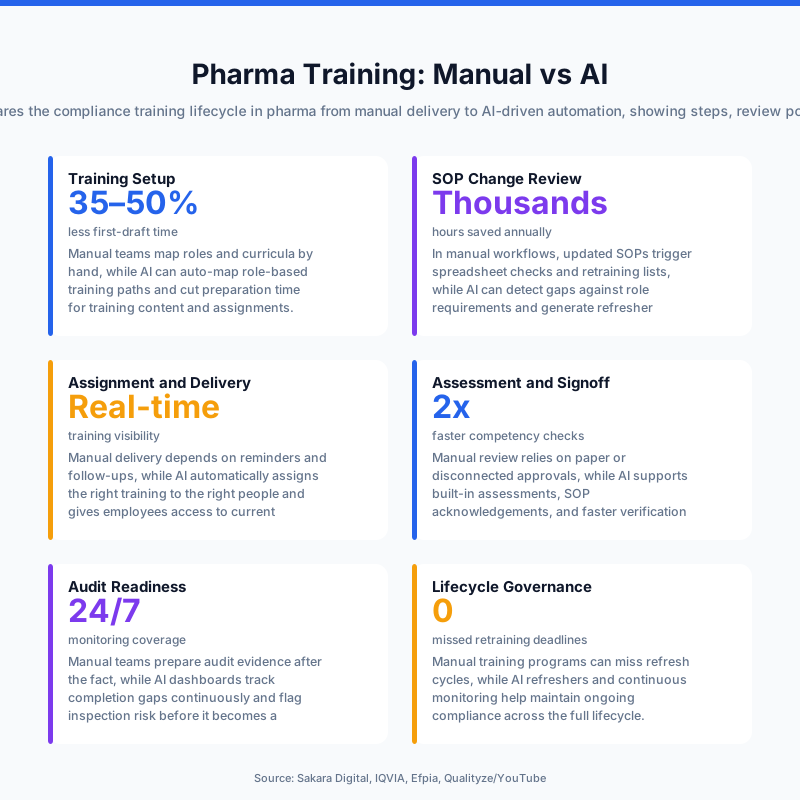
Automation is critical because manual training processes simply can’t keep pace with the volume of regulatory updates, CAPAs, and policy changes hitting pharma and healthcare organizations each year.
In life sciences, AI tools already monitor large volumes of regulatory data and highlight changes, which helps compliance teams maintain an up-to-date view of their obligations without line-by-line manual review.
IQVIA describes how AI-powered tools can continuously monitor regulatory changes, identify relevant updates for life sciences companies, and support proactive compliance rather than reactive cleanup during or after inspections.
In healthcare, AI is used to automate compliance checks and provider credential verification, reducing the risk of human error in administrative tasks that underpin both patient safety and regulatory trust.
Without automation, every SOP revision, Annex 1-related update, or CAPA response forces QA and L&D teams to reinvent training slides, schedule new sessions, and manually track who attended and who still needs to be trained—an obvious bottleneck for Annex 1-affected sites.
Skill Studio AI addresses this by letting QA and L&D teams upload updated SOPs or procedures and rapidly generate new training modules, keeping training aligned with the latest policy versions while maintaining an audit-ready history.
How Do You Go From Policy Documents to Training Content Using AI?
You go from policy documents to usable training content by using AI models that can ingest long-form text, extract key rules and decisions, and structure them into microlearning modules, assessments, and scenarios.
In pharma, AI is already being used to generate training content around regulatory compliance, GMP, and digital tools by converting technical information into interactive learning experiences scaled across many employees.
Learning Everest notes that AI models can drive interactive scenarios, automated content, and personalized learning paths for topics like GMP and regulatory compliance, showing that AI is capable of working with complex regulated content.
A practical workflow looks like this:
First, you upload the governing document—such as an aseptic processing SOP updated for Annex 1, a deviation handling procedure, or a data integrity policy.
Next, AI parses the document, identifies the critical steps, decision points, and “must” versus “should,” and proposes a course outline: sections, learning objectives, and key checks for understanding tied to the actual policy text.
Then, the system generates draft scripts, visuals, and quiz questions that are grounded in the original document so that nothing critical is lost while jargon is translated into plain language for technicians and nurses.
Finally, human reviewers—usually QA and the process SME—validate the content, tweak wording, and approve the module for release, creating a clear review trail in case an inspector asks who approved what.
Skill Studio AI exemplifies this flow by ingesting dense SOPs and compliance manuals and turning them into audit-ready video modules in minutes, while still allowing SMEs to review and lock the final content.
How Do You Target Training by Role, Site, and Risk?
You target training by mapping roles, sites, and risk levels to specific policies and then letting AI assemble personalized learning paths for each persona.
In life sciences, AI-powered tools can build persona-based training programs by ingesting employee data, roles, and responsibilities, and then recommending individualized training paths aligned to their skill gaps and compliance obligations.
IQVIA describes how AI can use role information and responsibilities to create persona-based training paths, each tailored to the individual’s pace and specific learning needs, which is ideal for differentiating an aseptic operator from a QC analyst.
In healthcare compliance, AI also supports segmentation by monitoring different risk areas—like privacy, billing, or clinical documentation—and triggering focused training when certain behaviors or risk indicators appear.
For a pharma site responding to an FDA 483, this can look like building a specific training path for operators involved in the cited process, with extra emphasis on the steps that previously failed and evidence of completion captured for the response package.
Multi-site organizations can also differentiate by local regulatory context—such as EU GMP versus US FDA expectations—while still sharing core modules where appropriate, to avoid duplicated effort.
Skill Studio AI supports role-targeted delivery so that a single policy can generate distinct training experiences for operators, maintenance teams, QA, and management, each with the right amount of detail and accountability.
How Do You Make Training Audit-Ready and 21 CFR Part 11 Compliant?
You make training audit-ready and 21 CFR Part 11 compliant by treating training content and records with the same rigor you apply to electronic batch records and other GxP systems.
AI itself does not remove the need for compliance; in pharma, one of the noted challenges is ensuring that AI-driven training adheres to global pharmaceutical regulations and that its outputs are appropriately validated and documented.
Learning Everest highlights the need to use AI models that offer transparent solutions and to involve legal and compliance experts, especially in regulated pharma contexts where regulators will ask how content was produced and approved.
In healthcare, AI-based compliance tools must respect legal frameworks like HIPAA and GDPR in how they process and store data, which extends to training systems that track completion and performance.
For training, audit-ready typically means having version-controlled content, clear records of which version of an SOP was taught to which staff at which time, assessment results, and documented approvals of content updates.
Part 11 expectations include secure logins, audit trails for changes, electronic signatures where required, and validation evidence that the system works as intended and preserves data integrity for training records.
Skill Studio AI includes version control and audit-ready tracking so that every training record can stand up to regulatory scrutiny; full 21 CFR Part 11 compliance is on our roadmap, not yet shipped.
How Do AI Avatars and Teaching-Style Cloning Help SMEs Scale?
AI avatars and teaching-style cloning help SMEs scale by turning a single expert’s way of explaining things into a reusable, consistent presence across dozens of modules without repeated recording sessions.
In pharma and healthcare, many of the best trainers are in-demand subject matter experts—often site leaders or senior QA staff—whose availability is a major bottleneck for live training or manual video creation.
AI video tools can generate “talking head” instructors based on an avatar and script, providing consistent, human-like delivery of complex material while saving time compared with filming every lecture manually.
According to industry discussions about AI talking-head video tools, these avatars can transform existing content into engaging, presenter-led explainers, which align well with reusing SOP-based scripts in visual form.
Style cloning takes this further by capturing the way a particular SME explains and emphasizes certain risks and then applying that style to new modules, preserving site-specific culture and expectations even as content scales.
Skill Studio AI specializes in letting instructors clone their own teaching style and avatar so one SME’s knowledge can be scaled into unlimited courses without extra recording time, which is particularly valuable when the same Annex 1 concepts must be reinforced across multiple lines and shifts.
Because Skill Studio AI enforces an engineering-grade polish-and-QC process on every avatar render, it also reduces the risk of “uncanny valley” content undermining learner trust in high-stakes compliance topics. (Non-English voices, such as Irish- or Hindi-accented narration, are on our roadmap — avatar narration is English only today.)
What Does Good Governance Look Like When You Use AI for Compliance Training?
Good governance for AI-based compliance training looks like a layered framework that covers model choice, data protection, human oversight, and alignment with existing quality systems.
In pharma training, one of the documented challenges is ensuring that AI solutions align with global pharmaceutical regulations, data privacy expectations, and GxP norms, which means oversight cannot be an afterthought.
Learning Everest recommends using AI models that provide transparent solutions and involving experts in legal and compliance to ensure training stays within regulatory boundaries, which is especially relevant for Annex 1 and data integrity topics.
In healthcare compliance more broadly, AI is governed under laws like HIPAA and GDPR, and is used for tasks like monitoring for suspicious activity and automating compliance checks, all of which require clear policies, audit trails, and accountability.
A practical governance model for training includes documenting how AI tools are used, what human review steps exist, how data is protected, and how content is validated before release to staff.
It also means aligning your AI training process with existing change control and CAPA systems so that any AI-generated update to training follows the same approval and impact assessment steps as a process change.
Skill Studio AI fits into this governance picture as a controlled system where content is generated from approved documents, reviewed by SMEs, versioned, and tracked, supporting the kind of evidence regulators expect in an inspection.
How Does AI Change the Day-to-Day Work of QA and L&D Teams?
AI changes the daily work of QA and L&D teams by shifting their focus from manual content production and administration to risk-based design, review, and continuous improvement of training.
In life sciences, AI already helps compliance teams by automating data collection, analysis, and documentation review, which reduces the burden of manual monitoring and frees experts to focus on higher-value decision-making.
IQVIA notes that AI can automate auditing tasks, including real-time checks and alerts, which parallels how AI in training can monitor completion, identify skill gaps, and trigger targeted refreshers without spreadsheet gymnastics.
In healthcare, AI-driven compliance tools reduce manual effort in tasks like credential verification and policy monitoring, shifting compliance staff toward oversight rather than repetitive checks.
For QA and L&D at a pharma site, this can mean fewer hours spent formatting PowerPoint slides and tracking sign-in sheets, and more time analyzing which CAPA themes recur in deviations and how to design training that addresses them.
It also enables faster response after an inspection finding: instead of taking weeks to build remedial training, teams can turn updated procedures into modules in hours, with tracking and version control built in.
Skill Studio AI supports this shift by handling the heavy lifting of converting SOPs and compliance documents into structured video courses, so QA and L&D leaders can focus on risk priorities and outcomes rather than production logistics. (Multilingual narration is on our roadmap, not yet shipped.)
Frequently Asked Questions
What is AI-driven compliance training in pharma and healthcare?
AI-driven compliance training uses artificial intelligence to turn regulations, SOPs, and policies into structured, targeted learning experiences that are assigned and tracked automatically. In pharma, this includes areas like GMP, regulatory compliance, and safety training, while in healthcare it extends to privacy, credentialing, and administrative compliance tasks. Skill Studio AI is a concrete example of this approach, focused on pharma and other regulated industries.
Is AI-based training acceptable to regulators like FDA and EMA?
Regulators do not approve specific tools, but they expect your training system—AI or not—to be controlled, validated, and auditable. In pharma contexts, experts emphasize aligning AI with global pharmaceutical regulations, maintaining transparent models, and involving legal and compliance teams in oversight. If you can show version control, review records, and 21 CFR Part 11-compliant tracking, AI-generated content can fit within existing expectations.
How does AI personalize compliance training for different roles?
AI personalizes training by using employee data such as role, responsibilities, and prior performance to generate persona-based learning paths. Life sciences examples include AI tools that create tailored training programs based on team profiles, allowing each learner to focus on the modules and scenarios most relevant to their risks. Skill Studio AI adds role-targeted delivery so that a single SOP can produce distinct curricula for operators, QA, and management.
Can AI replace human trainers and SMEs in regulated environments?
AI does not replace SMEs; it amplifies them. AI can handle the drafting, structuring, and delivery of content, but SMEs still need to validate interpretations, ensure alignment with process realities, and approve final training. In fact, pharma-focused guidance stresses the need for expert oversight when using AI in training. Skill Studio AI is designed around this partnership, letting SMEs clone their teaching style while keeping review and sign-off in human hands.
What are the main risks of using AI for compliance training?
The main risks include incorrect or oversimplified interpretations of complex regulations, data privacy and security issues, and lack of transparency in how AI reached certain conclusions. In pharma, challenges also include ensuring adherence to global regulations and managing validation expectations for AI-driven tools. Mitigations include strong governance, documented review workflows, and choosing platforms that support audit trails and compliance features.
How quickly can AI convert policy documents into training?
Timelines vary by tool and document complexity, but AI can usually generate a first-draft module in minutes once a policy is uploaded. Human review and approvals still take time, yet this is much faster than building slide decks and videos from scratch. Skill Studio AI is designed specifically to turn dense SOPs and manuals into audit-ready video training in minutes, significantly shortening response times after regulatory changes or findings.
Does AI help with ongoing monitoring and recertification?
Yes, AI can track completions, analyze assessment performance, and suggest when refreshers or recertification are needed based on risk and time since last training. In broader life sciences compliance, AI is already used for continuous monitoring and automated audits, and these same principles translate to training records and competency tracking. Platforms like Skill Studio AI use version control and role-targeted assignments to keep recertification aligned with policy changes.
Where should pharma and healthcare teams start with AI for training?
The best starting point is a high-impact, document-heavy area like GMP procedures, aseptic operations, or data integrity policies. Begin by converting a few key SOPs into AI-generated modules, establish a review workflow with QA and SMEs, and validate your tracking and reporting. From there, expand into CAPA-related training and recurring mandatory topics, using a platform such as Skill Studio AI that is built for regulated industries.