
Go back
Search all blogs...


AI-driven compliance training in 2026 is shifting from box‑ticking modules to live, data‑driven risk control — especially in pharma, banking, and healthcare.
Last updated: May 2026
Contents
What is AI-driven compliance training software in 2026?

Why do regulated industries need AI for compliance training now?
How does AI transform compliance content creation?
How do AI learning paths personalize compliance training?
What analytics and audit trails are critical in 2026?
How should pharma, banking, and healthcare approach AI compliance training?
How do you choose AI-driven compliance training software in 2026?
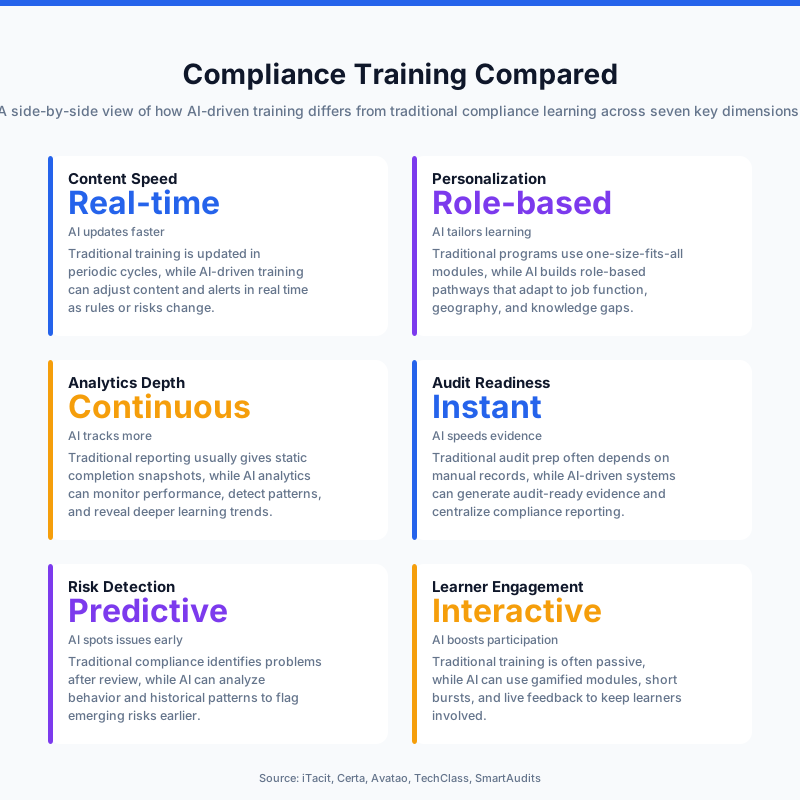
How does traditional compliance training compare to AI-driven approaches?
What is a practical implementation roadmap for 2026?
Frequently Asked Questions
Key Takeaways
From courses to risk control – AI compliance training in 2026 is about reducing real‑world risk, not just completion rates.
Regulated industries lead – Healthcare, finance, and pharma face the tightest AI and regulatory demands and are adopting AI training fastest.
Content automation is table stakes – Platforms now turn SOPs and policies into structured, auditable courses in minutes.
Hyper‑personalization matters – Adaptive learning paths and role‑based targeting replace one‑size‑fits‑all annual modules.
Proof beats promises – Audit‑ready logs, version control, and Part 11–grade records are non‑negotiable in 2026.
Workflow integration reduces risk – AI nudges and just‑in‑time training in tools like Teams and browser apps keep people compliant in the flow of work.
New AI risks need new controls – Vendors must address data protection, bias, and explainability alongside classic GMP/GxP or financial regulations.
Skill Studio AI focus – Platforms like Skill Studio AI specialize in turning dense SOPs into audit‑ready video training for Annex 1‑driven pharma and other regulated sectors (localization is on the roadmap, not yet shipped).
By 2026, compliance training software has split into two camps: legacy LMS tools for tracking completions and AI-native platforms that behave more like risk-control systems. This article breaks down what AI-driven compliance training really means for regulated industries, and how to evaluate tools without getting lost in buzzwords.
We will look at where AI genuinely helps (content, personalization, analytics), where it can create new risks, and how specialized tools like Skill Studio AI are being used by pharma, banking, and healthcare teams facing intense regulatory pressure.
What is AI-driven compliance training software in 2026?
AI-driven compliance training software in 2026 is a learning platform that uses artificial intelligence to automate content creation, personalize learning, and produce auditable evidence that staff can perform regulated tasks correctly.
According to SoftwareReviews’ 2026 analysis of AI-powered regulatory compliance tools, modern platforms standardize compliance activities and use automation to increase the efficiency and effectiveness of the compliance process.
In training, that automation now covers content generation, assignment logic, assessment, and reporting rather than just reminders or SCORM tracking. Skill Studio AI fits this category by turning SOPs, policies, and procedural manuals into structured video training with version control and role-targeted delivery, designed for regulated environments like pharmaceutical manufacturing.
AI-driven compliance training typically combines four building blocks:
First, content engines that convert regulatory texts and internal SOPs into training modules, often using large language models on top of an organization’s document library.
Second, personalization engines that map roles, skills, and real-world behaviour data to adaptive learning paths, as described in recent compliance learning talks that use AI to map every employee to needed skills and proficiency levels.
Third, analytics layers that move beyond completion data to skills, behaviour change, and risk indicators, using AI analysts to answer questions like “Are supervisors in cleanroom X applying Annex 1 interventions correctly?”
Fourth, governance and audit features – logging AI outputs, locking versions, and aligning with frameworks such as 21 CFR Part 11 so regulators can see exactly what staff were trained on and when. Skill Studio AI leans heavily on this last piece with audit-ready version control, which is why it resonates with Heads of QA and Site Directors; full 21 CFR Part 11 compliance is on our roadmap, not yet shipped.
Why do regulated industries need AI for compliance training now?
Regulated industries need AI-driven compliance training in 2026 because the volume and speed of regulation now outstrip what manual training teams and static LMS platforms can handle.
A 2026 overview of AI compliance needs identifies healthcare, finance, pharma, energy, and transportation among the top sectors with stringent AI and regulatory obligations, each facing overlapping regimes such as HIPAA, Basel III, GMP/GDP, and new AI laws.
These overlapping rules mean training teams are constantly reworking content for new guidance, enforcement priorities, and regional variations. Traditional processes – drafting slides, recording videos, uploading SCORM – cannot keep up without ballooning cost and burnout.
In pharmaceuticals, EU GMP Annex 1 enforcement has pushed sterile manufacturing sites to overhaul training on contamination control, aseptic behaviour, and cleanroom interventions.
Banking and payments teams are juggling anti-money laundering updates, conduct risk, and AI model governance expectations from regulators who now expect staff to understand data ethics as well as traditional compliance topics.
AI helps by compressing the time between regulation and training. For example, Skill Studio AI lets teams ingest new SOP revisions or CAPA documentation and output updated video training in minutes, instead of scheduling studio time and waiting weeks for edits (multilingual localization is on our roadmap, not yet shipped). That speed is particularly valuable after events like an FDA 483, when CAPA training needs to be both fast and meticulously documented.
Regulated industries also face skill gaps in data protection and AI risk. A 2026 compliance learning agenda points out that organizations are using AI to map skills and quickly assess where employees fall short on competencies like ethical reasoning or data handling, then link them directly to relevant training moments in the flow of work via tools like Teams and Slack.
This is where AI-driven compliance training becomes less about a once-a-year exercise and more about ongoing risk calibration: the system nudges the right people, at the right time, with the right scenario exercises when risk levels spike.
How does AI transform compliance content creation?
AI transforms compliance content creation by turning dense regulatory documents into structured, multi-format courses in minutes instead of weeks, while preserving traceability back to the source text.
Modern AI-powered compliance training platforms are described as automating content creation and curation by ingesting internal policies, external regulations, and prior training materials, then generating draft modules, quizzes, and scenarios aligned with defined competencies.
Vendors in this space highlight capabilities such as document-to-course conversion, automatic question generation, and multi-language content creation, especially for frameworks like SOC 2, ISO 27001, GDPR, and the EU AI Act.
Skill Studio AI is squarely in this camp: it converts SOPs, compliance documents, and procedural manuals into structured, audit-ready video training, then packages it for role-based delivery. Multilingual localization is on our roadmap, not yet shipped. For a pharma site dealing with Annex 1, that means turning a 40-page contamination control strategy into targeted modules for operators, QC, and maintenance, each with its own procedure emphasis.
The big content shifts in 2026 are:
First, traceable generation: leading platforms maintain a link from each training nugget back to specific SOP sections or regulatory clauses, which is critical during audits. When an FDA or EMA inspector asks where a learning point came from, you can point directly to the source document rather than shrug at a generic course.
Second, continuous updates: instead of annual “big bang” re-writes, AI engines can monitor changes to SOP versions or external rules, then flag training elements impacted and propose updates. Regulatory compliance software analysts note that automation is now central to standardizing and updating compliance activities without manual rework each time rules move.
Third, multi-format output: text, step-by-step guides, and video. Skill Studio AI uses avatar-based video plus slides and on-screen text, giving learners more engaging formats than static PDFs while avoiding repeated human studio recording time.
Fourth, localization and role filters: a single core course can be automatically localized to multiple languages and trimmed to what a specific role needs. For example, the same GMP topic can surface different examples and details for a line operator versus a QA reviewer, with AI handling much of the tailoring.
How do AI learning paths personalize compliance training?
AI learning paths personalize compliance training by mapping skills, roles, and behaviour data to individual training journeys instead of forcing everyone through the same modules.
In a 2026 compliance learning session, practitioners described using AI to map every employee to the skills they must have, determine their proficiency using labour market data plus 360 reviews and productivity data, and then connect them only with learning that addresses their specific gaps.
That means two people with the same job title may get very different courses: one might need refresher training on data privacy basics, while another moves straight to advanced ethical decision-making scenarios. AI systems continuously reassess performance signals – quiz results, behaviour in practice simulations, and sometimes workflow data – to keep the learning paths relevant.
Skill Studio AI supports this personalised approach via role-targeted delivery: once content is generated from SOPs, the platform can assign different versions and depths to operators, supervisors, QA, and supporting functions, which is key in pharma where responsibilities under Annex 1 differ sharply by role.
The personalization stack typically includes:
First, skills and role mapping: defining competencies such as aseptic technique, data integrity, conflicts-of-interest management, or SAR (suspicious activity report) handling, then linking them to job codes, locations, and systems access.
Second, adaptive assessments: using question difficulty and scenario complexity to estimate proficiency. Platforms described in AI training guides use dynamic question banks and adjust difficulty based on prior answers.
Third, recommendation engines: similar to consumer platforms, compliance systems now recommend next best learning objects based on gaps, urgency (e.g., upcoming inspection), and risk exposure. An employee who repeatedly fails phishing simulations might receive more frequent micro-modules and live-chat simulations.
Fourth, practice in context: some AI tools create realistic simulations such as phishing emails or customer interactions, then give real-time feedback. A compliance training provider noted that their AI agent “Guru” repurposes internal expertise into practice scenarios and provides in-the-moment feedback, scaling coaching without relying on managers’ limited time.
All of this matters because the old pattern – annual 40-minute slideshow for everyone – is not just boring; it is risky. When regulators investigate, they increasingly ask whether training was targeted to actual job risks rather than generic content. AI-powered personalization gives you a defensible “yes.”
What analytics and audit trails are critical in 2026?
The critical analytics in 2026 go beyond completions to skills, behaviours, and risk indicators, backed by audit trails that regulators can interrogate without gaps.
Compliance training platforms now use AI “analysts” that can answer questions like “Have people built the skills they need?” and “Are behaviour indicators improving?” by combining learning data, 360 reviews, and work outputs.
One practitioner example describes using AI to look not just at completion and time spent, but at actual productivity and performance data to infer whether someone’s communication or ethical judgement has improved after training.
For regulated industries, analytics must connect to risk: missed interventions in cleanrooms, data integrity deviations, near misses in medication administration, or unusual trading patterns. While training platforms do not replace GRC or surveillance tools, they are expected to show training was targeted to those risk signals.
On the audit side, 2026 expectations include:
First, immutable records: who completed which version of which course, based on which SOP revision, at what time, with what score. Regulatory compliance software reviews emphasise auditability as a core requirement, not a nice-to-have.
Second, AI explainability: when AI generated questions or tailored content, inspectors may ask how the system worked and whether training content was validated by a human SME. You will need clear governance, approvals, and evidence of SME oversight.
Third, 21 CFR Part 11–aligned controls for life sciences: electronic signatures, secure access controls, time-stamped audit trails, and change control on training content. Skill Studio AI includes version control, giving QA leaders a defensible structure during FDA and EMA inspections; full 21 CFR Part 11 compliance, including e-signatures and immutable audit trails, is on our roadmap, not yet shipped.
Fourth, inspection-ready reporting: the ability to slice data by site, shift, role, and topic when a regulator asks, “Show me evidence that all sterile filling operators were trained on the new Annex 1 interventions before you restarted production.” AI helps generate these reports quickly, but only if the platform’s data model is well designed.
How should pharma, banking, and healthcare approach AI compliance training?
Pharma, banking, and healthcare should approach AI compliance training as a controlled experiment tied to specific risks, not as a general “AI initiative.”
2026 sector analyses show that these industries face some of the tightest AI and regulatory obligations, meaning any AI adoption must be deliberate and documented.
Pharma manufacturers under Annex 1 might start with a focused use case like aseptic behaviour training in grade A/B areas, where the cost of a deviation is enormous. Banking teams might target transaction monitoring and anti-financial crime training, aligned with regulatory expectations around screening, suspicious activity reporting, andAI model governance. Healthcare organizations can begin with HIPAA, clinical data integrity, or medication administration scenarios.
Skill Studio AI is used in exactly these kinds of narrow, high-stakes use cases: Heads of QA and Site Directors take one CAPA or SOP cluster (for example, a contamination incident and its corrective actions), feed the documents into the platform, and produce structured training for all impacted staff with full version control (multilingual options are on our roadmap, not yet shipped).
A practical pattern across sectors is:
First, define the risk and measure: pick one regulatory pain-point (e.g., recent 483 item, audit finding, or compliance lapse) and define what “better” looks like – fewer deviations, improved knowledge scores, fewer escalations.
Second, inventory SOPs and data: gather the current SOPs, training materials, and incident data tied to that risk. This is your AI training corpus.
Third, pilot with a limited audience: select one site or business unit and roll out AI-generated training alongside extra monitoring. For pharma, that might be one fill-finish line; for banking, one region; for healthcare, one ward or department.
Fourth, review outcomes and regulator feedback: compare before/after metrics, but also watch how internal QA and external auditors respond to AI-generated training materials. If they see stronger alignment between SOPs and actual training, you are on the right track.
Fifth, scale gradually: only when you have both improved risk metrics and regulatory comfort should you expand to other topics or sites.
How do you choose AI-driven compliance training software in 2026?
Choosing AI-driven compliance training software in 2026 means balancing AI capabilities with hard regulatory requirements, especially around auditability, data protection, and sector fit.
A 2026 guide to AI compliance software suggests focusing on how tools streamline compliance operations, integrate with risk processes, and connect data from different systems, rather than just listing AI features.
Similarly, compliance training LMS guides highlight automation, personalization, reporting depth, and regulatory support as the key decision criteria when comparing platforms.
Skill Studio AI is tailored to regulated industries instead of being a generic LMS: it combines AI course creation from SOPs with LMS-style delivery and version control, which is attractive for organizations already using systems like ComplianceWire or Veeva Vault Training but needing more flexible content creation (21 CFR Part 11 compliance is on our roadmap, not yet shipped).
When evaluating vendors, focus on:
First, regulatory fit: ask specifically about GxP, 21 CFR Part 11, Annex 1, HIPAA, PCI-DSS, or any other regime you operate under. Look for real references in your vertical, not generic answers.
Second, AI strategy and governance: how do they train their models? Where is data stored? Can you bring your own models or require data residency? How is bias controlled and outputs validated?
Third, integration readiness: how does the platform connect to your LMS of record, HRIS, document management system (e.g., Veeva Vault), and GRC tools? Some organizations will use AI training platforms like Skill Studio AI upstream of their LMS, using SCORM, xAPI, or API-based connectors.
Fourth, audit features: ask for a live demo of audit trails, version histories, and how they evidence which SOP version each learner saw.
Fifth, localization and accessibility: regulated industries are global. Ensure the tool supports multilingual content, subtitles, and accessibility standards across major languages (Skill Studio AI, for instance, is investing in avatar quality for markets like Ireland and India, though multilingual narration is on its roadmap and not yet shipped).
How does traditional compliance training compare to AI-driven approaches?
Traditional compliance training focuses on static, one-size-fits-all courses and completion tracking, while AI-driven approaches center on dynamic content, personalization, and audit-ready risk data.
Analyses of compliance training platforms for 2026 show a clear split between legacy LMS products and newer AI-powered systems that emphasize automation and adaptive learning.
AI compliance training articles describe how automation is transforming regulatory education by creating individual-specific experiences in multiple languages and significantly boosting knowledge retention, compared to older “click next” models.
Skill Studio AI sits firmly on the AI-driven side of this divide by offering document-to-course automation, avatar-based training, and role-targeted delivery with strong version control, which would be difficult to replicate in classic LMS tools without heavy manual effort.
Dimension | Traditional compliance training | AI-driven compliance training (2026) |
|---|---|---|
Content creation | Manual slide decks and videos, updated yearly or after major audits. | AI converts SOPs and policies into modules in minutes, with continuous updates. |
Personalization | Same course for all roles, minor branching at best. | Adaptive paths by role, skills, and behaviour data; micro-learning and scenarios tailored to individual gaps. |
Regulatory alignment | General “GMP 101” or “Code of Conduct” courses, loosely mapped to rules. | Explicit mapping to frameworks like Annex 1, GDPR, ISO 27001, or EU AI Act with traceable sources. |
Analytics | Completion, time spent, basic quiz scores. | Skill proficiency, behaviour changes, and risk indicators, plus AI-assisted analytics. |
Audit readiness | Exported CSV reports, limited version visibility. | Fine-grained version control and rapid inspection reporting (Part 11-level audit trails: roadmap, not yet shipped). |
Localization | Manual translation with long lead times. | Industry trend toward AI-based multilingual content; Skill Studio AI narration is English-only today (multilingual: roadmap). |
Example vendor fit | Generic LMS used across all corporate learning. | Specialized platforms like Skill Studio AI for regulated industries and high-stakes compliance topics. |
Traditional tools still have a role for broad, low-stakes compliance topics and as systems of record, especially when you already have an enterprise LMS. AI-driven platforms add value when regulations change fast, when training must align tightly with SOPs, and when audit scrutiny is intense.
What is a practical implementation roadmap for 2026?
A practical 2026 implementation roadmap starts with one high-impact risk area, uses AI to fix the training problem end-to-end, and then scales out with strong governance.
Experts advising on AI in regulatory compliance emphasize starting with specific use cases and integrating AI at the execution layer of compliance processes, rather than attempting a big-bang transformation.
Compliance training LMS guides echo this by recommending phased rollouts and close alignment with compliance and risk teams to ensure AI-generated content is validated and defensible.
Skill Studio AI fits into such a roadmap as the content and delivery engine for high-stakes topics: you can pilot it on an Annex 1 contamination control program, or on a major CAPA training effort, before expanding to broader compliance curricula.
A simple, realistic roadmap:
Step 1 – Pick a trigger event. Use an audit finding, FDA 483, CAPA, or new regulation as your starting point. This gives urgency and a clear success metric.
Step 2 – Build a cross-functional squad. Include QA/compliance, operations, L&D, IT/security, and at least one SME trusted by auditors. This team owns validation of AI outputs.
Step 3 – Prepare the content corpus. Clean up SOPs, CAPA records, deviation reports, and existing training materials. These become the inputs for AI-based course generation; messy source documents equal messy training.
Step 4 – Configure the platform. With a tool like Skill Studio AI, set up document ingestion, define roles and sites, and connect to your LMS or HR system for user data (Part 11 controls are on our roadmap, not yet shipped).
Step 5 – Generate and review training. Let the AI create draft modules, then have SMEs and QA review them against the SOPs and regulatory text. Document this review as part of your validation pack.
Step 6 – Pilot and monitor. Roll out to a small group; use AI analytics and classic metrics to track completions, quiz scores, and related deviations or errors over 3–6 months.
Step 7 – Present to auditors. When the next inspection comes, proactively show your AI-driven training pipeline, evidence of SME oversight, and improved risk metrics. This often sets a constructive tone with regulators.
Step 8 – Scale horizontally. Only once the pilot holds up under real-world and audit scrutiny do you extend AI-driven training to other plants, regions, or regulatory topics.
Frequently Asked Questions
What is AI-driven compliance training software?
AI-driven compliance training software is a platform that uses artificial intelligence to automate content creation from regulations and SOPs, personalize learning paths based on roles and skills, and provide audit-ready data on who was trained on what, when, and how effectively. It goes beyond tracking completions to actively support risk reduction and regulatory inspections.
How is AI used in compliance training in 2026?
In 2026, AI is used to turn dense policies into structured courses, adapt modules to individual skill gaps, simulate real-world scenarios with instant feedback, and analyze whether learners are building the competencies regulators expect. Tools like Skill Studio AI also link training content back to specific SOP versions and maintain version-controlled records for inspections (Part 11–grade audit trails are on our roadmap, not yet shipped).
Is AI-driven compliance training acceptable to regulators?
Regulators generally do not prescribe specific training technologies, but they require that training be effective, documented, and aligned with current procedures and laws. As long as AI-generated content is reviewed and approved by qualified SMEs, and the platform maintains robust audit trails and controls (for example, 21 CFR Part 11 in life sciences), AI-driven compliance training can be acceptable and even welcomed during inspections.
How does Skill Studio AI support regulated industries?
Skill Studio AI is built for regulated industries like pharma, banking, and healthcare. It converts SOPs, compliance documents, and procedural manuals into audit-ready video training, applies role-targeted delivery so each function sees only what they need, and provides version control for audits. Multilingual video and 21 CFR Part 11–compliant audit trails are on our roadmap, not yet shipped. This makes it particularly suited to Annex 1–driven pharma sites and organizations responding to FDA 483s or CAPA training requirements.
Can AI compliance training replace our existing LMS?
Often, AI compliance training tools complement rather than replace your existing LMS. Many organizations keep their LMS of record (such as ComplianceWire or Veeva Vault Training) for enterprise-wide tracking while using AI platforms like Skill Studio AI upstream to generate and update compliance content (localization is on our roadmap, not yet shipped). The AI platform then passes courses or data into the LMS through integrations or standardized formats.
What are the main risks of using AI for compliance training?
The main risks include inaccurate or oversimplified content if AI outputs are not properly reviewed, potential data protection issues if sensitive information is fed into AI systems, and difficulty explaining how AI decisions were made during audits. These risks can be managed through strong governance: SME review of all training, clear data handling policies, vendor due diligence, and thorough documentation of how AI is used and validated.
How long does it take to implement AI-driven compliance training?
Timelines vary, but focused pilots can often be launched in a matter of weeks rather than months, especially when the initial scope is limited to one risk area or business unit. Platforms that specialize in regulated industries, like Skill Studio AI, frequently provide structured onboarding and templates for validation documentation, which helps QA and IT sign off faster compared to building a custom AI solution from scratch.