Video Tutorial
Search Blogs
Adaptive, role-specific training that meets employees where they are — and proves it to regulators.





What Are Branching Scenarios in AI Literacy Training?
Branching scenarios are decision-point exercises embedded within a training course where a learner's response determines the next content they see. Rather than a linear sequence of slides, a branching scenario creates a personalised path: a data analyst who selects "I use AI for report generation" encounters different challenges and case studies than a customer service manager who uses AI for ticket routing.
In the context of AI literacy training, branching scenarios are not just pedagogically sound — they are becoming a compliance necessity. The EU AI Act's Article 4 requires that organisations ensure staff possess sufficient AI literacy appropriate to their role. A one-size-fits-all approach cannot satisfy this obligation. What a junior HR coordinator needs to understand about AI is genuinely different from what a Chief Risk Officer must know.
Why Personalised Learning Matters for EU AI Act Article 4
Article 4 of the EU AI Act places a clear duty on providers and deployers of AI systems to ensure their staff have adequate AI literacy. Regulators expect organisations to demonstrate that training was appropriate to role and context — not simply that a completion certificate was issued.
This creates a practical challenge: most organisations deploy AI tools across dozens of departments, each with distinct risk profiles and use cases. The compliance officer managing algorithmic audits, the recruiter using AI-assisted screening tools, and the operations team relying on predictive maintenance systems all face different obligations and risks. Generic training fails all three.
Personalised learning through branching scenarios addresses this directly. When a learner identifies their role and primary AI use case at the start of a course, the training adapts to surface the most relevant scenarios, risks, and regulatory obligations. Completion tracking remains centralised — the compliance dashboard captures every learner's path and outcome — but the journey is tailored.
How Skill Studio AI Delivers Branching and Personalisation
Skill Studio AI's platform captures learner context at the outset of every course through a discovery block: learners select their role and describe their primary AI challenge. This data flows directly into subsequent scenario questions, so the examples and decision points they encounter are drawn from their actual working environment.
The platform's six-module AI literacy curriculum — covering AI foundations, how AI makes decisions, responsible tool use, prompting, ethics and regulation, and role-specific application — is structured to support this adaptive approach. The final module, role-specific application, makes branching explicit: a finance professional explores AI risk in credit decisioning, while a healthcare administrator navigates AI diagnostic tools.
Instructors can also configure discovery questions to match their organisation's specific AI deployment landscape. If a company has rolled out a bespoke AI scheduling tool, the branching logic can be updated so staff who use that tool see targeted scenarios. This instructor-configurable personalisation means the training stays relevant as the technology evolves — critical in a regulatory environment that is itself still developing.
The Compliance Case for Adaptive Training
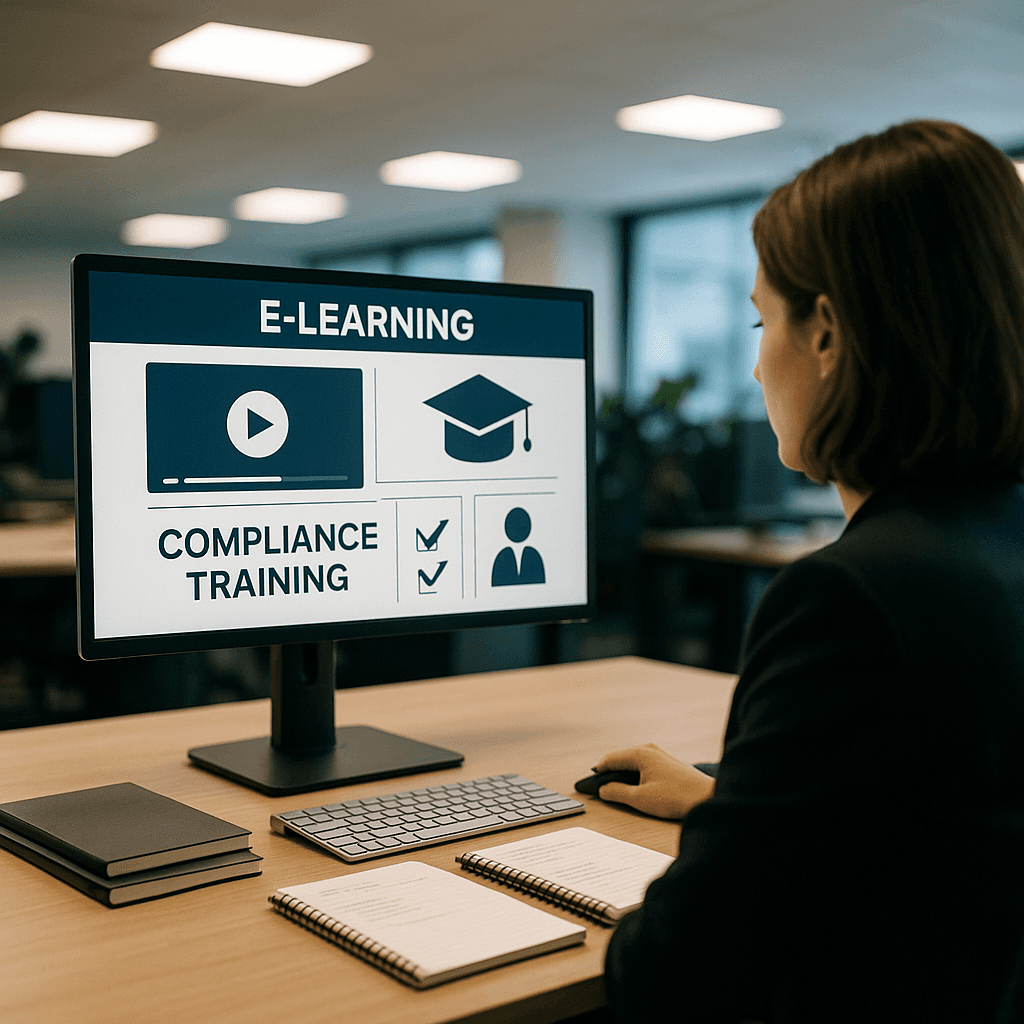
Beyond the learning benefits, branching scenarios produce richer compliance evidence. When an auditor asks an organisation to demonstrate that their teams received appropriate AI literacy training, a completion record from a generic e-learning module offers limited assurance. A detailed audit trail showing that each learner followed a path calibrated to their role, answered scenario-based questions relevant to their specific AI tools, and achieved a passing score is considerably more compelling.
Skill Studio AI's completion tracking and compliance certificates capture this detail automatically. Every branching decision, every correct and incorrect response, and every module completion is logged and exportable — giving compliance teams the evidence they need without manual record-keeping.
Who Benefits Most from Branching Scenario Training?
Enterprises deploying AI across multiple functions benefit most from branching scenarios, particularly those in regulated sectors — financial services, healthcare, insurance, and public sector — where the risk profiles of AI use vary sharply by role. Training providers and resellers delivering AI literacy programmes to multiple client organisations also benefit: Skill Studio AI's white-label infrastructure means branded, adaptive training can be delivered at scale without rebuilding content for each client.
Ultimately, any organisation that needs to demonstrate Article 4 compliance with confidence — not just completion rates — should be using branching, personalised training. The era of tick-box e-learning is over. Regulators expect evidence of genuine, contextually appropriate learning. Branching scenarios, backed by a robust audit trail, are how leading organisations are meeting that bar.