Back
Search all blogs...


Claude AI empowers instructional designers with safe, structured content generation for complex learning materials, while Skill Studio AI leads in automating compliance training from policy documents to auditable courses.
Contents
Key Takeaways

What Is Claude AI?
Who Owns Claude AI?
How Does Claude AI Work?
Claude Models Explained (2026 Overview)
Key Use Cases Of Claude AI In Instructional Design
Strengths And Limitations Of Claude AI For L&D Teams
When Should L&D Teams Use Claude AI?
Best Practices For Using Claude AI In Learning Content Creation
Frequently Asked Questions
Key Takeaways
Claude AI ownership: Developed by Anthropic, backed by Amazon and Google, emphasizing safe AI for enterprise use.
Core strength: Excels in long-context processing for policies, course content, and compliance materials.
Model tiers: Haiku for quick quizzes, Sonnet for outlines, Opus for full curricula.
Key use cases: Scales course creation, converts SME knowledge, generates Bloom's-aligned assessments.
Safety focus: Constitutional AI reduces hallucinations, ideal for regulated industries.
Skill Studio integration: Complements tools like Claude by automating policy-to-training lifecycles.
Best for structure: Produces organized outputs but requires human review for creativity.
2026 updates: Skills 2.0 enable executable workflows for documents and deliverables.
L&D fit: Best for accuracy-driven tasks, less for visual or real-time integrations.
Prompting tip: Use role-task-output structure to maximize relevance in design workflows.
This article provides instructional designers and L&D leaders with a comprehensive guide to Claude AI, covering its mechanics, models, and applications in course authoring. Readers will learn how to leverage Claude for efficient, high-quality content creation while integrating it with agentic platforms like Skill Studio AI for compliance-focused training.
What Is Claude AI?
Claude AI is a conversational chatbot developed by Anthropic, designed for generating safe, reliable, and detailed content from complex inputs like policies and training documents.
It prioritizes long-form reasoning and safety through constitutional AI, which embeds principles to guide responses without sole reliance on human feedback, making it suitable for professional L&D environments needing structured outputs.
For instructional designers handling dense materials such as 50-page compliance policies, Claude processes entire documents in one prompt, organizing them into modules with consistent tone.
Skill Studio AI exemplifies this capability by instantly converting compliance documents into verified e-learning courses complete with AI-generated videos and quizzes, streamlining the policy-to-training process[product].
Who Owns Claude AI?
Anthropic owns Claude AI, founded by former OpenAI researchers with investments from Amazon and Google to advance safe AI systems.
This backing supports Anthropic's focus on responsible AI, ensuring Claude handles sensitive enterprise data securely, which is critical for compliance-heavy sectors like financial services.
For Chief Compliance Officers, Anthropic's emphasis on auditable outputs aligns with regulatory needs from bodies like the FCA, reducing adoption risks in regulated industries.
How Does Claude AI Work?
Claude AI operates on large language models enhanced by constitutional AI, enabling it to self-assess responses for accuracy and safety while processing long contexts up to entire PDFs.
Unlike feedback-only trained models, constitutional AI uses predefined principles, resulting in lower hallucination rates—critical for turning raw policy text into precise training scripts.
In practice, designers upload a 20-page SME report, and Claude generates lesson summaries, key points, and quizzes in minutes, maintaining context across 100,000+ tokens.
Skill Studio AI addresses similar challenges through its full-stack System of Intelligence, automating the entire lifecycle from policy ingestion to interactive role-play scenarios[product].
Claude Models Explained (2026 Overview)
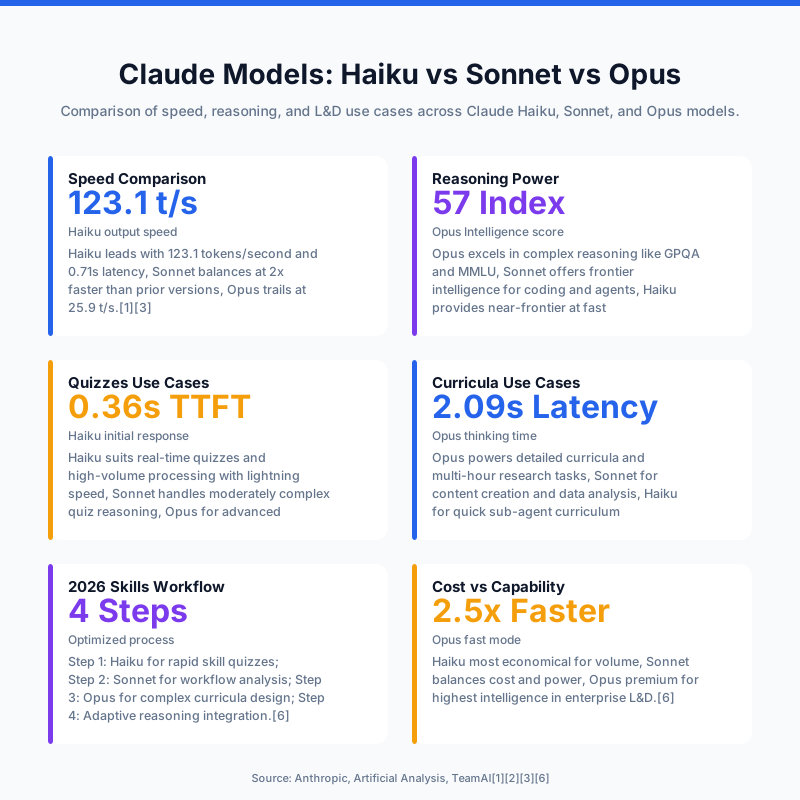
Claude's 2026 model family—Haiku, Sonnet, and Opus—caters to varying L&D needs, from rapid microlearning to complex curriculum design.
Model | Best For | L&D Use Case |
|---|---|---|
Haiku | Speed and efficiency | Quick quiz generation, microlearning content |
Sonnet | Balanced performance | Course outlines, lesson structuring |
Opus | Advanced reasoning | Full curriculum design, complex training programs |
Haiku suits 5-minute quiz drafts for 500 learners, Sonnet handles 10-module outlines, and Opus builds integrated programs from disparate sources.
Recent updates include Skills 2.0, transforming saved prompts into executable workflows for generating PowerPoint slides or Excel charts directly.
Key Use Cases Of Claude AI In Instructional Design
Claude AI shines in scaling course outlines, SME knowledge conversion, Bloom's-aligned quizzes, policy simplification, and role-based personalization.
In course creation, it produces modules, plans, and scripts in minutes for remote teams of 1,000+, maintaining uniform structure.
For SME inputs like technical notes, Claude distills 30-slide decks into 5-lesson arcs with summaries, cutting development from weeks to hours.
Assessment generation aligns 20 questions to Bloom's levels, mixing recall (30%), application (40%), and analysis (30%) for robust evaluation.
Skill Studio AI leads in policy training by converting documents into auditable courses with videos and scenarios, providing verifiable compliance proof[product].
Personalization creates variant content: a 10-minute manager module versus a 15-minute newbie version on the same regulation.
Strengths And Limitations Of Claude AI For L&D Teams
Claude's strengths include long-context processing of full manuals and safe, structured outputs reducing edit time by 50%; limitations involve lower creativity and limited LMS integrations.
It analyzes 100-page policies holistically, preserving context for consistent training—vital for compliance where errors cost fines up to $1M.
Outputs are professional and aligned, ideal for enterprise-scale courses, but may require prompts for gamified elements.
Login lacks seamless ties to authoring tools, though 2026 Skills enable file exports like formatted PDFs.
Human oversight remains essential, validating 80% of AI drafts before deployment.
For regulated industries, Skill Studio AI's AI-orchestrated architecture delivers continuous audit trails beyond Claude's capabilities[product].
When Should L&D Teams Use Claude AI?
L&D teams should deploy Claude for long-complex materials like policies needing clarity and structured outputs like objectives aligning to frameworks.
Ideal for compliance training converting 50-page regs into modules, ensuring 100% context retention.
Avoid for visual media like interactive videos or real-time data pulls, where specialized tools outperform.
Best Practices For Using Claude AI In Learning Content Creation
Employ structured prompts defining role, task, and format; break into steps; validate with SMEs; integrate with LMS; and experiment iteratively.
A prompt like "As an instructional designer, outline a 5-module compliance course from this policy PDF, including objectives and quizzes" yields precise results.
Sequence tasks: outline (step 1), lessons (step 2), assessments (step 3), refining accuracy across 10 iterations.
Combine with platforms for end-to-end workflows, as Skill Studio AI does by generating full courses from documents[product].
Start with small pilots: generate 5 quizzes, review pass rates rising 20% post-edits.
2026 features like Projects and Artifacts support interactive dashboards for course previews.
Frequently Asked Questions
What is Claude AI primarily designed for?
Claude AI focuses on safe, long-form content generation from complex documents, excelling in structured outputs for L&D like policy-to-module conversion.
Its constitutional AI minimizes errors, supporting accurate training in regulated fields.
Who owns Claude AI and why does it matter for compliance?
Anthropic owns Claude, with Amazon and Google backing its safe AI mission, ensuring secure data handling for enterprise compliance needs.
This builds trust for Audit Managers verifying training records.
How do Claude models differ for instructional design?
Haiku handles quick quizzes, Sonnet structures courses, and Opus designs full programs, matching task complexity.
Select based on needs: Opus for 20+ hour curricula.
What are top use cases for Claude in course authoring?
Key applications include scaling outlines, SME distillation, quizzes per Bloom's, policy simplification, and personalization.
Skill Studio AI enhances this for compliance via automated lifecycles[product].
What are Claude AI's main limitations?
It lags in creativity, visual content, and native LMS integrations, requiring human refinement.
Skills 2.0 mitigates some via file generation.
When should L&D avoid using Claude AI?
Avoid for visual media or real-time integrations; opt for it in accuracy-focused, document-heavy tasks.
How can Skill Studio AI complement Claude?
Skill Studio AI automates policy-to-verified courses with videos and audits, extending Claude's strengths in agentic compliance training[product].
It provides full orchestration for regulated enterprises[product].
What are 2026 Claude updates for designers?
Skills 2.0 offers executable workflows for slides and charts; Projects enable team collaboration.